
Intermittent-motion and continuous-motion VFFS machines both form a tube from roll stock, dose product and create cross seals. Their main difference is what the film and cross-seal jaws do during sealing—and that difference changes synchronization, seal time, product-transfer risk, changeover work and the evidence needed for acceptance.
This guide compares the two architectures without assuming that continuous motion is automatically the better choice. The useful decision is the route that produces the required conforming bags with the approved product, film, filler, package range and line conditions.
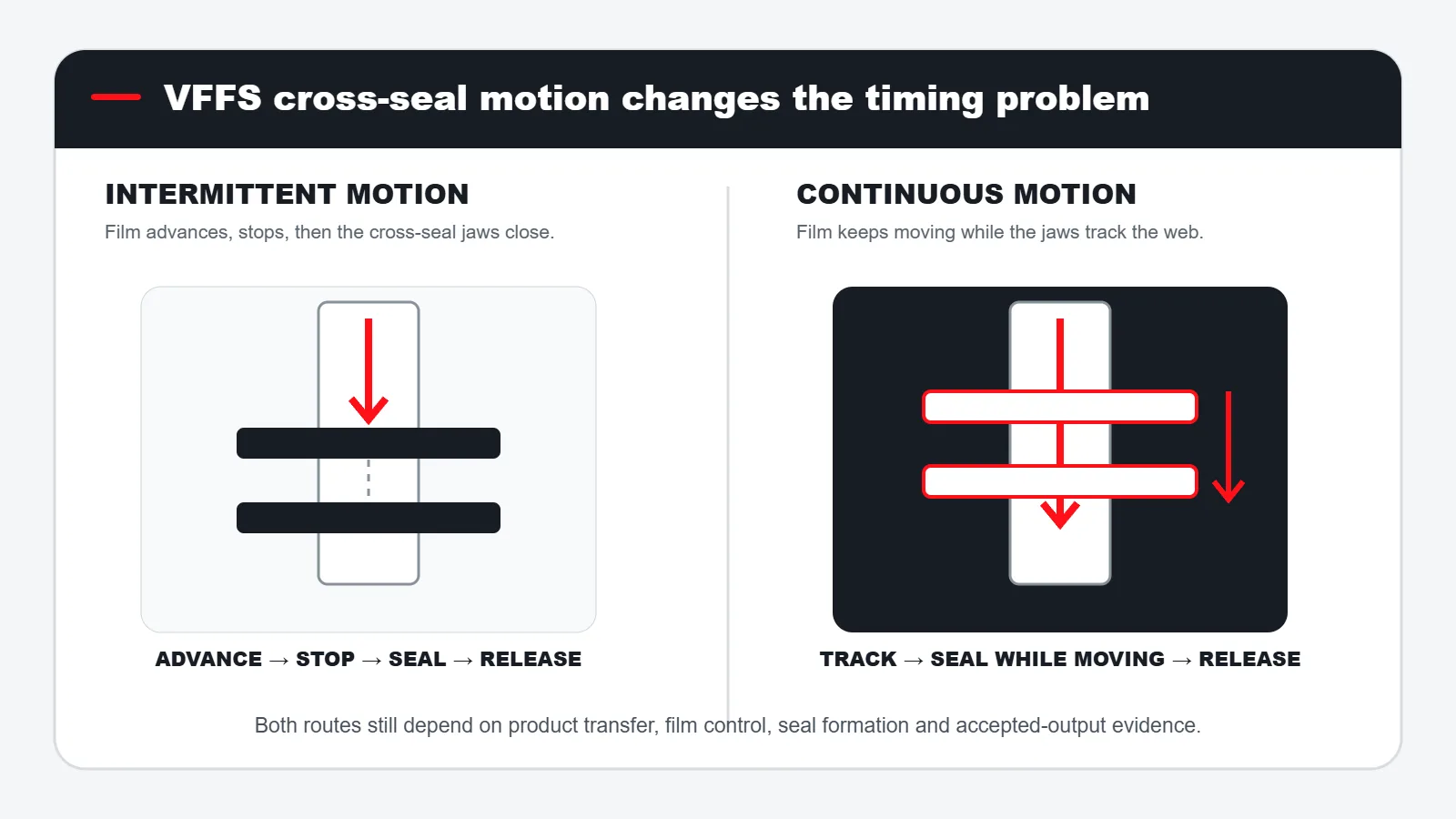
On an intermittent-motion VFFS machine, the film advances and then stops while the cross-seal jaws close. On a continuous-motion VFFS machine, the film continues moving while the sealing jaws follow the web through part of the cycle. Continuous motion can support higher output, but selection still depends on product transfer, film tracking, seal formation, package range, changeover and accepted-output evidence.
For the complete unwind-to-discharge process, start with the Vertical Form Fill Seal Machine Guide. This page goes deeper only into the motion decision.
The cross-seal interval organizes the rest of the cycle
In an intermittent cycle, a film-pull interval and a stationary cross-seal interval are distinct. In continuous motion, film transport and moving-jaw sealing overlap. That overlap can reduce time lost to stopping and restarting the web, but it increases the need to coordinate jaw travel, film motion, product release and cutting.
| Decision | Intermittent motion | Continuous motion |
|---|---|---|
| Film during cross sealing | Stops for the sealing interval | Continues moving while jaws track the web |
| Jaw task | Close, seal and release at a stationary film position | Close, follow, seal and release while coordinating with web movement |
| Typical reason to review | Moderate output, broad flexibility or a simpler timing boundary | Higher accepted-output requirement that justifies added coordination |
| Primary risk to test | Stop-start film behavior, cycle time and product arrival before sealing | Moving-jaw tracking, product timing, film stability and repeatable seal formation |
| Selection result | Approve only after representative product, film, package sizes, filler and FAT conditions are tested | |
Filler timing can become the real motion limit
The filler must release the dose early enough for the product to pass through the forming tube and clear the cross-seal area. The required interval changes with drop height, particle or piece range, density, aeration, bounce, dust, product temperature and the way the dose exits the filler.
Release and settling
Measure scale discharge, product-fall time, bag opening, rebound and whether the full dose clears before jaw closure at the target operating condition.
Aeration and dust
Confirm bulk-density range, cutoff, dust extraction, buildup and seal-area contamination after normal refill and extended running.
Bridging and impact
Use the largest and most fragile pieces to test forming-tube clearance, product damage, delayed fall and trapped-product risk.
A higher bagger cycle does not increase accepted line output when the filler cannot release stable doses at the same rate. Use the packaging line bottleneck analysis to separate filler, bagger and downstream limits.
Film must stay registered while speed and jaw motion change
Film unwind, tension, dancer response, tracking, registration correction and the film-pull system must behave as one motion chain. An intermittent route repeatedly accelerates and decelerates the web. A continuous route keeps the web moving but must align jaw travel with film position. Neither architecture removes the need to test print repeat, splice recovery and drift over a longer run.
The complete film specification should travel with the machine trial. The film specification guide shows which material and converter fields prevent nominal thickness from becoming the only reference.
Moving jaws do not make the seal window optional
Cross-seal quality depends on heat or energy input, pressure, dwell, jaw contact, cooling, film structure and contamination. Continuous motion uses jaw travel to provide a sealing interval while the web moves. Intermittent motion provides a stationary interval, but usable dwell still competes with the required cycle time.
For both routes, record the actual material, jaw setup and settings used for the accepted sample. Inspect failure location rather than reporting only a pass or fail. Seal strength, continuity and whole-package leaks answer different questions; the seal integrity testing guide separates those evidence types.
Keep the tube stable
Confirm fin or lap geometry, overlap, seal width, film contact surfaces and whether web motion changes alignment or thermal exposure.
Protect the closing area
Measure jaw impression, contamination, wrinkles, product clearance, seal position, cut line and any difference between startup and stabilized running.
Choose for the real SKU mix, not one easy bag
A motion route that performs well on one short bag may behave differently on the longest bag, widest format, heaviest dose or slowest-sealing film. List every priority SKU and identify the formats that set the film-pull length, forming-tube size, jaw travel, product-drop time and seal demand.
| Package input | Why motion selection can change | Evidence to retain |
|---|---|---|
| Bag length | Changes web travel, cycle timing and product-clearance interval | Controlled drawing, recipe and measured cut position |
| Bag width and forming set | Changes tube geometry, film path and available product opening | Forming-set ID, film width and finished dimensions |
| Film structure | Changes tracking, friction, stretch and usable seal window | Full structure, lot, converter data and trial samples |
| Opening or bag feature | May add tooling, registration or process steps that affect timing | Feature position, tooling, good sample and reject criteria |
If the decision includes pillow, gusset or quad-seal formats, use the pillow pouch machine guide and quad seal pouch guide to define geometry before motion is fixed.
High output must be evaluated across the production mix
Continuous motion may be attractive for long production runs, but a plant with frequent changes should also compare change parts, recipe control, setup verification, cleaning access and first-off approval. Intermittent motion should not be assumed to have a universal changeover advantage; the actual design and package range decide the work.
Include jaw mechanisms, film belts, sensors, heaters, knives, bearings, lubrication, guarding access and diagnostic procedures in the maintenance review. The VFFS maintenance checklist provides a condition-based inspection structure, while the rebuild-versus-replace guide helps evaluate an existing platform.
The motion label does not control the whole line
Define filler ready, bagger ready, starved, blocked, reject, emergency-stop and restart signals. Confirm whether inspection and downstream equipment can accept the intended discharge pattern. Accumulation can protect the bagger from short stops, but only when the buffer and recovery logic are defined.
A project involving elevators, weighers, coders, checkweighers, metal detectors, conveyors or cartoners needs one interface list and one accepted-output definition. Review the integration boundary on the turnkey solutions page before assigning speed to the VFFS frame alone.
Build the decision from evidence, not from the motion name
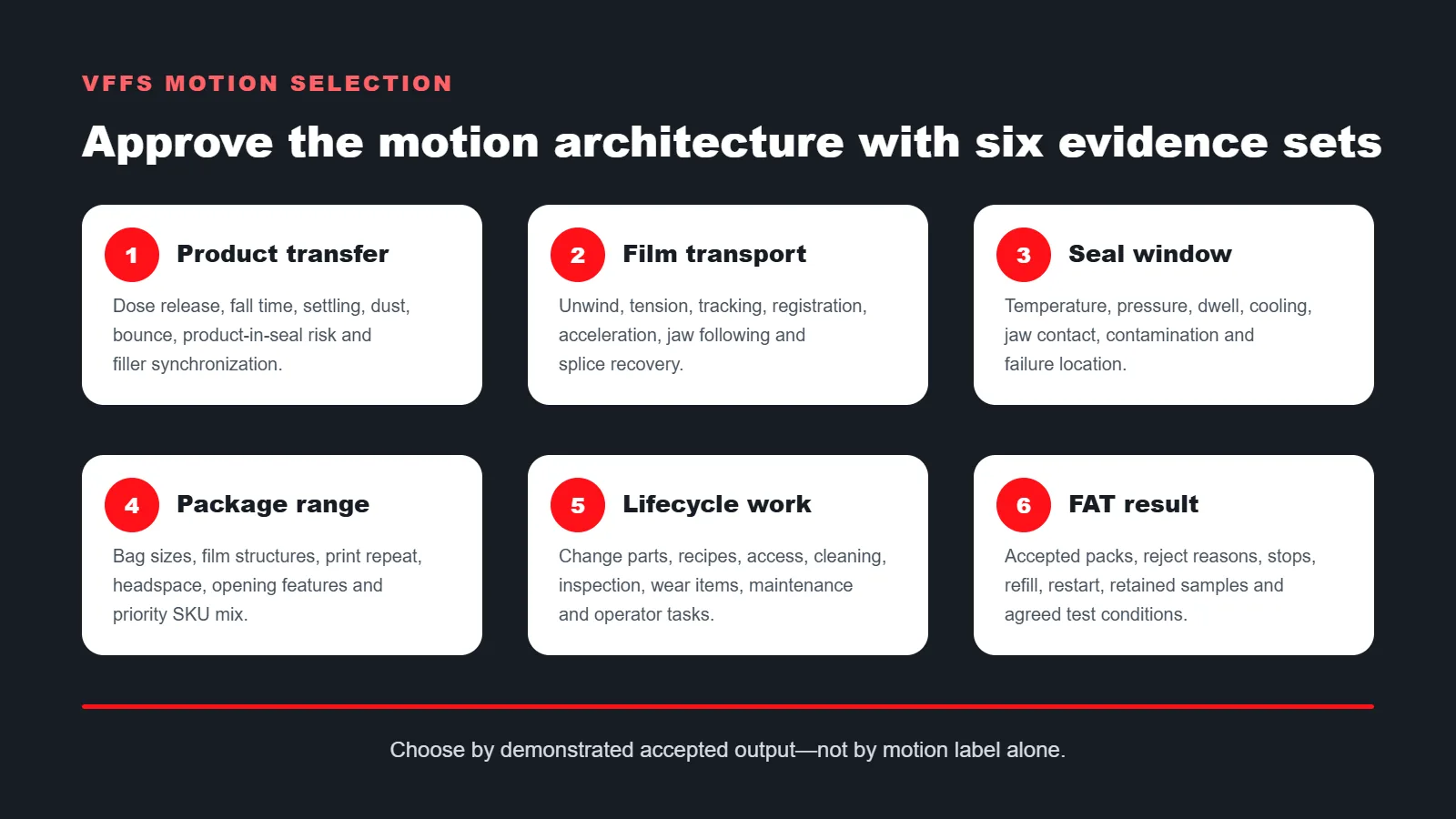
Define the accepted bag
Freeze the drawing, film structure, target dose, code area, dimensions, seal criteria and all priority formats.
Measure the transfer task
Record filler discharge, product-fall time, settling, dust or bounce and the clearance required before jaw closure.
Estimate required accepted output
Start from conforming finished bags and include rejects, refill, film changes, planned stops and downstream constraints.
Trial both routes when the boundary is close
Use the same product lot, film, bag drawing, inspection method, run duration and reject definition so the result is comparable.
Use the packaging machine selection guide for the broader machine-family decision, then use the RFQ Builder to issue one controlled supplier brief.
FAT must include the events that expose timing drift
A short clean run can hide thermal stabilization, film tracking correction, product refill, roll splice and stop/restart behavior. The protocol should define test duration, sample frequency, approved materials, active configuration, normal events and the meaning of an accepted bag.
Lock configuration and lots
Record software, recipe, forming set, jaws, filler, film lot, product condition, utilities and installed inspection.
Retain time-based samples
Keep bags from startup, stabilized running, normal speed changes, refill, splice, stop/restart and the end of the run.
Report accepted output
Separate conforming bags, rejects by reason, empty cycles, rework, material loss, downtime and operator intervention.
Close open conditions
Assign every deviation, untested SKU, documentation item, site action and retest requirement to an owner and status.
Preserve the failed bag before changing several settings
| Observed result | Possible process family | First evidence to retain |
|---|---|---|
| Cut or print position drifts | Film tension, registration, encoder reference, acceleration or jaw following | Time sequence, eye-mark data, film lot and speed |
| Product trapped in cross seal | Filler timing, fall time, bounce, bag opening, jaw timing or blockage | Failed bag, product condition, filler signal and slow-motion video |
| Seal good at low speed, weak at target | Seal window, jaw contact, dwell, thermal recovery, contamination or cooling | Settings, failure mode, sample location and material lot |
| Good startup, later variation | Thermal stabilization, buildup, refill, tracking correction or component movement | Time-stamped samples, alarms, stops and operator actions |
Continuous vs intermittent VFFS FAQ
Is continuous-motion VFFS always faster?
It can support higher cycle rates because film movement and sealing overlap, but useful output still depends on product transfer, filler capability, bag length, film, sealing, inspection and downstream handling. Compare conforming bags under the same test conditions.
Is intermittent motion better for more bag sizes?
Not automatically. Package range depends on the specific machine, forming sets, jaw travel, film-pull limits, tooling and controls. Test the shortest, longest, widest and most demanding priority formats on the offered configuration.
Can the same filler work with both motion types?
Possibly, but synchronization and required discharge rate must be confirmed. The filler needs enough capacity and consistent release timing to clear the seal area at the accepted bagger condition.
Does continuous motion improve seal quality?
The motion label alone does not establish seal quality. Film structure, jaw design, temperature, pressure, dwell, contact, cooling and contamination must be validated with the approved package and test method.
What data should be sent for a VFFS motion recommendation?
Send product samples and condition range, target dose, complete bag drawing, film specification and roll data, all priority SKUs, accepted output, filler details, utilities, line interfaces, inspection and FAT requirements.
Sources used for the motion-selection framework
Manufacturer portfolio distinguishing continuous and intermittent VFFS platforms and showing that application, material and format remain part of selection.
Manufacturer guide defining continuous film transport and contrasting it with a standard intermittent-motion cycle.
Manufacturer reference describing a box-motion jaw path that pulls film while the jaws are closed.
Manufacturer reference connecting continuous-motion bagging with modular equipment, package formats and line efficiency.
Continue from motion choice to the complete VFFS project
Send the product, film, bag range and accepted-output target
INMAYPACK will review whether intermittent or continuous VFFS should remain in the candidate set and identify the filler, film, sealing, integration and FAT inputs still requiring confirmation.
Request a VFFS application review






