
Home / Doypack Packing Machine / Spout Pouch Filling Machine
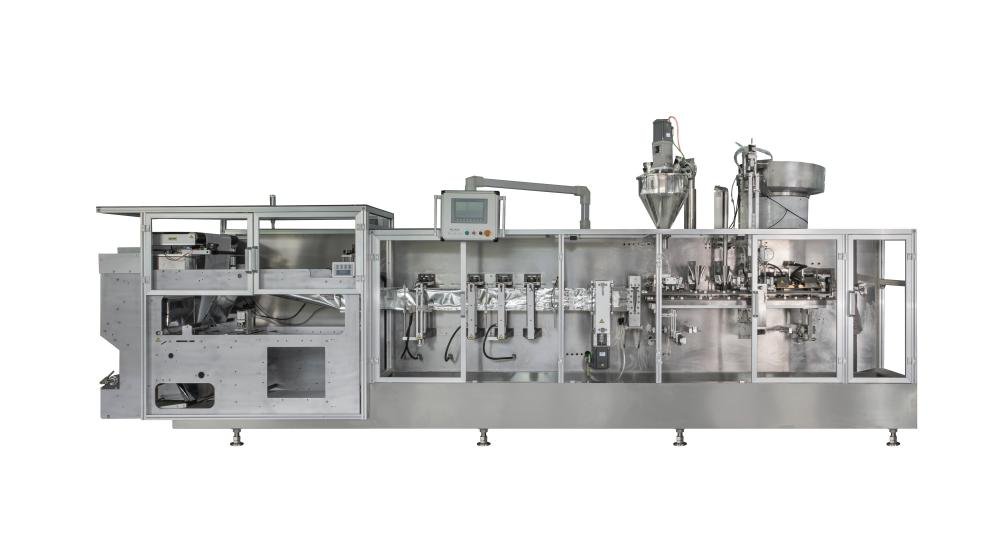
Spout Pouch Filling Machine HMS160 Roll-Film HFFS Line
HMS160-based systems form spouted pouches from roll film and integrate the selected filling and closure operations for liquid, sauce and paste applications.
Start with your product, fill range, pouch and spout format, and required accepted output. We will review the application and identify the configuration and sample information needed for a useful quotation.
Already buying pouches with the spout fitted? Compare the premade spout pouch filling and capping route before specifying roll-film tooling.
Review the Factory, Configuration and Acceptance Scope
Manufacturer identity
INMAYPACK · Shanghai, China · Founded in 2009
Configuration scope
Separate the machine, dosing equipment, closures and line interfaces.
Acceptance evidence
Request a trial plan and records for your product, film and pouch.
INMAYPACK was founded in 2009 and is based in Shanghai, China. Our project approach connects the machine platform, dosing method, supplied package, utilities, downstream interfaces and acceptance scope. The aim is to turn a broad equipment inquiry into a configuration that can be compared, quoted and tested.
When this roll-film route is worth evaluating
Your factory intends to make spouted pouches from rollstock and can define a stable film structure, pouch geometry and closure specification. Evaluate the forming, filling, spout-welding and capping scope together. Consistent materials and planned production runs help make the engineering and economic comparison meaningful.
When to compare a supplied-pouch route
If your converter supplies completed spouted pouches, or your project depends on many short runs and different pouch designs, compare the premade-pouch architecture first. A change in how the package arrives can change the machine, tooling, handling, acceptance plan and operating cost.
Use the doypack packing machine family to compare roll-film platforms, and turnkey packaging solutions when tanks, conveyors, inspection or secondary packaging are part of the project.
Spout Pouch Filling Machine Specifications and Configuration Scope
A spout pouch filling machine fills a liquid or paste into a flexible pouch with a dispensing spout and cap. The roll-film HFFS route also forms the pouch and integrates the selected spout operations. The premade-pouch route starts with a supplied package. Confirm this difference before comparing price, capacity or tooling.
Use this configuration checklist to define the equipment schedule for the proposed roll-film line. Request a model-specific drawing and current specification, then agree the product conditions and acceptance criteria. Machine limits, dosing limits and finished-pouch performance must be documented separately.
Machine and Package Reference
| Machine architecture | Horizontal form-fill-seal, intermittent pouch transport |
|---|---|
| Package supply | Roll film; spout and cap supply defined with the closure scope |
| Accepted output | Agreed finished pouches per minute or shift, for the specified dose, materials, run length and quality checks. |
| Dose range | Minimum and maximum fill volume reviewed with the dosing equipment, product behavior and pouch drawing. |
| Pouch dimensions | Agreed pouch drawing, forming geometry and tooling range |
| Film reel and web | Confirm reel diameter, usable web width, core size, repeat and handling limits on the model-specific drawing. |
| Installation envelope | Confirm machine dimensions, feeder and tank positions, service access, cleaning access and downstream interfaces. |
| Shipping and lifting | Request the actual packed dimensions, mass, lifting points and site access requirements. |
Utilities and Configuration Reference
| Frame in the reference proposal | Stainless steel 304 and carbon steel |
|---|---|
| Machine product-contact parts | SS304 in the reference machine configuration |
| Optional SR60 pump contacts | 316L in the quoted pump scope; verify the full product path |
| Connected electrical load | Request an equipment-level load schedule and the total for all included auxiliaries. |
| Electrical supply | Agree voltage, phase, frequency and site wiring for the destination before configuration release. |
| Compressed air | Confirm pressure, flow, air quality and included pneumatic equipment in the coordinated utility schedule. |
| Controls in the reference proposal | KEYENCE PLC; MCGS HMI; Panasonic servo; selected sensors and pneumatics |
| Documentation and guarding | Defined for the supplied configuration and the customer’s destination-market review |
Separate the machine base from the dosing equipment, spout feeder, tank, cap handling, discharge conveyor and format tooling. A feeder rating is not finished-pouch output; a pump material specification does not establish the material of every wetted component. Ask for one coordinated equipment and utility schedule.
From Roll Film to an Accepted Spouted Pouch
The process is specified as a coordinated production route. The exact station sequence depends on the pouch design, filling arrangement and closure modules; confirm the agreed layout rather than assuming every spout machine follows one sequence.
Define the roll and finished pouch
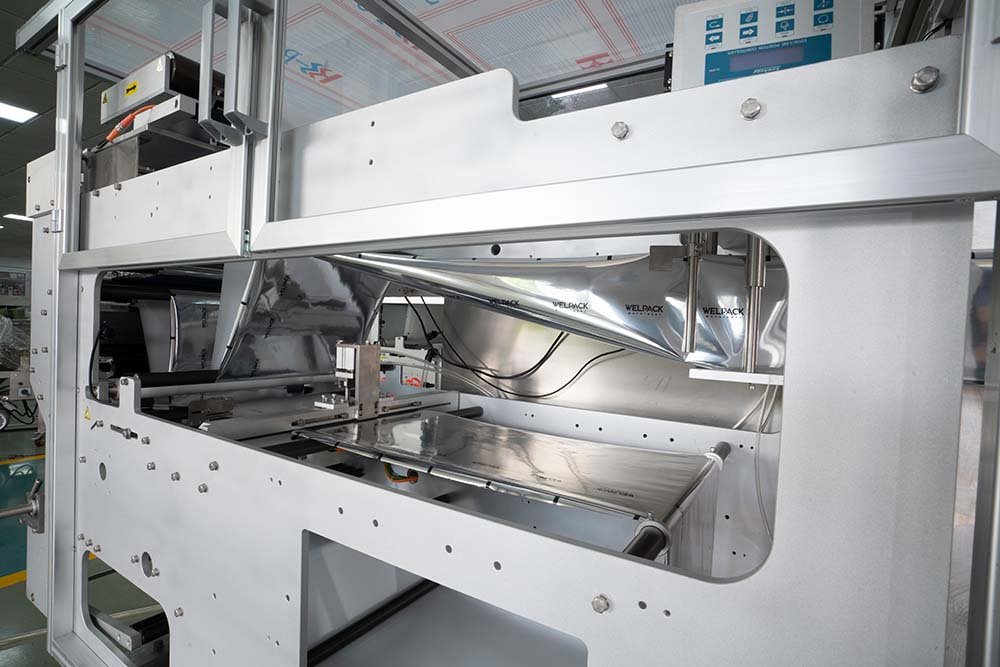
Start with the approved pouch drawing, laminate structure, web width, artwork repeat, winding direction and bottom-gusset geometry. Identify the seal zones and the spout location. This information determines how film preparation, forming, registration and cutting must work together before any product is dosed.
Form and stabilize the pouch
The forming and sealing stations create the pouch geometry from rollstock. Check tracking, formed dimensions, seal appearance and cooling using representative film. Heat-sealing conditions must suit the laminate; the appearance of an empty trial pouch alone does not prove its performance after filling and distribution.
Present the pouch to the filler
The pouch must remain supported and open through the dosing sequence. Review the gripper position, opening method, nozzle travel and product clearance. A package that shifts, folds or contacts the nozzle can create fill loss or contaminate the area needed for a reliable final seal.
Dose under representative conditions
Select the pump or dosing method from actual flow behavior, viscosity, particles, temperature and required fill range. Observe cutoff, drips, foam and settling during the agreed run. Review product supply and tank refill behavior as well as the dosing head; inconsistent feed can change the filling result.
Integrate the spout and cap operations
Confirm whether the spout is inserted and welded on the line, how the cap arrives and which closure operations are included. The operating sequence depends on the module arrangement. Trial the actual spout and cap, check presentation and handling, and agree the closure checks needed for acceptance.
Discharge and inspect accepted packs
Confirm how finished pouches leave the machine and enter conveying, coding, inspection or cartoning. Define what counts as an accepted pack and how rejects are handled. Include start, stop, recovery and downstream blocking in the line review so the quoted equipment works as a connected system.
Engineering Features to Check During Your Sample Trial
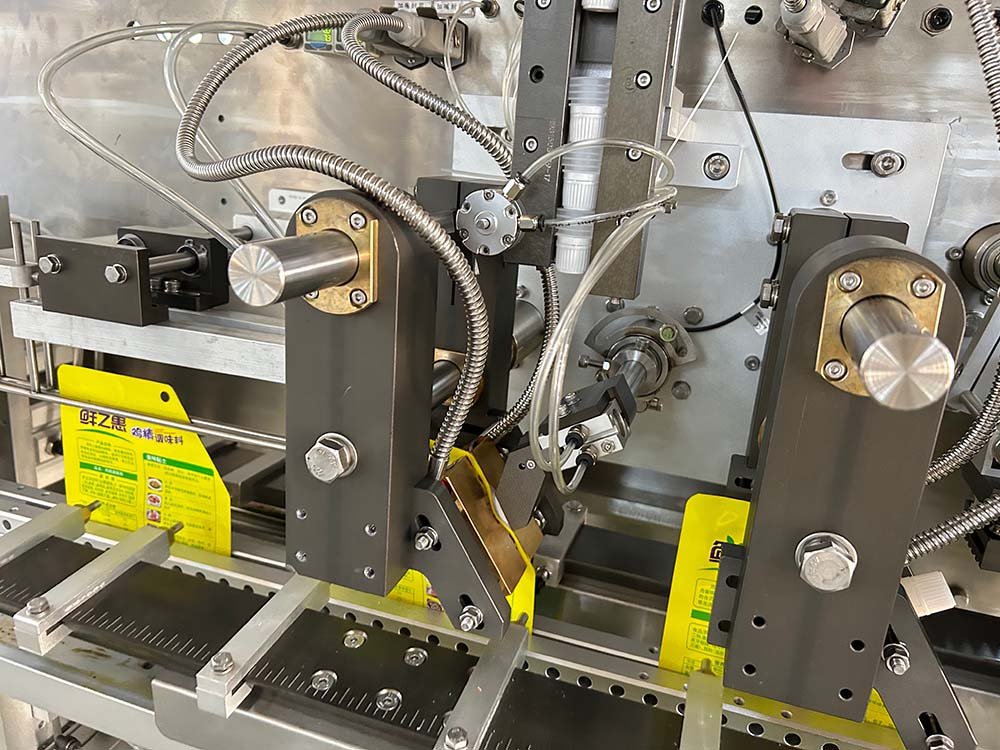
These assemblies give the project specific engineering decisions to verify. They should be reviewed against the actual product and pack, not treated as evidence of a universal speed, labor saving or defect-free result.
Sealing and cooling control
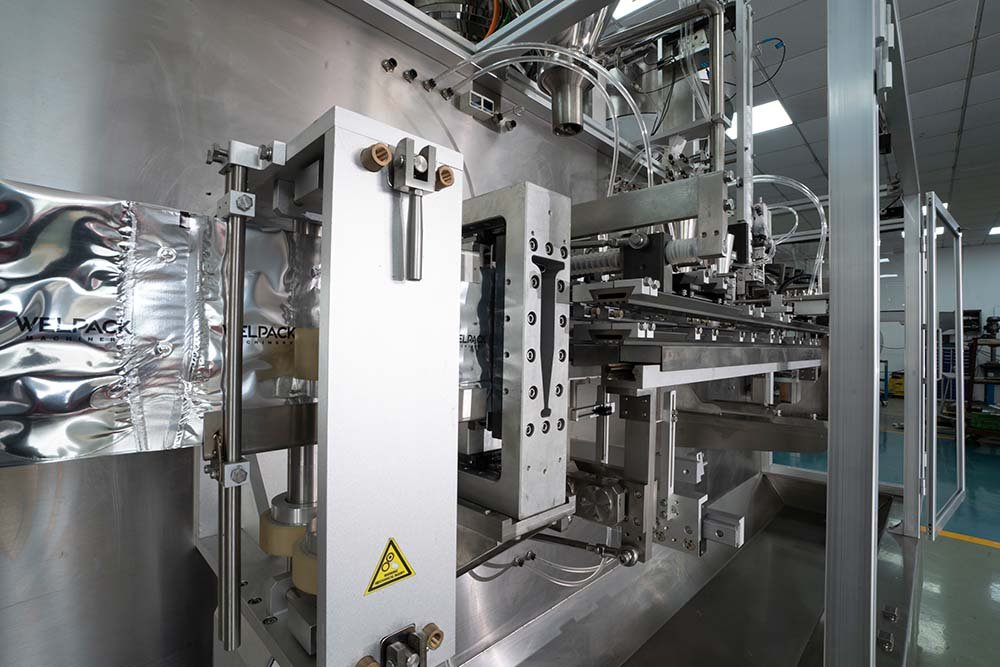
Seal performance depends on laminate, jaw condition, pressure, temperature, dwell and cooling. The referenced design includes sealing and cooling functions; the production settings must be trialed with your materials. Include the customer’s chosen seal checks, visible defects and leak-check method in the acceptance plan, rather than describing every finished pouch as leak-proof.
Controlled pouch transport
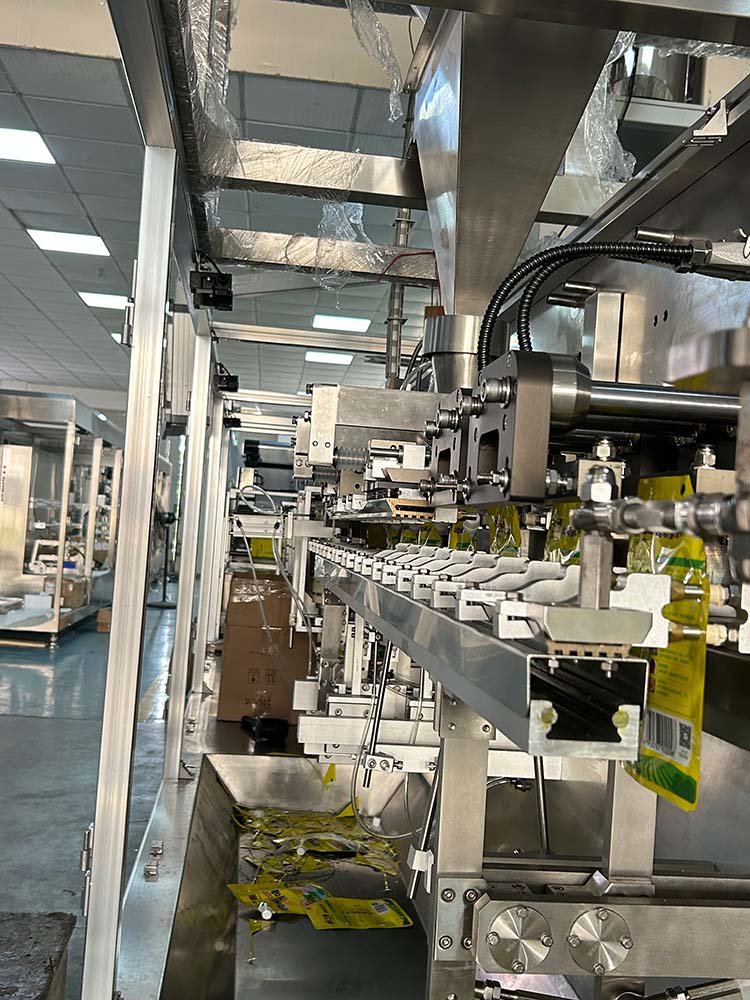
The supplied proposal describes servo-driven transport and pouch-gripping features. Review alignment, support and station adjustment with the actual package and fill level. Check what changes when the pouch is empty, partly filled and finished. Lubrication arrangements support maintenance planning; they do not remove inspection, wear checks or scheduled servicing.
Application-matched dosing
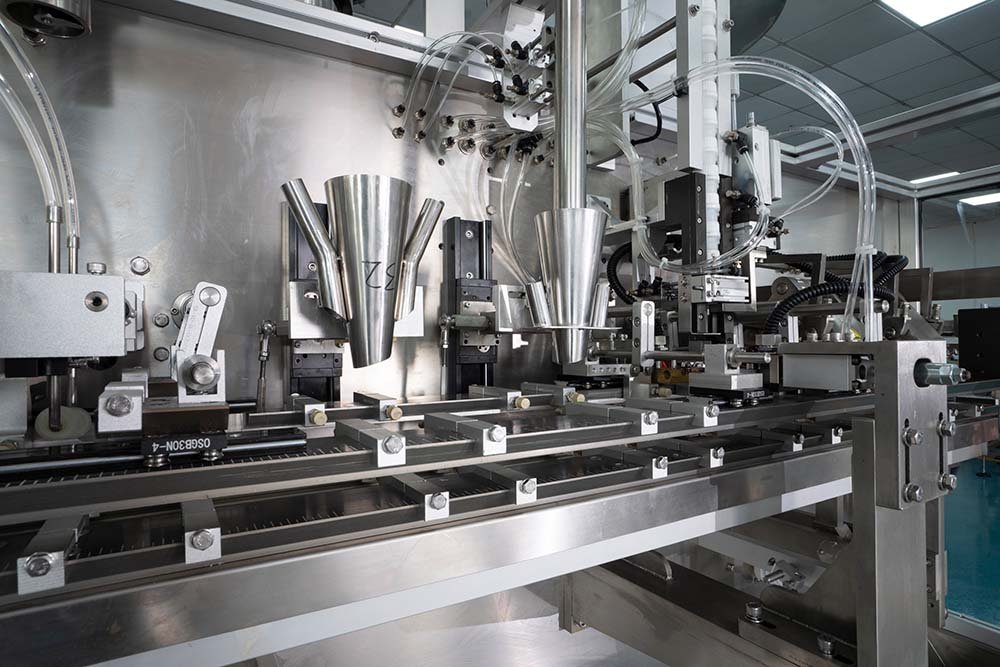
The reference SR60 servo rotor pump is one dosing option, not a universal answer for every sauce. Its quoted scope includes 316L product-contact parts and a CIP-capable design. Verify viscosity at the operating temperature, particle behavior, dose range, cutoff and the complete cleaning circuit before selecting the filler and nozzle arrangement.
For a top-spout or corner-spout project, include the closure drawing, weld flange and agreed package orientation. For another fill system or control component preference, state it in the URS and confirm availability, interfaces and documentation in the proposal.
Match the Product, Pouch and Filling Conditions
Food, beverage and non-food products require different product-path and acceptance decisions. Product names help screen the application; samples, operating conditions and package details determine the proposed configuration.
Juice and beverages
Specify pulp or suspended solids, filling temperature, foaming tendency and required headspace. Review the product supply, nozzle entry, cutoff and settling behavior. Confirm the customer’s hygiene and product-protection requirements separately; an ordinary filling line is not evidence of an aseptic process.
Ketchup, mayonnaise and dressings
Send representative product and state viscosity at the process temperature, particle content and sensitivity to handling. Review pump selection, nozzle clearance, seal-area contamination and product transfer from the tank. Evaluate the dose and package combination together instead of selecting the line from a condiment name.
Hummus, purées, honey and syrup
Describe particle size, stickiness, temperature dependence and any product separation. Trial the transfer path and filling cutoff with the intended pouch opening. Changes in temperature or product formulation can alter the result; include those production conditions in the proposed test and acceptance record.
Detergent and personal-care refills
Confirm foaming, product compatibility with seals and wetted materials, package barrier requirements and closure handling. Define the customer’s leakage and cleanliness checks. Where several formulations share the equipment, include cleaning, residue concerns and changeover responsibilities in the specification.
If the package route is still open, compare liquid and sauce packaging routes. For refill products, review the cosmetic spout-pouch packaging route; for industrial oils, review the lubricant oil spout-pouch route with the intended product and material requirements.
For sauce factories comparing pump, pouch and acceptance requirements, the top-spout doypack selection guide for sauces provides a related procurement discussion.
Roll-Film HFFS vs Premade Spout Pouch Filling
A spout pouch filling and capping machine can describe very different architectures. Compare the same package, fill requirement and accepted-output target. A lower machine price or a higher catalogue cycle rate does not settle the total production case.
| Decision | Roll-film HFFS route | Premade spouted-pouch route |
|---|---|---|
| Starting package | Rollstock, with forming and the selected spout operations integrated in the project. | A supplied pouch; confirm whether the spout and cap arrive fitted. |
| Formats and changeover | Evaluate film repeat, forming dimensions, spout tooling, settings and planned run lengths. | Evaluate pouch supply, magazine or feeding system, grip range and format adjustments. |
| Cost per accepted pack | Include film, spout and cap, startup scrap, rejects, labor, utilities and changeover. | Include supplied pouch cost, handling losses, filler scope, closure work and changeover. |
| Acceptance evidence | Trial the product, film and closure components as an integrated process. | Trial the product and the actual supplied pouch with the agreed filling and cap scope. |
| Project boundary | Specify roll handling, forming, dosing, spout processing and downstream interfaces. | Specify pouch presentation, opening or through-spout filling, cap handling and interfaces. |
Cost comparison: divide relevant production cost by accepted finished pouches over the same agreed period. Use current converter and equipment quotations, your staffing plan and observed losses. Keep assumptions visible so purchasing and production can compare the routes on one basis.
There is no fixed saving percentage or daily-volume threshold for every factory. Stable runs may favor one route, while a changing SKU mix or a different supplied pouch can favor another. Review the premade spout pouch filling and capping machine and the HFFS versus premade-pouch procurement comparison before fixing the architecture.
What to Send for a Spout Pouch Filling Machine Quote
A useful spout pouch filling machine quotation defines what is supplied and how it will be evaluated. You can start with the product, package and output target; the technical discussion can then close missing details. Send the following information for a scoped review.
Product and dose
State the product, fill range, density where relevant, viscosity at the intended temperature, particles, foaming and separation. Include the condition of the product arriving at the filler. If several formulations share the line, identify which represents the difficult filling or cleaning condition.
Pouch, film and closure
Provide a dimensioned pouch drawing, laminate structure, web and repeat data, spout location, closure drawings and representative samples. Confirm who supplies the film, spouts and caps. State whether any package component is already fitted when it reaches the machine.
Output and SKU mix
Give required accepted packs per minute or per shift, planned run length, production mix and expected changeovers. Identify quality checks and rejects included in the output count. Distinguish a maximum cycle rate from the finished-pack result your production manager needs.
Site and utilities
Specify installation destination, voltage, frequency, phase, compressed-air conditions, floor space and access. Include product-feed, cleaning and any water, drain or exhaust needs that apply. A machine footprint is not the complete access and service envelope.
Scope and interfaces
Identify tanks, pumps, feeding, coding, inspection, conveyors, packing and cartoning included in the project. Define which party owns each mechanical, electrical, safety and control handoff. Ask the quotation to separate included equipment, optional modules and exclusions.
Acceptance and commercial basis
State the requested trial materials, witness method, test records and acceptance criteria. Request the lead-time basis, delivery term, installation responsibilities, training scope, warranty conditions and spare-parts plan. Use a dated proposal so purchasing can compare a controlled scope rather than a headline price.
The reference proposal includes options such as the SPF-1 spout feeder, SR60 rotor pump, MT100L tank, outlet conveyor and selected format modules. Their inclusion changes the project scope. Ask for an equipment schedule, coordinated layout and utility list that cover all included items, rather than treating accessories as automatically supplied.
Plan the Sample Trial and Factory Acceptance Test
Agree Factory Acceptance Testing before relying on an output or quality claim. The protocol should connect your production requirements to observable checks using representative materials and defined operating conditions. Test duration and pass criteria are set for the project.
Freeze the trial configuration
Identify the supplied model, dosing system, pouch formats, spout and cap components, film and test product. Record which optional equipment is included and which interfaces are simulated. Use the same configuration identity throughout the test plan and the retained records.
Measure fill and accepted output
Agree the measurement method, sample timing, dose criteria, production duration and what counts as an accepted pouch. Record rejects and stops as defined in the protocol. A short burst at a maximum setting should not substitute for the agreed production test.
Check the pouch and closure
Agree the customer’s seal, leakage, cap and appearance checks using the intended materials. Record contamination, distorted pouches, closure defects and the disposition of rejected packs. Test methods and limits need to be defined for the product and package application.
Observe starts, stops and recovery
Include normal start-up, restart, material refill, film changes and relevant fault recovery. Observe the behavior of unfinished pouches and product during interruptions. If downstream equipment is included, evaluate blocking, starvation and restart with the connected line boundary.
Verify changeover and cleaning scope
Identify the formats included in the trial, required tooling and the steps operators must complete. Where cleaning is included, define the product-path boundary, access, materials and verification responsibilities. A CIP-capable pump alone does not validate the full line-cleaning process.
Retain evidence and close deviations
Agree the witness method, recorded settings, results, retained samples and documentation. List deviations and the correction or retest process. Separate demonstrated FAT conditions from checks that remain for delivery, installation or site acceptance at the customer’s factory.
Use the stand-up pouch machine FAT checklist to structure the witness discussion. FAT confirms the conditions actually tested; installation readiness, site utilities and upstream product supply still need their own agreed verification.
Installation, Training and Spare Parts for the Delivered Project
A packaging line needs a service plan that matches the delivered configuration. Confirm installation, operator training, maintenance information, support access and spare-parts responsibilities before the purchase specification is approved.
For installation, define site readiness, lifting and access, utilities, product and packaging materials, technician responsibilities and travel arrangements. Training should cover normal production, changeover, cleaning, alarms and the maintenance tasks agreed for the equipment.
For support, request the critical spare-parts list, component identification, drawings and relevant manuals. The reference proposal describes a remote-support provision; any network access must be arranged under the customer’s site policy and the agreed service scope.
Warranty coverage, exclusions, availability, dispatch arrangements and delivery timing belong in the current quotation and contract. They should not be presented as identical worldwide response promises. The customer’s destination-market and hygiene acceptance should also confirm the documentation and applicable CE-marking scope for the supplied configuration.
Review packaging machine service and support and the INMAYPACK project approach when agreeing lifecycle responsibilities.
Spout Pouch Filling Machine Procurement FAQ
Questions for factory owners, purchasing teams, production engineers and quality managers. Use the answers to define the application and the evidence needed before approving a machine purchase.
Does the HMS160 route use roll film or premade pouches?
This page covers the roll-film horizontal form-fill-seal route. The project forms the pouch and integrates the selected filling and spout operations. If your converter supplies completed spouted pouches, evaluate a premade-pouch filling and capping machine instead. Confirm whether the spout and cap arrive fitted before comparing the equipment scope.
What output should our factory specify?
Specify accepted finished pouches per minute or per shift, together with fill volume, product condition, package dimensions, spout and cap format, run length and quality criteria. Request the model-specific cycle limit and establish accepted output during the agreed product-and-film trial. Maximum speed is not a guarantee at every dose.
How much does a spout pouch filling machine cost?
The quotation depends on the machine configuration, dosing equipment, pouch and spout tooling, feeders, tanks, conveying, controls, testing and service scope. Send the product, dose, package drawing, target accepted output, utilities and destination. Request an itemized current proposal with options and exclusions so purchasing compares the same supplied scope.
Can one line handle both top-spout and corner-spout pouches?
The proposed format range depends on the module arrangement, spout location, pouch drawing and tooling. A different position or package geometry can require changes beyond a recipe setting. Provide drawings and samples for every required format, then confirm which combinations are included and how they will be demonstrated during the agreed acceptance test.
Can the line fill mayonnaise, honey or products with particles?
These products are evaluated from viscosity at the process temperature, particle characteristics, stickiness, foaming, product supply and dose range. The reference SR60 rotor pump is one option to review. Use representative product samples to evaluate transfer, cutoff and package cleanliness; a product name alone does not establish compatibility or accepted output.
Are recyclable or mono-material films automatically compatible?
No. Provide the actual film structure, thickness, seal window, mechanical behavior, artwork repeat and roll information. Trial forming, registration, spout attachment and sealing using representative materials. Package performance and the customer’s recycling or food-contact requirements must be evaluated for the specific material and market; a material label alone is insufficient.
Does a CIP-capable filler mean the complete line is validated for cleaning?
No. Confirm the proposed pump, tank, valves, seals, hoses, nozzles and their cleaning boundaries. Define the customer’s hygiene requirements, cleaning method and verification responsibilities for the supplied configuration. A component described as CIP-capable does not prove that every product-contact area in the complete line has an approved cleaning process.
What are the lead time, warranty and installation terms?
These terms are confirmed in the current quotation and contract for the chosen configuration and installation destination. Ask for the lead-time basis, delivery term, installation responsibilities, training scope, warranty coverage and exclusions, critical spare parts and support procedure. Historical project terms should not be treated as a universal promise for every machine order.
Compare Related Routes and Request a Defined Proposal
Keep the equipment choice tied to your package supply and production requirements. These related commercial pages help evaluate another package format, machine platform or line boundary without assuming all configurations are interchangeable.
Top Spout Flat Bag Packing Machine
Evaluate a flat-bag route when your required package is a small flat sachet with a spout. Confirm its own dose, pouch and closure scope.
Full Servo Doypack Packing Machine
Compare another roll-film platform when the pouch, product or required configuration differs. Review format and output evidence for that proposal.
Liquid Doypack Packing Machine
Evaluate liquid filling in a standard doypack when a spout is not required. Package supply and final closure remain separate selection decisions.
Turnkey Packaging Solutions
Define tanks, feeding, filling, inspection, conveying and secondary packaging under one coordinated project boundary and acceptance plan.
HFFS Pouch Machine Systems
Compare the roll-film pouch-making platform, package formats and filling-system interfaces for your application.
How Horizontal Form Fill Seal Works
Follow film forming, pouch opening, filling and sealing in the technical working-principle guide.
Send the Product, Pouch and Production Target
Start with your product, dose range, pouch or film specification, spout and cap details, required accepted output and destination. Include drawings or sample information where available. INMAYPACK can review the route and identify the next technical information needed for a configuration and quotation.
Email: sales@ewpackmachinery.com · WhatsApp +86 18658799162