
INMAYPACK · SG-series premade pouch systems
High Speed Premade Pouch Packing Machine
SG210 · SG320 · SG320D
Choose the SG platform for your pouch, fill volume and production target. Compare three model references, match the dosing system to your product and define the complete filling and sealing configuration.
- Supplied premade pouches
- Three SG model references
- Product-matched dosing
Packing speeds below are model references. Accepted finished-pack output is confirmed with the product, pouch, selected filler and agreed test conditions.
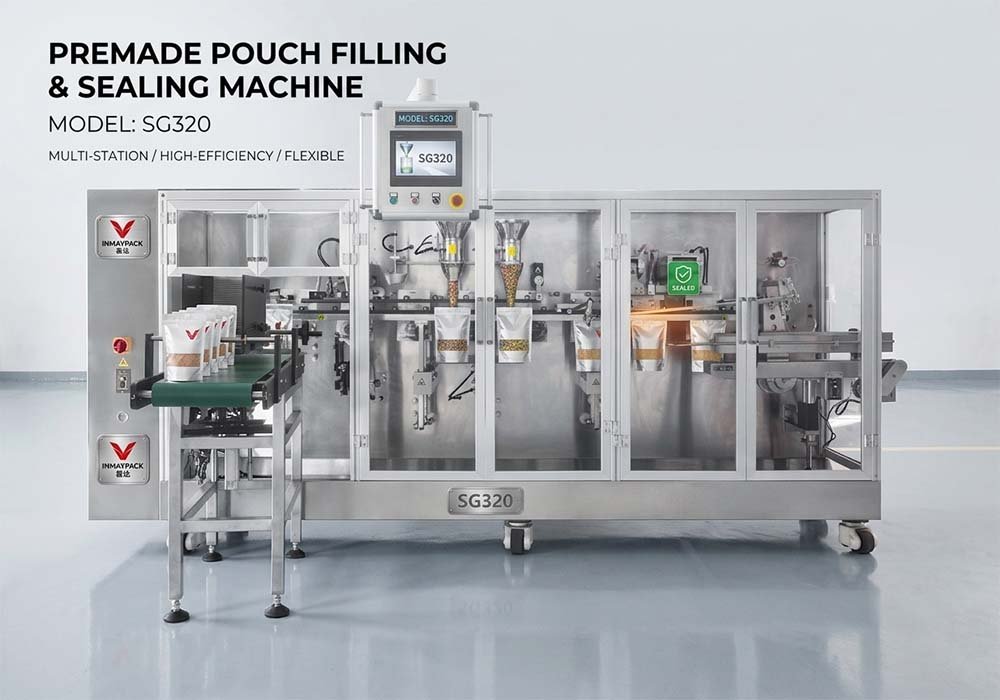
The machine and the production result
What is a high speed premade pouch packing machine?
A high speed premade pouch packing machine receives finished empty pouches and coordinates pickup, opening, filling, sealing and discharge. The pouch handler controls presentation and timing, while the selected filler supplies the measured product.
SG210, SG320 and SG320D are three model references with different pouch-size, fill-volume, packing-speed and power values. Shortlist the model from the actual package and required production result, then confirm the installed equipment with INMAYPACK.
For a side-spout liquid application, review the separate SG260 premade pouch filling and sealing configuration, including its product-path and spout requirements.
SG model selection
Compare SG210, SG320 and SG320D
Use the model-specific values to shortlist a platform. Confirm the production pouch, required dose and complete operating conditions before the machine configuration is released.
SG210
Review when the pouch and fill requirement fit the smaller SG format window.
- Minimum pouch reference
- 120×150 mm
- Maximum pouch reference
- 210×300 mm
- Fill-volume reference
- 1,500 mL
- Packing-speed reference
- 50 pouches/min
- Power reference
- 16 kW
SG320
Review when the pouch needs the wider size window or larger listed fill-volume reference.
- Minimum pouch reference
- 120×150 mm
- Maximum pouch reference
- 320×350 mm
- Fill-volume reference
- 3,000 mL
- Packing-speed reference
- 40 pouches/min
- Power reference
- 16 kW
SG320D
Review the paired-format arrangement, dosing distribution and discharge together.
- Minimum pouch reference
- 120+120×150 mm
- Maximum pouch reference
- 160+160×350 mm
- Fill-volume reference
- 1,000 mL
- Packing-speed reference
- 100 pouches/min
- Power reference
- 18 kW
Open the complete three-model reference specification table
| Parameter | SG210 | SG320 | SG320D |
|---|---|---|---|
| Minimum pouch-size notation | 120×150 mm | 120×150 mm | 120+120×150 mm |
| Maximum pouch-size notation | 210×300 mm | 320×350 mm | 160+160×350 mm |
| Fill-volume reference | 1,500 mL | 3,000 mL | 1,000 mL |
| Packing-speed reference | 50 pouches/min | 40 pouches/min | 100 pouches/min |
| Power reference | 16 kW | 16 kW | 18 kW |
| Pouch supply | Finished empty premade pouches; confirm drawing | Finished empty premade pouches; confirm drawing | Finished empty premade pouches; confirm drawing |
| Dosing system | Select and confirm for the actual product | Select and confirm for the actual product | Select and confirm for the actual product |
| Accepted production output | Agreed production samples and test conditions | Agreed production samples and test conditions | Agreed production samples and test conditions |
Read SG320D as a paired-format reference
The listed size notation is 120+120×150 mm to 160+160×350 mm. Confirm the individual pouch dimensions, paired/duplex arrangement and dosing layout in the approved drawing. The 100 pouches/min reference is not presented as a per-lane speed.
The listed fill volumes are reference figures, rather than a complete dose-range or tolerance specification for every filler. Power values identify the model reference; confirm voltage, frequency, phase, connected equipment and final installed load separately.
Pouch format & tooling
The pouch drawing defines the handling route
Pouch appearance and nominal dimensions are only the start. Gripping, opening access, sealing and product delivery depend on the complete package construction.
Supplied premade pouch
Confirm the finished package
Send width, height, gusset, laminate and thickness. Mark zipper, fitment, tear notch, hanging hole and permitted gripping zones where relevant.
SG320D paired-format review
Coordinate both pouch positions
Approve the paired arrangement, usable opening, dosing distribution, seal area and discharge pattern together. Compare the product result from each position.
Schematic package illustrations, rather than a tooling drawing or a list of guaranteed formats. Confirm every pouch feature and the corresponding installed opening/sealing functions.
Prepare the complete pouch and tooling review
| Package input | Define | Review evidence |
|---|---|---|
| Geometry & gripping | Finished width/height, gusset, zipper/fitment position, holes and corners | Approved drawing with safe gripping and sealing zones |
| Material & supply | Converter, layer structure, thickness, sealant, coating, curl, static and storage | Normal production samples, including replenishment conditions |
| Opening behavior | Separation, blocking, mouth access and feature restrictions | Trial at the required format extremes |
| Sealing & appearance | Temperature guidance, seal area, graphics and contamination risk | Agreed appearance, seal integrity and leak checks |
| Paired-format arrangement | Individual pouch drawing, simultaneous dose path and discharge | Position-by-position checks for the approved SG320D layout |
Equipment close-ups
See the pouch-handling mechanisms
Existing SG-series component photographs show the areas to review during configuration and testing. The approved model proposal identifies the components and functions actually supplied.
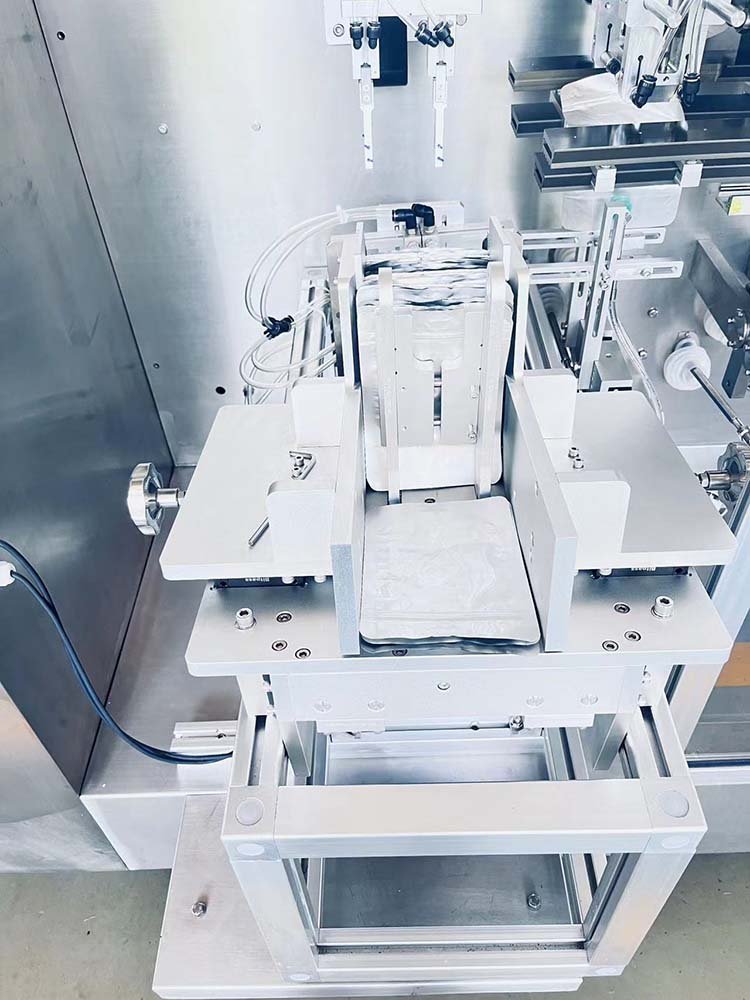
Pouch presentation
Check pouch separation, pickup and magazine replenishment with the intended production laminate.
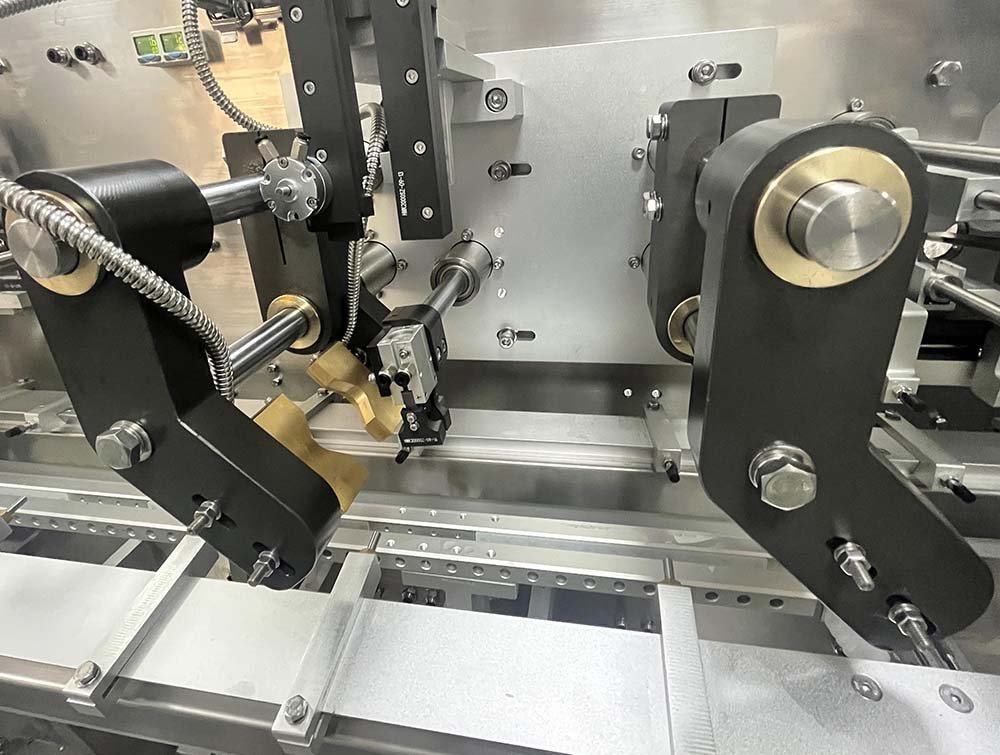
Opening assistance
Review the mouth opening, mechanical assistance and product-entry clearance for the finished pouch.
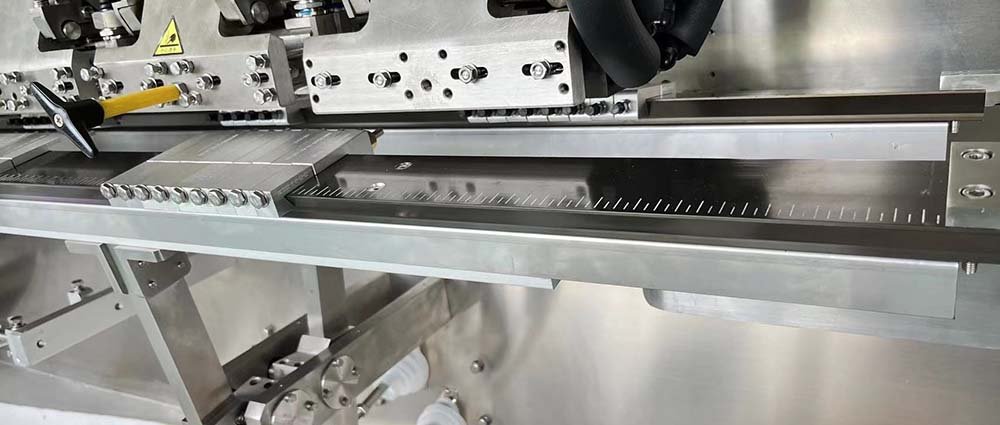
Gripping & positioning
Mark permitted gripping zones and confirm format-specific settings or change parts.
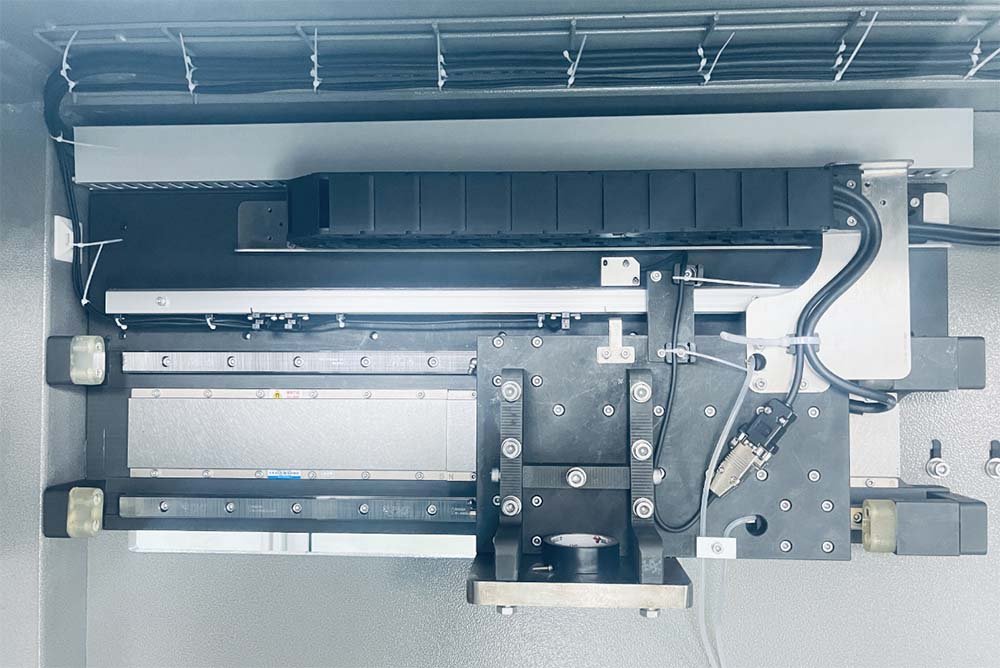
Linear transport
Confirm the installed transport arrangement, handoff timing, access and maintenance requirements.
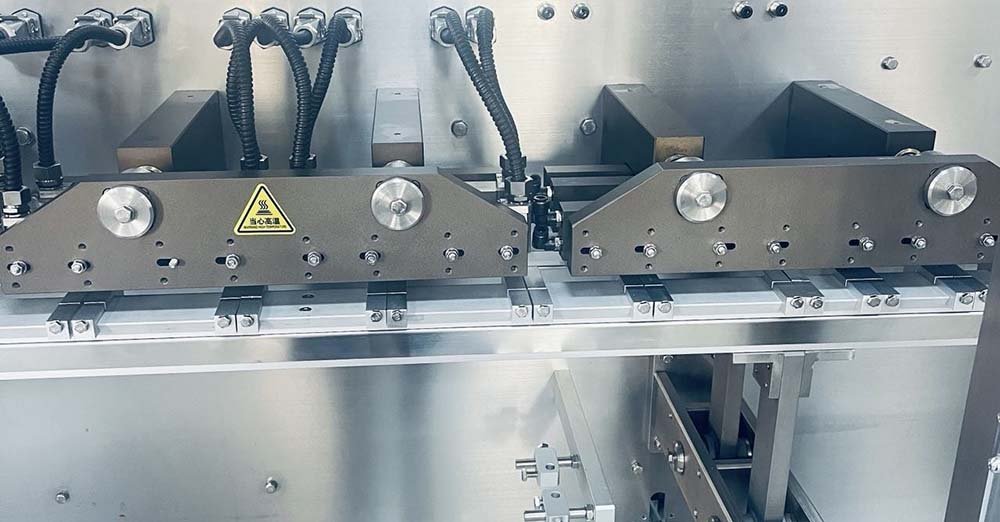
Heat-sealing jaws
Review seal-area cleanliness, material settings, dwell and any configured cooling interface.
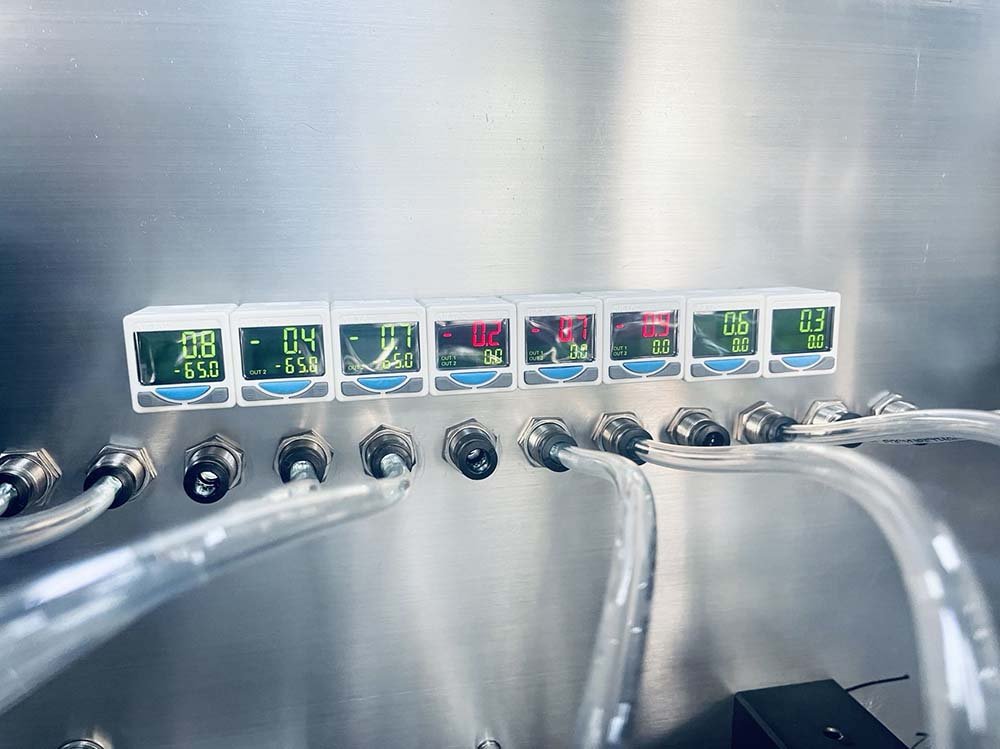
Vacuum monitoring
Include pouch-presence, opening conditions, fault response and restart in the agreed challenge test.
Control, detection and installed-function scope
Detect before filling
The separate SG260 application describes no-pouch/no-open interlocks and mechanical opening assistance. Confirm the selected SG model detection and withholding logic in its own proposal and trial.
Confirm the seal route
Define top-seal stages, cooling, material settings, contamination response and the finished-pack checks for the chosen machine.
Specify the motion system
Servo components, guides, automatic lubrication and recipe functions require confirmation in the selected model configuration.
Approve additional functions
Specify zipper assistance, code printing, gas requirements, inspection and reject handling when needed. Confirm each function and interface in the equipment list.
Filling architecture & applications
Select the filler for the actual product
Product delivery must fit the available pouch opening and filling time. The machine and dosing device have separate ranges, tolerances and operating conditions.
Liquids & smooth pastes
Review viscosity at filling temperature, foam, cutoff, drips, product compatibility and cleaning. The separate SG260 liquid side-spout configuration lists a particle-free rotor-pump route; it is an application-specific selection.
Powders & ground coffee
Review an auger or another suitable dosing route for flow, bulk density, aeration, dust, settling and refill. Confirm the actual dose range and seal-area cleanliness.
Granules, beans & pieces
Review a selected weigher, volumetric or other appropriate dosing device for particle size, fragility, stickiness, bulk density, drop distance and permitted variation.
Review coffee as a complete packing application
For coffee beans or ground coffee, compare the coffee pouch packing machine routes. Specify product condition, target weight, pouch features, selected dosing equipment and any gas or shelf-life requirement for the project.
Use the pouch filling system selection guide to compare metering routes. Confirm particles, product conditioning, cleaning and the complete wetted/contact-parts list before selecting the filler.
Compare the complete filler and product-supply requirements
| Filling boundary | Provide / agree | Selection and trial |
|---|---|---|
| Product behavior | Viscosity/temperature or density/flow; foam, dust, particles and fragility | Select pump, auger, weigher or another suitable device |
| Dose & tolerance | Minimum, nominal and maximum dose; agreed measurement method | Product trial across the proposed operating range |
| Fill cycle | Nozzle/chute entry, filling time, cutoff, settling and withdrawal | Coordinate pouch opening and clean sealing |
| Product supply | Refill, buffering, temperature/conditioning and level control | Define upstream equipment and stop/restart behavior |
| Paired operation | Approved split of dose delivery and refill to both positions | Evaluate both positions; avoid inferring per-lane output |
| Contact path & cleaning | Contact parts, seals, hoses, chutes, removable parts and cleaning method | Approved materials list and cleaning scope |
Working video & process functions
Watch linear premade pouch handling in operation
The existing video illustrates a premade pouch-handling concept. Confirm the exact SG model, filler, station arrangement and trial conditions for your project.
Public premade-pouch process demonstration. It does not establish the delivered SG210, SG320 or SG320D configuration or its accepted output.
Watch the working reference on YouTube →Present & pick up
Supply and separate a production pouch with the selected magazine and pickup tooling.
Open & check
Confirm a usable pouch opening and the installed detection response before product release.
Position for filling
Keep the pouch supported and align the selected product nozzle or chute.
Dose & settle
Coordinate the dose, cutoff and any required settling within the approved cycle.
Seal & stabilize
Apply configured seal stages and cooling with validated pouch-material settings.
Discharge & inspect
Transfer finished packs through agreed inspection, reject and downstream handling.
These are process functions, rather than a fixed station-count or station-allocation drawing. The selected model and installed options determine the exact arrangement.
Production target
Reference speed to accepted finished pouches
Measure the packs that meet the agreed dose, appearance, sealing and inspection criteria during the agreed production run.
Define the measured result
Accepted output
Conforming finished packs
÷ agreed run time
State whether startup, replenishment, minor stops and restarts are included. Track rejects and stopping causes alongside the output result.
Opening & replenishment
Laminate curl, static, blocking and magazine refill can change pouch presentation and usable filling cycles.
Dosing & settling
Dose size, viscosity, foam, powder aeration and product settling affect the available fill-and-seal time.
Sealing & discharge
Seal material, contamination, dwell, cooling, inspection and downstream capacity can constrain accepted output.
Paired-format consistency
For an approved paired arrangement, compare dose, opening, sealing, rejects and recovery at both pouch positions.
Agree the complete production-test basis
| Test boundary | Agree before the run |
|---|---|
| Materials | Representative product lot and condition; intended pouch converter and sample lot |
| Equipment | Named SG model, filler, tooling, options, product feed and downstream scope |
| Run basis | Format, dose, settings, duration, staffing and included stoppages |
| Pack acceptance | Dose method/tolerance, seal/leak, appearance, code and any cap/fitment checks |
| Recording | Accepted packs, rejects by cause, minor stops, refill, alarms and restart |
| Paired-format checks | Separate evidence for each approved pouch position; final output definition |
Price & quotation
What determines the high speed pouch machine price?
Request a current itemized quotation for your product and pack. The selected SG model, filler, package tooling and connected line scope determine the proposal.
Machine, dosing & package
- SG210, SG320 or SG320D model and approved layout
- Pouch range, tooling, feature handling and change parts
- Selected dosing system, feed and buffer equipment
- Contact materials, cleaning and required conditioning
- Code printing, inspection, rejects and discharge interfaces
Testing, installation & support
- Accepted-output target and agreed production samples
- Electrical supply, air, cooling and other utilities
- FAT evidence, drawings, manuals, recipes and spare parts
- Training, commissioning and installation responsibilities
- Destination, delivery terms and current warranty scope
Compare quotations on the same operating boundary
| Boundary | Included / optional / excluded items to confirm |
|---|---|
| Pouch handler | Model, controls, guards, installed handling functions and format tooling |
| Dosing & supply | Selected filler, product feed/buffer, contact parts, recipes and connections |
| Package options | Zipper/fitment handling, coding, gas requirements, inspection and rejects |
| Layout & utilities | Machine plus connected equipment, access, installed loads and utility interfaces |
| Production acceptance | Approved materials, required output, dose/seal criteria and agreed run |
| Handover & support | Documentation, training, spares, commissioning, delivery and warranty scope |
If the pouch supply route is still open, review the HFFS vs premade pouch machine comparison before finalizing the equipment scope.
Prepare your inquiry
Send your product and pouch. Get an SG model review.
Give INMAYPACK the information needed to compare the model, dosing system and complete packing result together.
Product & package
- Product name, photos and representative sample
- Viscosity/temperature or density/flow; particles, foam or dust
- Minimum / nominal / maximum dose and tolerance
- Pouch drawings, laminate, feature details and samples
- Launch SKU list and required format changes
Production & project
- Accepted finished pouches/min and operating pattern
- Selected filler or an open dosing-system requirement
- Product supply, downstream limits and required options
- Available factory utilities, layout and cleaning method
- Destination, trial evidence, installation and support scope
Plan the SKU matrix, cleaning and format changeover
List every launch SKU
Identify product/pouch combinations and minimum, nominal and maximum doses. Include the intended converter and any zipper, fitment or material differences.
Define format changes
Confirm magazine guides, pickup, gripping, opening, nozzle/chute, seal and printer adjustments. Agree required tools, change parts, recipes and first-off checks.
Define product-contact cleaning
List removable contact parts and the responsible operator. Confirm dry/wet cleaning, drainage, allergens, product-change checks and protection of non-washdown parts.
Confirm installed modules
Automatic lubrication, selected servo components, tank/pump, gas, inspection and CIP functions require their own approved equipment and interface scope.
Plan factory acceptance, documents and handover
Approve materials & equipment
Freeze the production product and pouch lot, named model, filler, format, settings, options and available utilities.
Test the complete process
Record pickup, opening, dose, contamination, seal results, inspection and downstream transfer with the agreed fault/restart checks.
Measure accepted output
Use the agreed run duration, staffing, replenishment and reject definition. For paired operation, keep position-specific evidence.
Close the handover
Agree as-built drawings, equipment list, recipes, manuals, backups, spares, training, deviations, test records and commissioning duties.
High speed premade pouch packing machine FAQ
Direct answers about SG models, pouch dimensions, dosing, output, power and pricing.
What packing speeds are listed for the three SG models?
What pouch dimensions are listed for SG210 and SG320?
Can the platform be selected for liquids, powders and granules?
Does no-pouch/no-open detection eliminate all waste?
How should the system be accepted before shipment?
Is SG320 always the best choice for a wider pouch?
What information is needed for a useful quotation?
How much does a complete high speed premade pouch system cost?
How should the SG320D paired pouch-size notation be read?
What filling volumes and power values are listed?
Are SG260 liquid pumps and side-spout equipment standard on these models?
Can I review the system for coffee beans or ground coffee?
INMAYPACK · Your SG-series pouch project
Request the SG configuration for your product and pouch
Send the product, dose range, pouch drawing and samples, required output and destination. Review the model, filler and complete packing scope together.