
INMAYPACK · Liquid & paste pouch systems
Premade Pouch Filling and Sealing Machine SG260
Build your side-spout pouch packing system around the product, pouch and finished-pack requirements. The SG260 reference combines servo pouch handling, rotor-pump filling, top sealing and a configured spout station.
- Premade side-spout doypacks
- Liquid & smooth paste applications
- Product-matched filling
Pouch size, dose and accepted output are confirmed with production samples and the agreed test. Start with the required pack, then define the machine configuration.
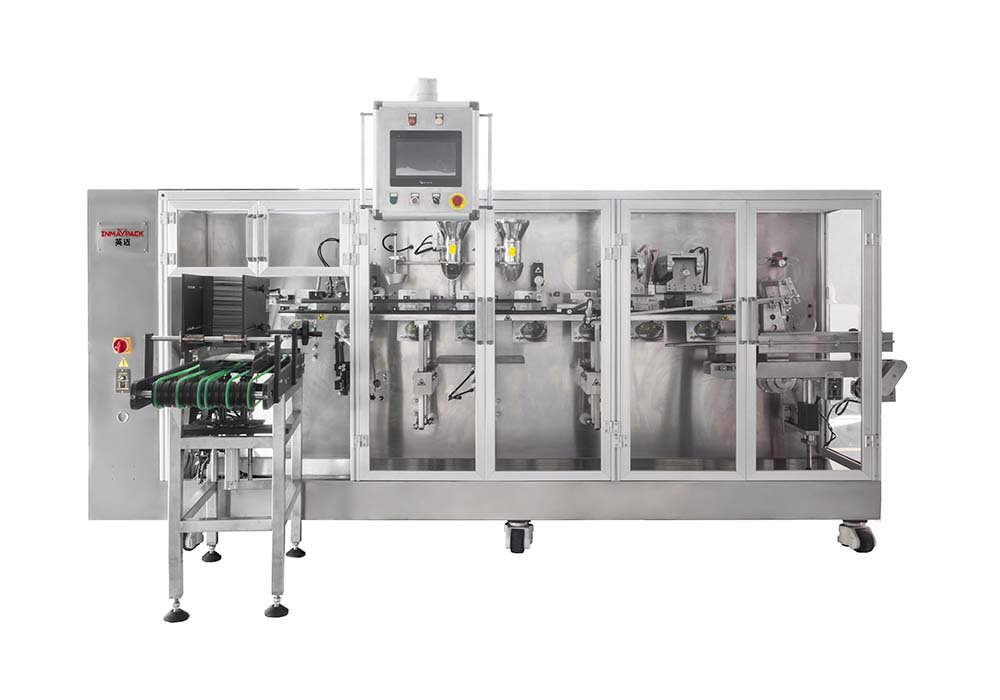
What the machine does
From premade pouch to filled and sealed pack
The SG260 application reference is a servo-controlled system for supplied premade side-spout doypacks. Product dosing, pouch handling, spout integration and sealing are selected as one coordinated process.
A premade pouch filling and sealing machine picks up a finished empty pouch, opens it, introduces the measured product and closes the package. The SG260 configuration adds side-spout handling to a linear servo pouch-transport route for compatible liquid and paste applications.
Send the production pouch, spout and cap together with the product. Their dimensions, material interfaces and filling behavior determine the tooling and operating conditions.
For package designs still under review, compare doypack packaging routes and the pouch filling system guide.
Servo pouch handling
The SG260 complete-line reference lists 11 servo motors, controlled pouch pickup, linear transport and automatic lubrication at key points.
Coordinated product supply
Two servo rotor pumps and one 100 L tank are listed for this application. The pump quantity is a configuration reference; the finished dosing arrangement is confirmed for your product.
Spout & discharge scope
The listed configuration includes a side-spout station, spout elevator and discharge conveyor. Spout welding, feeding and cap-handling interfaces follow the approved package.
Open the complete SG260 configuration and supply boundaries
| Equipment | Application reference | Confirm for your project |
|---|---|---|
| Main machine | 1 SG260 system; 11-servo complete-line reference | Production pouch tooling and station arrangement |
| Product filling | 2 servo rotor pumps | Dose, tolerance, viscosity, temperature and cutoff |
| Product buffer | 1 T100L tank, nominal 100 L | Usable level, refill, connections and required conditioning |
| Side-spout station | 1 listed side-spout station | Spout drawing, welding/sealing and cap-handling duties |
| Spout supply | 1 spout elevator; SPF-1 feeder reference | Orientation, transfer, buffer and replenishment |
| Discharge | 1 conveyor | Inspection, accumulation and downstream interfaces |
| Requirement-based modules | UV laser printer and checkweigher listed | Compatibility, installation and included/excluded scope |
Compare separate SG210 / SG320 / SG320D family references
These are separate family-model references. They do not specify the SG260 pouch range, dose, accepted output or power. Model suitability and the final installed load require a project-specific configuration.
| Model | Minimum pouch reference | Maximum pouch reference | Filling-volume reference | Packing-speed reference | Power reference |
|---|---|---|---|---|---|
| SG210 | 120×150 mm | 210×300 mm | 1500 mL | 50 pouches/min | 16 kW |
| SG320 | 120×150 mm | 320×350 mm | 3000 mL | 40 pouches/min | 16 kW |
| SG320D | 120+120×150 mm | 160+160×350 mm | 1000 mL | 100 pouches/min | 18 kW |
SG320D retains the paired-format notation 120+120×150 mm to 160+160×350 mm. Confirm the individual finished-pouch dimensions and paired layout in the approved drawing.
Package architecture
Choose the right spout-pouch route
The pouch supply condition changes the equipment you need. Review the pouch drawing, spout location, sealing flange and cap together.
SG260 application reference
Side-spout integration
Coordinate premade pouch pickup, product filling, top sealing and the configured side-spout station. Review the spout supply and welding interface with the production laminate.
Alternative package supply
Pouches with spouts already fitted
When empty pouches arrive with the spout already installed, review a dedicated spout pouch filling and capping machine for that opening and cap arrangement.
Schematic package illustrations. Final spout position, tooling and process sequence follow the approved pouch and spout drawings. A similar-looking pouch can require a different filling and sealing route.
Equipment close-ups
See the machine through its working details
Real SG-series mechanism photographs illustrate pouch presentation, opening, transport, sealing and feeder interfaces. Match the installed components to the final machine configuration.
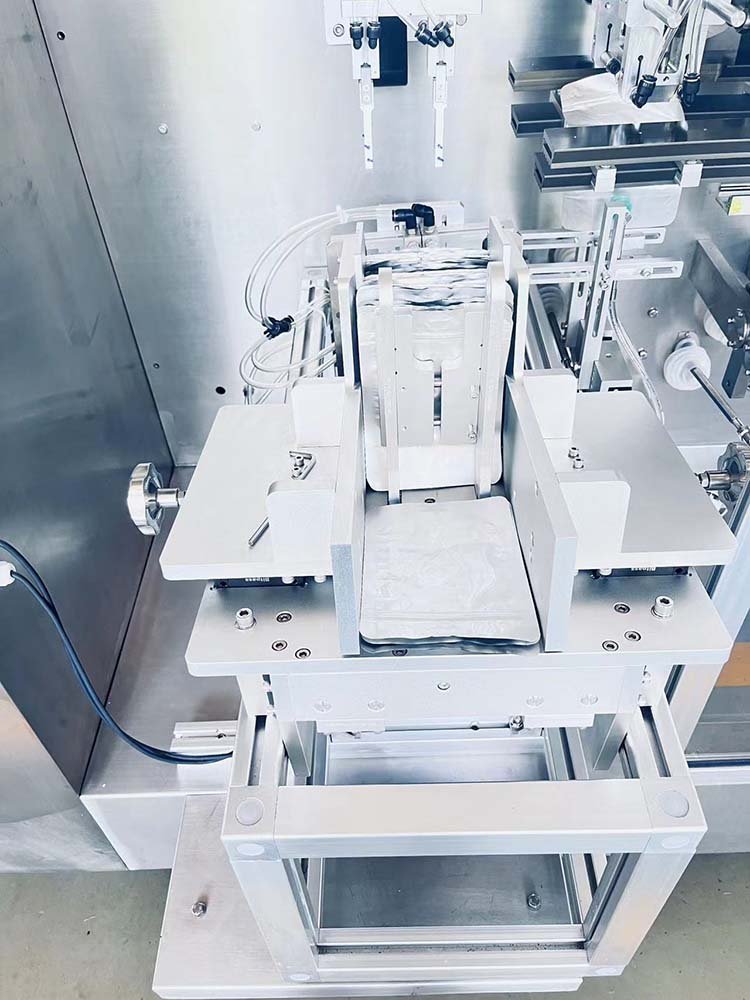
Pouch feeding station
Servo pickup stroke is adjusted through the touch screen for the confirmed pouch format.
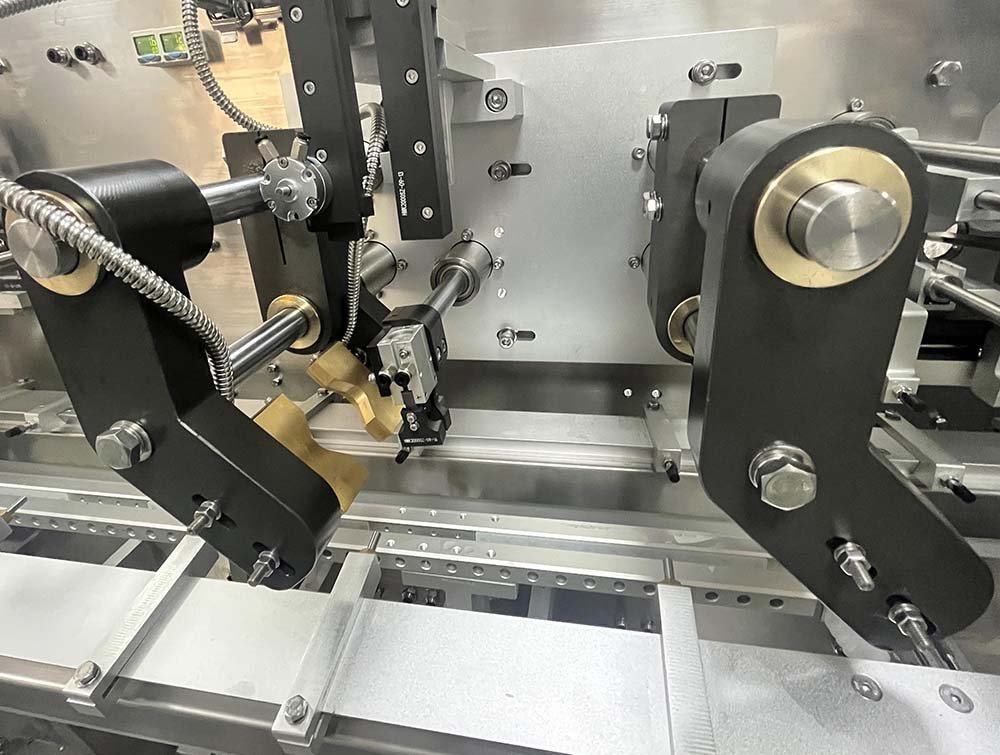
Opening & grippers
Vacuum opening works with mechanical assistance to support the pouch mouth during transfer.
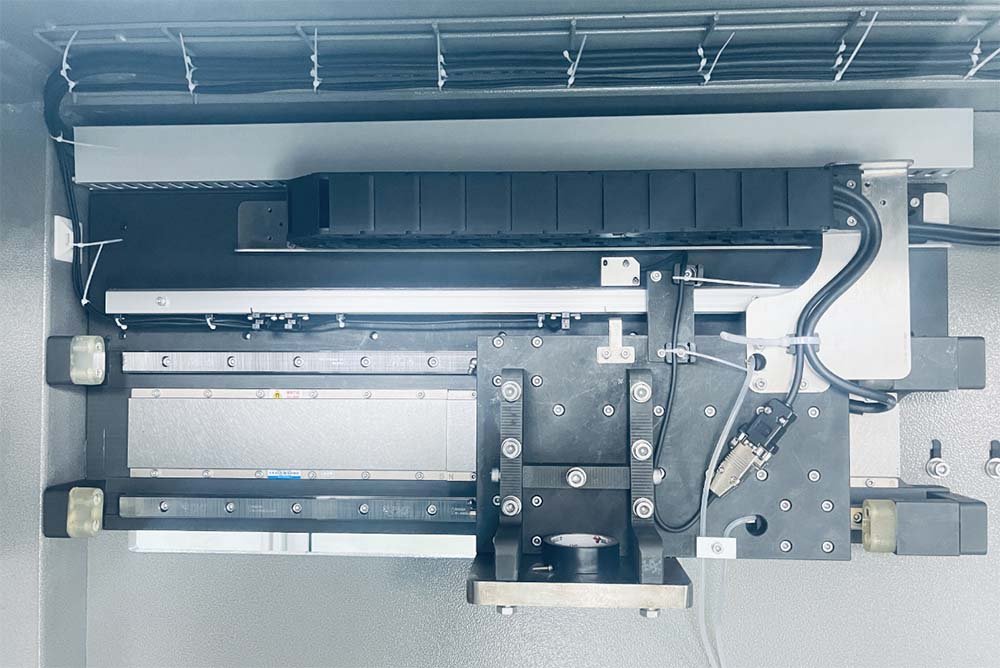
Linear servo transport
Linear motion coordinates the pouch handoffs; key lubrication points use an automatic system.
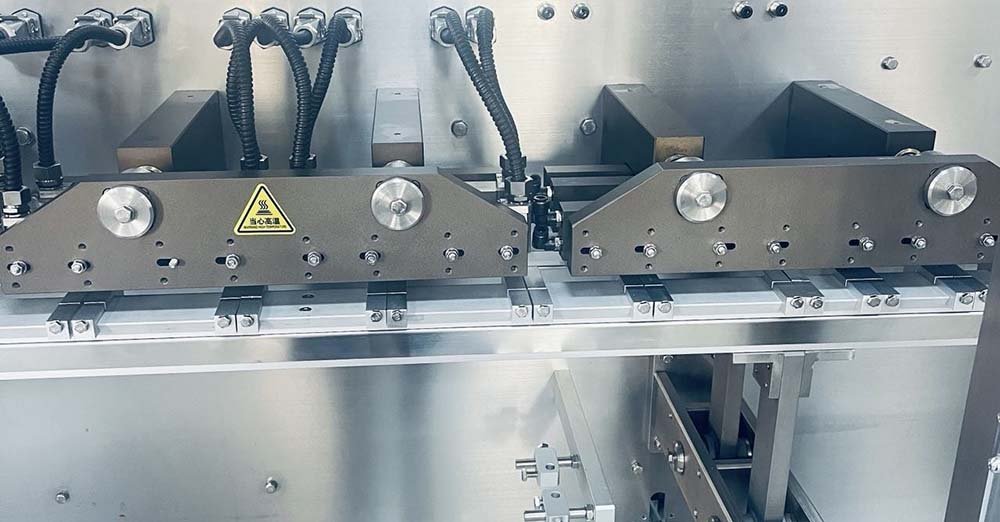
Heat-sealing jaws
The referenced top-seal route uses two heat-seal stages and cooling. Settings follow the production laminate.
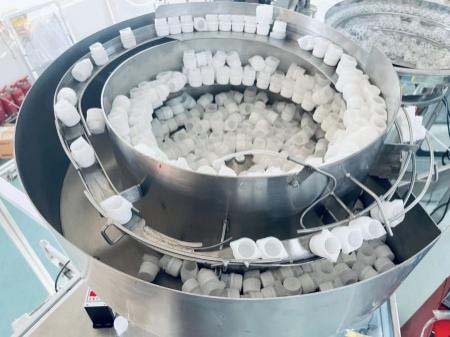
Vibratory feeder
Confirm the component orientation, transfer track and spout/cap tooling for the supplied parts.
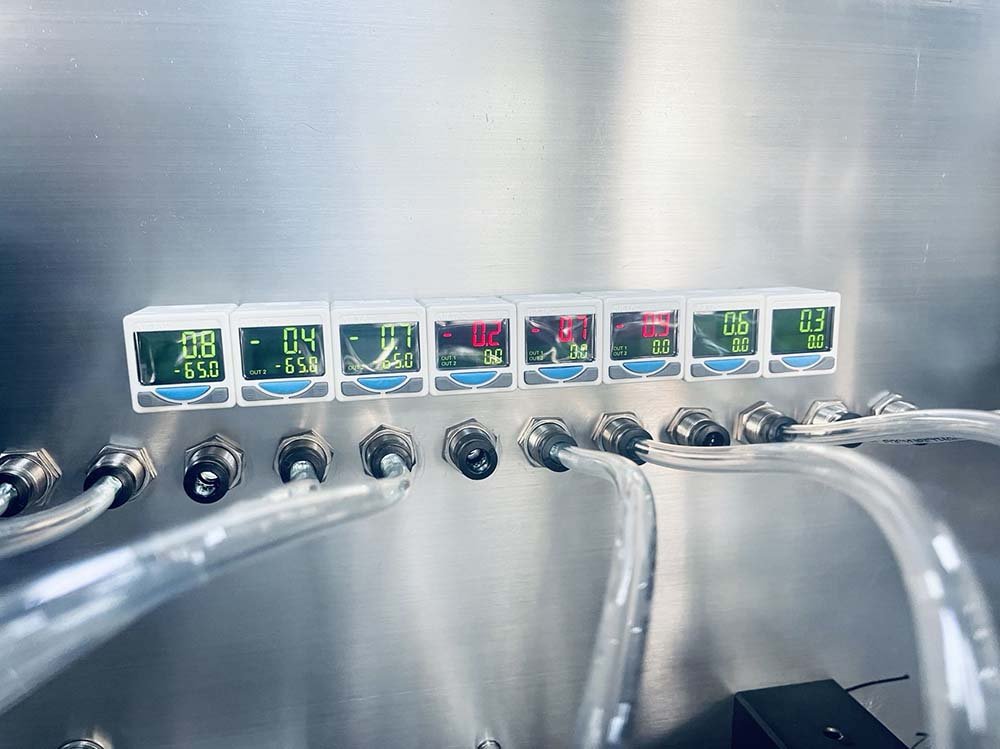
Vacuum monitoring
Include missing-pouch and unsuccessful-opening detection in the approved challenge and recovery test.
Pouch detection, sealing, cooling and changeover
No pouch / no opening
The documented system withholds filling and sealing when a pouch is absent or fails to open. Confirm the sensor threshold, reject handling and operator restart procedure with production pouches.
Heat seal & cooling
Review the two top-seal stages and water-cooling interface against laminate, seal area and operating conditions. Define leak, appearance and seal-quality checks for the finished pack.
Format changes & maintenance
Touch-screen adjustment supports the listed pickup stroke. Confirm all required mechanical tooling, recipe changes, first-off checks and lubrication/maintenance duties.
Additional package functions
Zipper flattening and date printing are requirement-based configurations. Confirm compatibility and installed scope; specify any separate gas, coding or inspection requirements.
Filling, buffer and contact materials
Rotor-pump filling. Defined by your product.
The quoted pump reference covers particle-free fluids up to 5,000 cP. Product temperature, viscosity, foam and cutoff behavior determine the approved operating window.
26 mL / revolution
This is the listed pump displacement. The pouch dose is set and verified through the selected operating recipe, rotor movement and actual product test.
100 L product buffer
The T100L reference provides product storage upstream of filling. Confirm refill, usable level, outlet arrangement and any heating, agitation or level-control requirement.
Contact materials by component
The pump and tank reference lists 316L contact parts; the pump also lists modified PTFE. The SG260 main-machine proposal separately lists SS304 product-contact parts.
Open the complete servo rotor-pump reference specifications
| Parameter | Component reference | Project confirmation |
|---|---|---|
| Pump type / quantity | Servo rotor pump; 2 sets listed | Final dosing layout and integration |
| Displacement | 26 mL/revolution | Dose is adjustable and verified by product trial |
| Fluid reference | 0–5,000 cP; without solid particles | Viscosity at filling temperature, foam and product composition |
| Pressure reference | 0.1–2 MPa | Approved product-path pressure and interface limits |
| Rotational-speed reference | 10–2,000 rpm | Pump rotation, not finished pouches/min |
| Power supply / load | 220 V, 50/60 Hz; 1.0 kW pump reference | Electrical interface and final installed load |
| Connection reference | DN32 inlet; DN19 outlet | Approved connection standard and piping drawing |
| Working-temperature reference | −40°C to 120°C | Pump-component reference; validate product, seals and complete line |
| Product-contact materials | 316L; modified PTFE | Confirm the complete wetted-parts list |
| Surface-finish reference | Ra ≤ 0.6 µm; EP reference Ra 0.4 µm | Selected finish and evidence for supplied contact parts |
| Control | Independent touch screen or integrated control | Selected machine/filler communication and recipes |
| Cleaning | CIP-capable reference arrangement | Cleaning route, utilities, recipe, drainage and acceptance |
Open the T100L tank and product-supply reference
| Parameter | Tank reference | Project confirmation |
|---|---|---|
| Tank / capacity | T100L; nominal 100 L | Usable volume and product-level operating limits |
| Product-contact material | 316L | Wetted parts and connection list |
| Surface-finish reference | Ra ≤ 0.6 µm; EP reference Ra 0.4 µm | Specified finish and supplied evidence |
| Cleaning | CIP-compatible reference | Cleaning connections, drainage, recipe and utilities |
| Product conditioning | Heating, agitation and level-control requirements to be specified | Approve required modules and product behavior |
Open the SPF-1 spout feeder technical reference
| Parameter | Feeder reference | Selection note |
|---|---|---|
| Feeder model | SPF-1 | Spout supply to the vibratory-feed route |
| Component conveying capacity | 10,000 pieces/hour | Feeder reference; not line output in finished pouches/hour |
| Hopper capacity | 50 L | Spout geometry, replenishment and buffering |
| Structure / belt | SUS304 / PU belt | Specified feeder construction |
| Power supply / load | 220 V, 50/60 Hz; 1.0 kW | Feeder reference, not complete-line power |
| Weight | 100 kg | Component installation reference |
| Dimensions (L × W × H) | 2,300 × 900 × 3,200 mm | Feeder envelope; include access and service clearances |
Compare the machine, pump and tank material references
| Component | Listed material | Scope |
|---|---|---|
| SG260 exterior | SS304 | Main-machine proposal |
| SG260 internal mechanisms | SS304 and aluminum alloy | Component-dependent |
| SG260 main-machine product-contact parts | SS304 | Confirm the actual product-contact path |
| Rotor-pump contact parts | 316L and modified PTFE | Separate filler reference |
| T100L tank contact parts | 316L | Separate tank reference |
Confirm all contact parts, seals, piping, connectors and cleaning interfaces in one approved list. The pump and tank material specification does not describe every part of the complete line.
Review particles before selecting the filler
The quoted rotor-pump fluid reference excludes solid particles. Fruit pieces, seeds, minced meat, fibers or other inclusions require a separate filler and product-path review. Test the actual recipe at the intended filling temperature.
Working video & process functions
Watch premade pouch handling in operation
Use the working reference to understand linear pouch handling. Confirm the SG260 station sequence, spout process and dosing arrangement in the project drawing and product trial.
Linear premade pouch handling concept. The public demonstration does not establish the exact SG260 delivered configuration, product dose or accepted output.
Watch the working reference on YouTube →Present the pouch
Pick up and transfer the production premade pouch with the selected format tooling.
Open & confirm
Use vacuum and mechanical assistance; withhold fill and seal after a missing pouch or unsuccessful opening.
Coordinate the spout
Feed and position the specified components. Approve welding/sealing and cap-handling responsibilities.
Meter the product
Coordinate rotor-pump movement, nozzle position, fill timing and cutoff for the chosen dose.
Seal & cool
Apply the configured top-seal stages and cooling with validated material settings.
Discharge & inspect
Transfer to the approved code, weight, leak, appearance or downstream checks.
These are process functions, rather than a fixed station-allocation drawing. The approved configuration determines their exact arrangement and timing. Specify spout and cap torque acceptance where required.
Product selection
Liquid and smooth-paste application routes
Start with the actual formulation and temperature. The examples below require a compatible pouch, dosing test and cleaning plan.
Sauces & condiments
Review smooth mayonnaise, sauce or particle-free jam formulations for viscosity, cutoff and clean sealing. Chunky, seeded or fibrous recipes need a separate dosing review.
Sweet & dairy products
Condensed milk, honey, milk and smooth yogurt are listed application examples. Verify product condition, temperature, foaming and any required conditioning or cleaning.
Concentrates & beverages
Review particle-free concentrated juice and compatible liquids for flow, splashing, foam, dose and pouch support. Agree hygiene and product-hold requirements.
Personal-care products
Cream, lotion and shampoo are listed examples. Confirm viscosity, aeration, chemical compatibility, filling temperature and the required product-change cleaning procedure.
Explore the liquid packaging machine range and cosmetic packaging routes for product-specific system selection.
Configuration & quotation
What determines the SG260 system price?
Request an itemized quotation for the finished pack you need to produce. Product dosing, package tooling, spout handling and connected equipment determine the project scope.
Machine, product path & package
- SG260 pouch format, tooling and installed process
- Rotor-pump selection, dose and product-feed arrangement
- Tank connections and required product conditioning
- Spout feeding, insertion, welding and cap interfaces
- Printer, checkweigher, discharge and downstream duties
Testing, installation & support
- Production samples and accepted-output criteria
- Contact materials and cleaning requirements
- Layout, electrical supply, compressed air and cooling
- FAT records, documents, training and commissioning
- Destination, delivery terms, spares and current warranty
Open the complete quotation-comparison checklist
| Scope | Provide / agree | Quotation evidence |
|---|---|---|
| Product & dose | Representative formulation; minimum, nominal and maximum dose; tolerance | Approved dosing and product-path scope |
| Pouch & spout | Dimensions, laminate, spout flange, cap and samples | Approved drawing and tooling |
| Output & quality | Accepted finished packs/min; weight, seal, leak, code and cap requirements | Agreed trial method and sample records |
| Cleaning & utilities | Wetted parts, cleaning recipe, drains, cooling, air and electrical interfaces | Approved layout, contact list and utility schedule |
| Supply & support | Equipment quantities, included options, exclusions, delivery and service duties | Current itemized quotation and handover list |
Prepare your inquiry
Send your product, pouch and spout. Get a defined configuration.
These inputs let INMAYPACK review the handling route, filling system and required production result together.
Product & package inputs
- Product name, formulation details and representative sample
- Viscosity at filling temperature; particles, foam and strings
- Minimum / nominal / maximum dose and permitted variation
- Pouch drawing, dimensions, laminate and physical samples
- Spout and cap drawings, sample parts and location
Production & project inputs
- Required accepted pouches/min and operating pattern
- Product supply, refill and conditioning requirements
- Sealing, spout, cap, code and inspection requirements
- Cleaning procedure, layout and available site utilities
- Destination, testing, installation and support scope
Plan sample testing, acceptance and handover
Approve the test inputs
Agree the product lot and condition, pouch/spout/cap samples, dose, installed equipment, settings, run duration and available utilities.
Check opening and filling
Record missing pouches, unsuccessful openings, dose variation, drips, refill events and product near the seal. Test the agreed detection and restart response.
Check the finished pouch
Agree top-seal and spout-seal checks, leaks, appearance, code, weight or volume and cap/torque criteria. Keep accepted and rejected samples with their records.
Measure accepted output
Count conforming finished pouches separately from empty cycles, stops, rejects and rework. Use the agreed production conditions and staffing.
Confirm cleaning & changeover
Review wetted parts, cleaning connections, recipe, drainage, format tooling, first-off checks and maintenance responsibilities.
Close the handover
Agree manuals, drawings, settings, backups, spare parts, training, deviations, test records and commissioning duties.
Premade pouch filling and sealing machine FAQ
Direct answers about SG260 configuration, pouch supply, pump selection, output, cleaning and pricing.
What is included in the SG260 application reference?
Is SG260 the same as SG320?
Does SG260 make pouches from roll film?
What if my pouches already have spouts fitted?
Can the quoted rotor pump fill products with particles?
Does 26 mL/revolution mean every pouch contains 26 mL?
How fast is the SG260 system?
What happens if a pouch is missing or fails to open?
Is the entire line made with 316L contact parts?
Can the system be cleaned by CIP?
What should be checked in the factory acceptance test?
How much does a complete SG260 filling and sealing system cost?
INMAYPACK · Your premade pouch project
Request the SG260 configuration for your pack
Send the product, dose, pouch and spout samples, required output and destination. Define the filling, sealing and complete-line scope together.