Sauce Packaging Procurement Guide
A sauce line does not fail only when the pump stops. It can keep running while product tails from the nozzle, sauce reaches the seal area, caps leave the station with unstable torque, or the pouch exits with a weak weld around the spout. Those defects turn nominal speed into rework, leakage claims and unplanned cleaning.
Mayonnaise, ketchup and comparable sauces create a linked engineering problem. Product rheology affects pump sizing and fill time. The nozzle affects dripping and seal contamination. Pouch opening and transport affect fill placement. Spout feeding, welding and cooling affect closure integrity. Cleaning requirements affect the product path, access and production schedule. A buyer should therefore assess the complete process, not a bagger and filler as separate purchases.
Quick answer: what should a sauce factory specify?
Select a top-spout doypack packing machine from the sauce’s full viscosity and temperature range, particulates, target fill, pouch and spout drawing, anti-drip requirement, seal-validation method, cleaning cycle and accepted good-pouch output. Confirm the configuration with representative sauce, production film, spouts and caps. A bags-per-minute figure without those conditions is not a dependable procurement basis.
1. Define the sauce across its operating range
“Ketchup” and “mayonnaise” are commercial names, not complete engineering specifications. The same product family can vary in viscosity, yield behavior, oil content, entrained air, temperature, particle content and sensitivity to shear. A sample taken from a warm process vessel can fill differently after the product cools in a buffer tank. A formulation at the low end of solids can behave differently from the factory’s heaviest seasonal batch.
Give the supplier the minimum, normal and maximum viscosity at stated temperatures. Add density, pH where relevant to material selection, particle size, fibrous content, tendency to foam, shear sensitivity, target fill range and allowable fill deviation. State whether the product arrives under gravity, pressure or vacuum and whether a buffer tank, agitator, jacket or level control belongs in the line scope.
Viscosity should not be copied from a generic internet table. Use the plant’s measured values and identify the test method, spindle or instrument, speed and temperature. Without the method, two viscosity numbers may not be comparable. For non-Newtonian sauces, a single value may be insufficient; the supplier needs to understand how the product behaves during pumping and after it rests.
A useful product matrix covers every SKU intended for the first phase. Mark the hardest product to pump, the product most likely to string from the nozzle, the largest particulates, the shortest cleaning window and the highest-risk allergen change. That matrix helps engineering select the challenge conditions for testing instead of running only the easiest formula.
2. Select the filling system from product behavior
A pump recommendation should explain how the product will move at the lowest and highest expected viscosity. The review should include suction conditions, pipe diameter and length, elevation changes, pressure, pump speed, nozzle size, valve action, fill profile and the stop/start condition. An underspecified product path can starve the filler; an oversized or poorly controlled path can create splashing, aeration or excessive pressure.
Servo-controlled rotor or lobe-style pumping can be evaluated for many smooth sauces, but suitability depends on the formulation. Products with larger particulates, high shear sensitivity or unusual cleaning requirements may require a different pump and valve arrangement. A piston-based system can suit other applications. Procurement should ask the supplier to justify the choice against the factory’s product matrix rather than accepting a pump name as proof.
The nozzle is a quality-control component. At the end of the dose, sauce may drip, form a tail or remain on the outlet. If that material reaches the pouch mouth, it can interfere with the top seal or spout weld. A closing or shut-off nozzle, controlled suck-back where appropriate, a suitable fill profile and accurate pouch positioning can reduce this risk. The correct combination must be confirmed on the real sauce because excessive suck-back or high shear can also affect fill accuracy and product appearance.
Ask how the control system handles a pouch that did not open, a missing spout, low product level, pump fault or downstream stop. “No pouch, no fill” logic should be demonstrated, including fault recovery. The restart must not release an uncontrolled dose into a mispositioned pouch or leave suspect packages mixed with accepted output.
| Process condition | Engineering risk | Evidence to request |
|---|---|---|
| Viscosity changes with temperature | Fill time, pressure and cutoff behavior change during the shift. | Trials at agreed low and high product temperatures with fill and drip data. |
| Product contains particulates | Valve blockage, particle damage or inconsistent distribution. | Maximum-particle trial, pouch inspection and sample comparison. |
| Product strings or tails | Sauce reaches the sealing zone after nozzle withdrawal. | Slow-motion or close visual check during sustained and stop/start runs. |
| Product foams or contains air | Variable fill level, overflow or poor headspace control. | Fill-profile test and settled-volume or weight verification. |
| Frequent allergen or flavor changes | Long sanitation time or retained product in the path. | Cleaning demonstration, inspection points and documented change procedure. |
3. Lock the pouch, spout and cap specification before RFQ
A physical pouch without a controlled drawing is not enough. Supply the finished width, height, bottom gusset, seal widths, spout location, spout neck and flange geometry, cap type, tamper-evident feature, print repeat, eye mark, film structure, thickness and dimensional tolerances. Identify whether the spout is inserted and welded online or supplied as part of a premade component.
Top-spout geometry affects how the pouch is formed, opened, supported, filled, welded and cooled. Small dimensional changes around the flange can change contact between the sealing tooling and film. Cap geometry affects feeding, pickup and applied torque. If several spout or cap suppliers are approved, send representative samples from each supplier and define the interchangeability expectation.
Factories planning multiple pouch sizes should list annual volume, fill range and changeover frequency by SKU. Ask which changes are handled by recipes, which require mechanical adjustments, and which require dedicated spout tracks, forming parts, sealing tools or guides. A machine that technically accepts several formats may still impose an uneconomic changeover if the scope is not reviewed in advance.
For a broader platform decision, compare the sauce project against the plant’s complete stand-up pouch packing machine requirements. The selected width and configuration should support the confirmed launch formats without relying on untested future assumptions. When the same plant also handles juice or drink concentrates, use the beverage pouch packaging equipment guide to separate product-path, hygiene, closure and acceptance requirements before reusing a sauce configuration.
4. Treat spout welding and top sealing as critical processes
The spout flange creates a three-dimensional sealing interface. Stable welding requires controlled spout position, clean film contact, repeatable temperature, pressure and dwell, and tooling matched to the flange. Cooling also matters because the newly formed seal can distort before it develops sufficient strength.
A visually flat seal does not prove leak resistance. The factory’s quality team should define the test method and acceptance limit. Depending on the product, distribution chain and package design, the plan may include leak testing, burst or compression checks, peel evaluation, cap torque, tamper-ring inspection, drop testing, seal-section review and retention samples. Challenge tests should include normal production and credible disturbances such as stop/start, low product level, roll change and spout replenishment.
Cap application needs its own acceptance criteria. Excessive torque can damage the cap, neck or tamper-evident ring; insufficient torque can cause leakage or consumer complaints. If servo capping or torque feedback is proposed, request setpoint access, recorded results or a sampling method, alarm behavior and a controlled manual verification using the factory’s approved instrument.
Seal contamination must be classified rather than hidden inside a single reject percentage. Record failures caused by product at the seal, incomplete pouch opening, spout misplacement, registration, temperature deviation, wrinkles and cap faults. That defect breakdown shows whether the constraint is the filler, web handling, spout station, sealing station or operator recovery.
For viscous products, I do not accept “the pump can handle it” as a complete answer. The useful question is whether the line can stop the dose cleanly, keep sauce away from the weld, recover after a stop and repeat the result at the factory’s hottest and coldest product conditions. That is where a fast demonstration becomes dependable production—or fails.
5. Make cleaning and changeover measurable
Cleaning requirements belong in the URS before the product path is finalized. List the cleaning method, agents, temperatures, flow, contact time, rinse criteria, drain requirement and frequency. Define which circuits are intended for clean-in-place, which components require clean-out-of-place, which surfaces are manually cleaned and where visual or swab inspection must occur.
A supplier statement that a system “can connect to CIP” does not prove that the buyer’s CIP cycle is effective. The review must cover the complete circuit: tank outlet, pump, valves, hoses or pipework, instruments, manifold and filling nozzle. Ask for flow-path drawings, drain points, dead-leg review, elastomer and seal compatibility, disassembly steps and the boundary between supplied equipment and the plant’s utilities.
The factory owns its sanitation validation. U.S. food plants should assess food-contact surface cleanability and resistance to the intended environment and cleaning procedures under 21 CFR 117.40. The sanitation program should also address cleaning frequency and allergen cross-contact controls described in 21 CFR 117.35. For EU food operations, the buyer should evaluate the equipment and cleaning arrangements against the applicable duties in Regulation (EC) No 852/2004. These references guide the customer’s audit and acceptance process; they do not create a regulatory approval claim for the machine.
Measure sanitation and format changeovers during FAT where practical. Record the sequence, number of operators, tools, removed parts, access limitations, water or cleaning-agent needs, inspection points, reassembly checks and restart waste. The resulting evidence is more useful for labor and capacity planning than an unsupported “quick change” claim.
6. Define output as accepted sauce pouches
Speed must be attached to a defined product, fill, pouch, spout, cap and quality standard. A useful target is accepted good pouches per minute over an agreed run duration. State the maximum permitted rejects, fill tolerance, seal test, cap torque range, coding requirement and whether startup waste is included.
The filling step may set the cycle time for a large or highly viscous dose. Spout feeding or cap application may become the constraint at another format. Seal dwell and cooling may limit a difficult film. The line’s sustainable result is controlled by the slowest stable operation, not the fastest servo axis.
Convert the accepted rate into shift capacity using the plant’s planned operating time, cleaning, product changeovers, film changes, breaks and expected availability. Keep that planning model separate from the FAT acceptance rate. FAT verifies defined machine performance under controlled conditions; it does not guarantee future OEE at the buyer’s site.
7. Build a sauce-specific URS and FAT
The URS should state required outcomes and operating boundaries. It should also identify which documents, samples and tests will verify each requirement. Suppliers can then mark compliance, deviation or clarification against the same specification. This reduces the risk of comparing proposals that include different assumptions about tanks, pumps, spout feeders, coding, inspection, conveyors or installation.
Send these inputs with the RFQ or URS
- Product matrix with viscosity method, temperature range, density, particulates, shear and foaming behavior.
- Target fill ranges, allowable deviation and planned SKU volume.
- Dimensioned pouch, spout and cap drawings with tolerances and approved samples.
- Film structure, thickness, roll data, print repeat, eye mark and sealing window.
- Required accepted output, run duration, reject limit and quality tests.
- Cleaning procedure, allergens, agents, temperatures, inspection and validation boundaries.
- Upstream feed, buffer tank, agitation, downstream inspection and case-packing interfaces.
- Utilities, room conditions, access, service clearances and electrical requirements.
- Documentation, training, spares, remote support, installation and SAT expectations.
FAT tests that matter for viscous sauces
Start with material verification: formulation, batch temperature, film lot, spout, cap and test instruments. Record the settings used. Run long enough to stabilize the filler and expose replenishment cycles, not only a short camera-ready demonstration.
During the run, capture good-pouch output, dose results, nozzle tailing, seal contamination, spout placement, seal or leak results, cap torque, registration, alarms and reject causes. Challenge stop/start recovery and at least one planned replenishment. If multiple formats are in scope, perform the agreed changeover and document time, tools, parts and startup waste.
Close the FAT with a signed results table. Every deviation needs an owner, corrective action, retest method and due date. Retain samples from the beginning, middle, end and challenge conditions. Video can support the record, but it does not replace measured results.
8. Compare suppliers on evidence and lifecycle fit
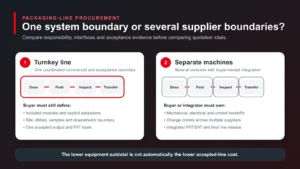
A complete proposal should show the scope boundary around product feeding, buffer management, filling, pouch forming, spout feeding, welding, capping, coding, inspection, reject handling and downstream conveyance. List exclusions. A low base price can become a high project cost when essential tanks, pumps, change parts, guards, documentation or site services appear later.
Ask for a line layout with operator and maintenance access, a utilities schedule, product-contact material list, electrical and controls architecture, spare-parts proposal, manuals, drawings, software backup, training plan and service terms. Confirm whether remote support can access the chosen controls platform and how the buyer controls cybersecurity and authorization.
Serviceability deserves the same attention as speed. Identify wear parts at the spout and sealing stations, delivery times, tooling storage, recommended inspection intervals and diagnostic information available to the operator. If the line will run several shifts, request a critical-spares calculation linked to procurement lead time rather than a generic parts kit.
Compare the complete liquid packaging route
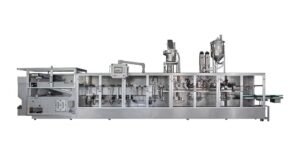
A top-spout doypack is one possible route for sauces and viscous liquids. Use the liquid and sauce packaging machine guide to compare flat sachets, roll-stock doypacks, formed spout pouches and premade-pouch systems by product behavior, pouch supply method, cleaning scope and accepted-output evidence. If a roll-stock doypack has already been selected, continue with the stand-up pouch machine selection guide before fixing the machine platform and FAT boundary.
Procurement FAQ
What sauce data does a top-spout doypack supplier need?
Provide viscosity values with test method and temperature, density, particles, shear and foaming behavior, target fills, product temperature range, flow source and cleaning requirements. Include the hardest SKU, not only the easiest sample.
Can one line pack both ketchup and mayonnaise?
It may be possible when the pump, nozzle, product path, cleaning method and fill range cover both formulations. The supplier should test the agreed extremes and demonstrate changeover and sanitation steps before confirming performance.
What causes sauce contamination in the seal area?
Common process causes include nozzle drip or tailing, splash, incomplete pouch opening, poor pouch position, excessive fill level and uncontrolled recovery after a stop. The FAT should classify the cause of every contaminated seal.
Can a top-spout filling system connect to CIP?
A connection alone is not proof of effective CIP. Review the complete circuit, cleaning flow and temperature, drainability, material compatibility, inspection points, retained product risk and the boundary between machine and plant systems. The buyer must validate its sanitation process.
How should a factory confirm pouch speed?
Specify accepted good pouches per minute over an agreed duration using representative sauce, production film, spouts and caps. Include fill tolerance, leak or seal tests, cap torque, reject limits and challenge conditions.
How much sauce and film are needed for FAT?
The amount depends on target rate, stabilization, run duration, number of SKUs, changeovers and repeated tests. Ask the supplier for a written material calculation covering setup waste, retained samples and contingency before shipping test materials.
Sources and evidence boundaries
- INMAYPACK engineering source: reviewed HMS320-2 duplex top-spout doypack project proposal for a mayonnaise and ketchup application. Project figures are identified as examples and remain subject to product, packaging material and final testing.
- U.S. eCFR, 21 CFR 117.40: Equipment and utensils.
- U.S. eCFR, 21 CFR 117.35: Sanitary operations.
- EUR-Lex, Regulation (EC) No 852/2004 on the hygiene of foodstuffs.
Test your sauce, pouch and spout before the PO
Send the product matrix, pouch and spout drawings, fill range, target accepted output and cleaning requirements. INMAYPACK will review the URS and define a sample-and-film test plan for the proposed formed spout pouch filling solution.
sales@ewpackmachinery.com · WhatsApp: +86 18658799162