
A useful coffee capsule machine comparison starts with the controlled capsule, lid and coffee—not with a model number or unloaded cycle rate. This guide explains how to compare the CF30, CF80, CF140 and CF240 reference routes, then turn the preferred route into a quotation and factory-acceptance requirement.
Choose the package route before choosing the machine
“Coffee capsule” is not one machine format. A K-Cup-style cup, a Nespresso-compatible capsule, a larger bottle-lid capsule and a custom molded cup can differ in rim geometry, stiffness, nesting, orientation, lid pickup and sealing behavior. Those differences affect the feeder, mold, filler, lid station, sealing head and reject logic.
Begin with a controlled drawing and representative samples from the intended capsule and lid suppliers. Add the real ground coffee, target dose range, permitted variation and target accepted output. Only then compare a compact rotary route, a format-specific rotary route, a double-head route or a multi-lane route.
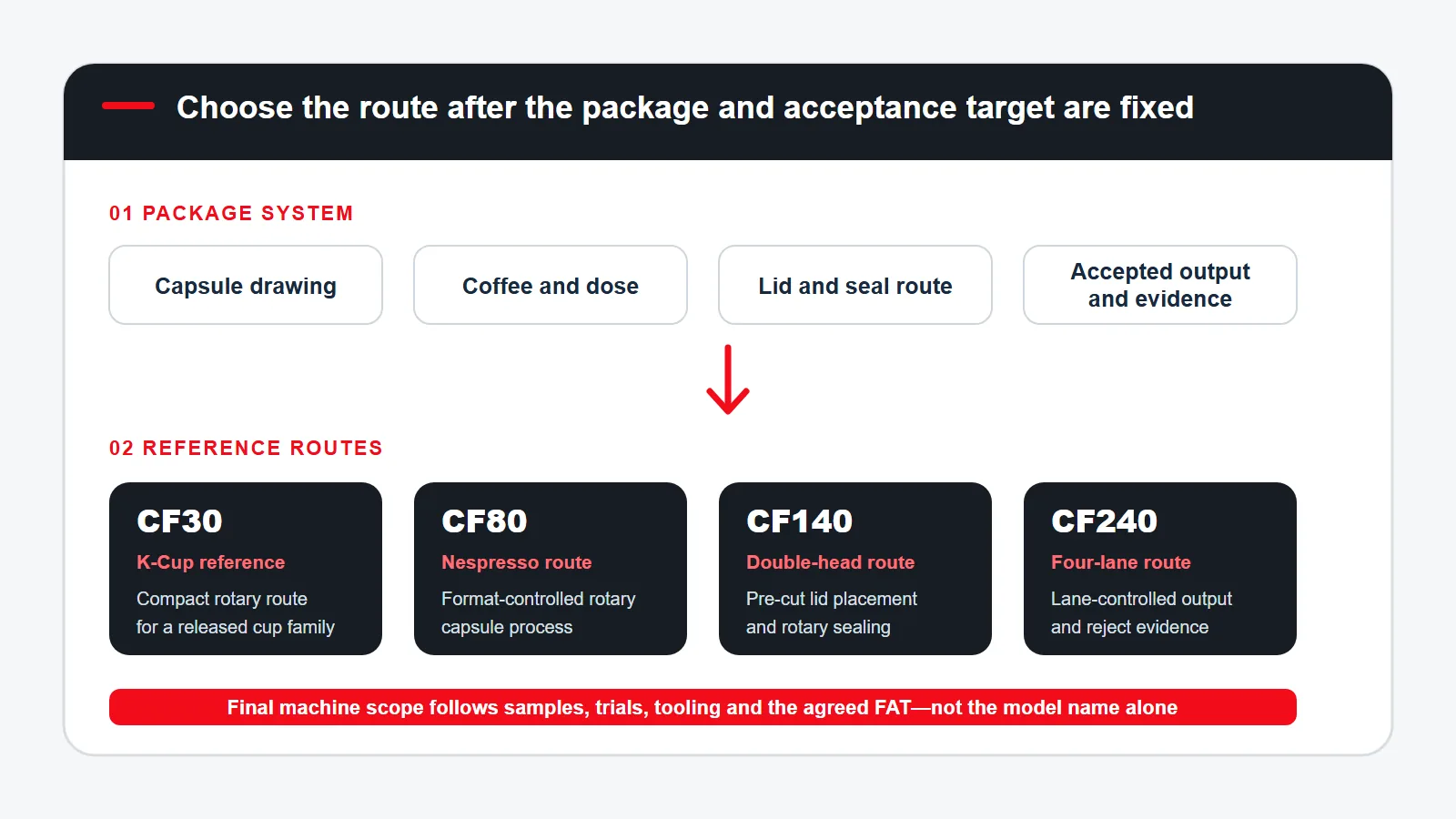
What the four INMAYPACK references are intended to compare
Compact K-Cup filling and sealing route
The CF30 K-Cup machine is the compact rotary reference. Use it when the project begins with one released cup family and the buyer needs a clearly defined small-line process. Confirm cup feeding, coffee dosing, lid placement, nitrogen boundary and accepted output with production materials.
Nespresso-compatible rotary route
The CF80 capsule machine is a format-controlled rotary reference for Nespresso-compatible projects. “Compatible” does not replace a drawing. The capsule supplier, rim condition, lid construction and seal test remain controlled project inputs.
Double-head pre-cut-lid route
The CF140 coffee capsule machine is the documented double-head rotary reference for pre-cut lids. Its source record states a 90-capsule/min reference, a 37–68 mm capsule outer-diameter range, 28–50 mm height range and 37–54 mm pre-cut-lid range. Final suitability still depends on samples, tooling and the agreed FAT.
Four-lane capsule process
The CF240 capsule machine is the four-lane reference for a controlled capsule family. It is appropriate to review when accepted-output demand justifies multiple parallel paths and the buyer can maintain lane identity for dose, lid, seal, reject and stoppage evidence.
Compare machine routes against the same requirement set
| Decision | CF30 | CF80 | CF140 | CF240 |
|---|---|---|---|---|
| Primary reference | Compact K-Cup rotary project | Nespresso-compatible rotary project | Double-head pre-cut-lid project | Four-lane capsule project |
| Use when | One controlled cup family and compact process scope are the starting point | A released compatible capsule family defines feeding, tooling and sealing | Pre-cut-lid handling and double-head rotary output fit the requirement | Required accepted output justifies lane-controlled architecture |
| Critical proof | Cup release, feeding, dose and lid seal | Capsule orientation, mold fit, dose and seal window | Lid pickup, placement, double-head balance and accepted output | Lane balance, lane-wise dose, seal, rejection and restart behavior |
| Do not assume | Every K-Cup supplier runs identically | “Compatible” capsules share one drawing | Dimensional fit alone proves product suitability | Four lanes automatically deliver four times the accepted output |
| Quotation boundary | State mold sets, filler, feeder, lid system, nitrogen, dust control, coding, inspection, outfeed, FAT materials, documentation and service scope. | |||
This table compares project routes, not guaranteed universal performance. A supplier quotation should state the exact model, configuration, capsule and lid samples, coffee condition and acceptance method used for the proposal.
Give every supplier the same technical brief
Capsule drawing and samples
Identify the capsule material, dimensions, rim, stack or nest condition, supplier and sample lot. Record whether multiple formats or suppliers must run on the same machine.
Coffee condition and dose
State grind distribution, bulk density, aeration, oil behavior, target dose, permitted variation, measurement method and refill condition.
Lid and sealing system
Define pre-cut or roll-stock lids, construction, diameter, pickup surface, print orientation and required seal evidence. Do not approve sealing from appearance alone.
Accepted output and run basis
Define good capsules per minute after rejects, run duration, replenishment events, allowed adjustments, reject criteria and downstream limits.

Measure conforming capsules, not empty machine cycles
A useful output test includes normal material replenishment, planned inspections and the disturbances expected in production. Count a capsule only when dose, lid placement, seal, code and appearance meet the agreed criteria. Record rejects and nonconforming packs by cause.
Fix the approved materials
Use the released coffee lot, capsule lot and lid lot, or document why a substitute is representative.
Run the confirmed configuration
Record mold, filler, recipe, sealing settings, nitrogen condition, inspection devices and downstream boundary.
Include normal operating events
Observe refill, lid replenishment, planned stops, restart, recipe recall and first-off release instead of testing only a short steady period.
Preserve lane or station identity
For multiple heads or lanes, retain dose, seal, reject and stop evidence by the source station so a weak path is not hidden in an average.
Calculate accepted output
Report conforming finished capsules after rejects and nonconforming units, with the run duration and sampling plan attached.
Decide whether one machine must serve one capsule or several
A second capsule format may require more than another mold. It can change the magazine or feeder, transfer geometry, filling position, lid pickup hardware, sealing head, recipe, reject verification and guarding. List every intended SKU and identify which parts and settings change.
Ask the supplier to show the changeover sequence, tools, access, part identification, recipe control and first-off inspection. If frequent format changes are planned, compare the total operating burden with the cost and risk of a dedicated format line.
Optimize around one controlled package
A dedicated capsule family can simplify feeding, tooling release, recipe control, spares and acceptance evidence.
Price the complete conversion scope
Request an itemized list of change parts, additional lid hardware, software recipes, validation samples, training and expected changeover procedure.
Compare the complete configured project
The lowest machine line item is not necessarily the lowest usable project cost. Compare the supplied filler, capsule and lid handling, nitrogen boundary, dust control, coding, inspection, outfeed, molds, FAT materials, documents, spares, delivery basis and site work. The coffee capsule machine price guide explains how to normalize these quotation layers without inventing a universal price.
Commercial terms should identify exclusions as clearly as inclusions. Record the named delivery basis and place, packing, installation responsibilities, utilities, training, warranty, remote support, on-site service and acceptance milestone in the signed quotation and contract.
Coffee capsule filling machine selection FAQ
Which coffee capsule filling machine should I choose?
Choose after fixing the capsule drawing, lid route, coffee and dose, accepted output, changeover scope and FAT method. CF30, CF80, CF140 and CF240 are reference routes for different project conditions, not interchangeable speed grades.
Can one machine run K-Cup and Nespresso-compatible capsules?
Do not assume it can. The formats can require different feeding, molds, filling positions, lid systems and sealing hardware. Ask for a written change-part and validation scope based on controlled samples.
Is the highest-speed model always the best choice?
No. A larger lane count can add tooling, lane-balance, inspection, cleaning and maintenance requirements. Select against accepted output, SKU pattern, labor, changeover and downstream capacity.
What samples should be sent before quotation?
Send representative coffee, controlled capsule and lid drawings, physical samples from the intended suppliers, target dose and tolerance, all planned SKUs and the required inspection and acceptance criteria.
What should a coffee capsule machine FAT prove?
It should prove feeding, filling, lid placement, sealing, gas control when required, reject logic, accepted output, replenishment, stops, restart and retained evidence using the approved configuration and materials.
Sources used for the selection framework
Official reference for machinery risk-assessment and risk-reduction principles.
Official reference for electrical, electronic and programmable electronic equipment of machines.
Seal-strength reference; the project must define the applicable capsule-lid sample and acceptance limits.
Current site map for capsule, pouch, stick, drip-bag and cartoning routes.
Continue with the guide that matches the project stage
Send the capsule, lid, coffee and accepted-output target together
INMAYPACK will review the package route, filling method, lane architecture, tooling boundary and FAT basis before recommending a reference configuration.







