A turnkey packaging line is usually the stronger procurement model when the buyer needs one coordinated responsibility boundary for dosing, packing, inspection, transfer, controls and acceptance. Separately purchased machines can be the better choice when the buyer has an experienced integration team, established controls standards, existing modules to retain or a justified best-of-breed requirement.
The useful comparison is not one quotation versus several equipment prices. Compare who owns every interface, how changes are controlled, what the integrated FAT and SAT must prove, and who remains responsible when individually functional machines do not produce an accepted line result.
Define turnkey and separate-machine scope before asking which is better
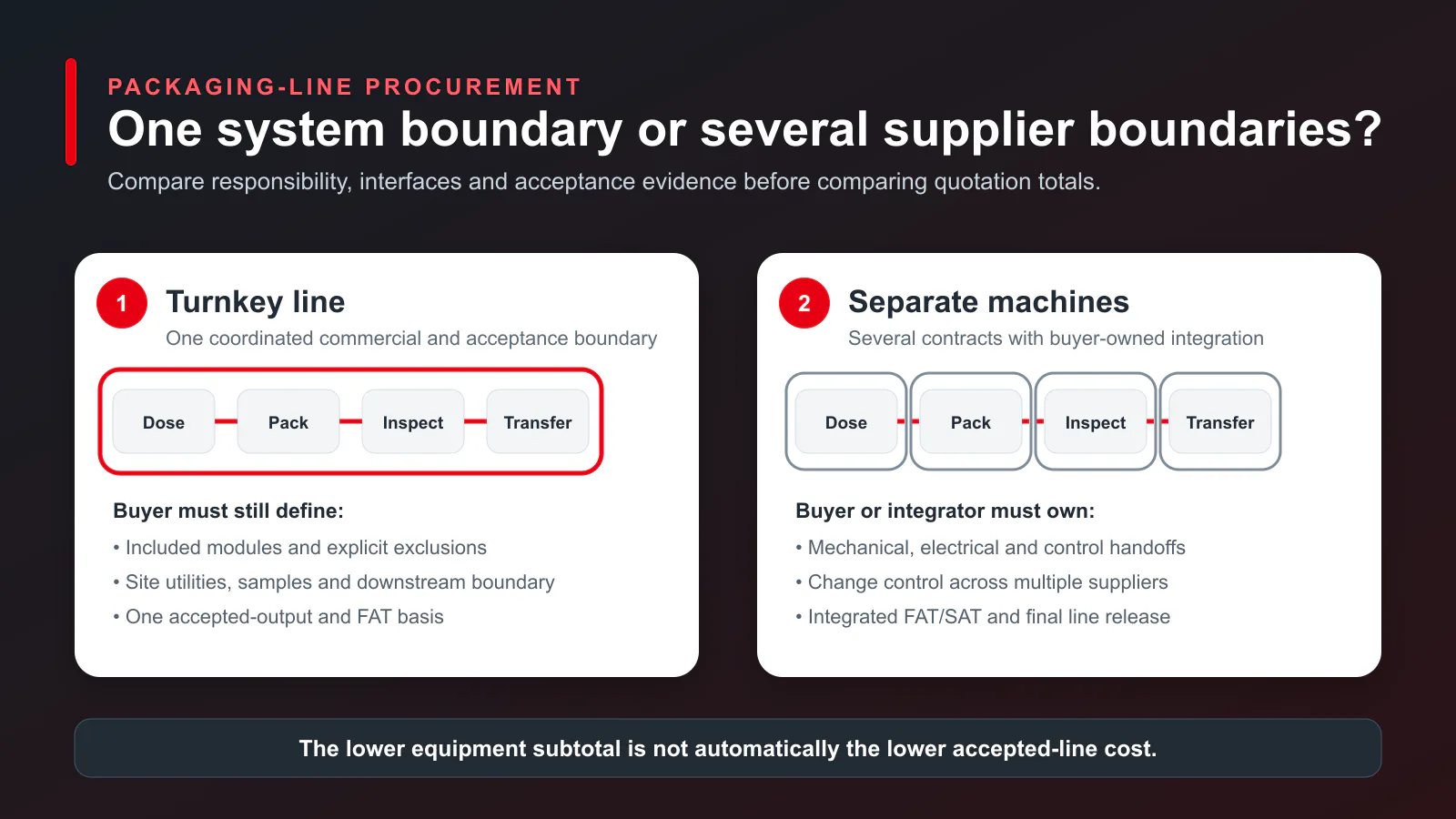
A turnkey line does not mean that one factory necessarily manufactures every device. It means one contracted party coordinates the issued line boundary and accepts defined responsibility for the combined result. That boundary may include product feeding, dosing, primary packaging, coding, inspection, rejection, conveying, secondary packaging, line controls, guarding, documentation, FAT, installation support and SAT.
A separate-machine project uses individual contracts for selected modules. The buyer, its appointed system integrator or another nominated party must then own the connections between those contracts. Buying a filler, pouch machine, checkweigher and cartoner separately does not automatically create an integrated production line.
One coordinated system boundary
The lead supplier manages included equipment, specified interfaces, combined controls behavior, documentation and the agreed acceptance basis. The buyer must still issue the product, package, output and compliance requirements.
Several supplier boundaries
Each vendor owns its contracted module. The buyer or integrator owns layout, transfers, data exchange, safety coordination, sequence control, change management and integrated line acceptance unless the contracts say otherwise.
Compare the two models by responsibility, not machine count
| Decision point | Turnkey packaging line | Separately purchased machines |
|---|---|---|
| Contract boundary | One lead contract coordinates the defined line result. | Multiple contracts end at individual machine boundaries. |
| Layout and handoffs | Lead supplier coordinates the issued arrangement and interfaces. | Buyer or integrator must reconcile heights, speeds, buffers, access and utilities. |
| Controls | Line states, interlocks, recipes and data interfaces are coordinated within scope. | Each machine may have a working PLC while the combined sequence remains undefined. |
| Change control | One lead party assesses effects across the issued system. | A change to one module may require several suppliers to revise drawings, software and timing. |
| FAT and SAT | Can be written around the accepted result of the complete available line. | Individual FATs need a separate integrated test plan and final release owner. |
| Schedule | Coordination is concentrated, but the line may depend on the lead supplier's management capacity. | Parallel purchasing can be flexible, but late interface discovery can consume the apparent time saving. |
| Cost visibility | More integration cost appears in the contracted line price. | Equipment subtotals may look lower while engineering, rework, travel, delay and acceptance work sit elsewhere. |
| Lifecycle support | One lead route can simplify line-level troubleshooting when support obligations are explicit. | Module specialists remain available, but the buyer must identify which supplier owns a cross-machine fault. |
Normalize engineering, controls integration, conveyors, guarding, utilities, documentation, FAT, installation, commissioning, trial materials, travel, training, spares, rework and schedule exposure before comparing the procurement models.
Choose a turnkey line when interface risk is the dominant project risk
A turnkey route is most valuable when the success criterion belongs to the complete system rather than one machine. This commonly applies when the product passes through several dependent processes, the buyer has limited internal automation resources, the production date is fixed, or no existing plant standard can absorb the integration work.
Output depends on the full line
Conforming packs per minute require the filler, packaging machine, inspection, rejection and downstream equipment to run under the same product and package conditions.
The buyer cannot be the hidden integrator
A coordinated supplier boundary reduces the number of technical and commercial handoffs the buyer must design, schedule and arbitrate.
Uncertainty crosses machine boundaries
Product behavior, package handling, code location, inspection and accumulation may require trials and changes that affect several modules at once.
Review INMAYPACK's turnkey packaging solutions when you need a commercial line boundary. Use the packaging system integration checklist when the next task is to specify interfaces, controls and acceptance records.
Use separate contracts when the buyer can deliberately own integration
Separate purchasing is not an inferior method. It can protect an installed equipment standard, preserve a proven process module or allow the buyer to choose a specialist for a critical operation. The advantage is real only when a named party has time, authority and technical information to integrate the result.
Retain standards and reusable assets
The site may already have approved conveyors, checkweighers, printers, controls architecture, safety devices and support capability. A new packaging module can be integrated into that established environment.
Make ownership explicit
The buyer has mechanical, electrical, controls, safety and project-management resources that can issue interface requirements and make binding decisions across suppliers.
Protect the critical technology
A proprietary filler, inspection method, closure system or downstream operation may justify direct selection and a dedicated supplier relationship.
Plan future integration now
Machines may be purchased in stages when the initial project defines future elevations, speeds, signals, utilities, floor space, guarding and test responsibilities rather than postponing them.
Issue one scope sheet to every candidate supplier
A price comparison is useful only when each quotation covers the same product condition, package definition, output basis, line boundary and evidence. The scope sheet should identify what enters the line, what accepted product leaves it and which functions are included between those points.
The packaging machine RFQ builder provides a structured way to collect these inputs before suppliers configure a proposal.
Assign every mechanical, electrical and information handoff
Most integration failures occur at a boundary that everybody discussed but nobody contracted. Build an interface matrix that names the supplying party, receiving party, design owner, approval owner, required document and acceptance test for every handoff.
| Interface | Questions that need an owner | Evidence before release |
|---|---|---|
| Product transfer | Who controls level, pressure, refill request, starvation, overflow, cutoff and cleaning access? | Process diagram, range data, trial result and alarm response. |
| Pack transfer | Who owns elevation, orientation, speed, spacing, support, accumulation, reject recovery and blocked discharge? | Issued layout, product-flow review and representative transfer test. |
| Controls and data | Which line states, permissives, faults, recipe identities, counters and production data cross the boundary? | Signal list, state model, network document, cause-and-effect test and backups. |
| Safety | Who evaluates combined hazards, emergency-stop zones, guard interfaces, reset logic and residual risk? | Integrated risk assessment, safety-function records and validation evidence. |
| Utilities | Who supplies, isolates and verifies power, air, vacuum, extraction, nitrogen, water, drainage and communications? | Load schedule, connection drawing, site check and measured values. |
| Documentation | Who compiles the final line manuals, drawings, certificates, settings, software, parts and training records? | Approved document register with revision and delivery status. |
Test the integrated production result, not a collection of demonstrations
An individual machine FAT can establish that the machine performs its contracted function under a defined test condition. It cannot prove line performance if the actual product feed, transfers, inspection, rejection, downstream equipment or line controls are absent. The procurement model must therefore state how separate evidence will be combined into a final release decision.
Freeze representative inputs
Record product and packaging materials, priority formats, recipes, included modules, utilities, inspection criteria, run duration, planned interventions and acceptance limits.
Count conforming finished packs
Separate gross cycles from accepted packs. Record rejects by cause, stops, refills, material changes, adjustments, recovery and any excluded time.
Verify the installed boundary
Confirm site utilities, safety, upstream and downstream behavior, network connections, product supply, environmental conditions and production support.
Close evidence, not promises
Every deviation should name the requirement, owner, action, due date, retest method and release authority. Commercial closure should follow the agreed evidence path.
PMMI's OpX Leadership Network describes FAT as a structured process for checking equipment against user requirements before shipment. The line contract still needs its own application-specific product, package, performance and acceptance criteria.
Include the cost of ownership transfer and production release
Capital price is only one part of the decision. A fair comparison includes the work required to convert purchased equipment into a released production asset. Some costs are visible in a turnkey quotation; others remain in internal labor, third-party contracts, trial material, schedule contingency or post-delivery troubleshooting.
Engineering and coordination
Layout reviews, interface documents, samples, trials, software standards, risk work, change control, supplier meetings and document approval.
Integration and acceptance
Combined testing, travel, site work, utilities, installation, debugging, training, trial production, deviation closure and production qualification.
Support and changeovers
Spares, response routes, software ownership, remote access, retained settings, new-SKU work, preventive maintenance and cross-supplier troubleshooting.
If the line is not meeting its intended output, use the pouch packing line bottleneck analysis to separate starvation, blocking, process loss and reject loss. Use the packaging machine maintenance guide to define lifecycle records and preventive work.
Make the procurement choice in six controlled steps
Define the accepted finished result
Fix the priority products, packages, output, tolerances, inspection, reject logic, run duration and evidence before selecting a supplier structure.
Draw the full process boundary
Show what enters, every required operation, what leaves, site connections and the interfaces with existing equipment.
Assess owner integration capacity
Name the available mechanical, controls, safety, quality and project resources. Do not assume normal operations staff can absorb an unplanned integrator role.
Identify critical specialist modules
Decide which processes justify direct vendor selection and whether the lead supplier can integrate them without weakening performance or support.
Normalize scope, cost and evidence
Compare issued inclusions, exclusions, interfaces, project work, FAT, SAT, documents, spares and lifecycle support rather than headline equipment prices.
Contract one owner for each boundary
Issue a responsibility matrix and require every interface and final line release decision to have a named owner before orders are placed.
Turnkey packaging line FAQ
Is a turnkey packaging line always more expensive?
Its quoted price may include more engineering, coordination, controls, testing and project responsibility. Compare the total work needed to achieve an accepted production line, not only the equipment subtotal. Separate machines may be economical when the buyer already has capable integration resources and reusable standards.
Does turnkey mean one manufacturer builds every machine?
No. A lead supplier may integrate equipment from several manufacturers. The important point is whether one contract clearly coordinates the included modules, interfaces, controls, documentation and acceptance result.
When should a buyer purchase machines separately?
Separate contracts can be appropriate when the buyer has strong system-integration capability, must preserve an installed plant standard, owns existing modules, needs a specialist process supplier or is deliberately executing a phased project with defined future interfaces.
Who is responsible if separate machines do not work together?
Responsibility follows the contracts. If no integrator or buyer team is explicitly assigned the mechanical, controls, safety and acceptance interfaces, a gap can remain between individually compliant supplier scopes. Assign ownership before purchase orders are released.
What should a turnkey line FAT prove?
It should test the available integrated boundary against an agreed protocol using representative product and packaging materials. The result should report conforming finished packs, rejects, stops, interventions and the agreed quality checks over the specified test period.
What information should be sent for a turnkey proposal?
Send product condition and samples, dose range, controlled package drawings and materials, required accepted output, inspection and coding scope, upstream and downstream boundary, utilities, destination requirements, existing standards, layout limits and required FAT and SAT evidence.
Sources used for the responsibility and acceptance framework
Primary industry guidance describing a structured factory-acceptance process against equipment requirements before shipment.
Primary technical reference for common packaging-machine state and information models used when coordinating machine controls.
Official ISO project page for the machinery-safety standard addressing integrated manufacturing systems. Applicable editions and destination requirements must be confirmed for each project.
Official ISO scope reference for packaging-machinery safety requirements. Project compliance remains configuration- and destination-specific.
Use the page that matches the next project question
Define the line boundary before requesting comparable quotations
Send the product, controlled package drawings, target accepted output, required operations, existing equipment, plant standards, utilities, destination and acceptance requirements. INMAYPACK will review whether a coordinated turnkey scope or a defined machine module is the stronger fit for the project.