Systems engineering guide · Packaging lines
Integration succeeds or fails at the handoff.
A fast filler, packer, checkweigher and cartoner do not automatically become a reliable line. The project succeeds when every product, control, safety, quality, utility and data handoff has an owner, a defined response and an acceptance test.
The integration boundary
One line, six connected interface types
The mechanical conveyor connection is only one boundary. A useful integration scope also records what the product must do, what each controller must communicate, how the safety zones behave, how rejected packs are contained, what utilities are available and which production data must be retained.
- Product flow: dose, orientation, transfer, accumulation and discharge.
- Controls: permissives, states, speed references, faults and recipe ownership.
- Safety: zones, guarded access, emergency-stop behavior and controlled restart.
- Quality: inspection, rejection, reject confirmation and sample traceability.
- Utilities: electrical supply, compressed air, extraction, network and environmental limits.
- Data: batch identity, counts, alarms, production states and required reporting.
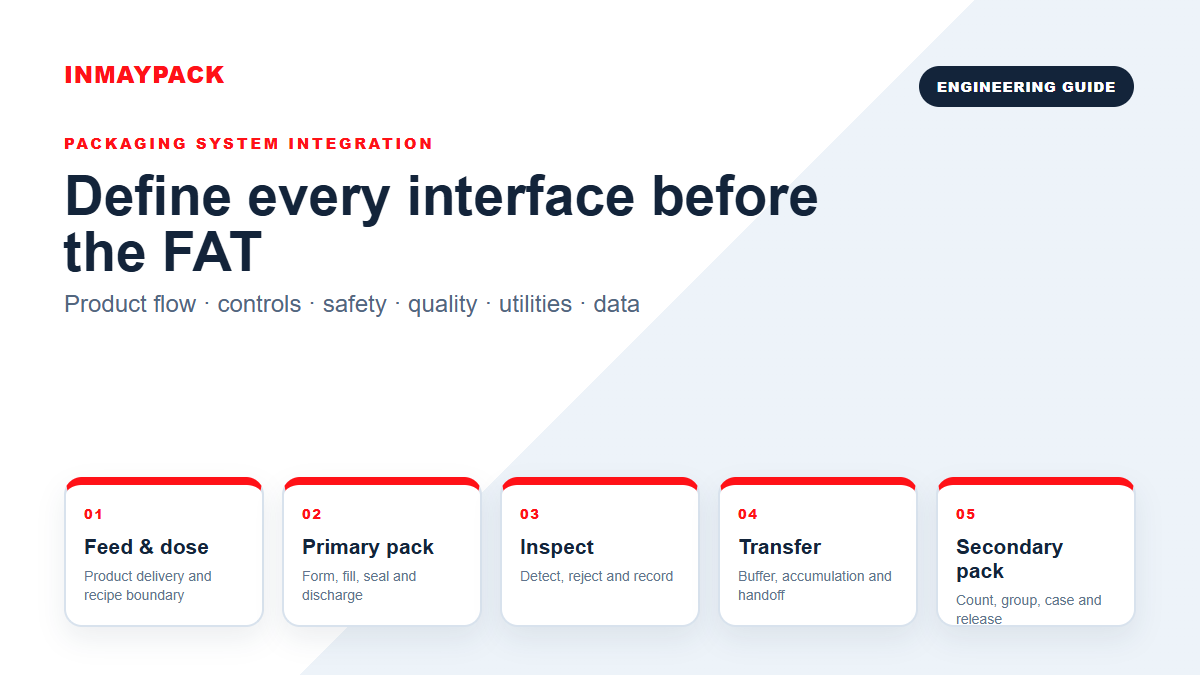
System map
Map the process from material entry to accepted output
Use one process map for the real project configuration. The same packaging machine may need a different interface design when the product, filler, inspection equipment, pack format or downstream handling changes.
Interface register
Record what crosses every machine boundary
An interface register prevents scope gaps from hiding inside separate quotations. Each row should identify the supplier responsible for the signal or physical handoff, the expected response, the failure behavior and the evidence that closes the item.
| Boundary | Questions to record | Evidence to request |
|---|---|---|
| Product handoff | What enters and leaves? At what orientation, spacing and allowable condition? | Controlled sample, transfer drawing and a run using the agreed product and pack. |
| Start / stop | Which machine leads? What happens when upstream starves or downstream blocks? | Cause-and-effect matrix plus observed state transitions during the FAT. |
| Speed coordination | Is speed fixed, recipe-based or remotely referenced? Where is the operating limit set? | Recorded setpoints and a sustained run at the agreed production basis. |
| Reject handling | Who generates the reject, where is it removed and how is removal confirmed? | Seeded-fault challenge with reject count and containment record. |
| Safety behavior | Which zones stop together? What remains energized? What authorizes restart? | Approved risk controls and witnessed stop, access and restart tests. |
| Data exchange | Which states, counts, alarms, batch values and timestamps are required? | Tag list, ownership matrix and verified data at the agreed receiving system. |
Decision sequence
Build the system boundary backward from accepted output
Define an accepted unit
Describe the finished pack, code, weight or fill condition, inspection status and secondary-pack condition that counts as acceptable output.
Confirm the production basis
Record the actual product, dose range, package format, film or premade pouch, inspection scope, shift assumptions and downstream destination.
Assign every interface
Name the responsible supplier for mechanical, electrical, control, safety, utility and data boundaries. An unassigned boundary is a future change order.
Turn requirements into tests
Write a pass condition, evidence method and owner for normal production, starvation, blocking, reject, fault, recovery and changeover conditions.
FAT evidence
Test the line as a sequence, not as isolated machines
Individual machine demonstrations remain useful, but they do not prove that the complete line can coordinate production and recover safely. The integration FAT should exercise the interfaces that can stop output or release an unacceptable pack.
Normal sequence
Start, ramp, steady production, controlled stop and planned restart using the agreed recipe.
Starved upstream
Confirm the downstream response to low product, missing packs or an unavailable dosing request.
Blocked downstream
Demonstrate accumulation, coordinated stop and restart without creating uncontrolled product or pack loss.
Inspection and reject
Introduce agreed test faults and verify detection, rejection, confirmation, counting and containment.
Fault and recovery
Record alarms, machine states, operator actions, reset conditions and the first-pack release check.
Format change
Verify recipe ownership, part changes, cleaning boundaries and accepted output after the change.
Use the separate packaging machine FAT checklist for a primary-machine test structure, and the packaging line bottleneck guide when a connected line cannot sustain its planned output. For a liquid drink application, apply these interface checks to the complete beverage pouch packaging line, including product supply, filling, package handling, closing, inspection and downstream responsibility.
The most expensive interface is usually the one nobody owned
A supplier may prove that its own machine runs correctly while the complete line still fails at the handoff. I would not close a packaging-line scope with separate equipment lists alone. The commercial package should include one interface register, one accepted-output definition and one integration test matrix that names an owner for every boundary.
Controls architecture
Use PackML or OPC UA only where the project needs them
Standardized machine states and data models can reduce ambiguity when equipment from different suppliers must communicate with supervisory systems. OMAC describes PackML as a way to encourage consistent machine behavior and a common operating approach, while the OPC Foundation publishes an OPC UA companion specification for PackML data representation. These are useful references—not automatic substitutes for the project interface register, tag list, risk controls or test plan.
A small standalone line may need only a clear hardwired or industrial-network handshake. A multi-machine system connected to plant reporting may justify a more structured state and data model. The requirement should follow the buyer's control architecture, cybersecurity rules and data-use case.
Project input
What to send for a useful integration review
Product and package
Product characteristics, dose range, package drawings, samples, coding and accepted-quality criteria.
Equipment boundary
Existing and new machines, supplier scope, layouts, elevations, utilities and available line space.
Production basis
Required accepted output, formats, shifts, planned changeovers and downstream handling condition.
Control standard
Plant network, controller preference, signal expectations, data consumers and remote-access rules.
Inspection scope
Required checks, test samples, reject routing, confirmation and production-record expectations.
Acceptance plan
FAT product, duration, pass criteria, evidence format, attendance and site-acceptance boundaries.
Use the supplier-ready packaging machine RFQ tool to organize these inputs into one brief before asking multiple suppliers to review the line.
Related decision paths
Continue with the correct commercial or technical page
Buyer questions
Packaging system integration FAQ
What is a packaging systems integrator responsible for?
Does every automated packaging line need PackML?
What is the difference between a machine FAT and an integration FAT?
When should the integration scope be frozen?
Technical references
Primary standards and interoperability references
- OMAC, PackML overview and implementation resources.
- OPC Foundation, OPC UA for PackML profiles.
- IEC, IEC 60204-1:2016+AMD1:2021 — electrical equipment of machines.
The applicable safety, electrical, food, cybersecurity and documentation requirements depend on the delivered system and destination market. Confirm them with the responsible project specialists.
Turn the equipment list into one testable line scope
Send the product, package, equipment boundary, accepted-output requirement and available layout. INMAYPACK will review the integration path and identify the interfaces that must be closed before quotation and FAT planning.