A VFFS film specification must connect the finished bag, printed web, roll build and real machine trial. A laminate name and nominal thickness alone do not tell a converter which side faces the product, where the registration mark belongs, how the web should unwind or whether the film can form, track, seal and cut on the intended vertical form fill seal machine.
Start with the approved bag drawing and production product. Then define measurable film and rollstock fields with their test methods. Close the loop with representative rolls, normal replenishment and accepted finished bags—not empty cycles or a laboratory seal result by itself.
Start with the finished bag and the actual VFFS web path
Vertical form fill seal equipment draws rollstock over a forming shoulder and around a forming tube. The overlapping web edges create a longitudinal back seal, while the cross-seal jaws close the top of one bag and the bottom of the next. That path makes the finished bag drawing the first control document.
State the nominal bag width, cut length or print repeat, longitudinal-seal type, longitudinal-seal allowance, cross-seal areas, cut position, registration target, tear feature, gusset and any hole or carrying feature. Mark the machine direction, print side, sealant side and product-contact side. A flat artwork file without these relationships is not a machine-ready web specification.
Bag geometry, forming tube, fin or lap seal, web tracking and actual tooling affect the issued value. The machine supplier, bag drawing and converter proof must agree before production film is ordered.
| Finished-bag field | Why the converter needs it | How to close the requirement |
|---|---|---|
| Bag width and length | Establishes the forming-tube family, web layout and cut repeat. | Issue a dimensioned bag drawing with tolerances and priority SKUs. |
| Fin or lap back seal | Changes the overlap, sealant-to-sealant relationship and forming path. | Confirm the machine tooling and show seal orientation on the drawing. |
| Cross-seal zone | Controls seal contact, cut position, headspace and print exclusion. | Show usable seal width, graphics clearance, notch and permitted product-in-seal condition. |
| Print repeat and eye mark | Connects graphics to bag length, registration correction and cutting. | State repeat, mark size, contrast, lane and sensor-facing surface. |
| Gusset or special feature | Changes web folding, bag opening, product space and downstream handling. | Approve the tooling route and retain formed samples before the full print run. |
If the package uses a longitudinal seam, review the fin seal vs lap seal packaging guide before fixing the web overlap.
Describe film properties together with the method and sample condition
“PET/PE” or another layer shorthand can describe a broad material family, but it does not control the complete structure. Layer thickness, adhesive or tie layer, barrier, ink system, sealant grade, treatment, ageing and storage can change stiffness, curl, friction, registration and the seal window.
The specification should identify the layer sequence from outside to product side, nominal total thickness, permitted variation, barrier requirement where applicable, sealant identity, print and lamination system, food-contact or product-contact declarations required by the buyer, and the test method for every controlled property.
Do not mix total thickness with individual-layer targets
State whether the requirement applies to total construction, named layers or both. Record the measurement method, conditioning and sampling plan so supplier and buyer results are comparable.
Separate inside and outside surfaces
Static and kinetic coefficient of friction depend on the surfaces, test method, temperature, age and conditioning. ASTM D1894-24 notes that slip-additive migration and film age can affect results. Name the surface pair and method instead of copying one unexplained COF number.
Use laboratory seals as a starting relationship
ASTM F2029-16(2021) covers laboratory heat-seal preparation and heat-sealability analysis, but it does not validate production equipment. Machine sealing still depends on contact, temperature, pressure, dwell, cooling, speed and contamination.
Fix the specimen and test technique
ASTM F88/F88M-23 measures seal strength and identifies failure mode. The sampling location, conditioning, strip preparation, technique and acceptance rule must remain consistent across qualification and production checks.
The roll must arrive ready for the intended unwind and registration system
Converters need the web width, print repeat, number of designs, machine direction and winding diagram before cylinders, plates or digital production are released. Specify whether print is surface or reverse, the eye-mark geometry and contrast, distance from the web edge, graphics exclusion around seals and cut, acceptable register variation and how artwork revisions are controlled.
The roll specification should also state core inside diameter, core width, maximum outside diameter, maximum roll mass, winding direction, treated or sealant side orientation, splice construction and marking, maximum permitted splices, roll-edge condition and limits for telescoping, blocking, wrinkles or damaged edges. These are handling and machine-interface fields, not cosmetic extras.
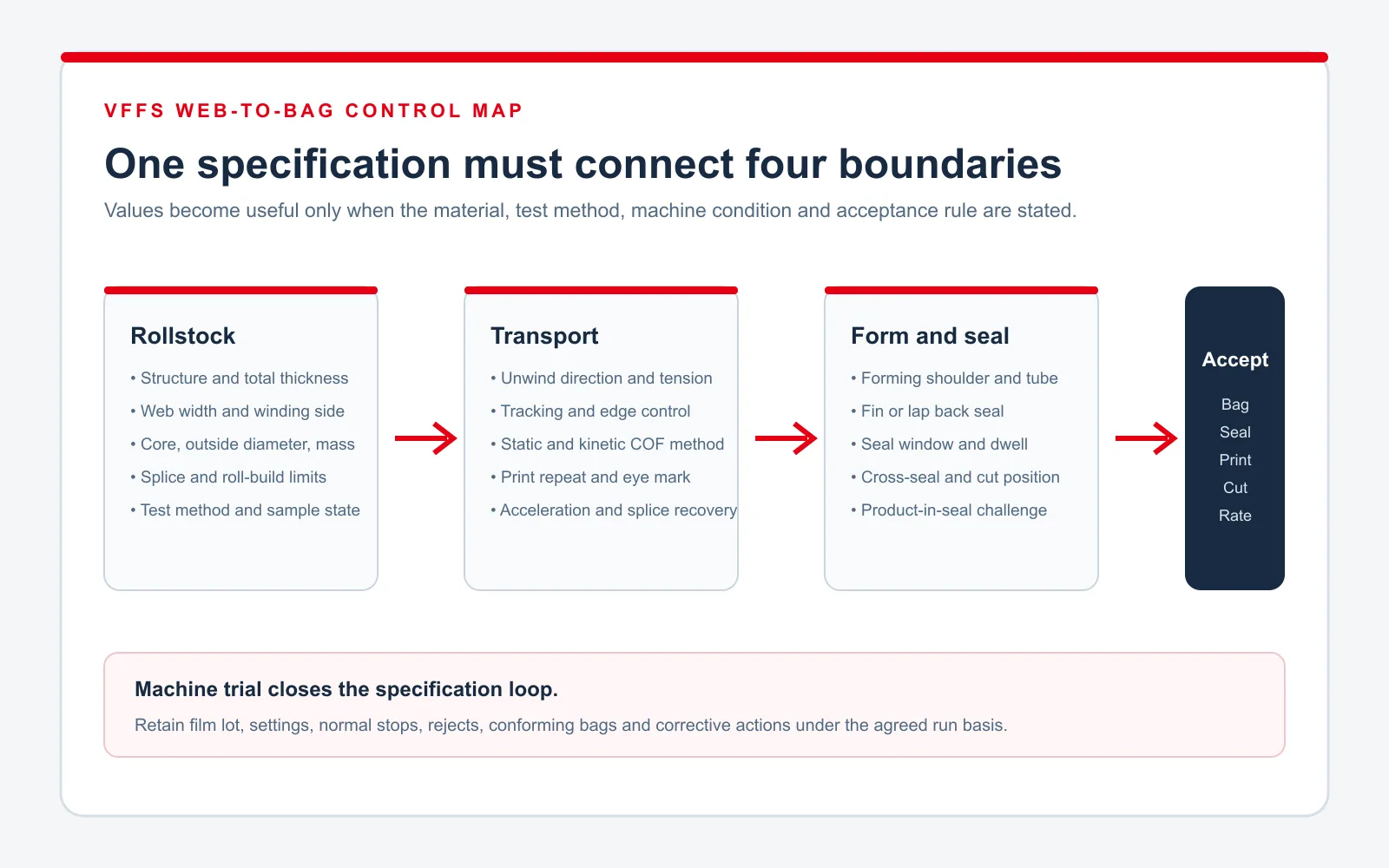
VFFS machinability is a system result, not a laminate label
The web must unwind, stay controlled through tension changes, track to the registration sensor, pass the forming shoulder without uncontrolled drag or curl, close around the forming tube, create the longitudinal seal, accept the product dose, form the cross seal and cut at the intended position. A film can pass one laboratory property test and still be unsuitable for that combined sequence.
| Machine zone | Film-related risk | Evidence to retain |
|---|---|---|
| Unwind and tension | Telescoping, blocking, inconsistent tension, roll inertia or damaged edges disturb web control. | Roll identity, loading orientation, tension settings, tracking behavior and splice recovery. |
| Registration and pull | Weak eye-mark contrast, variable repeat, surface slip or stretch shifts print and cut. | Sensor setup, mark drawing, registration trend, cut samples and normal acceleration events. |
| Forming shoulder and tube | Excess drag, stiffness, curl or wrong sealant orientation creates wrinkles and unstable tracking. | Tooling identity, web path, contact observations, formed tube and bag samples. |
| Back seal | Fin or lap mismatch, contamination or narrow operating window weakens the longitudinal seam. | Seal type, settings, sample location, strength or integrity method and failure mode. |
| Cross seal and cut | Product dust, particles, liquid splash, film thickness and motion timing affect closure and cutting. | Approved product condition, jaw settings, seal/cut samples, rejects and defect cause. |
Motion architecture also changes the timing problem. Use the continuous vs intermittent VFFS guide to connect web movement, cross sealing and product transfer.
Approve production-intent rolls under a stated machine-trial basis
Use material from the intended converter and production construction, not an unrelated clear test film. Record the film lot, roll number, conditioning, product lot, bag format, forming set, recipe, seal settings, target output, normal refill and the accepted finished-bag criteria. A short steady segment after the operator removes every imperfect bag does not establish the production result.
Approve documents before material is made
Align the finished-bag drawing, artwork, layer structure, property methods, winding diagram, roll limits, inspection plan and revision status.
Inspect incoming rolls
Record identity, width, core, diameter, weight, winding direction, edges, telescoping, splices, surface condition and storage history.
Establish the operating window
Document web control, registration, forming, longitudinal seal, cross seal, cut and product-transfer settings. Retain samples at the chosen conditions.
Run normal production events
Include roll loading, splice or roll change where required, product refill, planned stop, restart, speed change and representative contamination risk.
Count accepted bags
Remove rejected and nonconforming packs from the gross discharge. Report good bags, scrap, stops and corrective actions under the stated run duration.
Freeze the approved reference
Retain the approved film lot, signed specification, machine recipe, formed bags, seal-test record, artwork and deviation closure for future incoming comparison.
The certificate supports incoming control. It cannot demonstrate forming, tracking, sealing, cutting and accepted output on the buyer's configured equipment.
Send one controlled package to the film converter and machine supplier
Define the production task
Finished drawing, priority sizes, product state, dose range, headspace, contamination risk, storage, shelf-life and downstream handling.
Define measurable material fields
Layer sequence, thickness, sealant, barrier, print, treatment, COF surfaces and method, sealability method, compliance documentation and sampling.
Define the machine interface
Web width, repeat, eye mark, winding diagram, core, outside diameter, weight, splice, roll edge, artwork revision and converter samples.
Define proof before purchase release
Machine identity, tooling, recipe, run duration, output basis, seal and appearance checks, rejects, retained samples and deviation closure.
VFFS film specification FAQ
What information should a VFFS film specification include?
At minimum, connect the approved bag drawing, web width and repeat, layer construction, total thickness, sealant and print orientation, eye mark, winding, core, roll limits, splice rules, controlled test methods and machine-trial acceptance. The exact fields depend on the product, bag and configured machine.
Can a VFFS film supplier calculate the web width?
The converter can help create the web layout, but the value should be confirmed against the issued bag drawing, forming set, longitudinal-seal type and machine web path before the order is released.
What coefficient of friction is best for VFFS film?
There is no universal best value. State the inside/outside surface pair, test method, conditioning and machine need. Confirm the approved range with representative material on the configured equipment.
Is a laboratory heat-seal curve enough to approve production film?
No. It helps characterize the material and establish starting relationships. Production approval still requires the actual machine, web path, settings, speed, product condition, contamination risk and accepted-pack criteria.
Should the same film specification be used for intermittent and continuous VFFS?
Not automatically. Motion, acceleration, sealing time and web handling differ. The approved film and operating window must be demonstrated on the intended architecture and bag range.
What samples should be retained after a VFFS trial?
Retain identified rollstock, finished bags from normal running and restart conditions, seal or integrity test samples, print/cut references, machine recipe, trial results, rejects and closed deviations.
Sources used for the film-specification framework
Official ASTM reference for static and kinetic friction measurement, including method, surface, age and conditioning considerations.
Official ASTM practice for laboratory heat-seal preparation and heat-sealability analysis; it does not replace production-equipment validation.
Official ASTM method for measuring seal strength and reporting failure behavior under a controlled test technique.
Manufacturer reference connecting forming tube setup, fin or lap seal choice, film transport and bag-making sequence.
Continue from film definition to machine acceptance
Send the film, bag and production condition together
Provide the product, dose range, finished-bag drawing, film structure, artwork and winding diagram, roll limits, target accepted output, machine or proposed configuration and trial requirements. INMAYPACK will review the documented VFFS route before confirming an available machine scope.