Fin Seal vs Lap Seal Packaging: Film and Machine Selection
Updated: September 30, 2026
About INMAYPACK Engineering Team
INMAYPACK is a packaging machinery brand based in Shanghai, China, founded in 2009. The INMAYPACK Engineering Team publishes practical guidance on doypack, sachet, premade-pouch and coffee packaging. Machine suitability, performance and service terms depend on the confirmed model, configuration, product, package and agreed project scope.
Quick answer
A fin seal joins the two inside sealant surfaces of the web and leaves a projecting seam. A lap seal overlaps one web edge over the other and produces a flatter seam, but it requires the inside layer to seal reliably to the opposite outer surface. The right choice depends on the film construction, pack drawing, available forming and sealing hardware, product contamination risk and the acceptance method used during the production trial.
Do not release a roll width or forming set from appearance alone. State the seam type and allowance on the controlled package drawing, obtain the converter's film structure, and validate the finished package at the intended operating condition.
Seam geometry
What each longitudinal seam actually joins
Roll-stock packaging machines create a tube before completing the transverse or end seals. The lengthwise joint in that tube is commonly called a longitudinal seam, back seal, fin seal or lap seal. Those labels should be used carefully because the visible profile and the contacting film surfaces affect the material specification and machine setup.
Fin seal
Inside surface to inside surface
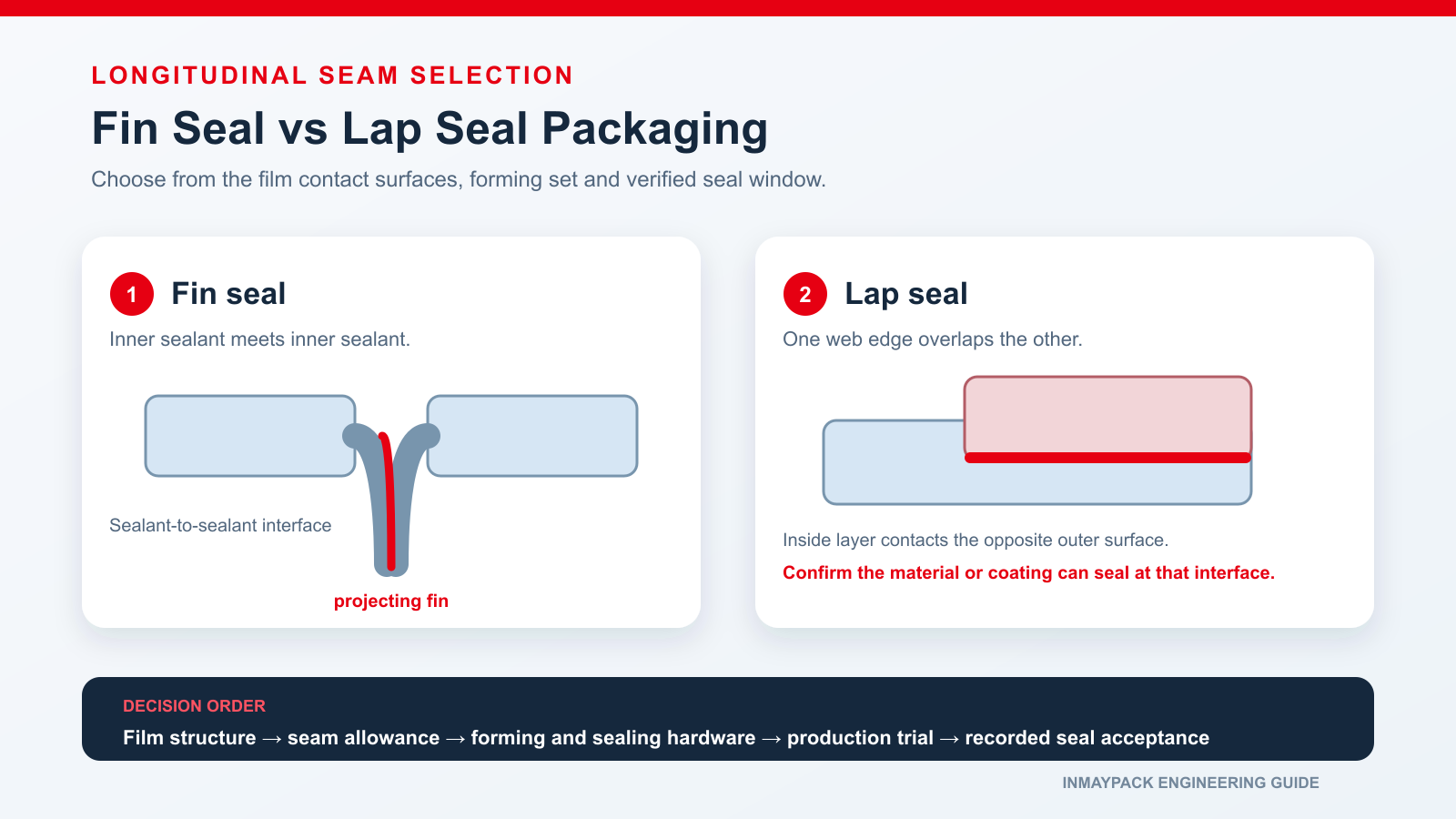
The two web edges turn toward each other so their sealant layers meet. The joined material projects from the package like a fin and may then be guided or folded against the pack, depending on the machine and finished-package requirement.
Lap seal
Inside surface to outside surface
One web edge overlaps the other and the joint lies flatter against the package. The proposed laminate must be able to seal across that inside-to-outside interface; a conventional outer print or barrier surface cannot be assumed to heat-seal to the inner sealant.
Figure 1. The visible seam is only part of the decision. The contacting layers, web allowance, forming geometry and accepted seal result must all agree.
Decision point
Fin seal packaging
Lap seal packaging
Contacting surfaces
Inside sealant against inside sealant.
Inside surface against the opposite outer surface.
Finished profile
A projecting fin remains after the longitudinal seal and may be guided or folded.
The overlap lies flatter against the package body.
Material question
Can the two inner sealant layers form the required seal window?
Can the inner and outer surfaces seal to each other without damaging print, coating or barrier performance?
Web-use question
Allowance must cover the two brought-together edges and required seal width.
Overlap and sealing allowance must be fixed on the drawing; savings cannot be assumed without calculation.
Machine question
Does the forming set and longitudinal sealer create and control the projecting fin?
Does the forming set maintain the required overlap and apply heat or pressure to the correct interface?
Film compatibility
Confirm the sealing interface before choosing the appearance
The converter's laminate description should identify the product-contact or sealant layer, outer layer, print location, coatings, thickness and intended sealing conditions. A commercial material name or total thickness does not show whether a lap-seal interface is workable.
Why fin seals are often easier to qualify
A fin seal normally brings equivalent inner sealant surfaces together. This can make the material interface more direct to characterize, but it does not guarantee a good production seal. Temperature, pressure, dwell time, web speed, contamination, wrinkles and the cooling condition still affect the result. The projecting seam also has to fit the finished-package geometry and downstream handling path.
Why a lap seal needs explicit film approval
A lap seal asks the inner surface of one edge to bond to the outer surface of the other. The outside may contain print, lacquer, paper, a heat-resistant layer or another surface that was not designed to act as a sealant. The approved laminate may therefore need a sealable outer layer, a patterned coating or another converter-defined construction. Ask the converter to identify the intended interface and support it with material data and trial film.
Procurement boundary: do not change from fin to lap seal only to reduce web width. First calculate the controlled overlap, confirm the laminate construction, verify the machine's forming and sealing hardware, and compare accepted packages under the same test method.
The same seam terms appear on different packaging machines
Fin and lap seals are not tied to one single machine family. The product path and package geometry still determine the correct equipment route. A quotation should state the actual forming method, sealing unit and finished-pack drawing rather than listing a generic seam option.
Vertical form fill seal
Film forms around a vertical tube
A VFFS machine draws film around a forming collar and tube, makes the longitudinal seam, introduces the dose and completes the cross seals. The forming set, pull belts, vertical sealer and product drop must work as one process.
Horizontal flow wrap
Film forms around a moving product
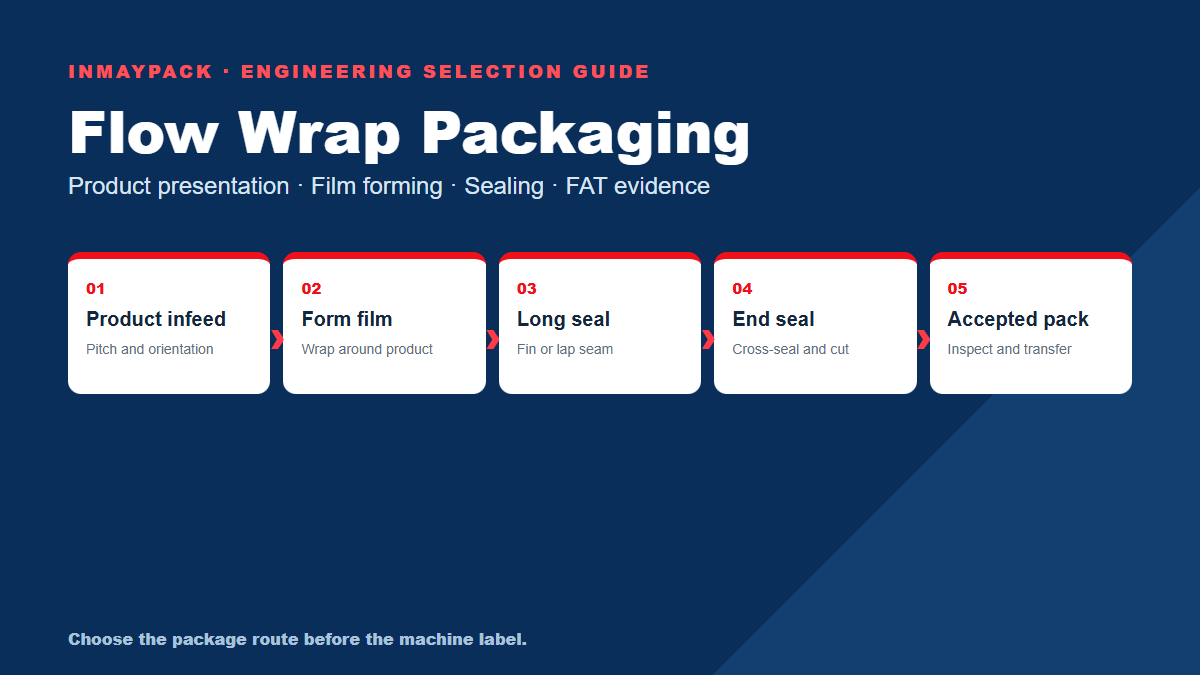
A flow wrapper forms a tube around spaced products. Fin wheels or another longitudinal sealing arrangement guide and seal the web before the end-seal jaws close and cut each pack. Product pitch and orientation are additional process inputs.
Stick packs
Each narrow lane needs a controlled seam
On a stick pack machine, one web may be slit into several lanes before each strip forms around its tube. Seam allowance, slitting accuracy, lane alignment, dose distribution and seal conditions must remain consistent across the full web.
Architecture boundary
HFFS pouch forming is a separate comparison
Some horizontal pouch-forming systems create flat, stand-up or shaped pouches through several stations instead of forming one simple tube around a product or vertical fill tube. Use the form fill seal machine guide when the route itself is not yet fixed.
Figure 2. On a horizontal flow wrapper, the longitudinal seam is one part of a timed path that also includes product infeed, tube forming, end sealing and cutting.
Drawing and web allowance
Calculate roll width from the controlled package geometry
The seam choice changes how the web edges meet, but there is no universal film-saving number that applies to every bag. Roll width depends on finished perimeter, gussets, folds, seam allowance, forming behavior, trim or tracking needs and the tolerances agreed with the converter and machine supplier.
Identify the finished package width, depth or gusset geometry and allowable dimensional variation.
State fin or lap seam on the drawing and dimension the intended longitudinal seal or overlap.
Mark the sealant side, print side, web direction, leading edge and eye-mark reference.
Confirm whether the finished fin remains upright, is folded, or must clear a downstream guide.
Release roll width only after the forming-set supplier and converter have checked the same drawing revision.
A narrower calculated web is useful only when the resulting package remains formable and sealable with production material. Track film use as accepted packs per roll or material mass per accepted pack, not from nominal web width alone.
Troubleshooting
Read seam defects as evidence from the complete process
Observed result
Inputs to check
Evidence to retain
Open or weak seam
Film interface, temperature, pressure, dwell or line speed, contamination and actual contact area.
Film lot, recipe, sample orientation, test method, force result and failure mode.
Wrinkled seam
Web tension, edge tracking, forming-set alignment, unequal overlap, product interference and jaw parallelism.
Web-path photos, measured overlap, station settings and affected samples.
Burn-through or distortion
Excess heat or dwell, unsuitable surface, uneven pressure, low web speed or local double thickness.
Recorded conditions, thermal checks where applicable and material identification.
Lap seam peels at outer layer
Outer-surface sealability, ink or coating location, treatment, contamination and laminate revision.
Converter statement, roll certificate, sample cross-section and controlled peel result.
Fin wanders or folds inconsistently
Forming geometry, guides, tension balance, web centering, pull-belt condition and downstream contact.
Running video, width measurements, setup references and retained packs.
Do not correct a weak seal by increasing temperature without checking the failure mode. A different material interface, poor alignment or contamination can remain hidden while higher heat creates new distortion or print damage.
Production trial
Verify the seam with the real film and operating condition
Laboratory heat-seal data can help define a starting window. Production equipment introduces web tension, moving surfaces, speed, product contamination and cooling conditions that must be tested on the intended line. Agree on the method before the sample roll is consumed.
Freeze the sample identity
Record converter, laminate construction, thickness, print or coating location, roll width, winding, lot and drawing revision.
Confirm the installed hardware
Identify the forming set, longitudinal sealer or fin-wheel arrangement, guides, jaw surface and relevant machine recipe.
Challenge the operating range
Run the agreed product, pack size and representative speed range. Include starts, stops, splices or planned changeovers where they affect the seam.
Inspect by defined locations
Retain samples from startup, steady running, recovery and any challenged condition. Preserve the seam orientation and identify the machine or lane reference.
Apply the agreed acceptance method
Use the buyer's approved visual, seal-strength, leak or other package test with stated conditioning, sample preparation, units and acceptance limit.
Release one controlled basis
Link the accepted material, package drawing, machine configuration, recipe and test record. A later film or coating change requires review before production use.
ASTM F88/F88M describes seal-strength measurement for flexible barrier materials and identifies the failure mode as part of the result. ASTM F2029 addresses laboratory heat seals for studying heat sealability. These methods do not replace the buyer's package-specific acceptance plan, and the selected edition and procedure should be stated in controlled documents.
Buyer questions
Fin seal and lap seal FAQ
Is a lap seal always cheaper than a fin seal?
No. A lap seal may use a different seam allowance, but total cost also depends on laminate construction, coatings, roll width, forming hardware, seal stability, rejects and accepted output. Calculate both options from the approved drawing and production result.
Can any heat-sealable film make a lap seal?
No. A film that seals well inside-to-inside may not seal inside-to-outside. The converter must identify whether the intended outer surface or coating is compatible with the lap-seal interface.
Which seal looks flatter on the finished package?
A lap seal normally lies flatter because one web edge overlaps the other. The final visual result still depends on overlap control, film stiffness, package shape and the forming process.
Can one machine switch between fin and lap seals?
Some platforms can be configured for more than one seam type, but change parts, forming geometry, longitudinal sealing hardware, web width and material compatibility must be confirmed for the exact machine. Do not assume a software recipe alone changes the seam architecture.
What should be sent to a packaging-machine supplier?
Send the finished package drawing, target seam, film structure, web and roll data, winding and print references, representative product, speed basis, contamination risks and the intended seal acceptance method. Mark unknown values for confirmation.
How should fin or lap seal quality be compared during FAT?
Use the same product, material lot or controlled equivalent, package drawing, operating condition, sample plan and acceptance method. Record accepted packs, rejects, stops, adjustments and the observed seal failure mode.
Review the film and seam before releasing the forming set
Send the package drawing, proposed laminate, roll data, product condition and acceptance method. INMAYPACK can review the machine route and identify which seam inputs still need confirmation.
INMAYPACK Engineering Team
Shanghai · Flexible Packaging Machinery
Need a Technical Opinion?
Tell us your product, material and target speed — our engineers will recommend the exact machine configuration for your line.