Selection guide · Packaging architecture
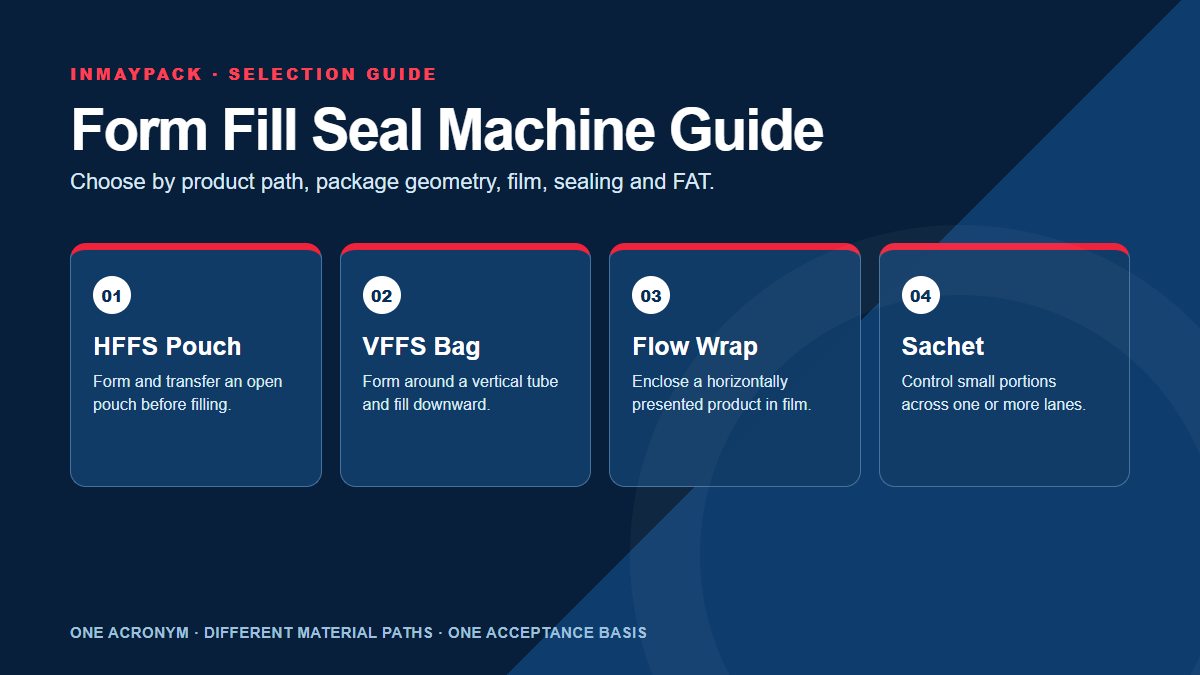
Quick answer: a form fill seal machine converts roll stock into a package, introduces the product and closes the pack in one coordinated system. HFFS pouch machines, VFFS baggers, horizontal flow wrappers and sachet systems all fit that broad definition, but they do not use the same material path.
The useful comparison begins with the finished package, product presentation, film specification, filling direction, seal design and accepted-output test—not with the acronym alone.
What “form, fill and seal” actually means
The familiar three-word description hides a longer chain of controlled handoffs. Film must unwind without losing tension or print reference. The web must become the approved package geometry. Product must arrive at the correct time without entering the seal area. The machine then completes the required seals, cut, inspection and discharge sequence.
That shared process boundary explains why several machines can be called form fill seal equipment while remaining mechanically different. A buyer should ask the supplier to describe the real material path rather than relying on a broad machine name.
- Film control: unwind, tension, web guide, registration and splice conditions.
- Package forming: tube, pouch, gusset, sachet or product-enclosing geometry.
- Product presentation: drop, pump, auger, weigher, conveyor or timed infeed.
- Sealing and cutting: long seal, side seal, top seal, end seal, cooling and cut position.
- Pack release: inspection, rejects, discharge and downstream condition.
Four routes that share the FFS label
HFFS pouch machine
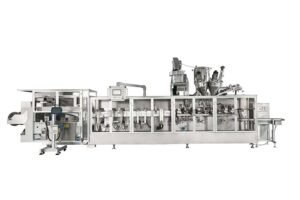
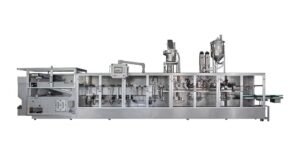
Roll film becomes a flat, stand-up, zipper, spout or shaped pouch through horizontal forming and transfer stations before filling and final sealing.
VFFS bagger
Film travels around a forming collar and tube. Product is normally delivered downward into a bag that receives longitudinal and cross seals.
Flow wrapper
A spaced product travels horizontally while film forms around it. Longitudinal sealing and cross-seal cutting create a pillow-style pack.
Sachet or stick pack system
One web may be divided into one or more lanes for small flat sachets or narrow stick packs, with dosing and seal control repeated across the web.
Compare the material path, not headline speed
| Route | What is formed | How product enters | Main application questions |
|---|---|---|---|
| HFFS pouch | Flat, stand-up or featured pouch from roll film | Into an opened pouch at a controlled filling station | Pouch geometry, zipper or fitment, opening access, transfer reference and top-seal cleanliness |
| VFFS | Tube-derived bag around a vertical forming tube | Normally downward through the tube | Product flow, drop height, forming set, back seal, cross seal and headspace |
| Flow wrap | Film tube around a horizontally presented product | Product arrives on a timed conveyor | Pitch, orientation, film tracking, long seal, end seal, cut position and discharge |
| Sachet / stick | Small flat or narrow packs, sometimes across multiple lanes | Metered dose into each lane or formed pocket | Lane balance, dose distribution, contamination, web layout, cutting and collection |
Confirm the package geometry and supply format before using “bag” or “pouch” to select a form-fill-seal route.
Engineering note: “horizontal” is not a complete specification
Horizontal form fill seal can refer to pouch-forming HFFS or a horizontal flow wrapper. One forms and transfers an open pouch before filling; the other forms film around an already presented product. State the finished package and product path in every quotation request.
Product, film and seal inputs decide whether the route is workable
Start with the real product condition
Describe particle size, fragility, dust, viscosity, temperature, stickiness, aeration, settling, splash, foam and any condition that changes during production. The same product name can require different feeding, filling and sealing controls when its condition changes.
Freeze the commercial package
Provide format, dimensions, material, seals, gussets, closure or fitment, headspace, coding area and the controlled drawing or approved samples. A package route should not be selected before those boundaries are clear.
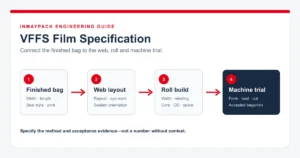
Give the supplier usable film data
- Structure, thickness and sealant layer
- Roll width, diameter, core and winding direction
- Print pitch, eye mark and artwork position
- Friction, stiffness, curl and splice condition
- Required seal geometry, test method and contamination risk
For pouch-forming HFFS projects, use the doypack film specification guide. For finished-pack release, review seal integrity evidence rather than judging appearance alone.
What belongs in a form fill seal machine URS
| URS field | Minimum information | Why it changes the proposal |
|---|---|---|
| Product | Samples, dimensions, condition, behaviour and variation | Determines feeding, dosing, contact parts and protection measures |
| Package | Format, drawing, dimensions, closure, seal and approved samples | Determines architecture, forming set, tooling and handling |
| Film | Structure, roll data, print reference and supplier specification | Determines unwind, tracking, forming and seal-window evaluation |
| Output | Saleable packs per minute, test duration, rejects and format list | Prevents empty-cycle speed from becoming the acceptance basis |
| Integration | Upstream supply, inspection, discharge, controls and utilities | Defines the real line boundary and responsibility |
| FAT | Product, material batch, test method, records and release criteria | Turns the quotation into a testable delivery scope |
The shortest machine description often hides the largest interface risk
I would not approve a proposal that says only “form, fill and seal.” The supplier should identify the material path, product presentation, package geometry, filling interface, seal method, inspection boundary and accepted-output test. Once those are visible, different routes can be compared on the same production basis.
Use one FAT basis for every shortlisted supplier
- Run the agreed product condition and dose range.
- Use production-representative film or approved package material.
- Record saleable packs, rejects, stops, recovery and changeover evidence.
- Test seals, coding, inspection and downstream handoff by the agreed method.
- Release the configuration only against the issued proposal and FAT record.
When the project includes fillers, conveyors, inspection or cartoning beyond the primary machine, use the packaging system integration checklist.
Continue with the guide for the confirmed route
Form fill seal machine FAQ
What is a form fill seal machine?
It is packaging equipment that converts roll stock into a package, introduces product and completes the required seals in one coordinated system. The term covers several horizontal, vertical, pouch, bag, wrapper and sachet architectures.
What is the difference between HFFS and VFFS?
HFFS moves film or the forming package mainly through a horizontal process. VFFS draws film around a vertical forming tube and commonly introduces product downward. The finished package and product path matter more than the acronym.
Is a horizontal flow wrapper the same as pouch-forming HFFS?
No. A flow wrapper encloses a horizontally presented product in a film tube. A pouch-forming HFFS system creates and transfers an open pouch before filling and final sealing.
Can one FFS machine package powders, liquids and solids?
Not as one universal configuration. Product feeding, filling access, contact parts, cleaning, seal protection and acceptance conditions must be validated separately.
How should FFS machine speed be compared?
Compare saleable packs under the same product, dose, film, package, format, test duration, allowed rejects and downstream condition. Mechanical cycles alone are not an acceptance criterion.
Does this page represent one INMAYPACK machine model?
No. This is an architecture-selection guide. Confirm available model, scope, specification and performance in the issued quotation for the real application.
Primary technical references
- PMMI ProSource — Horizontal Form/Fill/Seal
- PMMI ProSource — Vertical Form/Fill/Seal 101
- Syntegon — Vertical Form Fill Seal machines
- ULMA Packaging — Flow Pack wrappers (HFFS)
These references explain general equipment principles. The delivered INMAYPACK configuration remains controlled by the approved proposal, project documents and acceptance record.