Vertical loading
Products or grouped primary packs enter an erected carton from above. Confirm count, orientation, drop or placement limits, carton opening and settling.
Packaging systems configured around your application Defined project scope

Define the product grouping, carton drawing, loading direction, closure, upstream discharge and accepted boxed output before selecting an automatic cartoning machine.
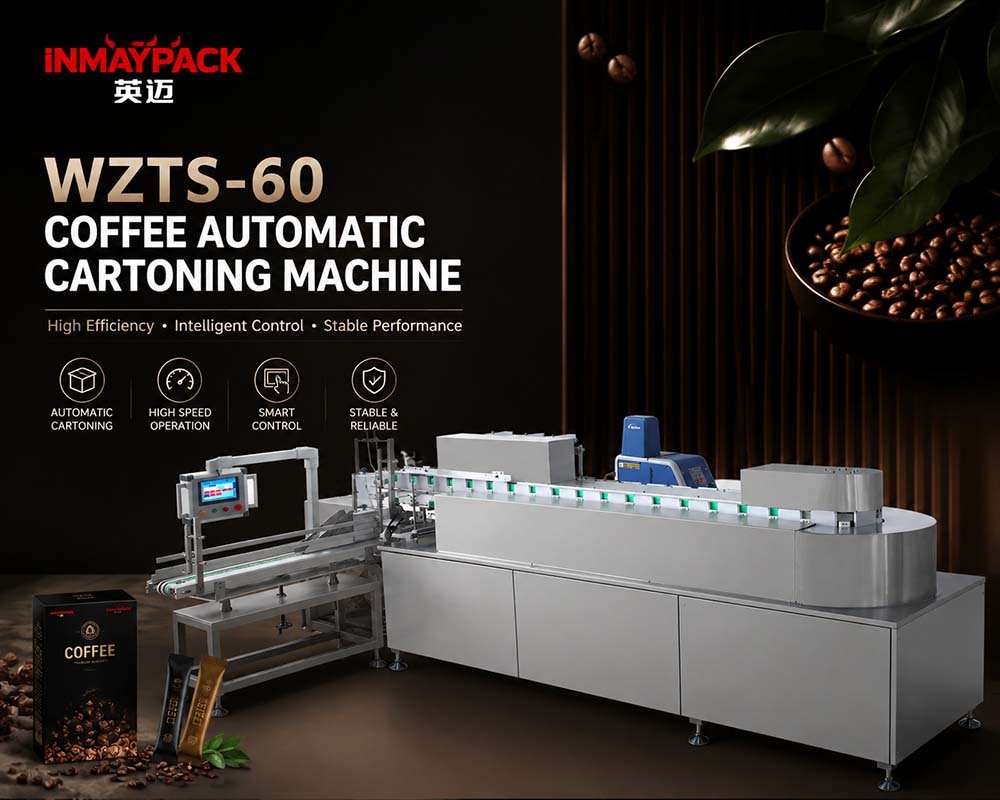
It is secondary packaging equipment that erects a folding carton, receives and groups the primary packs or products, loads them in a controlled orientation, closes the carton and discharges an accepted box. A cartoner is not selected from carton speed alone: carton geometry, product presentation and the upstream-to-cartoner interface determine whether the complete line runs reliably.
The same search term covers machines with different carton and product paths. INMAYPACK's confirmed reference on this page is the WZTS-60 vertical-loading system; any other architecture requires separate project confirmation.
Products or grouped primary packs enter an erected carton from above. Confirm count, orientation, drop or placement limits, carton opening and settling.
Products are pushed or transferred through a carton end. Do not treat this as interchangeable with the WZTS-60; product collation and carton motion require a separate architecture review.
Robotic top loading, tray loading and case packing solve different secondary-packaging tasks. Availability and scope must be confirmed against the actual project.
The WZTS-60 is the current documented INMAYPACK cartoning reference for counted capsules, sticks, sachets and other project-approved products. It erects, loads, codes or inspects as configured, and closes folding cartons by tuck-in or an approved hot-melt option.
These are reference specifications, not a universal acceptance promise. Final tooling, speed and closure depend on the approved carton, product count, infeed and FAT basis.
Control blank quality, board stiffness, crease geometry, storage condition and magazine refill.
Open and present the folding carton consistently before any product is released.
Count, collate and orient capsules, sticks, sachets or other approved primary packs.
Transfer the group without jams, damage, bounce-back or carton deformation.
Coordinate tuck-in or approved adhesive closure with batch coding and required inspection.
Define closed-carton quality, count verification, rejects and downstream handoff.
| Input | What to provide | Why it matters |
|---|---|---|
| Primary product | Actual capsule, stick, sachet or approved item; dimensions, weight, surface and damage limits | Counting, grouping, gripping and loading method |
| Group pattern | Units per carton, rows, layers, orientation and acceptable movement | Collation, loading head and change parts |
| Carton drawing | Controlled dieline, L×W×H, board grade, crease, flap and closure details | Magazine, erection, tooling and closure |
| Upstream supply | Machine discharge, rate, orientation, buffer, signals and restart behavior | Line synchronization and accumulation |
| Accepted output | Good cartons/min, run duration, allowed rejects, coding and inspection criteria | Comparable FAT and supplier acceptance |
| Destination scope | Power, air, guarding, language, documentation and site integration | Issued machine and compliance boundary |
Mechanical maximums do not prove line output. Define normal rate, short stops, accumulation, restart and the rule for starving or blocking the upstream machine.
A correctly sealed sachet can still arrive in the wrong attitude or group. Confirm transfer, counting, duplicate or missing-piece detection and reject logic.
Document permissives, faults, emergency stops, upstream/downstream signals, data requirements and who owns each interface.
Use the approved products, carton batch, group pattern, closure and test duration. Record good cartons, jams, rejects, stops and recovery.
For the full controls and interface boundary, use the packaging system integration checklist. For multi-machine delivery scope, review turnkey packaging line integration.
If the loading direction is not yet fixed, compare an end-load vs vertical cartoning machine by product presentation, carton opening, transfer path and acceptance evidence before requesting a configuration.
For coffee capsules, sticks, pouches or other confirmed coffee packs entering retail cartons, define the upstream product, count, pitch and handoff within the integrated coffee packaging line before fixing the downstream configuration.
Before connecting a wrapper to automatic cartoning, define product discharge, spacing and accumulation with the flow-wrapper packaging process guide. When individually wrapped cereal, protein or granola bars enter a retail carton, continue with the wrapped-bar infeed and cartoning requirements before fixing count, grouping or buffer logic. When individual or grouped bakery packs enter a retail carton, define orientation, count, accumulation, reject logic and transfer timing with the wrapped-cookie and biscuit cartoning requirements before the cartoner layout is released.
Most cartoning failures are interface failures: inconsistent pitch, mixed orientation, unstable groups, variable cartons or poorly defined restart logic. I would approve the machine only after the actual primary packs and production cartons have passed one agreed integrated run.
If the project starts with flexible food packs, first define the primary system on the food packaging machine selection page, then release the cartoner interface.
The documented WZTS-60 reference can be configured for counted capsules, sticks, sachets and other project-approved items. Each application still requires the real product, group pattern and carton to confirm handling and loading.
The source specification states 10–30 cartons per minute. Accepted output depends on the upstream supply, units per carton, carton behavior, loading, closure, inspection and FAT conditions.
The documented range is 40×30×50 mm to 180×180×300 mm (L×W×H), with carton board around 350 g/m² depending on the format. Final tooling is released from the approved carton drawing and samples.
The WZTS-60 uses tuck-in paper tongues at both ends as the standard documented closure and is compatible with an approved hot-melt option. The issued quotation must state the selected closure equipment and responsibility.
Run the approved primary products and production cartons at the agreed group pattern and line condition. Record good cartons, missing or extra products, jams, damaged cartons, closure quality, coding, rejects, stops and recovery over the agreed duration.
Send the product or primary-pack samples, group pattern, controlled carton drawing and samples, target accepted output, upstream discharge details, closure and coding needs, inspection, utilities, guarding and destination documentation requirements.
INMAYPACK will review the documented WZTS-60 route against your real primary packs, carton drawing, upstream interface and acceptance basis before confirming the configuration.