
Selection guide · Snack bar flow wrapping
Cereal, protein, granola, fruit, nutrition and candy bars may share a pillow-style pack, yet their handling, film and sealing risks can be very different. This article follows the decision chain from the unwrapped bar through infeed, wrapping, inspection and accepted downstream output.
A horizontal flow-wrap route is normally evaluated when individual bars can be presented at controlled orientation and pitch. Compare accepted packs made from the buyer’s real bars and film—not empty jaw cycles. Confirm product condition, film structure, seal technology, infeed variation, inspection, changeover and FAT evidence before fixing a model or output.
Need the underlying wrapping sequence first? Read the flow wrap packaging machine guide.
In this guide
Use one decision chain from the unwrapped bar to the accepted case
Each section below resolves a different quotation risk. Read the route definition first if the project is still being described only as a “snack machine.”
Package architecture
A wrapped bar is not the same project as loose snacks filled into a pouch
The word “snack” describes a market, not a packaging process. The first decision is whether the product is wrapped as one discrete item, grouped into a multipack, or dosed as loose pieces.
Individual bar flow wrap
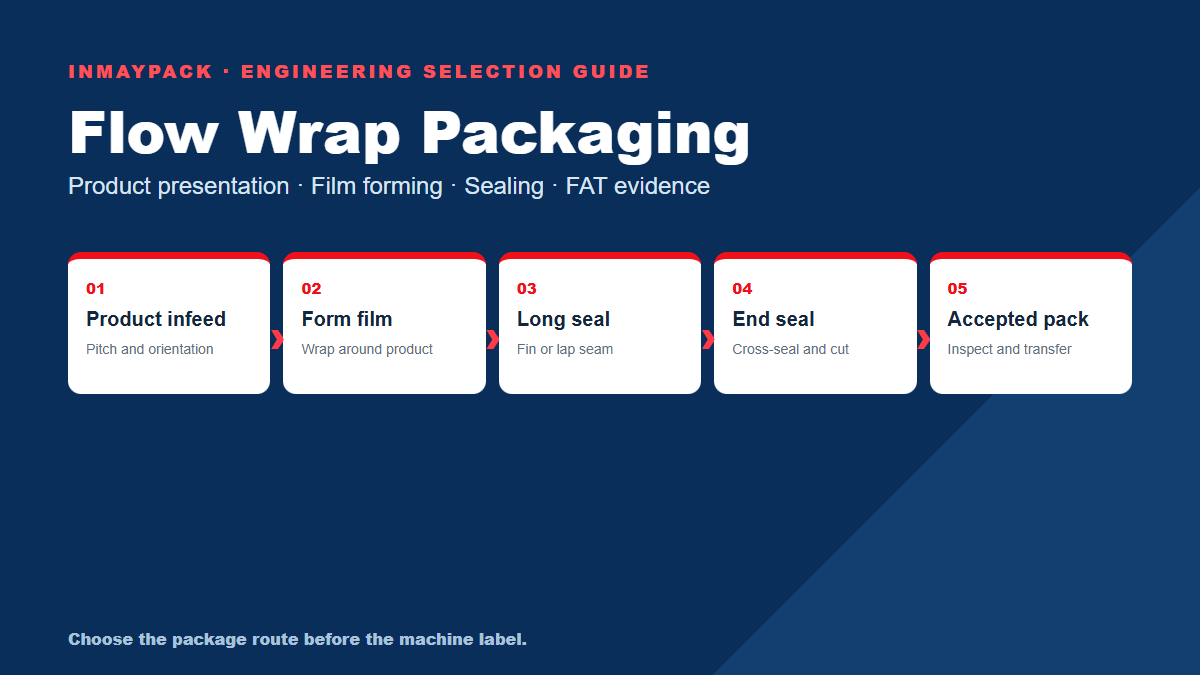
A formed bar enters horizontally at controlled pitch. Film wraps around it, receives a longitudinal seam, then the end seals close between products. This guide concentrates on that route.
Bars inside a multipack
Primary-wrapped bars may be collated and loaded into a larger flow wrap, carton or case. Count, orientation, accumulation and transfer become separate line interfaces.
Loose snack pouch
Chips, nuts, candy pieces and mixed snacks are weighed or dosed into a pouch. Use the snack pouch packaging machine guide for this different architecture.
Process chain
Six handoffs define the bar packaging line
Machine selection becomes reliable only when each handoff has an input condition, a response to variation and an acceptance check.
Product definition
The bar type changes the handling and sealing risk
Send the difficult SKU, not only a convenient sample. Variation in size, coating, stickiness, crumbs or temperature can change the practical infeed rate and the seal-contamination risk.
| Bar family | Inputs to record | Packaging risk to evaluate | Evidence needed |
|---|---|---|---|
| Cereal or granola bars | Length, width, height, edge condition, loose crumbs, inclusions and dimensional spread. | Crumbs at the end seal, product rotation, broken corners and inconsistent pitch. | Representative samples across the expected production tolerance and a defined damage check. |
| Protein or nutrition bars | Surface tack, oil migration, density, deformation, temperature and recipe variation. | Product sticking to guides or belts, drag marks, film contact and transfer instability. | Trials at normal and challenging product temperature or dwell condition. |
| Fruit or nut bars | Exposed fruit, nut protrusion, irregular edge, moisture, tack and fragility. | Film puncture, guide contact, misshapen packs and contamination at the cross seal. | Agreed appearance, puncture and seal checks on the approved film. |
| Chocolate-coated bars | Coating condition, allowable temperature, scuff sensitivity and product spacing. | Smearing, marking, heat exposure and coating transfer onto product-contact surfaces. | Product-condition limits plus agreed visual acceptance criteria. |
| Wafers or fragile bars | Break force, crumb generation, unsupported span and allowable drop or compression. | Cracking during transfer, belt transitions, metering and downstream accumulation. | Damage count before and after wrapping, including restarts and line recovery. |
| Multi-format bar range | All size envelopes, recipes, film repeats, change frequency and shared components. | Excessive change parts, slow first-off release and unstable settings between formats. | Changeover demonstration for the priority formats named in the URS. |
Package specification
Freeze the finished pack before the wrapper configuration
Controlled dimensions
Provide the product envelope, finished pack length and width, seal widths, product-to-seal clearance, cut position and permitted visual tolerances.
Opening and display
Define tear notch, easy-open direction, printed-panel orientation, code position, multipack marks and any retailer presentation requirements.
Protection target
State the applicable moisture, oxygen, aroma, light, puncture or shelf-life requirement. Package-performance claims require buyer-approved material and validation.
Seal acceptance
Name the visual, peel, leak, burst or other test method, sampling plan and pass criterion. “Looks sealed” is not a controlled quality requirement.
Material declaration
Record structure, thickness, sealant, friction, print repeat, roll direction, core, maximum roll, splice rule and storage condition.
Secondary-pack state
Define whether bars leave the wrapper flat, indexed, counted, stacked, accumulated or directly transferred into a cartoner.
When the project has not yet fixed the package architecture, start with the broader food packaging machine selection hub before requesting a model.
Infeed and buffering
Stable wrapper output begins upstream of the film
A wrapper cannot create correct spacing from touching, doubled, rotated or intermittently arriving bars without a defined distribution and metering strategy. Record the real upstream discharge pattern, including short stops, surges, rejected bars and recipe changes.
For a manually loaded line, specify operator positions, loading direction, ergonomic reach, expected sustained rate and what happens when a pocket is empty. For automatic lines, define belt speeds, gap-closing logic, product detection, accumulation capacity, branch distribution and the controlled response to upstream and downstream stops.
Commercial examples from established packaging suppliers show that bar lines may combine row distribution, buffering, horizontal wrapping and secondary packing. Those examples support the system principle; they do not establish INMAYPACK model availability or performance.
Infeed data sheet
- Upstream machine and normal discharge pattern
- Minimum, nominal and surge product rate
- Product orientation and permitted rotation
- Minimum spacing and touching-product frequency
- Product temperature and surface condition
- Allowed accumulation time and pressure
- Missing, broken or out-of-position product logic
- Restart and line-clearance requirement
Film and sealing
Choose the material and sealing technology as one testable system
Heat sealing
Confirm the approved film’s seal-initiation and operating window, dwell, pressure, product temperature and sensitivity. A nominal temperature alone does not define a repeatable process.
Cold sealing
Cold-seal materials may be reviewed for heat-sensitive products, but adhesive pattern, registration, web handling, storage and supplier validation remain part of the project.
Paper or mono-material route
Do not assume a material change is a drop-in replacement. Formability, friction, stiffness, print, barrier and seal behavior must be demonstrated on the selected equipment.
Use the flow wrap packaging guide for the full sequence from product presentation through longitudinal sealing, end sealing and accepted discharge.
Changeover and sanitation
Format flexibility must be demonstrated on the buyer’s priority SKUs
| Change area | What may change | What the buyer should request |
|---|---|---|
| Product path | Guide width, conveyor position, metering, sensors, height and transfer timing. | Named change parts, adjustment points, reference marks and an approved setup record. |
| Film path | Roll, forming set, print repeat, web position, tension and splice procedure. | Film-threading method, safe access, recipe ownership and first-off registration checks. |
| Sealing | Jaw pitch, cut, seam position, temperature, pressure and dwell or motion profile. | Protected recipes plus seal verification before production release. |
| Coding and inspection | Message, location, camera or sensor setup, rejection and traceability data. | Line-clearance rules, challenge samples and confirmation that rejected product is controlled. |
| Cleaning | Crumbs, oils, allergens, coatings and accessible product-contact or splash zones. | Cleaning boundary, removal method, inspection points, tools and release responsibility. |
| Downstream | Count, grouping, orientation, carton format, accumulation and recovery. | One interface test using the priority primary pack and secondary package. |
Inspection and FAT
Test saleable bars through normal production variation
A short, hand-fed demonstration can hide the interfaces that limit a real line. Write the production basis and defect rules before FAT so every supplier is measured against the same accepted output.
Minimum FAT basis
- Named product: priority bar SKU, condition, dimensions and acceptable variation.
- Named material: production-representative printed film, roll direction and approved specification.
- Line configuration: infeed, wrapper, coding, inspection, reject path and downstream state included in the test.
- Run rules: duration, replenishment, operator actions, planned stops and restart conditions.
- Accepted output: saleable packs separated from empty cycles, scrap, rejects and rework.
- Quality sample: product damage, registration, cut, code, package appearance and agreed seal tests.
- Challenge checks: missing, touching, rotated or broken product; film or registration fault; blocked discharge and controlled recovery where included.
Do not approve from these alone
- Maximum empty mechanical cycles
- A different, easier demonstration bar
- Unprinted or supplier-selected trial film
- A short run with hand-corrected infeed
- Visual seal appearance without an agreed test
- Primary wrapper output without downstream state
- A performance value missing reject and restart rules
Use the packaging system integration checklist to assign mechanical, control, safety, quality and data handoffs before factory testing.
The first unstable handoff usually matters more than the wrapper’s headline speed.
If bars arrive touching, warm, sticky, rotated or in unpredictable surges, a fast sealing section cannot turn that variation into accepted packs by itself. I would freeze the product condition, distribution logic, film and defect rules first, then compare sustained line output and recovery under the same test basis.
Quotation normalization
Ask every supplier to price the same operating boundary
| Quotation block | What must be stated | Why it changes the comparison |
|---|---|---|
| Product presentation | Manual loading or automatic distribution, guides, buffering, gap control and interface ownership. | A wrapper-only price may exclude the equipment that makes stable production possible. |
| Primary wrapping | Film unwind, forming, longitudinal seal, end seal, cut, controls, guarding and priority formats. | Separates the base wrapper from configuration-specific options and change parts. |
| Code and inspection | Printer, code verification, weight or contaminant checks, reject device and data interface when required. | Prevents quality controls from appearing later as unbudgeted additions. |
| Secondary packing | Counting, grouping, loading, carton or case route, accumulation and line controls. | Clarifies whether accepted output ends at one wrapped bar or a finished shipping format. |
| FAT and documents | Samples, film quantity, duration, pass criteria, drawings, manuals, parts list, training and open-item process. | Makes the acceptance evidence comparable before contract award. |
| Delivery and lifecycle | Incoterm, packing, freight boundary, installation, commissioning, initial spares, warranty and support response. | Converts machine price into a more complete project cost and responsibility map. |
For projects including distribution, inspection and secondary packaging, review the turnkey packaging line boundary. If finished bars must enter cartons, define the handoff with the cartoning machine selection page.
Related decision paths
Continue with the page that matches the actual package route
Buyer questions
Snack bar packaging machine FAQ
Which machine is normally used to package individual snack bars?
Is a snack bar packaging machine the same as a snack pouch machine?
What information is needed before requesting a quotation?
Can one wrapper run cereal, protein and chocolate-coated bars?
Should bar packaging use heat seal or cold seal film?
How should snack bar packaging speed be compared?
Can wrapped bars be connected directly to a cartoning machine?
Does this guide confirm a specific INMAYPACK bar-wrapper model?
Primary technical references
External examples used to verify the process principles
- ULMA Packaging, automated snack-bar distribution, horizontal flow wrapping, buffering and case-packing example.
- Syntegon, horizontal flow-wrapper applications, sealing approaches and package-style considerations for bars and bakery products.
- Syntegon, bar-line feeding, distribution, buffering, grouping and product-trial example.
These primary manufacturer sources support established flow-wrap and bar-line principles. They do not establish INMAYPACK model availability, output, supplied scope or project performance. Confirm all commercial facts in the issued INMAYPACK quotation and acceptance documents.
Application review
Send the real bar, film and line boundary
Provide bar samples or controlled dimensions, product condition, upstream discharge pattern, finished-pack drawing, production film, required accepted output, priority formats, inspection and downstream state. INMAYPACK will review whether an available horizontal packaging route or a coordinated line scope can be confirmed; model, performance and supply responsibility remain subject to the issued quotation.







