Factory Procurement Guide
A stand-up pouch line can look productive during a short demonstration and still become a daily source of lost output after installation. The usual causes are not mysterious: the selected filler does not match the product, powder reaches the seal area, the zipper or gusset is unstable, the film has a narrow sealing window, changeovers consume the shift, or the quoted speed cannot be sustained with the buyer’s real pouch and product.
For a food, beverage, nutraceutical or home-care factory, the buying decision therefore starts before a supplier recommends a model. The plant must define the product, finished pouch, fill range, verified line output, cleaning method, utilities and acceptance criteria as one system. That specification becomes the basis for a supplier comparison, the factory acceptance test (FAT) and the final purchase contract.
Quick answer: how should a manufacturer choose?
Choose a stand-up pouch packing machine from seven verified inputs: product behavior, pouch geometry, fill range, required net output, roll-film structure, changeover and cleaning needs, and FAT acceptance criteria. Do not shortlist a machine from nominal bags per minute alone. Require a trial with representative product and production film, then record good-pouch output, seal results, giveaway, reject causes and changeover time.
1. Define the product before discussing the machine
“Powder,” “granules” and “sauce” are only starting labels. Two products in the same category can require different feeding, dosing and sealing controls. A free-flowing granule behaves differently from an irregular gummy; a dry protein powder behaves differently from an oily seasoning; a smooth ketchup behaves differently from mayonnaise containing particulates.
Prepare a product-data sheet for every SKU expected on the line. At minimum, give the supplier the bulk density, particle size or viscosity range, target fill weight or volume, acceptable dosing tolerance, product temperature, tendency to foam or string, oil content, dust behavior, fragility, particulates and allergen-cleaning requirements. If the product changes seasonally or between suppliers, define the expected range rather than providing one ideal sample.
This matters because the stand-up pouch packing machine is only one part of the process. Its bag forming, opening, transport and sealing sequence must be synchronized with the dosing equipment. An excellent pouch former paired with the wrong filler is still the wrong line.
Questions procurement should ask production and quality
- Which SKU is hardest to dose or seal, and should that SKU define the test?
- Can product temperature or viscosity vary during a normal shift?
- What is the maximum acceptable giveaway or dosing deviation?
- Could dust, oil, sauce strings or particulates enter the sealing area?
- Which parts must be removed between allergens, colors or flavors?
2. Lock the finished pouch specification
A commercial pouch sample is not a complete machine specification. The engineering package should include a dimensioned drawing showing width, overall height, bottom gusset, seal widths, zipper location, tear notch, hang hole, spout or cap position, registration-mark details and permitted dimensional tolerances. State whether the package is a standard doypack, zipper doypack, top-spout pouch, shaped pouch or another format.
Also separate the finished pouch size from the fill volume. Nominal pouch volume does not guarantee usable fill volume for a specific product. Bulk density, headspace, product settling, zipper clearance and the position of the top seal all change how much product the pouch can hold reliably.
If several sizes will run on one platform, identify the smallest and largest pouch, the most frequently changed pair, annual volume by format and any planned future size. This lets the supplier disclose which changes are recipe-based, which require change parts and which may require a different machine width or forming system.
3. Match the dosing system to product behavior
The filler controls both accuracy and timing. A multihead weigher may suit many free-flowing pieces and granules; an auger is commonly evaluated for powders; a volumetric cup may suit certain uniform free-flowing products; and pump selection for liquids or pastes depends on viscosity, particulates, temperature, shear sensitivity and cleaning method. These are starting points, not automatic answers.
Ask the supplier to describe the complete product path: upstream feed, buffer hopper, level control, dosing device, discharge chute or nozzle, anti-drip or dust-control measures, product-contact construction and access for cleaning. The proposal should show how the filler communicates with the pouch machine when there is no pouch, no product, a dosing fault or a downstream stop.
| Product condition | Engineering question | FAT evidence to request |
|---|---|---|
| Free-flowing granules or pieces | How are bridging, breakage and target-weight distribution controlled? | Weight data, product damage check and sustained run at the agreed recipe. |
| Fine or dusty powder | How is dust kept away from the zipper and sealing faces? | Seal-area inspection, reject causes and cleaning time after the run. |
| Low-viscosity liquid | How are splash, foam and pouch movement managed? | Fill consistency, seal contamination rate and drip behavior at stop/start. |
| Viscous paste or sauce | Can the pump and nozzle handle the full viscosity and particulate range? | Hot/cold or min/max viscosity trials, tailing check and cleaning demonstration. |
| Mixed or fragile product | Can the feed system preserve the intended blend and appearance? | Component distribution and breakage comparison before and after packing. |
4. Specify verified output, not headline speed
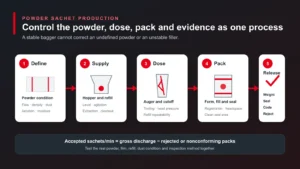
Nominal machine speed, test-cycle speed and sellable line output are different numbers. Procurement should define output as accepted pouches per minute or per shift at the agreed product, fill, pouch and quality criteria. This prevents an empty-cycle result or a short ideal run from becoming the basis of the investment case.
Write the conditions beside the target: SKU, fill amount, pouch size, film, zipper or spout requirement, operator level, trial duration, maximum reject rate, dosing tolerance and seal-test method. If the line includes feeding, coding, inspection, checkweighing, conveying or case packing, define whether the acceptance result applies to the isolated bagger or the complete integrated line.
A useful speed discussion includes the constraint map. A larger fill may extend dosing time. A difficult film may need a wider sealing dwell window. Powder extraction may require a slower or differently timed discharge. A zipper, spout or shaped cut introduces operations that a plain pouch does not have. The fastest component does not set the sustainable output; the slowest stable process does.
Convert speed into capacity
For budgeting, convert the accepted pouches-per-minute target into planned shift output. Apply scheduled operating time, changeovers, cleaning, breaks and a realistic availability assumption. Keep those planning assumptions separate from the FAT result. FAT proves the machine can meet an agreed short-term test; it does not automatically prove the plant’s future overall equipment effectiveness.
This distinction also protects the supplier evaluation. Two proposals with the same headline speed may have different changeover burden, reject control, operator dependence and upstream/downstream scope. Compare the rate of conforming output and the work required to sustain it.
5. Validate roll film, registration and seal quality
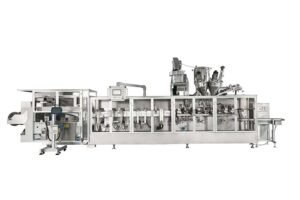
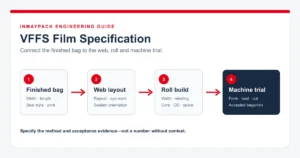
Horizontal form-fill-seal equipment forms the pouch from rollstock. The film is therefore a machine component as well as a packaging material. Supply the film structure, total thickness, coefficient-of-friction information if available, roll width, maximum roll diameter, core diameter, unwind direction, print repeat, eye-mark dimensions and sealing window. Provide production-grade printed rolls for the final test, not only plain trial material.
The supplier should confirm tracking, web tension, registration correction, bottom-gusset formation, zipper insertion or sealing where applicable, side seals, top seal and cutting. The FAT should include stop/start behavior and roll change, because registration loss and scrap often occur during transitions rather than during a stable five-minute run.
Define seal acceptance with the quality team. Visual appearance alone is not enough. Depending on the product and package, the plant may require leak testing, burst or peel evaluation, seal-width measurement, contamination challenges, drop testing, coding verification or retention samples. The method, sample count and acceptance limit should appear in the FAT protocol.
The engineering rule behind our proposal reviews is simple: do not freeze an output figure until the product, pouch drawing, film structure, fill range and acceptance method are defined together. A machine can cycle quickly and still fail the buyer’s real target if the zipper, dust, product tailing or seal window has not been included in the test.
6. Review changeover, cleaning and operator work
A flexible machine only creates value if the plant can change it safely and repeatably. Ask the supplier to list every adjustment and change part for the planned SKU matrix. Separate recipe changes on the HMI from mechanical adjustments, filler changes, forming-part changes and cleaning work. Request marked adjustment points, stored recipes, setup standards and a demonstrated changeover between two representative formats.
For cleaning, map all product-contact and splash-zone parts. Record tool requirements, access, removal weight, drainability, cleaning-agent compatibility, inspection points and reassembly checks. For allergen or flavor changes, the buyer’s sanitation program determines the validation requirement. The equipment must support that program; a generic “easy to clean” statement is not an acceptance criterion.
For U.S. food facilities, the buyer’s food-safety review should consider the equipment and utensils provisions in 21 CFR 117.40 as summarized by FDA, including cleanability, maintenance and installation that facilitates cleaning of equipment and adjacent spaces. For EU-market projects, the buyer should evaluate applicable food-contact materials under Regulation (EC) No 1935/2004 and any more specific measures relevant to the packaging material. These are the factory’s compliance and acceptance responsibilities; they are not replaced by a machine brochure.
Controls, alarms and recovery
Review how operators recover from no film, low product, no pouch opening, temperature deviation, registration error, coding fault, downstream blockage and emergency stop. An alarm is useful only when the operator can identify the cause and restart without creating an uncontrolled batch of suspect pouches. Ask which faults stop filling, which stop sealing, what data are retained and how rejected product is segregated.
Also confirm the plant utilities and environment: electrical supply, compressed-air pressure and quality, extraction, ambient temperature and humidity, floor loading, access route, line footprint and service clearances. A machine drawing should show not only its frame dimensions but also the space required for the unwinder, feeder, operator, maintenance and downstream equipment.
7. Turn the requirements into a URS and FAT protocol
The user requirement specification (URS) is the buyer’s control document. It should describe what the line must achieve without prematurely dictating every engineering detail. Suppliers can then propose different technical solutions against the same outcome and identify exceptions before the purchase order. Use the packaging machine RFQ builder to generate a supplier-ready brief from the same requirements.
Minimum URS package to send with an RFQ
- Product data for every planned SKU, including worst-case behavior.
- Dimensioned pouch drawings and physical samples.
- Roll-film specification, print repeat and representative production rolls.
- Minimum, normal and maximum fill quantities.
- Required accepted output by priority SKU.
- Dosing tolerance, seal and package-quality acceptance limits.
- Changeover matrix and target changeover time.
- Cleaning, allergen-control and product-contact requirements.
- Utilities, footprint, line interfaces and data needs.
- Documentation, training, spare parts, service and commissioning scope.
The FAT protocol should convert the critical URS clauses into observable tests. Record the test material, film lot, recipe, run duration, operator, start and end times, accepted output, rejects by cause, weight data, seal-test results, alarms tested, changeover result and open deviations. Agree in advance how a failed item will be corrected and retested.
After shipment, the site acceptance test (SAT) checks installation, utilities, safety interfaces, training, documentation and production performance in the buyer’s environment. FAT and SAT are related but not interchangeable: one verifies the completed equipment before shipment, while the other verifies the installed system and handover conditions.
How to compare stand-up pouch machine suppliers
A supplier comparison should show evidence, assumptions and exclusions—not just a price and model number. Issue the same URS to each shortlisted supplier and require a clause-by-clause response. Score the complete line, including filler, pouch-forming functions, inspection, interfaces, change parts, testing, documentation and after-sales support.
| Decision area | Evidence to request | Red flag |
|---|---|---|
| Application fit | Comparable product/pouch experience, process explanation and test plan. | Model selected from pouch width and bpm alone. |
| Output | Accepted-output definition with product, fill, film, duration and reject limit. | “Up to” speed without test conditions. |
| Seal quality | Documented seal controls and agreed test method. | Visual samples treated as the only proof. |
| Changeover | Change-part list, setup method and witnessed format change. | “Quick change” without steps or timing. |
| Cleaning | Product-path drawing, removal demonstration and material declaration. | Generic hygiene claim without access details. |
| Project execution | URS response, drawings, FAT protocol, manuals, training and deviation closure. | Important scope left for discussion after deposit. |
| Lifecycle support | Recommended spares, response route, remote support and local service scope. | No named support process or parts identification. |
Do not hide commercial questions. Ask for an itemized scope, payment milestones tied to approved documents and tests, delivery basis, installation responsibility, travel assumptions, warranty boundary, spare-parts pricing and software-access terms. If price is the next decision, use the existing doypack packing machine price guide as a budget framework, then request a project quotation against the completed URS.
Common purchasing mistakes
Buying the maximum advertised speed
The maximum rate may refer to a small pouch, light fill or ideal film. If the contract does not define the test conditions and accepted output, the number cannot protect the buyer.
Approving the filler and pouch machine separately
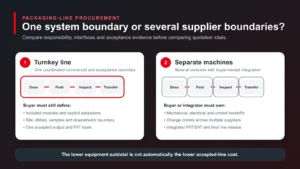
Separate vendors or modules can work, but one party must own timing, signals, physical interfaces and line performance. Otherwise each component may pass while the integrated line does not.
Sending only photos instead of pouch drawings and film
Photos do not define gusset geometry, tolerances, zipper position, print repeat or sealing behavior. Early samples reduce concept risk; production rolls are still required for final validation.
Leaving the hardest SKU until commissioning
The most difficult high-priority SKU should be part of supplier evaluation and FAT. A line proven only on the easiest SKU transfers the main technical risk to the buyer’s factory.
Treating CE marking or material statements as the complete audit
Documentation supports the buyer’s review, but the factory still must evaluate the installed process against its safety, hygiene, food-contact, HACCP and acceptance requirements. Ask for traceable declarations and verify the actual project scope.
Frequently asked procurement questions
What information does a supplier need before sizing a stand-up pouch machine?
Provide product properties, fill range, pouch drawings and samples, roll-film data, required accepted output, dosing and seal criteria, changeover matrix, cleaning requirements, utilities and line interfaces. Representative product and production film are needed before final performance confirmation.
How should a factory compare actual machine output?
Compare accepted good pouches per minute or shift under the same defined conditions: product, fill, pouch, film, run duration, dosing tolerance, seal test and maximum reject rate. Keep empty-cycle speed and short demonstration speed separate.
Can one machine pack powder, granules, liquid and paste?
The pouch platform may support multiple products, but each product can require a different filler, product path, seal-protection method and cleaning procedure. Feasibility should be evaluated SKU by SKU, including changeover scope and cross-contamination controls.
What should be included in a stand-up pouch machine FAT?
Include traceable test materials, run duration, accepted-output target, reject classification, dosing data, seal tests, registration checks, stop/start recovery, alarms, changeover, cleaning demonstration, documentation review and a deviation/retest process.
How much product and film should be sent for testing?
The quantity depends on line speed, stabilization time, number of SKUs, test duration and planned changeovers. Ask the supplier for a written calculation covering setup waste, repeated trials, FAT samples and contingency rather than accepting one generic quantity.
What belongs in the spare-parts and after-sales scope?
Request a recommended commissioning kit and operating spares list with part numbers, quantities, lead times and prices. Confirm remote-diagnostic access, support hours, response path, technician travel terms, manuals, electrical drawings, software backup and training deliverables.
Final buying rule
The best stand-up pouch machine is not the machine with the longest option list or the highest advertised speed. It is the line that produces the required sellable pouch, with the buyer’s actual product and film, at an accepted output and quality level that can be repeated by the plant’s operators.
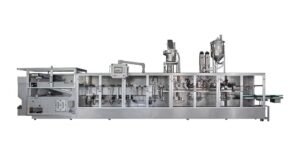
Start with the URS, expose the worst-case SKU, compare exceptions openly and make the FAT evidence part of the purchase decision. If you are still defining the platform, review the complete HFFS stand-up pouch solution and send the project data before selecting a machine width, filler or output class.
Sources and evidence notes
- U.S. FDA: Preventive Controls for Human Food—Small Entity Compliance Guide, including the summary of 21 CFR 117.40 equipment and utensils requirements.
- EUR-Lex: Regulation (EC) No 1935/2004 on materials and articles intended to come into contact with food.
- INMAYPACK engineering source: HMK-2000 zipper doypack HFFS project proposal. Public figures in this article are labeled as project-specific and require product/film validation.
Send your URS before you shortlist the machine
Share your product data, pouch drawing, fill range, film specification and required accepted output. INMAYPACK will review the application and define the sample-and-film test needed to confirm the configuration.
sales@ewpackmachinery.com · WhatsApp +86 18658799162