Opens in a new tab

Packaging systems configured around your application Defined project scope

Share your requirements • sales@ewpackmachinery.com

Top Spout Flat Bag Packing Machine

INMAYPACK · HS-160 SERIES

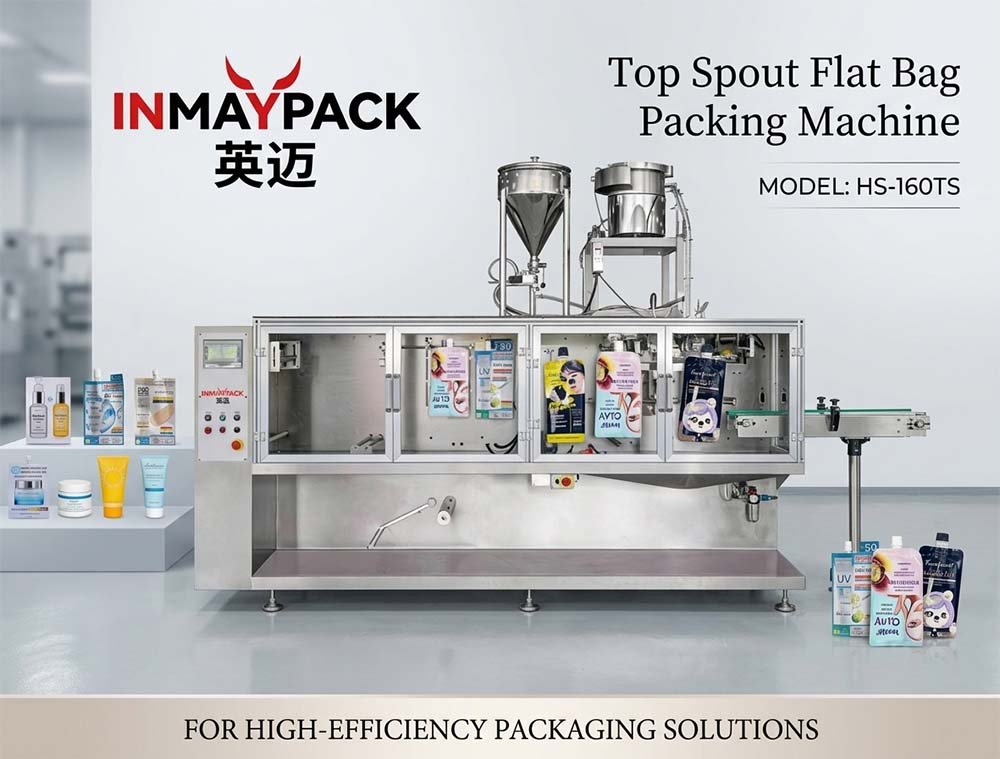
The HS-160 forms four-side-seal spouted sachets from roll film. Match the filler and top-spout tooling to your liquid, gel or paste.

HS-160TS · Simplex
Up to 50 mL 35–40 bags/min
HS-160TSD · Duplex
Up to 30 mL 70–80 bags/min total
INMAYPACK HS-160TS top-spout flat-bag packing machine promotional image
HS-160TS machine overview. Pack artwork illustrates applications, not customer projects.
Prefer WhatsApp or email?

Pack route & fitment drawing

What arrives at your filling line?

Choose top spout packaging equipment by the incoming material and the opening used for filling. The same finished shape can call for three different machines.

Three infeed routes for a flat spouted sachet
Incoming packMachine to evaluate
Roll film + loose fitmentsForm the flat pouch on the machine. Specify intermittent roll-film HFFS, metering, fitment placement and flange sealing. Use the station drawing to agree the order of operations. This is the HS-160 route.
Premade pouch, open bottom or edgeFill through the open edge and seal it. Review pouch gripping, filling access and edge-sealing tools for the supplied bag. An attached spout does not mean you have to fill through it.
Premade pouch, fill through the neckSupport the neck, fill through the bore and handle the cap. Compare the premade spout-pouch filling and capping line; check the support ring, track and cap supply.
Top-spout flat-sachet geometryA flat pouch has a spout centred at its upper edge. The fitment flange shares the top sealing area. Red bands identify the sealing perimeter. The drawing illustrates geometry, not dimensions or production tooling.Flat bodySpout flangeSealing perimeterTop-mounted spout
Flat-pouch geometry. The body stops at the film edge; total height includes the closure. Not a tooling drawing.

Read the body and the fitment separately

Start with the pack lying flat. Record body height and total height with the cap separately. Give the finished body width and height, the seal-band widths and the distance from a fixed edge to the spout centerline. Label dimensions that include the neck or cap. A drawing that ends at the cap can make the usable film pocket look much taller than it is.

Spout position and flange profile

Mark the spout position from the same edge used by the film converter. Add the flange cross-section and its material, the neck bore, cap outside diameter and the clearance needed to open it. The jaw must seat around the flange while the gripper holds the film. A change to the cap or shoulder can affect clearance even if the liquid dose stays the same.

For a shaped outline, identify the cut line and every narrow section around the neck. Show where the print mark travels relative to the finished cut and which face carries the variable code. For a repeat order, give the revision number for the drawing, laminate and fitment together. This prevents a familiar product name from being used for two different tool sets.

Drawing checklist: pouch, flange, neck, cap and film
Drawing and sample checklist
InterfaceInclude with your enquiry
Pouch body & positionBody width and height, total capped height, base and seal bands; centerline from a fixed edge, offset direction, face and angle.
FlangeSection, dimensions, resin grade and sealing ribs; send production fitments so the jaw profile can be checked.
Flow opening & neckInternal bore and narrowest passage; external neck profile, support ring, shoulder and rail or gripper contact.
ClosureCap outside diameter, thread, height, liner or plug; cap fitted or loose, membrane or band, required opening and reclosure behavior.
Film & outlineStructure, sealing layer, thickness, printed repeat and registration mark, reel diameter, web width, core and die-cut line.
Product & productionWorking temperature, density for a weight-based fill, particles, flow and foam; dose and tolerance, accepted output, smallest batch, SKUs and destination.

A cap diameter is not a spout bore. Gualapack’s BabyCap has a 33 mm cap diameter and is offered for 8.6 mm or 14 mm spouts. Supply the part number, drawing and actual assembly to check feeder and tool fit.

Does it need to stand? A standing base is a separate design requirement, not a size class. For a bottom gusset, compare the roll-film stand-up spout-pouch machine. A larger flat pack can stay flat.

Machine comparison

HS-160TS and HS-160TSD specifications

Read across one column for each SKU. The duplex version handles a narrower body and a smaller maximum dose. Its output figure already counts both positions. Check the regular order as well as the biggest pack before choosing a machine.

One-up formatHS-160TSSimplex · wider flat pouches
Two-up formatHS-160TSDDuplex · narrower flat pouches
Four-side-seal top-spout format references
Parameter HS-160TS simplex HS-160TSD duplex
Finished body, width × height 60 × 80 to 140 × 200 mm 60 × 80 to 80 × 200 mm
Maximum bag volume 50 mL 30 mL
Top-spout output 35–40 bags/min 70–80 bags/min in total
Main machine, L × W × H 3,200 × 1,000 × 1,400 mm 3,500 × 1,000 × 1,400 mm
Production choice Wider top-spout flat formats, one-up. Narrower top-spout flat formats, two-up. Confirm both outlets on the same run.

If the dose or finished body falls outside these two columns, send the original drawing, product sample and intended fitment. The larger flat-pouch references show how a different platform changes the available volume and width.

A separate HS-160TSD duplex proposal lists two servo micro-rotor fillers, two spout feeders, one 50 L tank and a 1.5 m outlet conveyor. No capper is listed. Ask for the dosing, fitment detection, reject path and accepted count at each outlet, with shared equipment and any cap operation itemized separately.

Simplex machine and service space

The HS-160TS schedule lists a 400 mm reel diameter, 360 mm web width and 76 mm core. It gives a reference main-machine weight of 1,500 kg, 4.0 kW electrical load and 100 L/min air at 0.6 MPa. The reference supply is 220 V, 50/60 Hz with neutral and ground. Include the required local supply in the quotation.

Place the tank, pump, spout feeder, optional elevator and collection equipment on the layout before setting the floor area or connected load. Allow room to change a reel, remove format parts and access the pump and tank for cleaning. Confirm the complete line utilities against the issued layout, as the values above describe the simplex main machine.

Controls and component schedule

The proposal lists Mitsubishi FX3U-48MT control, a Weinview 6070I operator panel and Panasonic MDME3530 film transport. Fuji temperature control, SICK registration sensing, Schneider frequency control, SMC vacuum, FESTO pneumatics and NSK bearings appear in the component schedule. Request the current bill of materials, approved equivalents and service parts for the quoted machine.

One proposal · two tool sets

Two tooling options in an INMAYPACK engineering proposal

An INMAYPACK budget proposal compared two ways to make a four-side-seal flat pouch on the HS-160 simplex. Its equipment schedule lists 35–40 bags/min; the buyer’s product, dose and target output were not recorded. The configurations show how moving the spout changes the tooling quote.

Regular bag with a centered spout

The first configuration combines the HS-160 main machine, a servo micro-rotor dosing unit and a 50 L supply tank. Its feeder presents the spout at the center. A 1.5 m outlet conveyor carries the finished packs away. A spout elevator appears as an option.

For a repeatable setup, send the plug or cap in its delivered state and a sample from the production batch of fitments. Ask the supplier to show the position of the flange after welding, its clearance from the side seals and the pack opening after the consumer removes the closure.

Special outline with a spout toward one side

The alternate configuration adds a die-cut mold for one bag size and a feeder set up to insert the spout on one side. An offset top spout is not the same as an angled corner spout. This option retains the pump, supply tank and discharge conveyor. The special tool has one specified size. List other widths, outlines and offsets individually when comparing quotations.

Send the offset dimension, which side it references and the width of film left beside the flange. Mark any shoulder radius on the die drawing. The supplier can then check the feed direction, clearance at the gripper, printed repeat and room for the sealing tool.

The equipment proposal establishes the tooling choices. The actual formula, dose repeatability, cap operation and sustained accepted rate belong on the trial record for the customer’s pack. If a second design will follow a pilot run, include both drawings in the first enquiry so the quotation identifies shared parts and a second tool where needed.

Compare my tooling drawings

Filler and controls

Meter the product at its working temperature

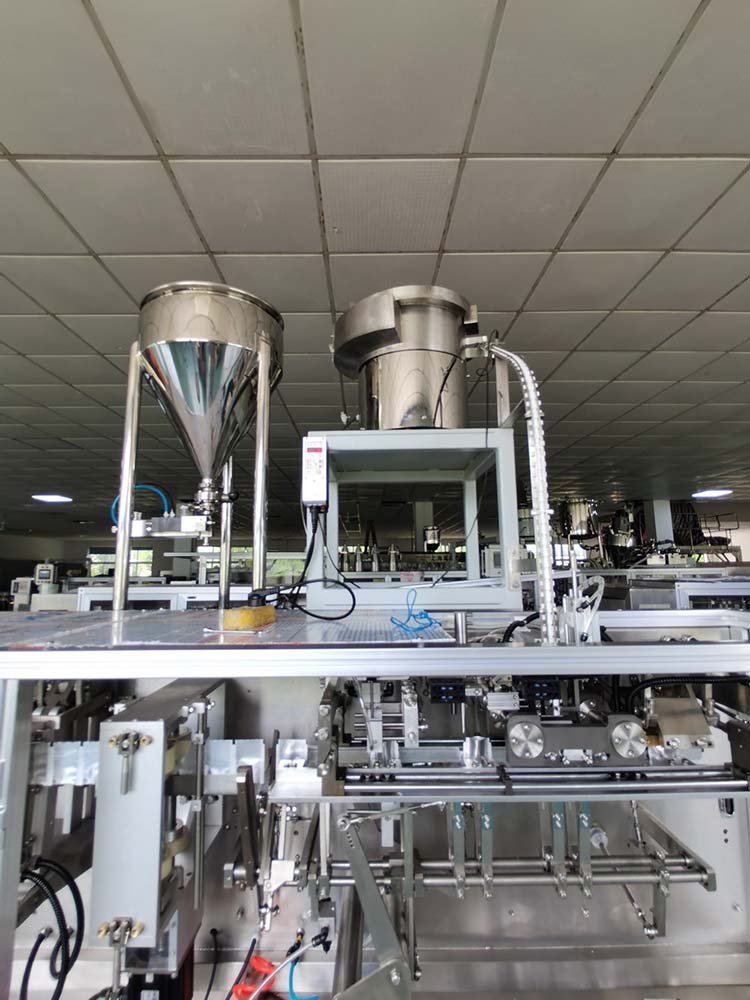
Hopper and upper feed assemblies on the HS-160 packaging platform
Hopper and feed assemblies above the pouch stations.

100 mL / 60 PPM is a pump listing. The proposed servo micro-rotor pump meters the dose by controlled rotation. The finished top-spout flat-pouch references remain 50 mL for simplex and 30 mL for duplex. A pump entry alone cannot size the pocket or establish the number of sealed, accepted packs per minute.

The main-machine quotation identifies SS304 contact parts. The pump is listed as SS316L and the ST-50L tank has an inner 316L surface and outer 304 surface. Ask for the final wetted-parts list through the nozzle, including flexible connections, valve seats and seals. The maximum useful portion depends on pump control, usable space in the pouch and the time available before closure.

Fruit preparations and dairy liquids

Describe pulp dimensions, suspended solids, air pickup, temperature and any settling while the line pauses. For dairy formulas, specify product handling, cleaning release and any required process-temperature records. The trials should use the production formulation.

Honey, jam and sauces

Supply the thickest expected batch at the normal filling temperature. Note strands at cutoff, grains, seeds, separated oil or pieces. The quoted pump has a reflux and reverse-draw arrangement. Observe the first discharge after a pause and the film around the flange.

Sports gels and cosmetic portions

Give the required dose, the product’s flow through the chosen opening, and how the customer dispenses the last portion. For lotions, shampoo and other personal-care liquids, describe foaming and adhesion to the neck. Include the smallest repeat batch when several formulas use the same equipment.

Product trial matrix: flow, foam, particles and short runs
Match the trial to the product at its working temperature
At the fillerConfiguration and trial check
Free-flowing liquids & syrupsKeep feed pressure stable; check splash, air pickup and individual net content at cutoff and after a refill.
Lotions, smooth gels & honeyReview rotor or piston metering, nozzle geometry and reverse draw. Check stringing, product left in the line and the first pack after a pause.
Purée, pulp or piecesMeasure the largest particles and fibres. Match pump, valve and nozzle clearances; compare portion consistency and product condition after transfer.
Foaming shampoo or detergentReview feed pressure, fill profile and nozzle travel inside the actual opening. Check foam height, settled net content and product deposits on the sealing band.
Several short-run formulasIdentify common or dedicated contact sets. Measure startup product, end-of-run hold-up, cleaning consumption and the time to a released first pack.

Compare piston and rotary-pump filling or use the foaming-liquid trial guide when selecting the nozzle and filling profile.

Record the setup with the first approved sachet

Give each setup a film, fitment and tooling revision. Store the fill setting, nozzle position, web register and sealing settings with a labeled first-off pack. An operator changing only the recipe on the screen may still need different feeder guides or a different contour tool. Mark those adjustments on the signed changeover sheet.

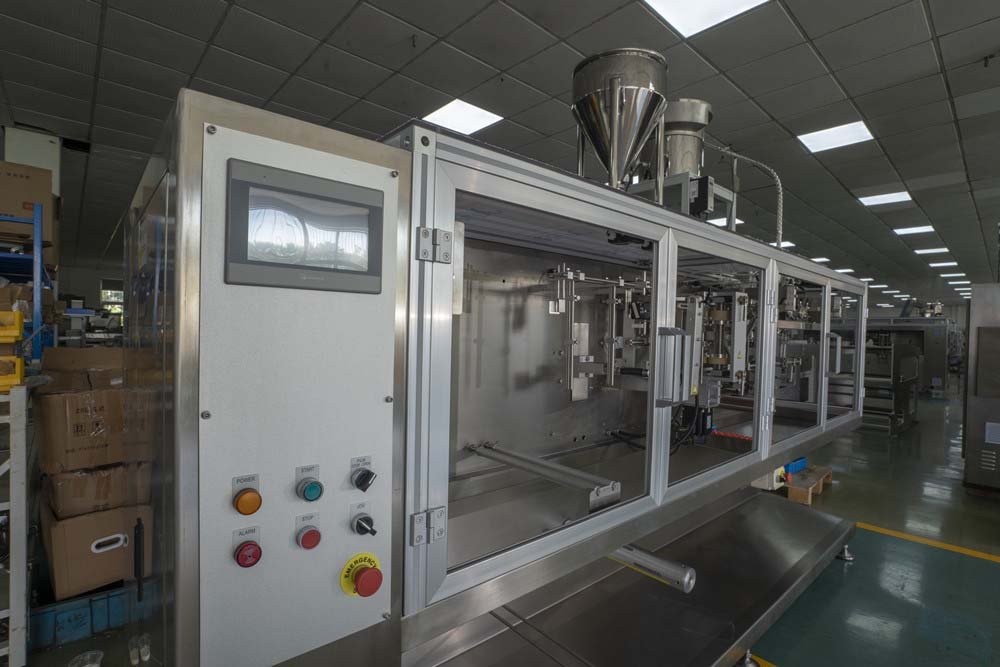
Operator panel and guarded stations on the HS-160 horizontal packaging machine
Operator-side view of the controls and guarded stations.

Flange seal and closure

Make the seal around the flange repeatable

A top-spout sachet brings a molded flange between two film panels. The flange changes the thickness across the closing area. Identify the film sealant layer and the fitment resin, then have the film supplier, fitment supplier and machine builder approve the same sample. A sound edge seal does not establish seal quality at the two flange-to-film transitions.

At the trial, retain filled packs at startup, during normal running and after a restart. Mark the orientation and keep the corresponding film and fitment lot numbers. Inspect for local creasing, a displaced flange or a trail of product through the closing area. Choose a leak or seal-strength method appropriate to the filled package, with a clear decision for each sample.

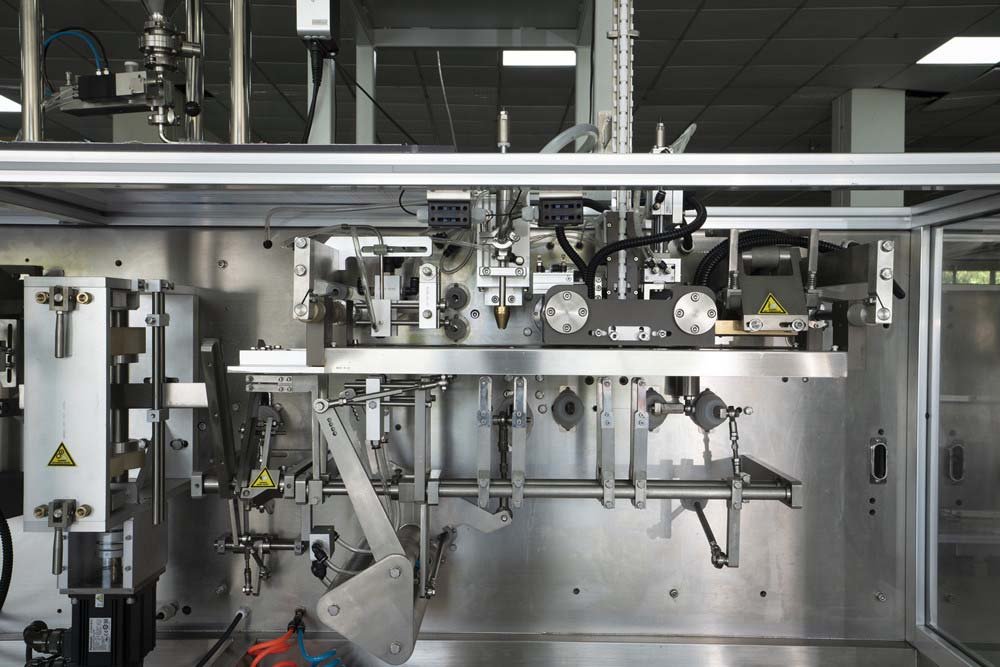
Pouch-transfer and sealing-area mechanisms on the HS-160 platform
Pouch-transfer and sealing area. Jaw tooling is matched to the approved drawing.
  1. Film and registerReel, forming tools and printed repeat.
  2. Dose and fitmentOpen edge, filler, flange and cap supply.
  3. Inspect and dischargeSeal checks, coding, rejects and count.

Agree the station sequence before tooling release

Start the station drawing at the reel and follow the registered web into the forming tools. Identify the points where the sachet is held open, receives product and receives the fitment. Mark when the flange weld and remaining seals are made, how the cap arrives and where coding, rejection and counting take place. Obtain the specific station order for the proposed machine.

How the fitment and cap arrive
Closure and fitment scope
Supplied stateWhat the quotation must identify
Preassembled cap or plugFeeder clearance, tool clearance and any closure operation actually needed. Do not order a capper merely because the pouch has a spout.
Loose capsCap supply, positioning and tightening, specified torque or opening check, and the reject path for a missing or incorrect closure.
Fill through the neckPouch support, minimum usable bore, nozzle access, contamination control and closure sequence.
Special opening or safety featureAnti-choking design, child resistance and tamper evidence serve different purposes. Name the closure part, market and required package-level test.

Changing film? For mono-PE or mono-PP, trial the film sealant, spout resin, jaw profile and cooling together. Inspect both flange transitions at steady running and after a restart. For hot filling or retort, the product owner defines the process; test the filled film, fitment and closure after that process.

A fill-through-spout design is another possible arrangement. SN Maschinenbau describes its HSF 100 as forming a pouch with a center spout and then filling through the spout. This requires a usable bore and access to the neck during filling. Use the HSF 100 station description to compare that process with the spout insertion and filling/capping guide when the quotation uses both terms.

Pouch fit calculator

Check the bag drawing against both machines

Enter finished body width, body height and fill volume. The comparison uses the published rectangle and volume for each model. It cannot calculate headspace or clearance around the fitment from the outside dimensions. Add order size and net production minutes together if you also want to compare the required count at discharge.

Use the two worked orders below or compare the model specifications to check your drawing.

Review this format with INMAYPACK

Outside a listed size or planning a short run? Request a review of your pouch drawing.

75 × 125 mm · 25 mL

For an order of 18,000 good pouches in 300 net minutes, production needs 60 accepted packs/min. At 75 × 125 mm and 25 mL the drawing falls within both published size and volume references. A single simplex machine is listed up to 40 bags/min. The duplex is the configuration to put forward for a trial at the requested rate.

100 × 160 mm · 45 mL

A 100 × 160 mm, 45 mL drawing changes that decision. Both width and volume exceed the duplex references. If 9,000 good packs are due in 300 minutes, the order needs an average of 30/min. The simplex can be considered on published dimensions and dose. Ask for a trial and a schedule allowing for short runs, cleaning and waste.

Use net time consistently. If the production plan already allows for a changeover, avoid deducting those minutes again. If the packing line shares a feed tank or a downstream cartoner, give the hours available for this order. A low daily quantity can be made in one short batch.

Applications and market references

Which configuration fits your product and order?

Compare two drawings inside the HS-160 series, then see how a heavier fill, a larger pouch or a short repeat order changes the equipment decision.

These are application planning examples, not customer installations or measured results.

45 mL · HS-160TS

Cosmetic lotion

100 × 160 mm · 30 good packs/min target The pouch is too wide for duplex. Start with simplex.

Read the configuration and trial plan

A wider flat pouch for a travel-size lotion

A personal-care producer is planning a 45 mL lotion in a 100 × 160 mm flat pouch with a top spout. The example order is 9,000 accepted packs in 300 net production minutes, requiring an average of 30 good packs per minute. The brief prioritizes clean dispensing, an attractive seal around the neck and manageable cleaning between formulas.

Configuration to evaluate. The HS-160TS simplex is the appropriate starting point against the published body-size and volume references. This drawing exceeds the HS-160TSD duplex width and volume references. Start the filling assessment with the servo micro-rotor dosing arrangement and review the supply tank, product temperature, nozzle position and reverse-draw setting using the production lotion. Specify the flange tooling and the supplied state of the spout and cap as separate items.

Trial, acceptance and buying decision

Trial and acceptance. Inspect the seal area for lotion carryover after startup, during steady operation and after a short stop. Measure net content using controlled tare values, then evaluate leakage, cap operation and how easily the user empties the pack. Record the product remaining in the tank, pump and hoses at the end of the batch so the producer can compare short-run operating costs.

Procurement decision. Choose the platform from the whole pack drawing before comparing speed. Add a second lotion or shampoo SKU to the tooling and cleaning review if it is part of the launch plan.

Review my lotion pouch and product sample

25 mL · HS-160TSD

Energy gel

75 × 125 mm · 60 good packs/min target The target is above the simplex listing. Trial both duplex outlets.

Read the configuration and trial plan

Duplex planning for a compact energy-gel pack

A sports-nutrition manufacturer proposes a 25 mL gel in a 75 × 125 mm flat pouch. The planning order is 18,000 accepted packs in 300 net minutes, or 60 good packs per minute. The top spout must dispense the gel cleanly while leaving enough film around the flange for a consistent seal.

Configuration to evaluate. The dimensions and dose fall inside both published format references. The required rate exceeds the simplex reference, making the HS-160TSD duplex the configuration to take into a product trial. The quotation should identify the dosing, fitment supply, inspection and reject arrangement for each pouch position. Define the cap delivery state and the station sequence before releasing the tooling.

Trial, acceptance and buying decision

Trial and acceptance. Use the production gel at its specified working temperature. Observe stringing, trapped air, dispensing through the chosen opening and contamination at the flange transition. Record net content and accepted output separately for both outlets. Include refill, brief stop and restart conditions, and test the downstream collection or cartoning interface at the same operating rate.

Procurement decision. Compare accepted packs over the agreed run period, including the defined loss categories. A two-position mechanism alone does not establish the usable shift output. For a later larger gel pack, review width, volume and the complete tool set again.

Compare a duplex configuration for my gel pack
Pet purée100 g · larger flat pouch

Start with product flow and the preservation process

A pet-food producer is developing a 100 g purée in a resealable flat spout pouch. An initial 110 × 180 mm body drawing and an order of 9,000 accepted packs in 300 net minutes are planning inputs. The buyer needs to accommodate fibres or soft particles, retain a clean closure and define the product’s preservation process.

Configuration to evaluate. Measure density at the filling temperature before translating the 100 g target into a required volume. The current HS-160 size and volume references are not a sufficient basis for this larger-dose project. Request a larger flat-pouch configuration, or compare an already-spouted premade pouch route when the converter supplies the complete pouch. Review the pump, valve passages and nozzle against the actual particle distribution and product behaviour during stops.

Trial and acceptance. Check dose consistency, particle passage, product deposits around the fitment and the filled pouch after the specified thermal or storage process. The product owner’s qualified process team should define the preservation conditions and the applicable food requirements. For a retorted package, review film, spout, closure and final-package tests as a matched system.

Procurement decision. Separate the packaging machine scope from the product-process scope, then assign responsibility for both interfaces. Include rejection, batch coding, cleanability and product recovery in the line quotation.

Review a larger flat-pouch line for my pet-food formula
Household refill250 mL · flat or standing refill

Compare the flat refill and standing refill routes

A household-product brand proposes a 250 mL liquid refill in a flat pouch, with a preliminary body drawing of 160 × 220 mm. The example order is 6,000 accepted packs in 300 net minutes, requiring 20 good packs per minute. The buyer wants controlled pouring, a closure that survives distribution and an economical launch across two fragrances.

Configuration to evaluate. Both the body dimensions and volume exceed the two HS-160 references on this page. Keep the flat-pouch brief and request a larger platform assessment. If the package must stand upright in use or on the shelf, compare a gusseted spout-pouch route. If the converter supplies pre-spouted pouches, assess the appropriate premade filling and closure line instead of purchasing unnecessary pouch-forming equipment.

Trial and acceptance. Review the formula against every wetted material, seal and hose. Test foaming during filling, drips after cutoff, package leakage after handling and the operation of the selected cap. Define any required child-resistant or other closure performance for the actual product and sales market. A cap’s appearance alone does not establish those properties.

Procurement decision. Compare landed pack cost, tooling, cleaning between fragrances, product residue, utilities and downstream handling. Provide the product safety data and actual fitments with the enquiry.

Compare larger flat and stand-up refill configurations
Nutrition concentrate20 mL · short batches

Plan around small batches and repeatable changeovers

A contract packer plans a food-based nutrition concentrate in a 20 mL top-spout flat pouch. The starting drawing is 75 × 120 mm, and the example batch is 6,000 accepted packs in 240 net production minutes, equivalent to 25 good packs per minute. Three formulas are planned, with the same proposed outer pack and different product characteristics.

Configuration to evaluate. The HS-160TS simplex is a starting candidate against the published format references. Establish the controllable dose and actual pocket volume with product and packaging trials. Assess the servo micro-rotor arrangement together with short product connections, accessible wetted parts and suitable batch identification. Keep the food-product brief separate from any medicinal or aseptic requirement.

Trial and acceptance. Measure product hold-up and the quantity required for stable first-off packs. Compare net content at startup, during the run and after a pause. Run the agreed changeover from the last accepted pack of one formula to the first accepted pack of the next, including cleaning and quality release. Verify the code, package identity and closure against the approved SKU record.

Procurement decision. Compare the total cost of short batches with a premade open-edge filling route if the launch volume is small. Define which contact parts and format tools can be shared, and price any dedicated sets before ordering.

Plan a multi-formula spouted-sachet configuration

Small samples and larger flat pouches

For a 2 or 10 mL sample, send the smallest repeat batch, dose tolerance and supplied bag. For a 100, 250 or 400 mL flat pack, send the body drawing, fill, headspace and fitment for a larger platform review. Neither request has to become a stand-up pouch.

Compare published pack and machinery references
Public packaging and machine references — not INMAYPACK installations
Named referenceWhat it changes in the purchase
IMPAK · small bottom-fill packsSP02OZ022MM · 2 mL (31.75 × 63.5 mm) and SP0204W6MM · 10 mL (50.8 × 101.6 mm) arrive already spouted and fill from the bottom. Both are narrower than the 60 mm HS reference. The capacities refer to water, not the minimum HS dose.
IMPAK · fill through the spoutSP20MLVF43BFTS · 59 mL uses the neck opening. Send the actual supplied bag, not just its nominal volume, to compare a premade line with roll-film equipment.
ACEPACK · larger flat-pouch machinesS-180DC and S-180C specifications: the S-180DC lists a 100 mL maximum and up to 90 × 180 mm; the S-180C lists 400 mL and up to 180 × 225 mm. These are ACEPACK references, not HS limits or guaranteed simultaneous maxima.
SÜDPACK, SN Maschinenbau & MENSHENFruit-purée pouch project: the SPM 50 makes empty spouted pouches and loads them onto rails for a separate filler. Agree neck support, rail infeed and where the count changes from empty pouches to accepted filled packs.
Ajinomoto USA & Jel SertPackaging World’s 2006 Amino Vital Jel report describes a 140 mL side-gusseted, reclosable stand-up pack contract-packed by Jel Sert. Its standing base calls for a different route from a flat sachet.
Discuss a similar pack

Factory acceptance

Accept the pouch, the closure and the count together

Agree the acceptance run with purchasing, production and quality. Use the saleable formulation, the converter’s production film and representative lots of spouts and caps. Identify the output counter and what gets rejected before that point. The trial sheet should also say whether the rate is measured over a stable period or over a run that includes agreed interruptions.

Before release, agree the dose limits, flange seal, restart checks and accepted count for each outlet.

Open the seven-point factory acceptance record
Records for the factory acceptance test
Checkpoint What to measure or retain Decision to agree
Dose and flow Individual net amounts, controlled tare, product temperature, calibrated scale, sample count, average and individual limits, with separate records per outlet. Use measured density if converting between mass and volume. Which limits apply to each pack? Check both positions on duplex equipment and sample after a refill.
Flange, body and cap Finished dimensions, spout position, retained samples marked at both flange transitions, cap condition and opening or reclosure behavior. Does the pack meet the drawing? Which leak, opening or closure checks release the lot?
Feed and restart Record a normal refill and a controlled stop/restart. Identify first-off packs and anything rejected before normal production resumes. Who authorizes restart, how are rejects separated, and when does accepted output resume?
Output and handover Timed run, total pouches, accepted pouches, rejects, interruptions, tooling and recipe revisions. Do the accepted packs meet output and quality together? Keep retains and agreed outstanding actions.
Pack and lot identityDrawing and tool revisions, formula batch, film lot, fitment and cap part numbers.Which signed-off drawing, physical sample and run length release this SKU?
Detection and rejectionWhere the equipment is supplied, challenge a missing fitment, missing cap or wrong code using agreed test packs.Trace the rejected unit to its destination and exclude it from accepted output on the correct outlet.
SKU change and releaseRecord the last accepted SKU-A pack and first accepted SKU-B pack. Include tool changes, cleaning, startup losses and quality release.Which steps and parts are shared? Use elapsed time and measured hold-up from the actual change.

Clean the entire wetted path

A direct CIP connection is listed for the micro-rotor pump. The ST-50L tank includes a spray ball, level detection and cleaning-related fittings. Trace the circuit from the tank to the end of the nozzle, including hoses, valves, gaskets and branches. Agree which pieces are washed in place, which are removed, where fluid drains and what the next recipe must pass before release.

When moving between two cosmetic fragrances or from a dark sauce to a light one, retain an approved first-off sample after cleaning. Include product recovery, waste film, spare seals and time to rethread the film in the changeover record. The liquid-pouch filling accuracy guide covers tare and sampling when acceptance depends on an individual pack. Agree an application-specific residue or microbiological release method with the product team.

Site acceptance with the connected line

Repeat the agreed checks on site with the actual supply, utilities and downstream equipment. Test run/ready/fault signals, accumulation, restart, coding and reject tracking. Close open FAT actions and record which supplier owns each interface. Use the pouch seal-integrity guide for test questions; select the method separately for the flat-film edges, flange and closure.

Quotation and handover

Obtain comparable prices for the complete line

Send the material and temperature, dose in mL or grams, required tolerance, drawing with units, film specification and a loose spout and cap. Include each order size, production calendar and the destination. The supplier can use this brief to quote a line for a particular finished pack and identify the next sample it needs.

Specify the machine and format tools

List the chosen simplex or duplex platform, each bag outline, the position of the spout and the number of tool sets. Separate the forming parts, fitment feeder, optional elevator, welding jaws, die-cut mold and coding. Ask which items a future SKU can share.

Price the product path

Include the supply tank, pump, valves, transfer line and nozzle for each formulation. Identify who supplies the upstream mixing or holding equipment, clean utilities and drainage. Give ceiling clearance and the connection points so a refill can be made during production.

Price the delivered output

Define cap supply and application, any cap checks, detection of a missing fitment, leak inspection, rejects and discharge. If an operator counts or packs the finished sachets, specify the output at that point and the amount of accumulation permitted.

Roll stock or premade?

Compare cost per accepted pack

Conversion cost per good pack = total comparable production cost ÷ accepted packs. Include film or bought pouches actually consumed, fitments and caps, labour, utilities, cleaning, tool and machine allocation, maintenance and product lost at startup or left in the line.

Use the same order mix and smallest repeat batch. If material spend already includes wasted film, do not charge that waste twice. Compare installed cost, minimum material orders, changeovers and residue; a cheaper empty bag does not by itself make a cheaper filled pack.

Agree the responsibilities at handover

Request installation drawings and a list of commissioning conditions. Record who provides film, product and fitments for factory and site testing, who approves the first sample and who signs off a design change. Ask for the lead-time start point, training, manuals, recommended spares and destination-specific service terms, quote validity, shipping basis, installation, warranty and payment milestones in the quotation.

Use the packaging machine RFQ builder to assemble the pack brief. For more equipment after the pouch discharge, include turnkey line integration in the same enquiry. The service and support team can review duties at installation and future format changes.

Request an itemized quote

Before you order

Top-spout flat-pouch questions from buyers

What is a top spout flat bag packing machine?

It is equipment configured to package a product in a flat pouch with a dispensing fitment at the top. The HS-160 route on this page starts from roll film and forms four-side-seal flat packs. The filling, spout insertion, sealing and closure operations should be defined in the machine’s station drawing.

Does the HS-160 feed finished premade pouches?

The reference HS-160 proposal is a roll-film HFFS configuration. A premade pouch with an open bottom needs a different feeding and sealing arrangement from a pouch filled through its spout. Send the incoming pouch in its supplied state so the correct route can be selected.

How do I choose between simplex and duplex?

Compare body size, dose and required accepted output together. The HS-160TS reference covers a wider body and up to 50 mL. The HS-160TSD reference is narrower, up to 30 mL, with 70–80 bags/min already counted as total output. Use the order calculator, then validate the complete pack in a trial.

Can I ask about a 2 mL or 10 mL sample pack?

Yes. Send the pack drawing, required dose tolerance and smallest repeat batch. Small flat-spout packs exist in the market, including open-bottom premade formats, but their dimensions may fall below the current HS-160 references. The review should cover tooling, controllable dose and whether a premade filling route better fits the launch volume.

Can INMAYPACK review a 60, 100, 250 or 400 mL flat pouch?

Yes. Submit the flat-pouch brief for a wider platform assessment. These volumes should not be added to the HS-160TS or HS-160TSD specification columns. Keep the package flat if that is the intended design; select a stand-up route when the pack needs a suitable standing base.

Does spout insertion include automatic cap tightening?

Spout insertion positions and seals the fitment into the film. Cap supply and tightening are separate operations. If the fitment arrives preassembled, identify whether the machine needs to operate the closure. If it arrives uncapped, the quotation should specify the cap-handling station, closure requirement and nonconforming-pack handling.

Which spout dimensions are needed?

Provide the internal bore, neck profile, support ring, flange cross-section, cap outside dimensions and supplied assembly state. Include the fitment supplier’s part number and samples. Two assemblies with a similar cap diameter may need different feeder guides and sealing tools. For an offset spout, mark its centerline from a fixed edge. Send revised drawings plus the finished pouch, production film and loose fitments; the feeder guide, gripper clearance, die or jaw may need to change.

Are anti-choking, child-resistant and tamper-evident caps the same?

No. They address different aspects of package use and opening. Select the required features for the product and market, then review the complete closure system and the evidence supporting it. The machine configuration should match the specified assembly and its test requirements.

Can honey, lotion and gel use the same filling equipment?

They may share parts of a configuration, but the selection depends on working-temperature flow, particles, foaming and the required dose. Test the thickest or otherwise most demanding formula and record product hold-up, cutoff and cleaning. Specify shared and dedicated contact parts for each SKU.

Does the pump’s 100 mL rating increase the machine’s pouch capacity?

No. It is a dosing-component listing. The finished pouch also depends on usable film space, the fitment, forming tools and cycle time. Use the separate finished-pouch reference for each model and the approved pack trial.

Can the line use mono-material film?

A mono-PE or mono-PP proposal needs a matched review of the film sealant, spout resin, tooling and processing window. Trial the actual material at normal running and stop/restart conditions, then evaluate the complete package. A recyclable-film description alone does not establish compatibility with a specific setup.

What is needed for hot filling or retort applications?

Provide the product owner’s defined process conditions and the complete package specification. Review the film, spout, cap, filling conditions, handling and final-package tests together. The packaging equipment scope and the product’s preservation process should have clear acceptance responsibilities.

Does a CIP connection clean the whole line?

A connection is part of the cleaning design. The complete product path still needs a defined procedure, suitable access or removal of parts, drainage and an application-specific release method. Review the tank, pump, valves, hoses and nozzle as one system.

How long does a format or product change take?

Measure the actual change on the selected equipment and products. State whether the timing includes emptying, cleaning, changing tools, threading film, replacing fitments and quality release. The useful production measure is the time between the last accepted pack of one SKU and the first accepted pack of the next.

What determines the price and delivery schedule?

The platform, format tools, dosing system, fitment and cap operations, inspection, downstream equipment and installation scope determine the quotation. Delivery should be tied to the agreed technical approval, sample requirements and commercial milestones. Send your launch schedule and planned future formats with the first enquiry.

Project review

Send your top-spout project for review

A pouch photo is enough to start. Tell us whether you receive roll film, an open-edge pouch or a pouch to fill through the neck. If you have them, add the product and filling temperature, body drawing and capped height, spout/cap part or sample, fill and tolerance, accepted output or order and net minutes, smallest batch and destination. We can then identify the model, tooling and samples to review.

Request a top-spout configuration
Contact INMAYPACKsales@ewpackmachinery.comWhatsApp +86 18658799162

About INMAYPACK and Forester Xiang

INMAYPACK was founded in 2009 in Shanghai, China. Forester Xiang is the founder and chief packaging engineer.

INMAYPACK engineering facts
Headquarters Shanghai, China
Founded 2009
Founder and chief packaging engineer Forester Xiang

About INMAYPACK engineering

Tell Us About Your Packaging Project

Send your product and package details. INMAYPACK will review the application before recommending a machine configuration.

✓ Application reviewed before recommendation

✓ Project details stay private

✓ Configuration-specific technical reply