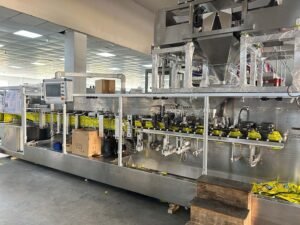
Foaming liquid pouch filling must be judged by the accepted filled-and-closed pouch, not by pump output or the appearance of the liquid level alone. Identify where foam first appears, review the product supply and nozzle sequence, then test dose, contamination of the closing area and accepted output together.
This guide helps buyers specify trials for foam-prone liquid products in flexible pouches. It covers the handoff from product supply to filling and closure. Use the liquid packaging machine selection hub for the equipment route; here the task is to define evidence for a workable filling window.
The checks and matrices below are proposed evaluation tools, not INMAYPACK foam measurements or a guarantee of foam-free operation. Filling actions, foam-handling devices, nozzles and compatibility require review for the actual product, pouch and quoted configuration.
Locate the first foam observation before changing the filler
Record whether foam is already visible in the supplied product, appears during discharge, or becomes a problem as the pouch moves toward closing. These are different observations and may involve different equipment owners. A photograph of foam at the finished pouch cannot establish where it originated.
Identify the product batch, approved preparation method, temperature at filling, hold time, transfer route and relevant operating state. If the supplied product condition changes during the trial, mark the change. Review observations made through approved inspection or sampling arrangements; do not open guarded equipment or disconnect a live product circuit to investigate.
Proposed observation map. Scroll horizontally on small screens; keyboard users can focus the table and use arrow keys.
| Observation point | Evidence to retain | Question for the review |
|---|---|---|
| Product presented to the dosing system | Batch, preparation, condition, supply arrangement and event time | Was foam present before the pouch-filling stage? |
| Delivery at the nozzle | Approved fill profile, nozzle position, product condition and identified video or samples | Does the observation change with discharge conditions? |
| Filled pouch before transfer | Dose result, visible foam, usable space and closing-area condition | Can the filled pouch proceed to closure in its current state? |
| After movement and closure | Transfer event, seal or cap result, rejects and accepted output | Did the complete sequence preserve the required package result? |
Keep observation and diagnosis separate. Foam appearing after a refill or restart is a useful event marker, but timing alone does not prove a pump fault, suction leak or formulation problem. Give the relevant process and equipment suppliers the same record before deciding on a corrective action.
Treat the pouch opening as a filling constraint
An open-top pouch and a pouch filled through a spout present different access conditions. Confirm where product enters and which area will subsequently be sealed or capped. A spout shown in a photograph does not establish that filling takes place through it.
Review the actual drawing and samples for nozzle access, support of the pouch, the product-delivery path and the space needed for displaced air to leave during the proposed fill. Ask the supplier to show the nozzle's permitted position and withdrawal sequence. Do not copy a nozzle diameter or insertion depth from an unrelated container.
The available package space must be assessed with the approved dose and product condition. A pouch that accepts a calm laboratory sample may behave differently during the production sequence. Check the area that must remain suitable for top sealing, or the spout and cap interfaces where those are the closing route.
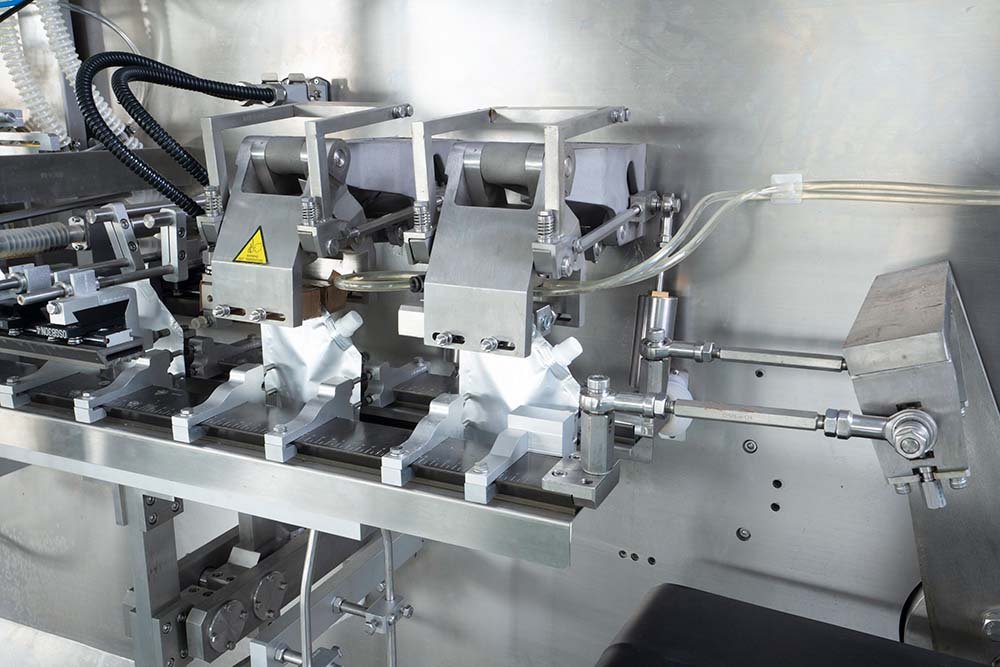
Review product delivery, nozzle motion and closure timing as one sequence
A filling proposal should identify what controls product delivery and what controls nozzle position. Pump type, dosing principle and nozzle motion are separate choices. The piston versus rotary pump guide explains the dosing comparison; neither name alone establishes the behavior of a foam-prone product in a pouch.
FILAMATIC's filling-action discussion describes bottom-up filling as one approach used for products prone to foaming or splashing, with nozzle motion coordinated to the rising product. Its examples concern its own equipment. A flexible pouch's access, support and cycle must still be reviewed; this is not a universal instruction to insert a nozzle into every pack.
Where a supplier proposes a changing delivery rate, moving nozzle or staged fill, request the actual sequence and its limits. Include approach, filling, cutoff, withdrawal, pouch transfer and closing. Determine which steps share a station and which consume time before the next accepted package can be produced.
Foam-handling hardware is also a configuration question. Volpak's Home Care flyer describes selecting filling and foam-extraction systems for foaming soaps according to product and production speed. It illustrates why the proposed assembly matters; it does not establish that a foam-extraction device is included in an INMAYPACK quotation.
Review a process change as a change. Extra settling time, a revised fill profile, added equipment or a formulation change can alter the project boundary. Record the proposal, responsible party and affected acceptance requirements. Do not silently change the product or exclude the added time to make a demonstration appear to pass.
Test the real product through the operating events that can disturb it
Agree the production-representative product, batch preparation, temperature, pouch construction, dose, supply conditions and machine configuration before the trial. State the applicable measurement method and who can authorize changes. Water or an unapproved substitute may support a limited mechanical check, but it does not close the original product's foam requirement.
Use a sample plan linked to operating events and filling positions. Select the groups relevant to the purchase rather than treating every possible event as mandatory. Preserve the sequence around a disturbance, including failed packs, authorized adjustments and the conditions at which running became stable again.
Proposed foam-prone product trial matrix. The approved project plan defines sample counts, duration, limits and permitted adjustments.
| Trial group | Conditions to identify | Results to connect |
|---|---|---|
| Stable running at the required production setting | Product batch, temperature, dose, filling position, recipe and pouch lot | Individual dose, foam observation, closing-area condition and accepted output |
| Normal replenishment | Supply event timing, relevant level or transfer state and sample order | Results before, during and after the event |
| Approved stop and restart | Hold condition, restart sequence and any adjustment | First-pack disposition, foam and closure results until stable running resumes |
| Another approved recipe or package | Product and pouch change, parts, settings and cleaning/release status | Whether the revised configuration still meets the combined requirement |
If nozzle motion or delivery settings are changed, keep the previous and revised trial groups separate. Confirm that the change is permitted for the equipment and product before testing it. Retain enough information to reproduce the approved condition rather than saving only a successful video.
Read dose, foam, closure quality and output on the same basis
A visible foam level is not a measurement of the quantity of liquid supplied. Use the approved net-dose method and retain individual results in sequence. The liquid pouch filling accuracy guide covers the measurement basis and interpretation of dose results.
Keep foam observations tied to a defined point and time in the sequence. A pouch inspected immediately after filling and one inspected after an unrecorded wait are not equivalent observations. If a delay is part of the proposed process, include its equipment, handling and effect on accepted output in the trial.
Record splash, product strings, dripping, wet closing surfaces, seal defects and cap-related failures separately. They can occur alongside foam without being the same failure. A corrected dose result does not close an unresolved seal or cap result, and a clean closure does not establish the correct dose.
Count accepted packages over the agreed elapsed interval, with rejects, stops and interventions visible. Define the inclusion of replenishment, waiting and restart before comparing trials. Do not compare a pump's delivery rating with accepted pouch output or omit recurring delays from one configuration's result.
Make the quotation show who owns the foam-related requirements
Request a defined product-supply boundary, dosing assembly, nozzle arrangement, pouch-handling route and closing equipment. Identify what is included, optional, provided by the buyer or dependent on another supplier. Where a proposed foam-handling function affects the product path or cleaning, ask for the relevant arrangement and verification requirements.
The product owner controls the approved formulation and product-release requirements. The equipment proposal must identify the operating conditions it is intended to accommodate. The acceptance plan connects those responsibilities with the actual product and pouch, so a failed result is not passed between suppliers without a named next action.
Release the configuration against identified drawings, settings, product and packaging revisions, test records and remaining-item decisions. A change in formulation, temperature range, supply method, pouch opening or nozzle assembly requires review of the affected evidence. Earlier approval should not be transferred automatically to a changed condition.
Buyer questions about filling foaming liquids into pouches
Does bottom-up filling guarantee foam-free pouch filling?
No universal result is assumed. Review whether the proposed pouch and machine can accommodate the nozzle motion and complete cycle, then test the actual product and package. A general filling-action example does not establish a supplied option or performance guarantee.
Can a longer waiting time solve the acceptance problem?
It may be a proposal to investigate, but it must be recorded and tested. Include any waiting, handling, space and effect on accepted output in the process boundary. Do not inspect a rested sample while reporting the rate of a different, uninterrupted sequence.
Does foam above the apparent fill level prove overfilling?
No. Use the approved dose measurement rather than the visible foam level alone. Record quantity, foam condition and closure results separately, then evaluate them against the same trial identity and conditions.
Can an empty-pouch demonstration approve a foaming product?
It can demonstrate limited pouch handling under its stated conditions. It does not establish wet filling, foam control, dose accuracy or closure quality with the intended product. Keep those remaining tests explicit.
Send the product condition with the pouch requirement
Share the formulation description, filling temperature and preparation conditions, dose, pouch drawing, supply arrangement, required accepted output and available sample observations. INMAYPACK can review the requested configuration and the product trial needed for a proposal.
Sources linked above: FILAMATIC's filling-action article and Volpak's Home Care flyer. They provide manufacturer examples, not INMAYPACK option lists or test results. The observation map and trial matrix are proposed planning tools; no universal pressure, nozzle depth, settling time or output is specified.