Choose between piston and rotary pump filling by the product entering the dosing system, the required dose range and the time available to deliver it into the pouch. A piston system meters through a controlled cylinder stroke; a rotary positive-displacement system moves product through repeated rotor displacement. Neither name, by itself, establishes the finished-pouch accuracy or the best choice for your recipe.
This guide is for buyers specifying liquid or paste dosing as part of a pouch packaging system. It compares the selection questions behind the mechanisms—not brands, universal performance ratings or stand-alone bottle fillers. Start with the liquid packaging machine routes if the package format is still undecided.
First separate pump type, drive type and pouch motion
Equipment descriptions often combine three different choices. “Servo” describes a drive or motion-control arrangement. “Piston” describes a displacement mechanism. “Rotary” may describe a pump, but it may instead describe the machine carrying pouches between stations. Read those terms separately before comparing quotations.
- Reciprocating piston filler: a piston moves within a cylinder, with a valve arrangement directing product into the chamber and then toward the filling nozzle.
- Rotary pump dosing: rotating pumping elements move product; a dosing application must also define how their motion, discharge and cutoff are controlled.
- Rotary pouch machine: the package carrier indexes or rotates between operations. It does not identify the metering mechanism.
- Servo-controlled filling: this can describe either mechanism, depending on the actual design. It does not mean that each filled pouch is weighed.
Also ask what “rotor pump” means in the specific offer. A rotary lobe design, a gear design and a reciprocating piston assembly are not interchangeable names. Obtain the pump identification and product-path drawing rather than assigning a mechanism from the sales label alone.
A useful distinction: a piston filler is itself a positive-displacement device. The choice here is not “piston versus positive displacement”; it is between particular displacement mechanisms and the complete dosing assemblies built around them.
How piston and rotary pump dosing differ
Piston filling: cylinder displacement and a refill stroke
In a reciprocating piston filler, the cylinder and working stroke establish the nominal displaced volume. The filling sequence must admit product, change the valve state and discharge toward the pouch. Accutek’s piston filling overview describes this as volumetric positive-displacement filling. The useful procurement question is which cylinder, valves, drive and nozzle are proposed together for your dose and product.
Ask how dose adjustment is achieved and when a cylinder or other change part is needed. A large stated maximum dose does not show that a much smaller dose has been demonstrated on the same assembly. Equally, a proposal using multiple strokes for one pouch must account for those strokes in its filling sequence. Request the actual arrangement rather than assuming every size change is a recipe-only adjustment.
Rotary pump filling: displacement during controlled rotation
A rotary lobe pump is one rotary positive-displacement design: its rotating elements move product through the pump. Fristam’s FL2 description illustrates a bi-wing rotor configuration. This is an explanation of a pump principle, not a statement that an INMAYPACK proposal includes that manufacturer or design.
For a rotary-pump dosing proposal, ask how the controller turns pump motion into a dose: the commanded rotation, speed profile, calibration and discharge-valve sequence all need to be defined. Confirm whether the assembly has independent dose measurement or relies on calibrated displacement. A transfer pump that supplies a hopper is not automatically the component metering each pouch.
Product behavior matters as well as geometry. Fristam’s shear-thinning application report explains that pumping can change viscosity and that internal slip reduces volumetric efficiency. Its application is not an INMAYPACK filling trial. The selection lesson is to assess the actual operating product, not only a viscosity value measured before processing.
Compare the product and dose requirements that can change the choice
Use the following matrix to identify questions for each proposed assembly. It is a design-review tool, not a declaration that one mechanism accepts all thin liquids, thick sauces or particles. Ask the supplier to mark each requirement as demonstrated, requiring a different configuration, or still unresolved.
On a small screen, scroll the table horizontally. Keyboard users can focus the table area and use the arrow keys.
| Your requirement | Piston proposal: ask | Rotary pump proposal: ask |
|---|---|---|
| Smallest and largest required doses | Which cylinder and working stroke serve each dose? Are change parts or multiple strokes required? | Which pump displacement and commanded rotation serve each dose? Is the smallest dose demonstrated with the selected cutoff? |
| Product changes with temperature or mixing | Will the chamber refill consistently at the specified product conditions and cycle? | How are calibration and delivered dose checked across the specified product conditions? |
| Particles, fibers or fragile inclusions | Show the passage through the inlet, valves, cylinder outlet and nozzle—not just the cylinder bore. | Identify the rotor geometry and product passages, then the downstream valve and nozzle. Assess the finished product, not just its passage through the pump. |
| Foaming, entrained air or texture sensitivity | What feed, stroke and discharge arrangement will be reviewed with the actual product? | What feed, speed profile and discharge arrangement will be reviewed with the actual product? |
| Several recipes on one packaging line | List cylinder, valve, seal and nozzle changes by recipe; separate settings from physical replacement. | List pump, seal, valve and nozzle changes by recipe; separate recalibration from physical replacement. |
| A narrow spout or limited open-pouch access | Confirm the nozzle and delivery sequence within the package opening and available filling time. | Confirm the same package constraints; pump capacity alone does not establish usable pouch output. |
Turn the matrix into a practical shortlist
Keep a piston candidate on the shortlist when the proposed cylinder and valve assembly has a clear working range for your doses, a workable refill sequence and acceptable changeover requirements. Keep a rotary-pump candidate when the identified pump and controls have a clear dosing basis across your products and package sizes. If both remain suitable, compare the demonstrated package result, supplied scope and routine changeover work—not the mechanism name.
Do not eliminate a candidate just because a product is called “sauce.” A smooth sauce, an aerated sauce and a sauce with fragile pieces pose different questions. Supply a representative sample plus the product’s condition at the filler. If particle passage or texture preservation is unresolved, carry that as a qualification gate before making the purchase decision.
Fit the dosing assembly into the available pouch cycle
Compare complete sequences rather than pump flow ratings. For a piston proposal, identify the refill and delivery strokes and which operations can occur while the package is elsewhere. For a rotary-pump proposal, identify the rotation profile, valve timing and stopping sequence. For both, include nozzle positioning and the time before the pouch can move safely to its next operation.
A pump’s output in a free-flow test does not establish the accepted output of a pouch line. The actual opening, product delivery path, fill height and cutoff condition must work with the pouch-handling sequence. A wider pump operating range cannot compensate for product landing outside the package or remaining in a seal area.
- At the feed side: identify the supplying tank, replenishment arrangement and responsibility for maintaining the agreed inlet conditions.
- At the dosing side: identify whether each head has its own metering assembly or shares an upstream arrangement. Request the actual mapping.
- At the nozzle: confirm opening size, insertion or positioning, cutoff and any proposed anti-drip feature with the product and package.
- At the controls: ask what happens when a pouch is missing, filling is interrupted or the machine restarts. Record which product is rejected or requires checking.
The liquid form-fill-seal guide covers the broader connection between filling, pouch formation and sealing. For this comparison, the key deliverable is a workable dosing sequence for the selected package—not a second packaging-route decision.
What INMAYPACK equipment references establish
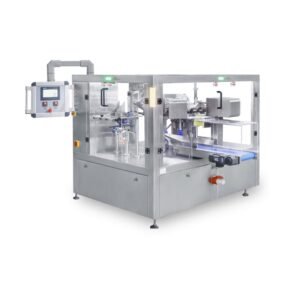
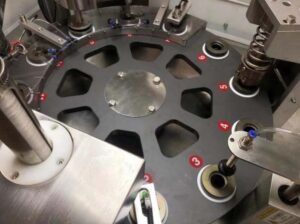
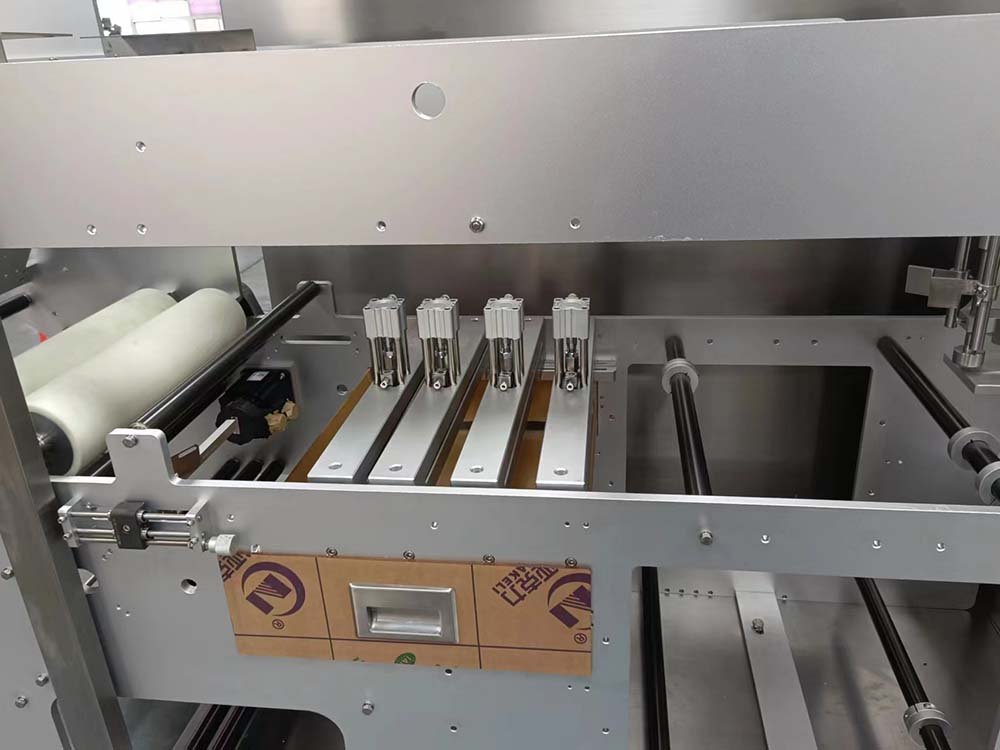
INMAYPACK’s documented six-head and twelve-head spout-pouch filling/capping configurations include piston metering. These references distinguish the pouch-handling arrangement from the filling mechanism: a rotating carrier does not establish that the dose comes from a rotary pump. Review the spout pouch filling and capping platform for that package route; the selected configuration must still be defined in the proposal.
Separate proposal documentation describes a servo rotor-pump dosing assembly and a mixing-tank module. That supports discussing a rotor-pump option at component level. It does not establish an interchangeable replacement for every piston filler, a confirmed lobe geometry, or a proven operating range for your recipe. Ask for the proposed assembly identification and its interfaces before comparing it with a piston offer.
Use these references to ask configuration-specific questions. Do not combine the capacity of one model, the pump description of another and a third machine’s cleaning claim into one assumed specification.
Compare cleaning, change parts and the complete quotation
For a piston assembly, ask which cylinder, piston seals, valves and nozzle parts are accessed or removed during a changeover. For a rotary-pump assembly, ask about the pump cover, rotors, seals, valves and discharge path. The exact tasks depend on the design; neither mechanism name establishes the cleaning method or time.
A component described as CIP-capable does not establish the cleaning scope of the hopper, hose, manifold, nozzle or surrounding pouch machine. Use the hygienic design buyer checklist to define contact parts, cleaning boundaries and evidence. Keep recipe changeover, product-contact cleaning and exterior machine cleaning as separate items.
| Quotation line | Record for each candidate | Why it changes the comparison |
|---|---|---|
| Metering assembly | Identified mechanism, drive, cylinder or pump size, valves and included controls. | A pump-only price and a complete controlled filler are different scopes. |
| Product supply | Tank, agitation if required, transfer equipment, level control and buyer-supplied interfaces. | The filler depends on an agreed product supply; upstream equipment may be a separate item. |
| Package interface | Nozzles, change parts, installation, machine signals and responsibility for integration. | A working bench assembly is not yet an integrated pouch-filling station. |
| Recipe and cleaning changeover | Included replacement parts, access, procedures, inspection tasks and training scope. | Routine work and parts ownership may differ even when both candidates fill the product. |
| Verification and support | Agreed sample run, measurement basis, documentation, spares and service terms. | Compare defined deliverables; do not assume trials or support are included. |
There is no useful universal price winner without that scope. Compare the cost of the agreed dosing installation and the work needed between your actual recipes. Do not assign a payback or running-cost saving until the relevant labor, parts, product loss and operating assumptions are available.
Make the decision at three configuration gates
- Product-path gate: the proposed assembly is identified, its passages and contact parts are reviewed, and unresolved flow, particle or texture questions have a defined test.
- Dose-and-cycle gate: each required dose has a specified setup and fits the proposed pouch sequence, including refill, delivery and cutoff. Any change parts or alternative assemblies are listed.
- Handover gate: the quoted scope assigns supply, integration, cleaning documentation, trial evidence and service responsibilities. Outstanding exceptions are visible before approval.
Before comparing accuracy claims, agree what is measured and under which conditions. Use the liquid pouch filling accuracy test framework for measurement, operating-window trials and acceptance records. This guide selects what to compare; that framework evaluates the delivered dose.
For a viscous sports formulation in narrow sticks, the energy gel stick-pack trial guide covers product preparation, nozzle cutoff, seal-area checks and lane-specific records. Confirm the proposed pump and configuration with the actual sample.
Decision rule: choose the configuration that satisfies the product, dose and pouch requirements with an acceptable changeover and support scope. If an essential condition is unresolved, qualify it with an agreed sample trial or exclude that use from the proposal. Do not select a universal winner from the words “servo,” “piston” or “rotary.”
Buyer questions about piston and rotary pump filling
Is a servo piston filler the same as a servo rotary pump filler?
No. Servo control describes the drive arrangement; the displacement mechanisms differ. Ask what the motor controls, how the dose is set and whether an independent measurement is used. Neither label establishes closed-loop measurement of every finished pouch.
Does a rotary pouch machine require a rotary pump?
No. Rotary may describe how pouches move between stations. INMAYPACK’s documented piston-based spout-pouch configurations illustrate why package motion and metering must be identified separately. The proposed filling assembly, rather than the machine’s layout label, determines the dosing principle.
Which system is more accurate for liquid pouches?
A mechanism name is not enough to answer. Compare the selected assemblies using the same product conditions, dose definition, package and measurement basis. Include the supply and nozzle behavior in the assessment; do not compare an isolated pump claim with a finished-pouch result.
Can one filling assembly handle both thin liquids and thick sauces?
Possibly, but the actual recipe range must be reviewed. Request a recipe-by-recipe record of settings, change parts, supply conditions and cleaning tasks. Confirm the difficult ends of the range through agreed trials instead of assuming that success with one product covers the others.
Prepare a product-specific dosing review
Send INMAYPACK your product description, condition at filling, minimum and maximum doses, pouch or spout details, and required accepted output. Include particle or texture concerns, recipe changes and the intended cleaning approach. These details allow the proposed metering assembly and its interfaces to be reviewed together.
Equipment selection, supplied modules, sample trials and service scope are subject to the confirmed project proposal. No universal speed, filling tolerance or cleaning result is implied.