Put two samples on the table before asking for a machine price. One should show the empty pouch exactly as it reaches your filling line. The other should show the pack you intend to sell. The difference between them tells a supplier which operations to quote.
A spout insertion machine joins a fitment to the pouch film. A filler meters product through an available opening. A capper applies the closure to the neck. If your converter supplies a sealed pouch with an open spout, filling and capping can be the whole packaging job at your plant. If you buy roll film, someone must also form the pouch and seal the film around the fitment. One detail can change the order again. A pouch with a fitted, capped spout can arrive with a separate edge left open for filling.
What work does a spout inserter perform?
A pouch fitment insertion machine positions the neck of the fitment at a specified point on the pouch and joins its flange to the sealant layer of the film. Its deliverable can be an empty pouch ready to send to a packer. The packer then has to support that neck during filling, keep product clear of the closure, apply the cap if required, and release the finished pack.
On the equipment list, underline the last operation each supplier agrees to deliver. “Spout inserted and seal checked” ends at an empty pouch. “Filled and capped” assumes a usable fitment already exists unless the quote also lists the insertion equipment. Scaldopack illustrates the distinction with two separate machines, its SI-60 spout inserter and its Monofiller for premade spouted pouches.
Choose the line from the material that arrives
Ask the converter to mark the fill opening on the drawing and show the production delivery format. A capped retail sample alone leaves both questions unanswered.
On narrow screens, swipe inside a table to read all columns.
| What arrives at the line | Where the product enters | Equipment decision |
|---|---|---|
| Finished empty pouch, spout fitted, cap supplied loose | Through the neck, if the product and nozzle fit | Quote the pouch infeed, carrier, filler, cap feed, cap application and discharge. Evaluate the premade spout pouch filler and capper. |
| Premade pouch, fitted spout already capped, a separate edge left open | Through the open edge | Scope pouch opening, filling access and final edge sealing. Confirm whether the supplied cap stays on throughout. Waldner documents a corner-spout, open-top filling arrangement. |
| Empty pouch with a reserved opening, spout supplied separately | Through the mouth or fitted neck, as shown on the process drawing | Assign the joining step and the transfer to the filler. The SG260 side-spout configuration is one integrated premade-pouch reference. |
| Roll film and separate fitments for a flat, four-side-seal pack | At the station and opening specified for that line | For a small flat pouch, review the HS-160TS and HS-160TSD top-spout route. Identify the film-forming, dosing, spout-feeding and joining stations. Ask how the closure arrives. |
| Roll film for a stand-up spouted pouch | As specified for the gusseted format and fitment | Compare the HMS160 roll-film spout pouch route. Include the base drawing, fitment position, sealing tools and filled-pack stability in the review. |
A sixth inlet condition deserves a separate note on the quotation. If a fully sealed pouch arrives with a tightened cap and filling must take place through the neck, somebody must remove the cap. Specify how the cap will be handled and whether a new one is required. A tamper-evident component can make removal and reuse impractical. Obtain the closure supplier’s decision before choosing the infeed.
A small flat-pouch example
Illustrative buying scenario. A personal-care packer is considering a 25 mL refill in a 75 × 140 mm flat body with a centered spout. One converter offers finished pouches on rails. Another supplies printed roll film and loose fitments. Both offers could produce the same retail outline. They put different work on the factory floor.
With the railed pouch, send a loaded rail and matching cap samples to the filler supplier. With the roll film, specify the body dimensions, flange and film construction to the machine builder. The example dimensions and dose fall within the published format references for both HS-160 models. The next decision is whether the required number of accepted packs per shift justifies running two positions and whether each position gives an acceptable fill with the actual lotion. Count output from both positions together. The duplex budget configuration lists two spout feeders. Request a separate line item for capping if your closure needs that operation. Have the quotation identify precisely how each pack reaches its saleable closure condition.
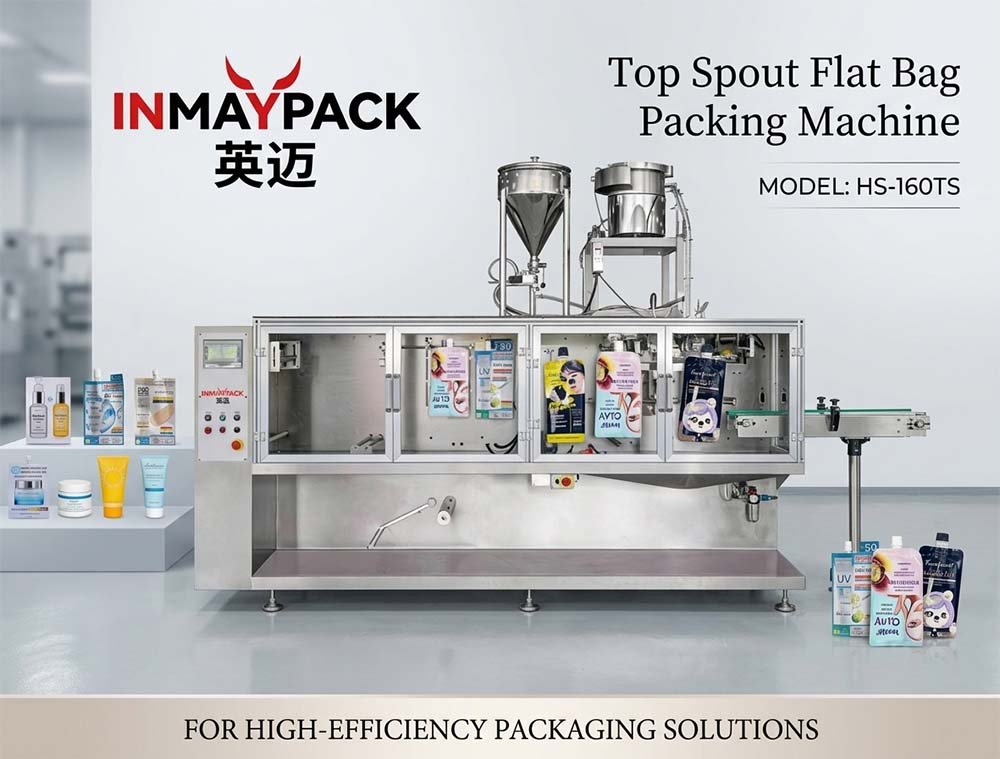
For other roll-film formats, the horizontal form-fill-seal equipment guide gives the wider machine context. For this drawing, keep the flat body and center spout attached to every quote revision.
Approve the pouch, fitment and cap together
The flange and the pouch film
Request the film construction and sealant face, the flange material and rib profile, and one dimensioned view showing the spout centerline from a fixed pouch edge. For an offset or corner spout, also mark the angle and the support orientation. On a shaped flat pouch, mark the cut contour and jaw clearance. An outer width that fits the holder shows only that the pouch can be held. Check whether the jaw closes around the flange and whether the seal band remains continuous beside its shoulders. Establish a sealing window with the proposed film and fitment whenever the sealant layer changes.
The rail and the filling opening
Ask for the neck support dimensions and tolerances, the clearance under the support ring, and a sample of the actual rail end or carrier. Mark the clear internal bore separately from the thread or cap outside diameter. For a gel or product containing pulp, check the narrowest point in the full filling path, including the valve and nozzle. For a foaming liquid, observe air escape, the liquid level at cutoff and product reaching the threads. Run the thickest or most aerated production condition you expect to receive.
The cap and its final seal
List the cap part number, thread, liner or plug if present, and delivery condition. Ask how the tooling will support the fitment against rotation. Agree on the cap supplier’s opening test, time after application and leak check. The capper setting, a measured opening torque and the location of a leak answer three different questions. The spout pouch cap testing guide gives the test record for this part of the job.
Who owns the transfer from the converter to the filler?
A converter can supply a sound weld and the filler can still lose production if the pouches arrive loose while the infeed expects loaded rails. Add the following handover sheet to each quotation. Replace the suggested lead with a named company or plant function when the purchase order is agreed.
| Handover | Suggested lead | What both sides sign off |
|---|---|---|
| Film and fitment to joining station | Converter for bought-in pouches, machine builder and materials supplier for in-house joining | Approved film and flange revisions, sample joints, seal inspection method and disposition of suspect lots |
| Empty pouch to filling line | Converter and filling-line integrator | Orientation, rail or carrier drawing, loaded sample, replenishment method, buffer capacity and who supplies returnable rails |
| Product to nozzle | Packer’s process engineer and filler supplier | Product at working temperature, feed pressure or level, dose, air escape and cutoff at the agreed opening |
| Cap to closed pack | Closure supplier and capper integrator | Cap delivery state, feeding and support tooling, closure method and how opening and leakage are checked |
| Accepted pack to downstream equipment | Packer and line integrator | Discharge height and orientation, reject destination, stop/restart signals and who counts accepted output |
Illustrative handover failure. A converter keeps the bore and thread on a replacement spout but changes the support-ring profile. The cap fits a hand sample, yet the new rings bind at the rail joint. Before releasing the new lot, pass representative pouches through an actual rail joint, cycle the transfer and check the nest under filling and capping load. Record the component revision with the disposition. That short test targets a fault a cap fit check would miss.
If joining and filling run in different shifts or plants, agree on storage, lot release and the buffer between them. Specify what the line does when a rail empties or downstream discharge stops. Give rejected pouches a separate destination before the buffer is replenished.

Test the empty joint and the finished pack separately
Agree on the factory acceptance test (FAT) before shipping trial material. Identify which site can reproduce each operation. When the converter owns the weld and the packer owns filling, retain empty pouches from the same lot as the filled samples. Keep the component lot, station or lane, product condition and time on each sample record.
| When to sample | What to keep or observe | Decision the evidence supports |
|---|---|---|
| After joining, before filling | Empty joints from each active position, material lots, flange location and agreed weld checks | Release a fitment/film combination for the next trial, or hold the affected lot or position |
| During loading and after rail replenishment | Accepted transfers, jams, dropped pouches, last good and first good pouch after a stop | Distinguish rail, guide and carrier faults from filling faults |
| At filling and closure | Dose result, condition of threads or top-seal area, cap seating, timed opening samples and separate unopened leak samples | Locate a defect at the cap, flange or pouch seam and assign the next investigation |
| At restart and format change | First approved pack from each position, adjustments, rejected material and elapsed time | Establish the time from the last accepted pack of one order to the first accepted pack of the next |
| At discharge over the agreed run | Elapsed minutes, filled units, rejects by reason and accepted units leaving the line | Compare finished output on the same basis as the purchase specification |
For example, if a pack leaks at the shoulder of the flange while the cap and neck remain dry, retain the pack and a matched empty pouch. Inspect the join and adjacent pouch seam before changing the capper setting. If leakage appears around the cap after a restart, inspect seating, threads and product on the neck. Retain unopened specimens for leakage checks so an opening test cannot disturb the seal being investigated.
Specify the run length, refill and restart events, sample counts and pass criteria with the packaging owner. A machine demonstration cannot release the product’s storage life or distribution performance. Use the machine FAT checklist for the wider run and attach the spout-specific records above.
Compare the cost per accepted pouch
Ask both suppliers to cost the same sellable pack at the same annual volume. Bought-in spouted pouches carry the converter’s joining cost in the unit price. In-house conversion moves that work into film, spouts, setup scrap, labor and tooling. Count the cap once, including it in the pouch price only when the supplier actually provides it. Ask each supplier to itemize the base format, tooling for later sizes, commissioning, and any downstream equipment excluded from the offer. Annualize equipment and tooling on the same finance basis.
A worked comparison
Illustrative budgeting example in USD. All figures below are assumptions for two hypothetical offers. Each column covers 1,000 accepted units at discharge. Packaging includes components consumed in rejects. Product loss covers discarded contents only. The saleable product and common downstream costs are equivalent in this example.
| Cost per 1,000 accepted pouches | Buy fitted pouches and fill | Form from film, fit the spout and fill |
|---|---|---|
| Delivered packaging consumed, including matched caps | $96 | $63 |
| Discarded product | $4 | $7 |
| Variable operating labor, utilities and wear | $12 | $18 |
| Total variable cost | $112 | $88 |
To use your own figures, divide the variable cost for the run by the number of accepted packs at discharge. Then divide the additional annual fixed cost by the saving per accepted pack.
Suppose in-house forming carries $18,000 more annual fixed cost, including annualized equipment and tooling. Its variable saving is $24 per 1,000 accepted packs, or $0.024 per pack. The break-even volume is $18,000 ÷ $0.024 = 750,000 accepted packs per year. At 600,000 packs, buying fitted pouches costs $3,600 less on these assumptions. At one million, in-house forming costs $6,000 less.
If shorter orders and extra starts reduce the measured saving to $15 per 1,000, break-even rises to 1.2 million accepted packs. If the in-house route has no variable saving and its fixed cost is higher, increasing volume alone cannot recover that difference. Check that the plant can actually run the required volume after changeovers, cleaning and rail or reel replenishment. Ask both suppliers to replace these inputs with their own itemized offers and your trial yields. The spout pouch quotation guide covers the broader filling-system price comparison.
Buyer questions
Do I need a spout inserter if the converter already installs the spout?
An accepted, factory-fitted spout removes the joining operation from your filling line. Show the filler supplier the pouch as delivered. Ask who supplies rails, handles any pre-applied cap, and performs the last closure operation. If you need only an empty-pouch inserter, specify that deliverable separately when requesting supplier scope.
Can a pouch with a fitted spout be filled through the top edge?
Yes, when the converter leaves an edge open for filling and the line can grip, fill and seal that edge. This can suit a product that passes poorly through the neck. Review seal-area contamination and access with production samples. A finished pouch with every edge sealed requires another filling path.
Will a second pouch with the same spout diameter run on my existing rails?
The bore alone cannot answer that. Compare the flange, support-ring geometry, thread, cap outside diameter, pouch centerline and orientation. Have the converter and machine supplier approve the same drawing revision. Ask them to demonstrate loading, transfer and stable support during closure using samples from the intended supply.
Which output should go into the purchase order?
Use accepted filled-and-closed pouches per agreed elapsed time. Record which interruptions count and how many rejects leave the line. For example, 8,400 accepted pouches in a six-hour production window means 23.3 accepted pouches per elapsed minute. If the supplier gives a running rate for one station, ask for the full-line trial or the operating assumptions that connect it to that shift target.
What changes when I switch film suppliers or cap designs?
Identify which interface changes. A new sealant or flange material calls for joining trials on the actual combination. A changed cap may require feeding, application and opening checks even when the pouch body is identical. Give the revised components their own trial record before combining results across lots.
Request a spout pouch route review
For an initial review, tell INMAYPACK how the pouch arrives, the product and dose, the required accepted packs per shift, and which operations you want quoted. If drawings are still in preparation, describe the two samples in the message field. You can share photos of the incoming pouch and the finished pack during the technical review. A drawing showing the fill opening, spout and cap revisions, and a loaded rail or roll-film specification will help settle the tooling and trial scope.