Packaging systems configured around your application Defined project scope

Share your requirements • sales@ewpackmachinery.com

HS Series · Duplex horizontal HFFS

HS-180D Duplex 4-Side Seal Sachet Packing Machine

Review the HS-180D as a two-lane, reel-fed flat-sachet platform. The source configuration records a 60 × 80 to 90 × 220 mm duplex format range and a maximum reference of 100 bags/min; the accepted project result still depends on the approved product, filler, film, pouch drawing and FAT method.

Build an HS-180D Review Brief
2 lanesDuplex source configuration
100 bags/minRecorded maximum, not accepted output
60 × 80–90 × 220 mmRecorded duplex pouch range
150 mlRecorded maximum volume reference
HS-180D duplex 4-side seal sachet packing machine
Quick engineering answer

Use the HS-180D when one controlled web must produce two flat sachets per cycle

The HS-180D is a horizontal form-fill-seal platform for four-side-seal flat sachets made from roll stock. Its duplex layout creates two parallel pouches and provides two filling positions. That can raise aggregate output, but only if both lanes receive stable product flow, remain registered, seal within the approved process window and discharge conforming packs.

A suitable starting route

  • The accepted pack is a flat four-side-seal sachet, not a stick pack, premade pouch or stand-up pouch.
  • The finished drawing falls within the recorded duplex reference range after seal bands, cut position and registration are included.
  • The product can be matched to a confirmed dosing system and clean cutoff.
  • The buyer needs a two-lane HFFS route and will validate good output during a controlled trial.

Do not select it from speed alone

  • A 100 bags/min headline does not establish accepted production speed for every material.
  • A 150 ml volume boundary does not prove that any liquid, paste, granule or powder will dose cleanly.
  • Two lanes do not remove lane-to-lane variation; they make lane identity more important.
  • Final compliance, brands, options, warranty, delivery and service belong in the issued quotation.

Selection boundary: the retained HS-180D document is explicitly a budget proposal. It states that dose, pouch size and output must be confirmed after product samples, packaging film and final tests are received. This page uses its numbers as source references, not as unconditional guarantees.

Duplex process

Follow the product and film through both lanes

A useful review tracks where a shared disturbance can affect both lanes and where a local condition can affect only one.

Unwind and register

Control reel condition, web direction, tension, eye-mark input and print repeat before the material reaches the forming area.

Form two pouch paths

Divide the working web geometry into two flat-sachet lanes while holding the approved width, seal bands and lane pitch.

Create initial seals

Establish the pouch boundaries needed for filling. Tool contact, temperature, pressure, dwell and contamination all affect the usable window.

Dose by lane

Deliver product through two confirmed filling positions. Record dose checks by lane so an aggregate average cannot hide one unstable path.

Finish seal and cut

Complete the perimeter seal, control print-to-cut position, and apply any approved notch, code or discharge option.

Count accepted packs

Separate gross discharge from conforming output. Retain defects, stops, refills and restart results with lane identity.

Source specification

HS-180D reference data and the condition attached to each value

These values come from the retained February 2026 HS-180D budget proposal. The final technical agreement and FAT protocol must supersede this reference where the approved project differs.

ItemRecorded HS-180D referenceWhat the project must confirm
Machine conceptHorizontal form-fill-seal, intermittent motion, form from reelFinal web path, duplex tooling, controls and supplied options
Pouch formatDuplex flat pouch / four-side-seal sachetDimensioned drawing, seal widths, cut, notch, code and artwork repeat
Recorded pouch rangeMinimum 60 × 80 mm; maximum 90 × 220 mmOne approved SKU set under the chosen two-lane layout
Recorded maximum output100 bags/min in duplex reference configurationConforming bags/min with approved product, film, run duration and reject rule
Recorded maximum volume150 ml per pouchReal product density, rheology or flow, filler and clean cutoff
Filling positions2 stationsSelected filler arrangement and how each lane is supplied and sampled
Film reel400 mm maximum diameter; 440 mm web; 76 mm coreUsable web layout, reel build, winding, splice, tension and registration
ConstructionSUS304 appearance and product-contact parts; internal SUS304 and aluminum alloy referenceContact-parts schedule, finish, guarding, cleaning method and site standard
Machine envelope3500 × 970 × 1500 mm; 1200 kgFinal GA drawing, access, filler height, conveyor and service clearances
Utilities6.0 kW; 200–415 V, 50/60 Hz, N+G; 100 L/min at 0.6 MPaIssued electrical load, phase, air quality, connections and local installation scope
Noise / safety reference≤70 dB and CE standards recorded in the proposalMeasurement conditions and applicable destination-market conformity documents

Component brands shown in a budget proposal are configuration references. The issued bill of materials should confirm the PLC, motion, HMI, temperature, sensor, bearing and pneumatic package supplied for the order.

Product and filler

Match each application to its dosing and cutoff problem

The retained proposal records seeds at 0.5–10 g as its stated product basis. Other products are possible engineering routes only after the filler, product behavior and cleaning boundary are confirmed.

Seeds and free-flowing granules

Define particle size, breakage, segregation, bridging and rebound. Confirm whether cup, weighing or another metering method can feed two lanes consistently.

Powders

Define bulk density, aeration, dust, moisture sensitivity, compaction and flow. An auger route still requires product trials and lane-identified dose data.

Liquids and pastes

Define viscosity at operating temperature, particulates, strings, splash, drip and cleaning. Confirm the pump and nozzle arrangement before applying the volume reference.

For product-led filler selection, use the pouch filling system guide. If the job is specifically powder, compare the powder sachet packing machine route. Liquid and paste applications should also be reviewed against the dedicated liquid sachet machine before the HS-180D filler is frozen.

Machine evidence

Use the photos to review access and architecture, not to assume the final BOM

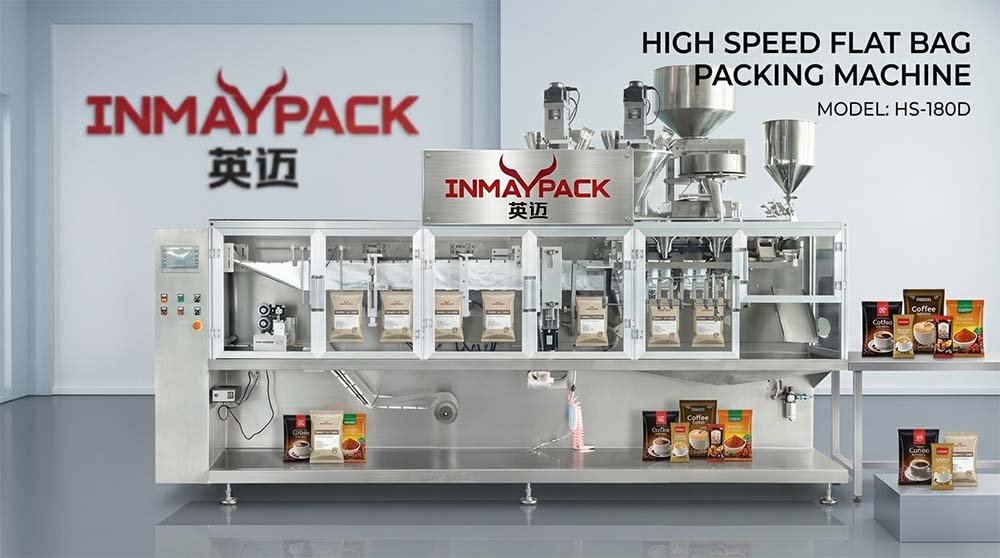
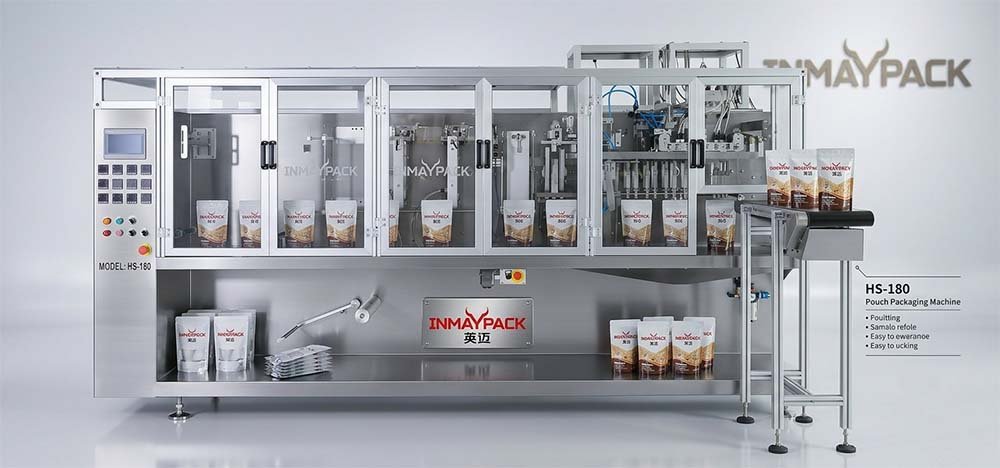
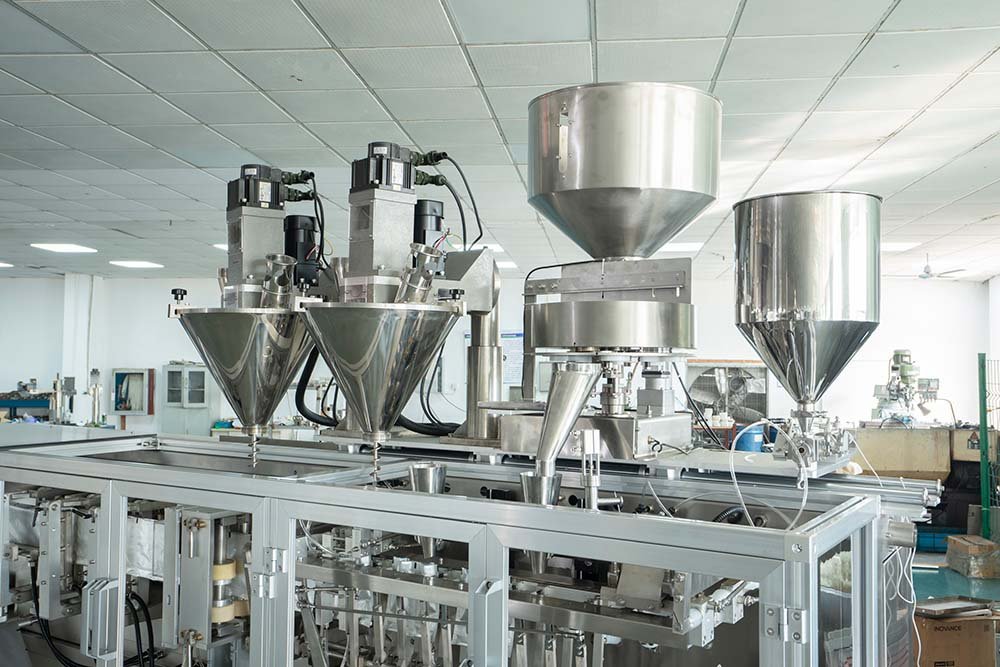
The first image on this page is the retained HS-180D machine reference. The detail images below are HS-series architecture references already held by INMAYPACK; the delivered HS-180D configuration must be confirmed by its own drawing and quotation.

Film and pouch drawing

Freeze the web layout before calling a pouch size compatible

Film data to submit

  • Laminate structure and supplier data
  • Total thickness and sealing-layer orientation
  • Reel width, core, maximum OD and winding direction
  • Print repeat, eye mark, lane pitch and splice method
  • Seal initiation and usable sealing window from the converter

Finished-pouch drawing to submit

  • Overall width and length for every SKU
  • All four seal bands and allowed product-free area
  • Cut, tear notch, perforation and code positions
  • Artwork orientation and allowable registration tolerance
  • Accepted visual, seal and leak-test criteria

The 440 mm source web reference is not the same as two times the nominal pouch width. The usable layout must also accommodate lane spacing, seals, trim, tracking and the actual forming path. For a broader format comparison, review the 3-side and 4-side seal sachet machine page.

Accepted output

Measure conforming sachets, not only cycles or discharge count

A duplex machine can produce two sachets in one cycle, but the useful production result must deduct every rejected or nonconforming pack and record the cause.

Accepted bags/min = gross discharged bags − rejected or nonconforming bags

Record the test basis

Product lot and condition, target dose, film lot, pouch drawing, active lanes, recipe, run duration, staffing and upstream/downstream conditions.

Separate each lane

Keep dose, seal, registration, code, cut, reject and stop evidence under a consistent Lane A / Lane B identity.

Include disturbance

Observe refill, film splice if required, normal adjustments, stop/restart and first-off release. A short steady sample alone does not establish production behavior.

Factory acceptance test

Write the HS-180D FAT around six controlled decisions

Test areaDefine before the runEvidence to retain
Product and doseProduct identity, condition, minimum/nominal/maximum dose and acceptance methodLane-identified samples, measured results, rejects and adjustment record
Film and formatApproved laminate, reel data, drawing, print repeat, seals, cut and codeFilm lot, retained packs, registration results and drawing check
Seal integrityMethod, sample frequency and pass/fail criteria appropriate to the packLane-identified seal samples and test results
Accepted outputRun duration, good-pack definition, reject rule and planned disturbancesGross count, good count, defects, stops, refill and restart results
Alarms and guardingChallenge list, permitted bypasses, interlocks and recovery ruleSigned challenge record and corrective actions
HandoverApproved BOM, change parts, drawings, manuals, spares and training scopeDocument register, photos, settings and open-item list

Do not copy dose tolerances, seal limits or reject percentages from another project. Put only the agreed, measurable criteria for the actual product and package into the protocol.

Project scope

Turn the machine reference into a complete, comparable quotation

Two HS-180D quotations can show the same base model and still describe different systems. A useful comparison separates the base HFFS functions from the product-specific filler, format parts, inspection, discharge, documentation and site work.

Base forming and sealing scope

Identify the reel stand, web controls, duplex forming tools, seal stations, pulling and cutting system, guards, controls and standard discharge. The issued drawing should show how the film enters, where the two lanes are defined and which adjustments belong to an operator or technician.

Product-specific scope

Name the selected filling principle, hopper or tank, product distribution, refill control, nozzles or funnels, contact materials and cleaning access. A generic “powder filler” or “liquid filler” line item is not enough to compare two technical offers.

Quality and line scope

State coding, inspection, reject handling, counting, outfeed and any link to secondary packaging. Define every exchanged signal and the response to a downstream stop so the machine is not accepted as an isolated island.

Quotation lineQuestions that prevent an incomplete comparison
Format setWhich exact pouch drawings and SKU change parts are included? What remains a future option?
Filling systemWhich product and dose range were used to size it? How are both lanes supplied and verified?
Coding and inspectionWhat is detected, what triggers an alarm, and what output is automatically rejected or retained?
Utilities and installationWhat supply quality, connections, lifting, platforms, access and site work remain with the buyer?
Documentation and sparesWhich drawings, manuals, BOM, recommended spares and software backups are delivered?
AcceptanceWhich products, films, run durations, sample frequencies and measurable pass criteria govern FAT and site acceptance?
Operation and maintenance

Check changeover, cleaning and restart before approving the format range

A large stated range has little value if frequent SKUs require uncontrolled adjustments or inaccessible cleaning. The operating review should follow a real format change and a normal product-contact cleaning sequence.

Format changeover

  • List every mechanical, recipe and sensor setting that changes.
  • Identify dedicated tools and format parts for each approved SKU.
  • Record the first-off inspection needed before both lanes return to production.
  • Verify that lane labels and saved recipes remain unambiguous.

Product change and cleaning

  • Map product-contact parts from supply through the two filling paths.
  • Define removal, access, drainage, dust or drip control and inspection.
  • State whether cleaning is dry, wet, clean-in-place or manual disassembly.
  • Confirm the release check before the next product or allergen campaign.

A restart check should not be treated as an informal operator judgment. Agree how many first-off sachets are isolated, which measurements are repeated, and when both lanes are released. If the downstream conveyor, counter or cartoner has stopped, also define whether product continues to dose, whether pouches are rejected and how accumulated packs are cleared without losing traceability.

Local planning tool

Build an HS-180D configuration review brief

Complete what you know. Blank items remain marked TO CONFIRM. Nothing in this form uploads or sends automatically.

Buyer questions

HS-180D configuration questions

Does the HS-180D guarantee 100 accepted sachets per minute?

No. The retained source records 100 bags/min as a duplex maximum reference. The accepted result must state the real product, filler, film, pouch dimensions, test duration, quality criteria and treatment of rejected packs.

Can it run every pouch size between 60 × 80 and 90 × 220 mm?

The proposal records that duplex range, but a project still needs a dimensioned drawing and an approved web layout. Seal widths, lane pitch, artwork repeat, notch, cut and tooling can limit a specific SKU set.

Can one HS-180D pack seeds, powder and liquid?

The frame can be engineered around different filling methods, but compatibility is not established by the frame alone. Each product requires a confirmed filler, cutoff behavior, cleaning boundary and FAT method. Multiple product families should be listed before quotation.

Are the listed component brands and CE scope fixed?

No. They are references from the retained budget proposal. The issued bill of materials should name the supplied brands or approved equivalents, and the project should define the conformity documents required for the destination market.

What must be sent for an engineering review?

Send the product and dose range, product condition, finished-pouch drawing, film specification, target conforming output, quality checks, utility data, downstream boundary and any destination-market requirements.

Confirm the product and web layout before fixing the HS-180D scope

Share the real product, dose range, finished-pouch drawing, film data and accepted-output method. INMAYPACK can then review the duplex layout, filler, controls, options and FAT boundary for the issued proposal.

Tell Us About Your Packaging Project

Send your product and package details. INMAYPACK will review the application before recommending a machine configuration.

✓ Application reviewed before recommendation

✓ Project details stay private

✓ Configuration-specific technical reply