
An end-load cartoning machine and a vertical cartoning machine may both erect, load and close folding cartons, but they solve different product-presentation problems. End load—also called side load or horizontal cartoning—moves a prepared product group through an open carton end. Vertical or top loading places the product through the open top of the carton.
The better route is determined by the product or primary pack, the required grouping pattern, the way that group can be controlled before loading, the carton drawing, the available floor plan and the accepted line result. Do not choose from the carton dimensions or a headline speed alone.
End load and vertical load describe how the product enters the carton
The terms are easier to compare when the carton and product paths are drawn. In an end-load system, the carton is commonly erected and transported with an end flap area open. A controlled product group is aligned with that opening and transferred laterally into the carton. The product must remain sufficiently organized during collation, acceleration and insertion.
In a vertical-loading system, an erected carton is presented with its upper opening available for loading. Counted, grouped or individually handled products move downward into the carton before flap closing. The loading device and product support still need to match the real pack: a loose capsule, a stick pack and a fragile sachet do not create the same feeding task.
End-load cartoning route
A stable product group is prepared beside the carton and transferred through the open end.
- Collate
- Time
- Side transfer
- Close ends
Vertical cartoning route
The carton opening faces upward while the counted or grouped product is placed from above.
- Erect
- Count
- Load down
- Close flaps
Compare the architectures against the same issued product and carton
| Decision point | End-load / horizontal cartoning | Vertical / top-load cartoning |
|---|---|---|
| Loading direction | Product enters through an open carton end or side. | Product enters through the carton opening from above. |
| Product presentation | Usually needs a controlled group that can be pushed or transferred laterally without losing orientation. | Needs controlled counting, pick-and-place, chute, magazine or other top-loading presentation. |
| Typical upstream task | Collation, spacing, stacking, tray handling or bag timing before insertion. | Counting, orientation, accumulation and vertical placement before flap closure. |
| Carton relationship | End opening and insertion clearance must match the product-group cross-section and transfer path. | Top opening, internal support and fall or placement path must protect the product during loading. |
| Product control risk | A group may skew, separate, snag or compress during lateral transfer. | Products may bridge, rebound, tilt, nest or receive impact during downward placement. |
| Line layout | Product and carton paths commonly need space for collation and side insertion. | May use a compact loading zone, but vertical access, feeding height and service clearance still matter. |
| Changeover work | Collation guides, infeed pockets, insertion tools and carton transport may change with the format. | Counting devices, chutes, magazines, loading tools and carton supports may change with the format. |
| Accepted output | Depends on stable group formation, insertion, flap control, closure and downstream release. | Depends on reliable counting, placement, carton support, closure and downstream release. |
A quoted cartons-per-minute value is meaningful only with the approved product, units per carton, carton material and dimensions, closure method, upstream supply, reject criteria, run duration and normal interventions.
Start with the group that must reach the carton opening
The primary pack or product is only one input. The decisive question is whether the required retail group can be created, held and transferred repeatedly. A bag may suit end loading when it reaches the cartoner with controlled shape and spacing, but the same bag can become unstable when fill distribution, trapped air or seal geometry changes.
Consider end loading
Wrapped bars, trays, compact bag groups and other controlled formats may be collated and transferred through a carton end when the insertion path and clearances are verified.
Consider vertical loading
Capsules, small sachets, stick packs and similar units may suit counting and downward loading when orientation, bridging, damage and count verification are controlled.
Test before selecting
Neither direction is automatically correct. Product support, robotic handling, trays, magazines or a different secondary-package route may be needed.
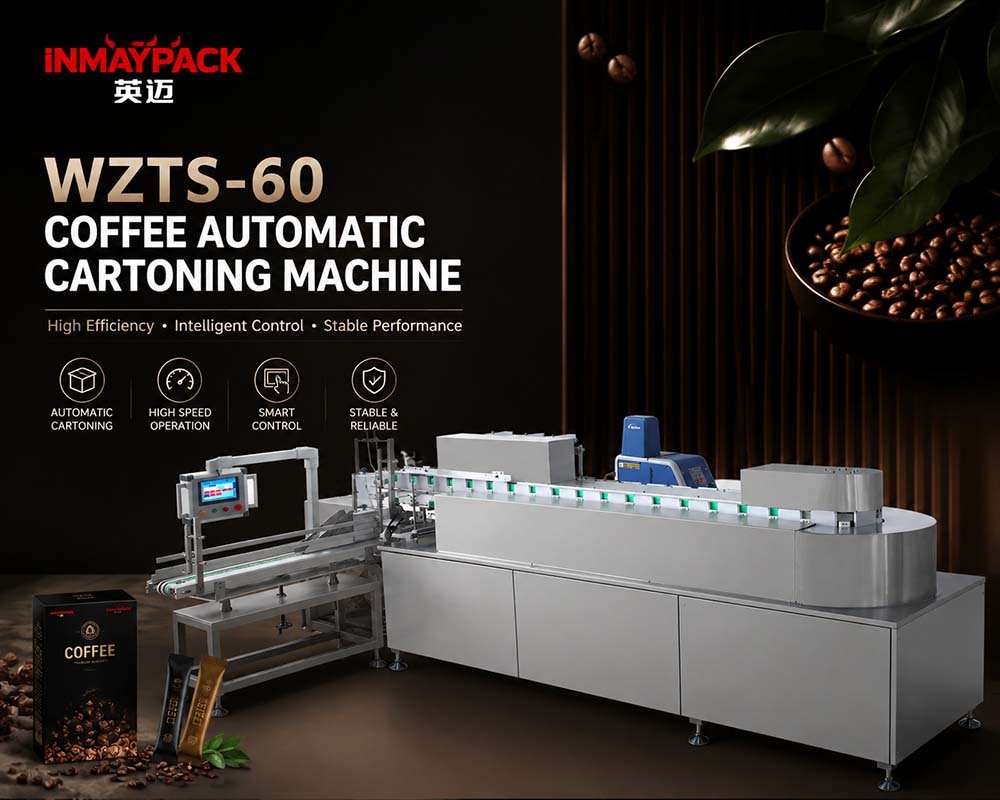
Use the cartoning machine systems page to review the current commercial scope. For coffee capsules, sticks and sachets, review the documented WZTS-60 automatic cartoning machine.
Keep the WZTS-60 vertical route separate from an end-load requirement
WZTS-60 vertical loading
The documented WZTS-60 reference erects folding cartons, handles an approved count or group, loads vertically and closes both carton ends using the configured tuck-in or approved hot-melt route. The source specification records a reference output of 10–30 cartons per minute and a carton range of 40 × 30 × 50 mm to 180 × 180 × 300 mm. Final tooling and accepted output remain project-specific.
Horizontal end loading
An end-load inquiry should be treated as a distinct equipment requirement. INMAYPACK must review the product group, horizontal transfer, carton opening, insertion tooling, closure and integration boundary before confirming whether an available solution can be offered. The WZTS-60 figures must not be copied into an end-load proposal.
Issue the carton drawing before the loading route is frozen
Carton length, width and height do not fully define machine suitability. Board stiffness, grain direction, pre-break quality, flap design, score consistency, glue area, print and code zones, internal fit and allowable compression affect erection, loading and closure. Samples from the intended converter should be tested with representative primary packs.
The cartoner must accept normal upstream variation without hiding defects
A cartoner does not receive a perfect laboratory sample on every cycle. The upstream machine stops, restarts, changes film or lidding material, rejects units and releases products with normal spacing and orientation variation. The cartoning project must state how the infeed accumulates, times, counts and recovers from those events.
| Interface | Questions to define | Required evidence |
|---|---|---|
| Product handoff | What orientation, spacing, count, stability and release signal reach the cartoner? | Interface drawing, sample run and accepted transfer window. |
| Accumulation | How much buffer is available, and what happens during starvation, blockage or a cartoner stop? | Line-state sequence, capacity calculation and recovery test. |
| Recipe identity | How do upstream pack, group pattern, carton and cartoner recipe remain matched? | Recipe list, changeover verification and mismatch challenge. |
| Inspection and reject | Where are count, leaflet, code, flap, glue and finished-carton checks performed? | Inspection matrix, reject confirmation and fault challenge. |
| Controls | Which ready, run, starved, blocked, fault, stop and emergency states cross the boundary? | Signal list, cause-and-effect test and software backup. |
| Downstream release | What carton orientation, spacing and condition must enter checkweighing, case packing or manual handling? | Discharge definition and representative downstream test. |
Use the packaging system integration checklist to define controls, safety and interface ownership. If one supplier must coordinate the full boundary, review turnkey packaging solutions.
Test the loading route with production-intent product and cartons
A short empty-machine demonstration cannot establish the accepted cartoning result. The factory acceptance test should use the approved product or primary packs, controlled cartons and the configured loading route. It should include normal replenishment, planned stops and restarts, inspection challenges and the agreed run duration.
Freeze the test inputs
Record product or primary-pack lot, carton lot and revision, group pattern, leaflet or insert, closure material, recipes, utilities and environmental conditions.
Verify product presentation
Challenge spacing, orientation, count, accumulation, refill and transfer. Record jams, misfeeds, dropped units, damaged packs and corrective action.
Verify carton handling
Measure erection, opening, loading clearance, flap control, tuck or glue closure, coding, inspection and reject behavior across the approved formats.
Run normal events
Include starvation, blockage, planned stop, restart, material replenishment, rejected upstream packs and recovery without clearing away inconvenient results.
Count accepted cartons
Report conforming finished cartons after removing rejects and nonconforming units. Retain stop, reject and fault evidence by cause.
Close deviations
Name the requirement, owner, action, due date, retest method and release authority for every open item before shipment or final acceptance.
A test with rigid capsules does not prove performance with flexible sachets, and a stable carton board does not prove another converter's material. The acceptance claim is bounded by the recorded test inputs.
Send these details before asking for a cartoning-machine quotation
Define what enters the cartoner
Send samples, dimensions, weight, orientation, fragility, surface behavior, seal or lid geometry, current upstream equipment and discharge pattern.
Control the secondary package
Send the dieline, finished drawing, board specification, grain direction, tolerances, closure, code area, insert and production-intent samples.
Define the accepted result
State units per carton, priority formats, conforming cartons per minute, run duration, permitted rejects, inspection method and downstream condition.
Fix the integration boundary
Provide layout, elevations, utilities, destination requirements, guarding boundary, data needs, upstream and downstream interfaces, FAT, SAT and documentation scope.
The packaging machine RFQ builder helps organize product, package, output, utility and acceptance inputs before a project review.
End-load and vertical cartoning machine FAQ
Is an end-load cartoning machine the same as a horizontal cartoning machine?
In common equipment terminology, end load, side load and horizontal cartoning describe the broad route in which the product enters through an open carton end. The exact machine still needs a defined carton path, product infeed, transfer mechanism and closure.
Is a vertical cartoning machine the same as a top-load cartoner?
The terms often describe the same general loading direction: the product enters through the carton opening from above. Suppliers may use the terms differently, so the issued layout and sequence should show the actual product and carton paths.
Which cartoner is better for sachets and stick packs?
Neither direction is automatically better. Vertical loading may suit counted packs that can be guided downward, while end loading may suit a controlled collated group. Pack stiffness, seal geometry, trapped air, orientation, count and carton fit must be trialed.
Which route is faster?
Speed depends on the product, group pattern, carton, loading mechanism, closure, inspection and upstream supply. Compare conforming finished cartons under the same test inputs rather than unrelated catalog maxima.
What cartoning architecture does the INMAYPACK WZTS-60 use?
The documented WZTS-60 reference uses vertical loading for approved counted or grouped products. Its published reference values must not be applied to a horizontal end-load project.
What should a cartoner FAT include?
Use production-intent products and cartons, record the approved formats and recipes, run normal replenishment and stop/restart events, challenge inspections and rejects, and report conforming finished cartons together with stops, rejects and deviations.
Sources used for the cartoning-route framework
Industry organization terminology distinguishing horizontal end-load carton form/fill/seal and vertical carton form/fill/seal machine categories.
Manufacturer reference explaining that end loading is also called side or horizontal cartoning, while top loading is associated with vertical cartoning.
Manufacturer reference showing the connection between carton feeding, product infeed, side loading, changeover and line integration.
Manufacturer reference showing that horizontal cartoning selection depends on product presentation, feeding systems, carton range and achievable output.
Use the page that matches the next cartoning question
Define the loading route before fixing the cartoner
Send the product or primary packs, required group pattern, controlled carton drawing and samples, target accepted output, upstream discharge, downstream boundary, site layout and FAT requirements. INMAYPACK will review the documented vertical-loading route and identify where a different architecture requires separate confirmation.







