
Useful packaging machine maintenance is not a universal calendar. It is a controlled system that connects the supplied machine manual, site safety procedure, actual duty cycle, product environment, observed component condition, spare-parts plan and release evidence.
This guide shows how to structure that system across flexible-packaging equipment without inventing one interval for every machine.
Build the plan around failure modes and production evidence
A checklist becomes useful only when each task has a machine location, method, limit, responsible role and record. “Check the sealer” is too vague. “Inspect the upper end-seal face after safe isolation; record contamination, coating damage, parallelism concern and the accepted-pack verification after release” gives the technician and supervisor something repeatable.
Start from the machine-specific manual and supplied maintenance documents. Add site knowledge from fault history, product deposits, cleaning chemicals, ambient dust, humidity, temperature, operating hours and changeover frequency. A machine producing a fine powder in multiple shifts creates a different inspection burden from the same platform running a clean, free-flowing product on one shift.
Separate operator care from maintenance intervention
Cleaning a visible surface during an approved production routine is not the same task as reaching behind a guard, releasing stored pneumatic pressure or working near a drive. The maintenance plan should identify which tasks belong to trained operators, which require authorized maintenance personnel and which require supplier or specialist support.
Where unexpected energization, startup or release of stored energy could cause injury, use the employer’s documented energy-control procedure. Electrical, pneumatic, vacuum, gravity, thermal, spring and mechanical energy may all remain after a normal stop. A stop button, HMI command or opened guard is not automatically an energy-isolation method.
For US workplaces, OSHA 29 CFR 1910.147 establishes requirements for controlling hazardous energy during servicing and maintenance. Other jurisdictions and company standards may differ, so the site must determine and enforce the applicable procedure. This article is a planning guide, not a substitute for the machine manual, risk assessment or legal safety instruction.
After intervention, release should also be controlled: guards restored, tools and loose parts removed, personnel clear, utilities returned in an approved sequence, alarms reviewed and a defined test pack produced. If the machine connects to a filler, conveyor, coder, checkweigher or cartoner, the release boundary must cover the full interface that was disturbed.
Divide the packaging line into maintainable systems
A single work order titled “packaging machine” hides where degradation begins. Build an asset hierarchy that matches the physical process and electrical or pneumatic drawings. This makes recurring faults searchable and prevents one department from maintaining the primary machine while ignoring the filler or downstream equipment that determines accepted output.
Feeding and dosing
Hoppers, agitators, augers, weighers, pumps, valves, nozzles and product-contact seals. Record buildup, abrasion, leakage, calibration drift and cleaning condition.
Film or premade pouch path
Unwind, tension, tracking, registration, forming, pouch separation, magazines, pickoff, opening and gripping devices.
Sealing and cutting
Seal faces, coatings, heaters, sensors, pressure devices, cooling, knives and cut registration. Link condition findings to finished-pack evidence.
Drives and mechanisms
Belts, chains, bearings, cams, guides, screws, couplings, gearboxes, servos and lubrication points. Record play, noise, temperature and wear indicators.
Sensors and automation
Photoeyes, proximity switches, vacuum switches, encoders, safety devices, HMI recipes, alarm history, backups and communication links.
Utilities and interfaces
Electrical supply, air treatment, vacuum, extraction, cooling, gas, conveyors, coding, inspection, reject and downstream accumulation.
Use the packaging-system integration checklist when failures cross machine boundaries, and the pouch-line bottleneck analysis when the slowest accepted-output constraint is unclear.
Use shift, weekly and planned-runtime tasks for different purposes
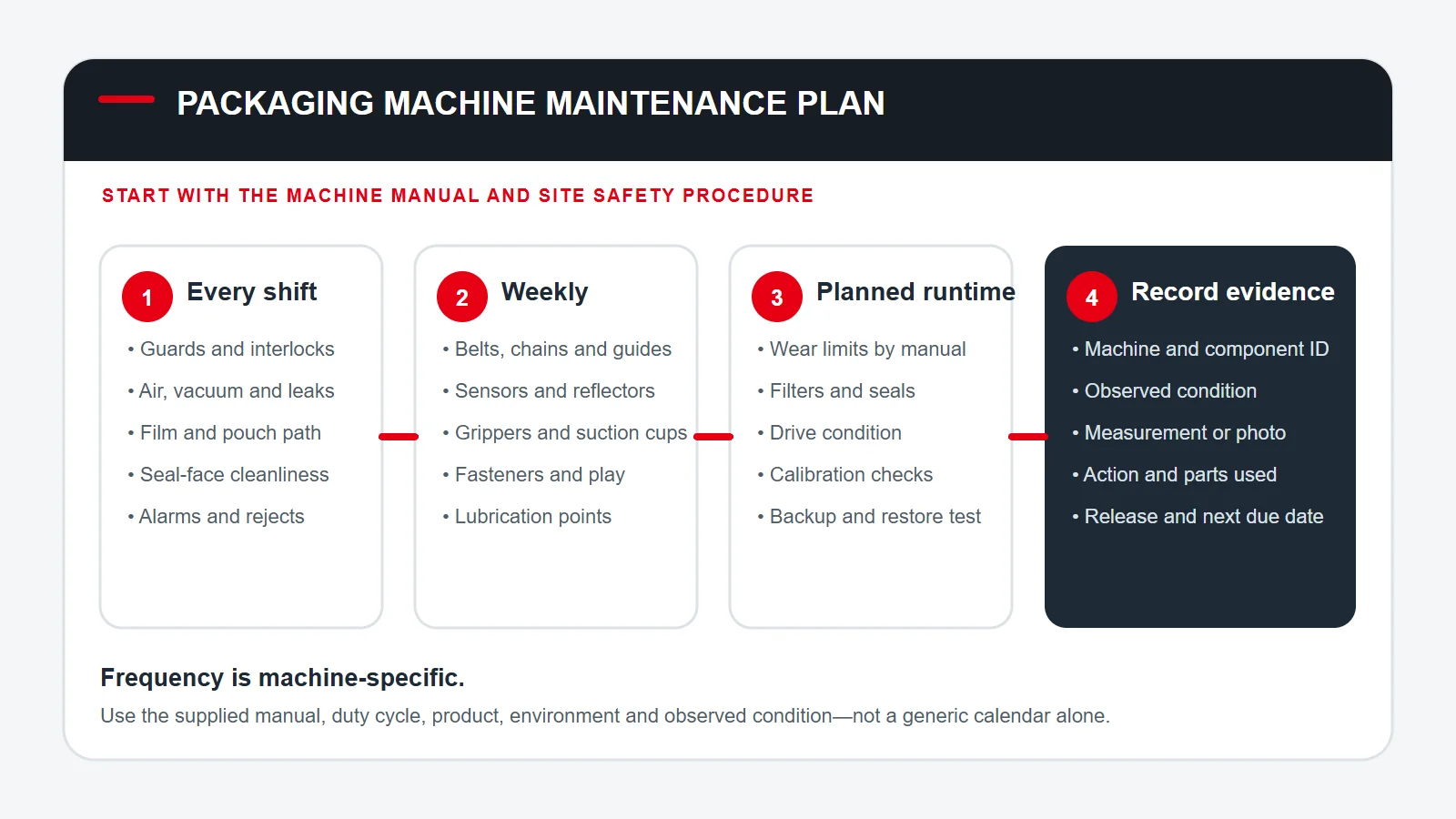
Frequent tasks should be fast, observable and tied to an immediate operating risk. Deeper tasks may require planned downtime, safe access, measurement or partial disassembly. Do not move a difficult task into a daily checklist just because it is important; give it a realistic interval, owner, access method and shutdown window.
| Frequency layer | Best suited to | Example evidence | Do not assume |
|---|---|---|---|
| Start of shift / changeover | Visible condition, guards, leaks, package path, seal-face cleanliness, alarms, reject devices and approved setup. | Signed check, abnormality photo, first-off accepted pack and unresolved defect reference. | That an operator check replaces safe isolation or a technical inspection. |
| Weekly condition review | Belts, guides, fasteners, grippers, suction cups, sensors, air preparation, accessible lubrication points and developing play. | Condition grade, measurement where specified, action owner and target date. | That every component uses a seven-day interval. |
| Runtime / cycle task | Wear parts whose life follows motion, heat cycles, product abrasion or repeated gripping and sealing. | Meter or cycle reading, replaced-part ID, reason and post-work verification. | That catalogue life equals the actual site replacement interval. |
| Planned shutdown | Guarded drives, deeper cleaning, alignment, calibration, electrical checks, backups and integrated-line tests. | Work package, isolated boundary, findings, parts, test result and release authorization. | That restoring machine motion proves pack quality or line readiness. |
For vertical baggers, the VFFS maintenance checklist provides machine-family-specific inspection points. Keep that checklist separate from this site-wide maintenance framework.
Record change, not only pass or fail
A binary tick box can hide deterioration. Where practical, use a simple condition scale or measurement so the team can see whether a component is stable, gradually degrading or changing rapidly. The limit and method must come from the manual, approved engineering standard or a validated site rule.
What can change over time?
Seal temperature recovery, air leakage, vacuum response, belt tracking, registration correction, cycle interruptions, reject frequency, motor load, vibration, noise, play, contamination and time required for changeover.
What happens after a warning?
Define whether the response is monitor, adjust, plan replacement, stop at the next safe opportunity or stop immediately. Include who can make the decision and what evidence releases the machine.
Use the rebuild-versus-replace framework only after repeat faults, obsolescence, performance gaps and integration limits have been documented; age alone is not a decision.
Treat product hygiene and mechanical care as one coordinated plan
Cleaning can expose, protect or damage machine components. Powder entering a guide, sauce reaching a sensor, washdown affecting an enclosure or an incompatible chemical attacking a seal may create both hygiene and reliability problems. The cleaning procedure should identify product-contact and non-product-contact zones, approved chemicals, concentrations, temperatures, tools, disassembly limits, drying and inspection.
Lubrication tasks need the same precision: approved lubricant, exact point, amount, interval, access method and action after over-lubrication or contamination. “Lubricate when needed” is not a controlled instruction. Excess lubricant can attract dust or migrate; insufficient lubricant can accelerate wear. Where food-contact risk exists, the site must define its applicable hygiene and lubricant requirements.
Close the loop from observation to verified production release
A work order should answer more than “repaired.” Record the symptom, machine state, affected SKU, alarm or defect, diagnosis, safe intervention boundary, action, part number and revision, settings changed, test method, verification result and next action. This turns maintenance history into evidence for spare levels, training, design changes and future quotations.
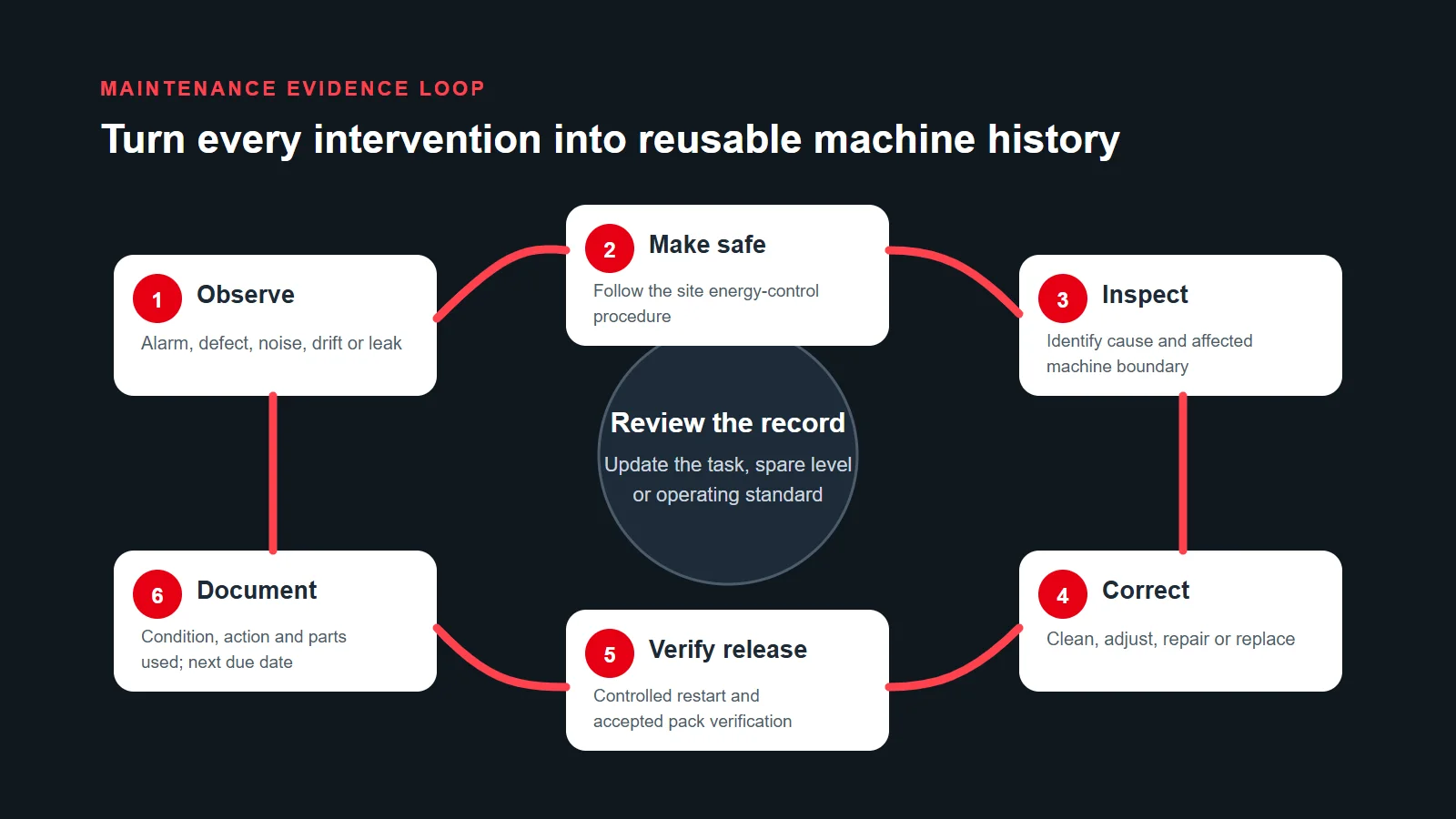
Preserve the distinction between a machine that runs and a line that produces accepted packs. After maintenance, verify the disturbed functions: dose, registration, seals, code, cut, inspection, reject, discharge and downstream transfer as applicable. A short empty-cycle run may confirm motion but cannot by itself release a production process.
Stock parts by consequence, lead time and evidence
A long parts list is not the same as a risk-based spare strategy. Classify components by whether failure stops the machine, reduces output, creates a pack-quality risk or can be temporarily bypassed under an approved procedure. Combine that consequence with failure history, lead time, shelf life, storage condition, revision compatibility and repair options.
Stops safe production
Hold or establish a rapid supply route when a single failure has no approved alternative and prevents safe accepted production.
Predictable use or wear
Reorder from actual use and planned shutdown demand. Keep lot, material and dimensional identity where they affect machine or pack performance.
Exchange and return loop
Define fault confirmation, preservation, repair supplier, turnaround, acceptance test and how the repaired unit returns to inventory.
Use the pouch packing machine spare-parts guide to build a component identification brief with photos, nameplate data, machine serial information and dimensions.
Separate symptoms, causes and waiting time
If every stop is recorded as “machine fault,” maintenance data cannot guide investment. Use a controlled reason structure that separates product supply, package material, machine mechanism, controls, utility, operator response, cleaning, changeover, inspection rejection and downstream blockage. Preserve the original alarm, but add the confirmed cause after investigation.
Record the time spent diagnosing, waiting for safe access, waiting for a part, performing work, testing and releasing production. A ten-minute repair after a six-hour parts delay needs a different corrective action from a six-hour diagnosis. Review frequency, total downtime and recurrence—not only the longest individual stop.
Build a usable maintenance program in 90 days
Weeks 1–2: define the asset and safety boundary
Collect manuals, drawings, parts lists, backup procedures and existing work orders. Identify every connected machine and utility. Confirm who is authorized for operator care, maintenance, electrical work and energy isolation.
Weeks 3–4: create the first task library
Convert manual requirements and proven site tasks into controlled instructions with location, method, tools, limit, role and record. Remove duplicate or vague tasks.
Weeks 5–8: run and correct the schedule
Execute tasks on representative shifts and SKUs. Record access time, findings, missed boundaries and production impact. Change the plan where real evidence shows the task or interval is impractical.
Weeks 9–12: review risks and release the system
Rank recurring faults and spare gaps, confirm shutdown capacity, train the responsible roles and approve the reporting routine. Set a review date based on condition history and operational change.
When maintenance requires repeated format work, connect it to the pouch-machine changeover guide. For new equipment, place documentation, spare parts, training, backups and maintenance access into the packaging machine RFQ brief before quotation comparison.
Packaging machine maintenance FAQ
How often should a packaging machine be maintained?
There is no universal interval. Use the supplied manual, component requirements, runtime or cycle count, product and cleaning environment, observed condition and failure history. Separate frequent operator checks from planned isolated maintenance.
What belongs on a daily packaging machine checklist?
Only tasks that are safe, fast and observable within the approved operator procedure: guards and obvious damage, leaks, air or vacuum condition, film or pouch path, accessible cleanliness, alarms, rejects and first-off pack evidence. Do not place guarded technical work on a daily operator list.
Should maintenance be calendar-based or condition-based?
Use both where appropriate. Ageing materials may need calendar control, motion wear may follow runtime or cycles, and measurable deterioration may support condition triggers. The machine manual and validated site experience define the method.
What should be recorded after a repair?
Record the symptom, machine and component identity, product or SKU, diagnosis, isolation boundary, action, settings, parts used, verification method, accepted result, responsible person and next due action.
When should a machine be rebuilt or replaced?
Review repeat failures, safety and guarding limitations, control-system obsolescence, parts availability, maintainability, product and package changes, accepted output and integration requirements. Machine age by itself is not enough.
Sources used for the maintenance framework
US regulatory reference for energy-control procedures during covered servicing and maintenance.
OEM reference connecting training, maintenance, adaptation and lifecycle support for packaging lines.
OEM example of maintenance planning, fault history and downtime analysis using recorded machine information.
OEM lifecycle example covering spare parts, field service, preventive maintenance, modernization, remote services and training.
Continue with the task that matches the machine condition
Send the machine, symptom and production evidence together
For an INMAYPACK equipment review, provide the machine model and serial information, product and package, alarm history, photos or video, observed condition, recent changes, parts already replaced and the required production outcome. The evidence determines the next diagnostic step; a symptom alone does not identify the cause.







