
“Pouch” and “bag” often describe overlapping forms of flexible packaging. Neither word, by itself, tells a machine supplier how the package is supplied, opened, filled, sealed or accepted.
A usable equipment specification replaces the label with a dimensional drawing, material structure, closure details, product data and the required production result. That information determines whether the project belongs on a rollstock form-fill-seal machine, a premade-pouch system or a dedicated sachet or stick-pack platform.
“Pouch” and “bag” are not complete machine specifications
The Flexible Packaging Association lists bags and pouches among the forms made from film, paper and foil combinations. Other systems classify them differently: GS1 measurement guidance discusses bags and pouches together as flexible packages, while the UNECE package-type list gives “bag” and “pouch” separate codes. These references are useful for consistent data, but they do not create one universal factory-floor naming rule.
Converters, brand owners and machine builders may use the same word for different constructions. A supplier may call a flat, three-side-sealed pack a pouch; another may call it a bag or sachet. A stand-up pack may be supplied as a finished premade pouch or formed from rollstock inside an HFFS machine. The printed noun therefore cannot select the equipment route.
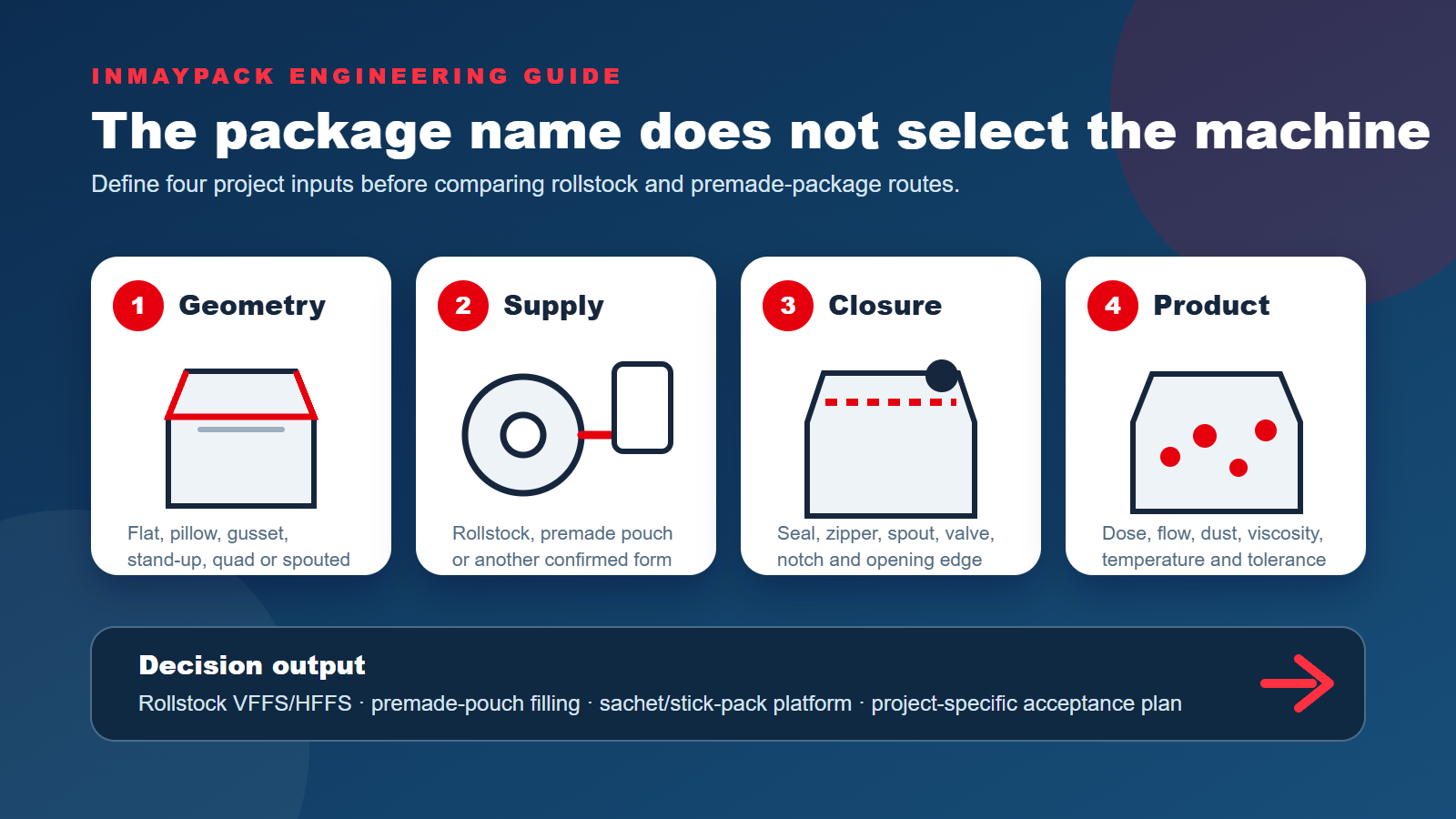
Define the physical package before discussing the machine
Start with what can be drawn, measured and tested. A useful package drawing shows the finished width and length, all seal bands, gusset depth, opening edge, registration reference and the position of every closure or fitment. If the package must stand, hang, pour, reclose or pass through a downstream cartoner, those functions also belong in the package specification.
| Definition field | What to state | Why the machine supplier needs it |
|---|---|---|
| Finished geometry | Flat, pillow, stand-up, bottom-gusset, side-gusset, quad-seal, shaped or spouted; include a dimensioned drawing. | Determines forming, support, gripping, opening and sealing requirements. |
| Seal layout | Back or fin seal, lap seal, three-side seal, four-side seal, top seal and any seal-free product zone. | Defines the sealing stations, jaw contact and contamination risk. |
| Supplied state | Rollstock, individual premade packages, wicketed bags or another confirmed delivery form. | Selects the web-handling, bag-feeding or pouch-magazine route. |
| Opening and closure | Open top, zipper, spout, valve, tear notch, peel feature or permanent seal. | Changes opening verification, closure handling, sealing and inspection. |
| Material structure | Converter, laminate construction, thickness range, sealant layer, friction data and approved samples. | Affects transport, forming, heat input, sealing window and package release. |
| Product condition | Particle size, bulk density, viscosity, temperature, dust, oil, aeration and dose range. | Determines the filler, product path, headspace and seal-area controls. |
The wording on an artwork file is not a substitute for these fields. Two packs sold as “stand-up pouches” can need different equipment when one arrives premade with a zipper and the other is formed from a registered roll on a horizontal form-fill-seal machine.
The supply format separates the main equipment families
The most important early question is not “bag or pouch?” It is “what enters the packaging machine?” A roll of flexible material needs forming and web control. A converted package needs separation, presentation, opening and holding. Those are different handling tasks even when the finished packs look similar on the shelf.
VFFS bag-making route
A vertical system forms film around a tube, creates the longitudinal seal, meters product and makes cross seals. Pillow bags and certain gusseted or quad-style formats can belong here, subject to the confirmed film, forming set and project configuration. Review the VFFS machine guide for the complete process path.
HFFS or Doypack-forming route
Horizontal web handling can form, seal, fill and close flat or stand-up package constructions. The achievable geometry and features depend on the installed modules and approved laminate. The Doypack machine group covers the relevant rollstock project routes.
Premade-pouch filling route
A premade pouch packing machine receives already converted packages. It must separate, grip, open, confirm and support each pouch before filling and final sealing. Package stiffness, opening behavior, zipper position and dimensional consistency directly affect handling.
Sachet or stick-pack route
Small-dose packs can be made across one or more lanes from rollstock. “Sachet,” “packet,” “stick” and “small pouch” are sometimes used loosely, so specify the seal pattern, cut, lane count, dose and accepted output. Start from the sachet packing machine group.
A form-fill-seal machine creates the package within the process. A premade-package machine handles a package that already exists. That difference is more useful than the bag-versus-pouch label.
Translate common market names into verifiable construction
Market names are still useful for finding examples, but each name must be followed by a drawing and sample. The table below shows the questions that prevent a familiar term from becoming an incorrect machine assumption.
| Common description | Construction to confirm | Machine-selection question |
|---|---|---|
| Pillow bag | Longitudinal seam plus top and bottom cross seals; confirm fin or lap seam, film width and headspace. | Is the package made vertically around a forming tube, or supplied in another form? |
| Flat pouch | Three-side or four-side seals, opening edge, tear notch and any zipper or fitment. | Is it supplied premade, made from rollstock horizontally, or produced on a sachet platform? |
| Stand-up pouch | Bottom-gusset geometry, top opening, zipper or spout position, filled stability and seal bands. | Will the project form the pouch from rollstock or fill a converted premade pouch? |
| Side-gusset bag | Gusset depth, longitudinal seam position, top/bottom closure and filled cross-section. | Can the forming set control the intended gusset and filled shape with the approved product? |
| Quad-seal bag or pouch | Four corner seals, gussets, longitudinal seam, base and filled geometry. | Which seals are created in the machine, and how is the pack supported before discharge? |
| Spouted pouch | Spout type and position, cap, pouch neck geometry, seal around the fitment and leak criteria. | Is the fitment inserted during pouch forming, or does the machine receive a premade spouted pouch? |
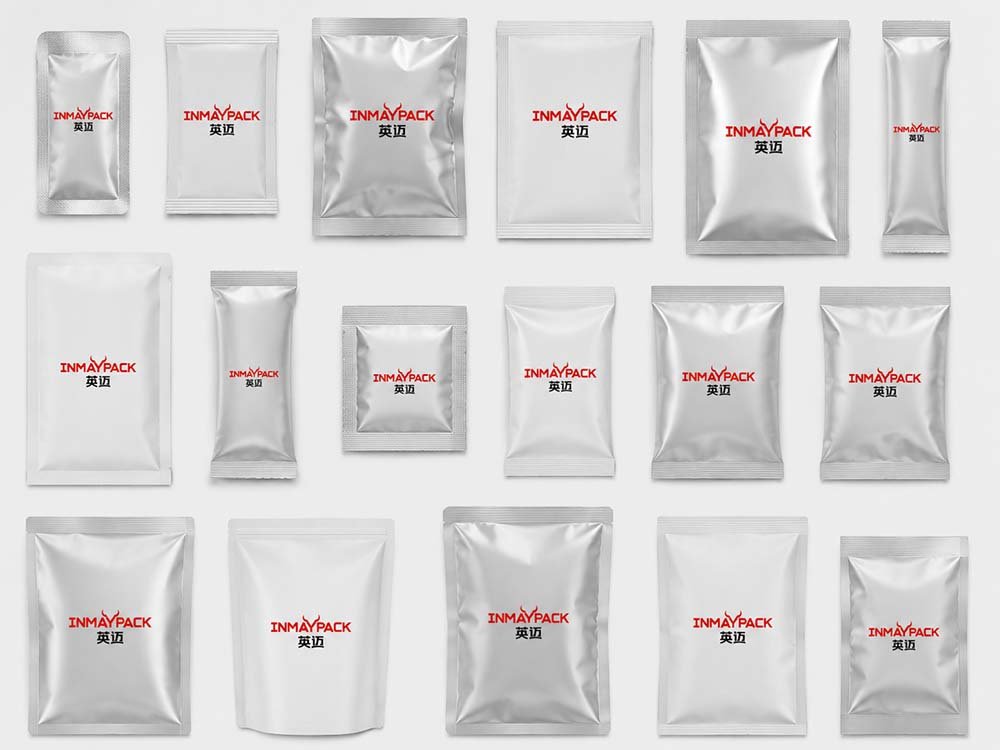
For two formats that are often confused, see the detailed three-side versus four-side seal guide. For corner-sealed gusseted construction, use the quad-seal pouch guide.
The product can change the correct route even when the package is unchanged
The same drawing may behave differently when filled with free-flowing granules, dusty powder, aerated powder, viscous sauce or fragile pieces. Product behavior affects dosing, settling, splash or dust control, required headspace, cleaning access and the risk of contamination in the final seal.
Granules and pieces
Confirm piece size, shape, breakage limit, target weight, bulk density and how the product enters the package. A falling product stream may require more headspace or different timing than the same pack filled with a compact dose.
Powders
State flowability, aeration, dust, oil content and density range. The project may need an auger, dust extraction, settling time or seal-area cleaning; the package noun does not reveal those requirements.
Liquids and pastes
Provide viscosity at the real filling temperature, particulate content, foaming, stringing, required cutoff and cleaning method. Splash control and nozzle withdrawal can determine whether the intended seal remains clean.
Fragile or irregular products
Define acceptable damage, orientation, presentation and transfer limits. A package can be geometrically suitable while the proposed infeed or dosing route is not.
This is why a package discussion should connect to the complete pouch filling system selection, not stop at the outer container name.
A zipper, spout or valve is part of the package-handling task
Added features can change material tracking, pouch opening, support, sealing and inspection. Their presence should be shown on the dimensioned drawing with tolerances and an agreed orientation. “Resealable pouch” is not enough information for a machine review.
- Zipper: identify whether it is already converted into a premade pouch or applied from a separate zipper web during forming. Provide its position, profile and opening requirement. The zipper pouch machine page explains the project-level route.
- Spout and cap: identify top or corner position, fitment geometry, cap feeding, torque or closure acceptance, leak test and whether the pouch arrives with the spout installed.
- Degassing valve: state valve type, location, application method and the product/packaging process that requires it. Do not assume every coffee bag or pouch uses the same valve route.
- Tear notch or laser score: define the opening location and tolerance, and identify whether it is created by the converter or the packaging machine.
These details also affect changeover. A machine that can physically carry two package sizes may still need different guides, grippers, forming sets, zipper tooling, spout tooling or recipes. The quotation should list those change parts explicitly.
Rollstock and premade packages require different incoming evidence
For rollstock, provide the approved converter, roll width, maximum roll dimensions, core, unwind direction, print repeat, eye-mark details, splice method, material construction and sealing layer. The machine review must also cover web tension, tracking, static, forming behavior and the usable sealing window.
For premade packages, provide production-representative samples and the converter drawing. Inspect dimensional spread, blocking, curl, stiffness, zipper condition, opening consistency and the position of features relative to the gripping and sealing zones. A hand-opened sample does not prove that a pouch magazine and opening station can handle the production lot reliably.
ASTM F17 provides terminology for primary barrier packaging, while GS1 provides repeatable package measurement guidance. Use the standard or customer method appropriate to the project, and record exactly how dimensions are taken. A width measured flat, a filled shelf width and a gusset depth are different quantities.
Accept the finished package, not the label used in the quotation
The acceptance plan should connect machine operation to a conforming finished pack. Define the test product, packaging material lot, dose, run duration, normal replenishment, permitted adjustment, reject logic and the method used to inspect seals, leaks, dimensions, closure and appearance.
ASTM F88/F88M measures seal strength in flexible barrier materials and can support a defined seal-strength method. ASTM F2096 covers gross-leak detection by internal pressurization for applicable porous and nonporous packages. These methods answer different questions. Choose tests that match the package design and product risk rather than treating one test as a universal release standard.
Freeze the package definition
Approve the drawing, materials, closures, artwork reference, tolerances and production samples that represent the intended supply.
Freeze the product and dosing condition
Record the real product, dose range, temperature, flow behavior, filler, allowable giveaway or tolerance and cleaning state.
Run the complete operating sequence
Include replenishment, normal stops, restart, changeover elements and downstream transfer rather than judging only a short steady sample.
Count conforming output
Separate gross cycles from accepted finished packages. Record reject cause, affected station or lane and the agreed disposition.
Retain traceable evidence
Keep material and product identities, settings, samples, inspection results, deviations, corrective actions and the approved release record.
Send these inputs before requesting a bag or pouch machine
- Finished-pack drawing: width, length, gussets, seal bands, opening edge, registration marks and feature positions.
- Supply format: rollstock or premade package, plus converter details and representative production samples.
- Material: laminate construction, thickness range, sealing layer, print repeat and any available friction or sealing data.
- Product: name, state, density or viscosity, particle size, temperature, dust, oil, aeration and cleaning concerns.
- Dose: minimum, nominal and maximum quantity with tolerance and measurement method.
- Closures and options: zipper, spout, cap, valve, notch, coding, gas flush, inspection and reject requirements.
- Output target: required conforming packages per minute, shift pattern, SKU mix and changeover frequency.
- Utilities and site: voltage, frequency, phase, compressed air and any nitrogen, extraction, water or cooling interface.
- Acceptance method: FAT duration, samples, package criteria, inspection method, permitted rejects and documentation.
These inputs allow a supplier to compare the pouch packing machine routes on the same project basis. Without them, two quotations may describe different package constructions, fillers, inspection scopes and acceptance conditions even when both use the word “pouch.”
Pouch vs bag packaging FAQ
Is a pouch the same as a bag?
The terms overlap in common flexible-packaging usage, but some data and trade systems distinguish them. For machine selection, neither term is sufficient. State geometry, supplied form, material, opening, closure and filling process.
Which machine is used for a pouch?
A pouch may be formed from rollstock on an HFFS or other form-fill-seal system, or it may be supplied premade to a pouch-filling machine. Small flat packs may instead belong on a sachet platform. The correct route depends on the drawing, material, product and required output.
Can one machine run both bags and pouches?
Only when the specific formats fall within the machine’s confirmed forming or handling range and the required change parts, filler, sealing hardware and controls are included. A shared market name does not prove compatibility.
Are stand-up pouches always premade?
No. Stand-up constructions can be supplied as converted premade pouches or formed from rollstock on an appropriate horizontal system. The RFQ must state which supply route is intended.
What samples should be sent for a machine review?
Send production-representative packaging material, finished-pack samples, the current dimensioned drawing and enough real product for the agreed test. Identify the converter and material lot so the trial can be traced.
What should a comparable quotation state?
It should identify the package route, model and configuration, filler, options, change parts, included interfaces, test materials, output definition, acceptance method, documentation and commercial exclusions.
Sources used for the package-definition framework
Flexible Packaging Association, flexible packaging industry definition, including bags, pouches, rollstock and other flexible forms.
GS1, Package and Product Measurement Standard, measurement guidance for flexible packages including bags and pouches.
UNECE Recommendation 21, codes for package types, listing bag and pouch as distinct coded names.
ASTM International, F17 terminology and flexible-package test standards, including F88/F88M seal-strength testing.
Send the package drawing, material and product
INMAYPACK will review the supplied package route, product, filler, closures, target output and acceptance plan before recommending an available machine configuration.
Request a Package Route Review






