
Cookie and biscuit packaging selection
Start with the product format, not a headline machine speed.
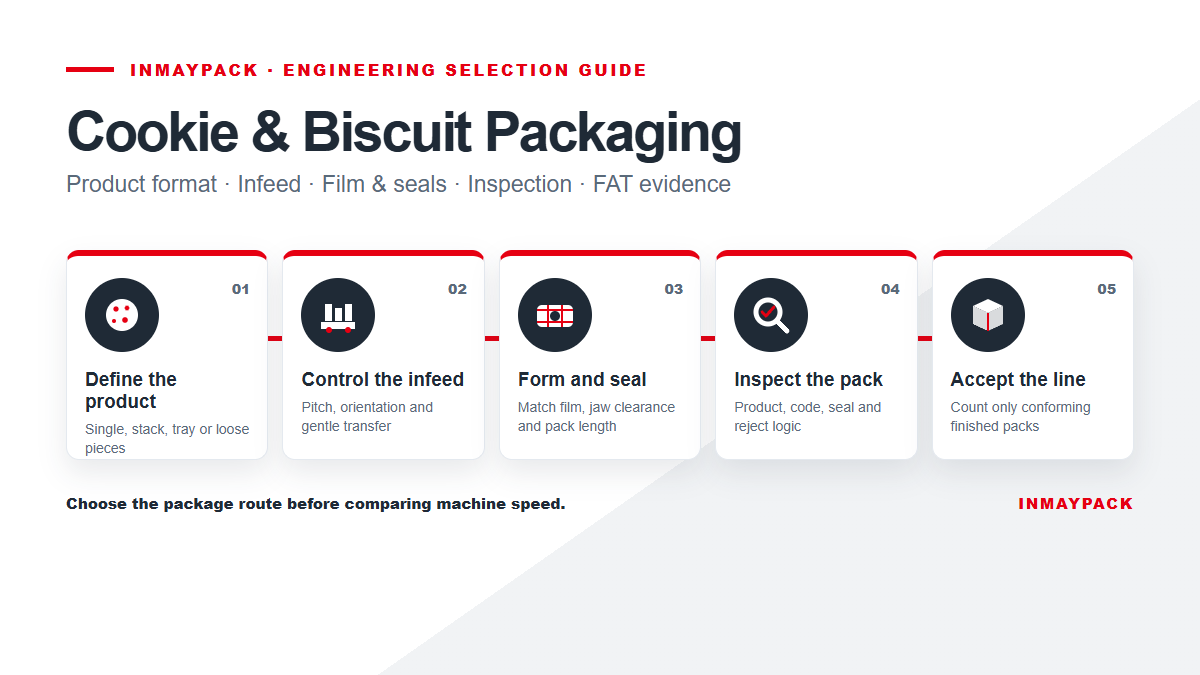
A single cookie, an on-edge biscuit stack, a tray-supported assortment and loose mini cookies are four different handling tasks. Define the accepted retail pack and how the product reaches it before comparing packaging machines.
A horizontal flow-wrap route is commonly evaluated when cookies or biscuits can arrive at a controlled orientation and pitch. Stacks, trays and multipacks need additional counting, grouping or loading logic. Loose small pieces intended for a pouch may instead use a weighing-and-pouching route. The right quotation connects product handling, film, sealing, inspection and downstream transfer under one acceptance test.
Architecture decision
Which packaging route fits the finished cookie or biscuit pack?
“Cookie packaging machine” is a search term, not a complete machine specification. The primary route changes with how the product is presented and what the consumer receives.
| Finished pack | Route to evaluate | Critical questions |
|---|---|---|
| One cookie or biscuit per pillow pack | Controlled infeed into horizontal flow wrapping | Can each piece be oriented and pitched without chipping, overlap or product entering the seal zone? |
| Stack or on-edge group | Counting, grouping and stack transfer before wrapping | How is count verified, how stable is the stack, and what happens when one piece is missing or tilted? |
| Tray-supported cookies | Tray loading or tray infeed followed by wrapping | Is the tray buyer-supplied, how is it denested or loaded, and does it protect the product without disturbing the film path? |
| Loose mini cookies in a pouch | Weighing or counting plus VFFS or premade-pouch packing | What dose, count, pouch style and breakage limit define an accepted pack? Review the multihead weigher packing route when weighing is appropriate. |
| Retail carton with primary packs | Flow wrapping plus accumulation, counting and cartoning | What orientation, count, buffer and reject logic must be maintained between the wrapper and cartoning machine? |
If the package route is still unclear, first review the broader flow wrap packaging machine guide. It separates horizontal wrapping from doypack HFFS, VFFS and sachet architectures.
Product behavior
Fragility, crumbs and surface condition determine the handling risk
Two products with the same drawing can behave differently after baking, cooling, coating or storage. Send representative samples from the real process and identify the conditions that are hardest to run.
Edge chips and cracked pieces
Review drop height, guide pressure, belt transitions, acceleration and contact surfaces. Define whether a chipped edge, crack or broken piece is a reject.
Product in the seal area
Crumbs can follow the product into the longitudinal or cross-seal region. The FAT should include seal-area inspection and the approved cleaning method.
Oil, sugar and coatings
Oil migration, sugar dust, chocolate or other coatings can change friction and contaminate product-contact parts. Test at the relevant product temperature and dwell condition.
Diameter, thickness and warpage
Record normal variation rather than submitting only ideal samples. Product variation affects guides, stack stability, pack length and seal-jaw clearance.
INMAYPACK engineering note
The wrapper cannot correct an unstable product presentation by itself.
Reliable wrapping begins before the forming box. If pieces arrive doubled, rotated, touching or at an inconsistent pitch, the film and sealing jaws receive an unstable task. Define the product supply, distribution, accumulation and reject response as part of the packaging line rather than treating the infeed as an unnamed accessory.
Infeed and distribution
Define how every product reaches the sealing cycle
The required level of automation depends on production flow, product variation, labor boundary and the agreed response to gaps, doubles and stoppages.
Describe the production discharge
Provide the number of upstream lanes, discharge height, orientation, spacing, temperature, normal output pattern and expected interruptions.
Define manual and automatic responsibility
State whether operators load individual pieces, trays or stacks, or whether automatic distribution, counting and transfer are included in the project.
Set rules for missing or doubled product
Agree whether the machine creates an empty pack, suppresses the pack, stops, rejects or recovers automatically when product presentation is incorrect.
Test restart and accumulation
Normal production includes stops. The line test should cover starvation, blocking, restart, buffer behavior and product condition after recovery.
For a multi-machine project, use the packaging system integration checklist to assign mechanical, controls, safety, quality and data responsibility at every handoff.
Film and sealing
Qualify the actual film, pack drawing and seal requirement
Do not select a wrapper from product dimensions alone. Film behavior, print repeat, pack length, longitudinal-seam position and end-seal clearance all affect the running window.
Controlled pack drawing
Provide product and pack dimensions, orientation, seam style, fin or lap position, end-seal width, print position, easy-open features and coding area.
Approved film
Identify the supplied film structure, thickness, sealant face, roll width, print repeat, roll data and any barrier or appearance requirement that must be tested.
Seal acceptance
Agree visual, peel, leak, burst or other applicable checks and limits. Barrier, gas-flush or hermetic performance must be validated for the confirmed configuration.
Use the project-specific inspection method agreed in the URS. A visually closed pack is not proof of the required seal performance unless the approved check and acceptance limit are also defined.
Inspection and downstream flow
Count accepted packs, not cycles
A useful output figure excludes products or packs that fail the agreed checks. Inspection and reject handling must be included in the same line-speed basis.
Product and pack presence
Define missing, doubled, rotated, exposed, crushed or trapped product conditions and how each condition is detected or sampled.
Print and code
Confirm registration, code content, code position, readability method and response when a code is absent or incorrect.
Seal and cut position
Inspect product-in-seal events, cut position, wrinkles, open seals and other agreed defects using the approved test method.
Transfer after wrapping
Record discharge orientation, accumulation, inspection, rejection, grouping and the interface to cartons, cases or other downstream equipment.
Request for quotation
Send the inputs that change the machine and line scope
| Input | What to send | Why it matters |
|---|---|---|
| Product | Samples, controlled dimensions, weight range, surface condition, fragility, crumbs, temperature and normal variation | Sets the handling, guide, transfer and cleaning basis |
| Pack format | Single, stack, tray, loose pouch or multipack; controlled drawing and accepted sample | Determines the packaging architecture and upstream equipment |
| Film | Structure, thickness, sealant face, roll width, print repeat and sample roll | Changes forming, tracking, sealing and coding requirements |
| Output | Target accepted packs per minute, production pattern, product gaps and required format changes | Sizes the infeed, wrapper, buffer, inspection and downstream route |
| Inspection | Product, code, seal, weight, metal detection, rejection and traceability requirements | Defines accepted output and reject logic |
| Site and scope | Floor plan, utilities, upstream discharge, downstream equipment, documents, FAT and site-service expectations | Defines the commercial boundary and integration responsibility |
When the request includes feeding, wrapping, inspection, conveying or cartoning, review the turnkey packaging line scope before comparing supplier totals.
Factory acceptance test
Build the FAT around difficult real products and conforming packs
A demonstration with ideal pieces and an unspecified film does not prove the production task. The FAT basis should be agreed before equipment is released.
- Identify the exact product variants, production condition, sample quantity and film used for the test.
- Record the installed configuration, recipe, guides, forming parts, sealing setup and inspection equipment.
- Define warm-up, steady-run duration, format changes, planned stops, starvation, blocking and restart checks.
- Agree the defect list: chips, cracks, doubles, missing pieces, product in seal, poor code, open seal, miscut and damaged pack.
- Record total cycles, conforming finished packs, rejects, stoppages, causes and approved deviations separately.
- Confirm documents, training, spare-parts scope and remaining site responsibilities before shipment.
Use the packaging line bottleneck analysis method to distinguish product starvation, wrapper stops, inspection rejects and downstream blocking when the complete line is evaluated.
Cost and scope drivers
Why two cookie packaging machine quotations may not be comparable
The useful comparison is not the machine count or the lowest total. Check whether every proposal covers the same product presentation, format range, inspection, downstream interfaces, documents and acceptance test.
Product distribution and loading
A manually loaded wrapper and a line receiving products automatically from several production lanes are not the same scope. Confirm distribution, buffering, counting, stacking, tray handling and operator responsibility.
Change parts and approved recipes
List every product and pack combination that must run. Forming parts, guides, sealing position, code location, recipe management and changeover checks may differ by format.
Inspection and rejection
State whether coding, product presence, checkweighing, metal detection, seal checks and reject confirmation are included, buyer-supplied or outside the project.
Documents, FAT and site work
Compare drawings, manuals, training, spare parts, shipment, installation, commissioning, third-party interfaces and FAT evidence against the same written responsibility matrix.
Keep uncertain items visible as open questions. A quotation that assumes an ideal product, one film, manual loading and no downstream integration should not be compared directly with a proposal that includes automatic distribution, inspection and cartoning.
Related decision paths
Continue with the part of the project that needs definition
Buyer questions
Cookie and biscuit packaging machine FAQ
Which machine is commonly used for individual cookies or biscuits?
A horizontal flow wrapper is commonly evaluated when each product can be supplied at a controlled orientation and pitch. The final route depends on product fragility, dimensions, film, seal requirements, infeed automation, inspection and downstream handling.
Can one line pack both single cookies and biscuit stacks?
One platform may support more than one approved format, but single pieces and stacks require different counting, grouping, guides, infeed logic, pack length and change parts. Each priority format should be shown in the quotation and FAT plan.
How can cookie breakage be reduced during packaging?
Start by controlling upstream cooling and product condition, then review drop heights, belt transfers, guide pressure, acceleration, stack stability and sealing-jaw clearance. The accepted breakage definition and sampling method must be agreed.
How are crumbs kept out of the seal?
Stable product presentation and correct pack length help keep product and crumbs away from the sealing zone. Cleaning access, extraction or other controls depend on the confirmed product and line. Seal-area inspection should be part of the test.
Can loose mini cookies be packed in a pouch?
Yes, a loose-pouch project may be evaluated with weighing or counting followed by VFFS or premade-pouch packaging. That is a different architecture from wrapping an individual oriented cookie and should have its own product, dose and breakage test.
What determines the cost of a cookie packaging line?
The main drivers include product presentation, manual or automatic infeed, format range, film and sealing requirements, inspection, rejection, coding, accumulation, cartoning, controls integration, documents and acceptance scope. Compare quotations only after these boundaries match.
What should be sent before requesting a proposal?
Send product samples, controlled dimensions and variation, finished-pack drawing, film data and sample roll, target accepted output, production pattern, required formats, inspection needs, floor plan, utilities, upstream and downstream interfaces, destination market and FAT expectations.
Primary technical references
Official manufacturer application references
- ULMA Packaging, automated bakery, biscuit and snack-bar packaging and case-packing example.
- Syntegon, horizontal flow-wrapper application and sealing overview.
These sources support established packaging-route and application principles. They do not establish an INMAYPACK model, output, supplied scope or customer result. Confirm all project facts in the issued quotation and approved test documents.
Prepare a comparable request
Request a cookie or biscuit packaging-route review
Send product photos and samples, the finished-pack drawing, film information, target accepted output, required formats and upstream/downstream scope. INMAYPACK will review the information needed to define a project-specific route.







