
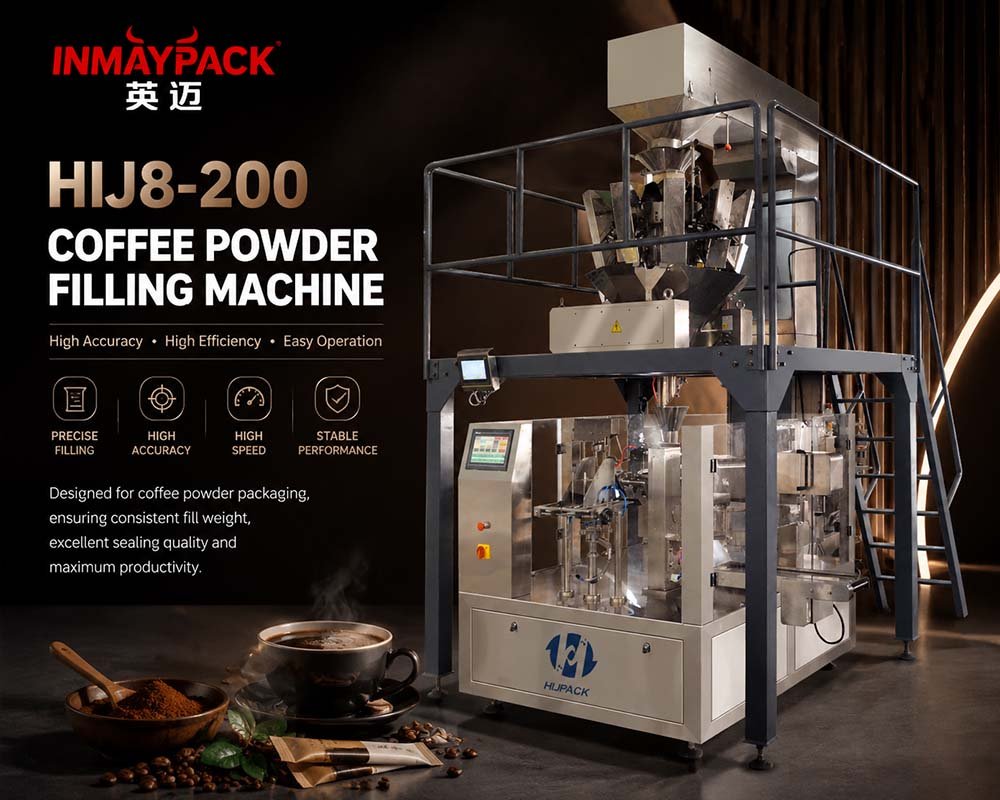
Coffee Powder Filling Machine HIJ8-200
Automate coffee powder packing in premade pouches.
Combine rotary pouch handling, servo auger dosing and powder refill for your ground or instant coffee project. The documented powder configuration covers 100–1,000 g; confirm your coffee, pouch and required output through sample trials.
Choose the right powder pouch route.
This HIJ8-200 page covers a coffee powder configuration. Explore a broader powder or coffee-pouch guide when you are still comparing the application.
Powder Pouch Filling
Compare premade-pouch handling, powder dosing and product-specific filling requirements.
Review powder pouch machines →COFFEE BEANS OR GROUND COFFEECoffee Pouch Packing
Compare coffee products, pouch formats and the filling route before selecting the machine.
Review coffee pouch options →Coffee powder packing, from refill to sealed pouch
Bring dosing and pouch handling together.
The HIJ8-200 combines premade-pouch handling with a selected servo auger and powder refill arrangement. Review the coffee, pouch and fill weight as one system.
Packing a powder other than coffee? Use the powder pouch filling machine guide to compare the product, dosing equipment and pouch requirements together.
View the complete application scope and HIJ8-200 key facts
The HIJ8-200 is an eight-station rotary machine that opens, fills and seals already-made pouches. A servo-driven auger doses the powder; a refill conveyor supplies the filler. The coffee proposal covers 250 g, 500 g and 1,000 g applications and selects a 100–1,000 g powder system. Its broader 10–2,500 g platform reference is product-dependent and does not establish that full range for this coffee configuration. Submit the grind or particle form, bulk density, flow behaviour, pouch construction and all requested weights before selecting the tooling.
This product page covers the supplied premade-pouch route for coffee powder. If the buyer still needs to compare that architecture with a bag formed from roll film, review the ground coffee pouch packing route before fixing the machine scope.
HIJ8-200 Key Facts
| Machine Type | Automatic rotary premade pouch coffee powder filling machine (8 stations) |
|---|---|
| Dosing System | Customized servo auger filler + powder conveyor for the documented coffee powder project. Bean weighing is a separate configuration. |
| Filling Range | Coffee powder project: 100–1,000 g. Other weights require a selected and tested configuration. |
| Dosing Accuracy | Component-sheet references and 0.1 g scale resolution do not replace SKU-specific filling trials. Agree acceptance for each weight. |
| Packing Speed | 20–60 pouches/min platform reference; accepted coffee line output depends on dose, pouch and operating conditions. |
| Pouch Types | Stand-up pouch, zipper pouch, 3-side seal pouch, flat pouch |
| Pouch Size | Width 80–200 mm × Length 100–400 mm (250 g / 500 g / 1 kg coffee bags) |
| Control System | The proposal lists Siemens PLC/HMI, Schneider converter and Festo pneumatics. Confirm the issued component list. |
| Total Power | 3.3 kW main pouch machine only; add filler, conveyor and auxiliary loads. |
| Machine Weight / Dimensions | 1,400 kg / 1,890 × 1,830 × 1,430 mm |
| Manufacturer | Supplier contact: INMAYPACK. Issued equipment, commercial and service documents define the project commitments. |
Output boundary: the specification lists 20–60 pouches/min and a cam-design reference of up to 65 cycles/min. Neither the 65-cycle figure nor the auger’s independent cycling rate is an accepted finished-pouch output. Test the selected coffee, weights and pouches, including refill, restart and changeover conditions.
A rotary premade-pouch system with servo auger dosing for suitable ground and instant coffee powders. The documented coffee project uses a customized auger filler and conveyor for 100–1,000 g packs. Match the coffee, pouch and required accepted output through sample trials.
Three documented coffee pack weights.
One application-led review.
The selected coffee powder project covers 100–1,000 g. Match the dose, pouch material, opening and seal area for each format.
Coffee powder application
Coffee powder application
Coffee powder application
Pack illustrations show representative formats, not approved pouch drawings or finished test samples. Final format and accepted output follow the selected coffee and production pouch trials.
HIJ8-200 Technical Specifications
Key data for the coffee powder configuration. Open the full specification below for component references, utilities and acceptance conditions.
Open complete machine and auger specifications
| Model | HIJ8-200 |
|---|---|
| Pouch Type | Stand-up pouch, zipper pouch, 3-side seal pouch, flat pouch |
| Pouch Size (mm) | W 80–200 × L 100–400 |
| Filling Range | 10–2,500 g, product-dependent platform reference. Documented coffee powder project: 100–1,000 g. |
| Packing Speed | 20–60 pouches/min; actual line acceptance is sample- and configuration-dependent. |
| Total Power | 3.3 kW main machine; not the total connected load of the powder line. |
| Compressed Air | ≥0.6 m³/min customer supply. Obtain pressure and air-quality requirements in the issued utility schedule. |
| Machine Weight | 1,400 kg |
| Dimensions (L×W×H) | 1,890 × 1,830 × 1,430 mm |
| Contact Material | The proposal references stainless steel 304 and other materials. Confirm every product-contact component in the material list. |
| Packing Range | Coffee powder project: 100–1,000 g. The generic component sheet separately lists 1–1,000 g subject to power and hopper upgrades. |
|---|---|
| Accuracy | Component reference: ≤±2% at ≤100 g; ≤1% at 100–500 g. Agree the criterion at the overlapping 100 g boundary and test each SKU. No numerical 500–1,000 g guarantee is supplied. |
| Free Scale Precision | 0.1 g scale resolution; not the achieved filling accuracy. |
| Filling Speed | 40–120 fills/min component reference; not finished pouches/min. |
| Power | 0.95 kW (1.2 kW upgraded) |
| Hopper Volume | 25 L (enlarged 35 L) |
| Memory | Stores up to 10 product formulas |
| Structure | Documented stainless-steel structure and quick-disconnecting hopper. Verify fitted access, seals and cleaning instructions; do not assume whole-line washdown. |
The reference component list is part of the proposal, not a promise that all future machines use identical suppliers. The auger sheet also lists 130–260 kg and 800 × 790 × 1,900 mm; its supply reference is three-phase AC 208–415 V, 50–60 Hz. Obtain the complete line layout, local voltage selection and connected-load schedule before planning installation.
Engineering checks for coffee powder pouch packing
Evaluate dosing, pouch handling, powder control and cleaning as one configuration. Reference photos illustrate different equipment arrangements; the approved HIJ8-200 scope defines what is supplied.
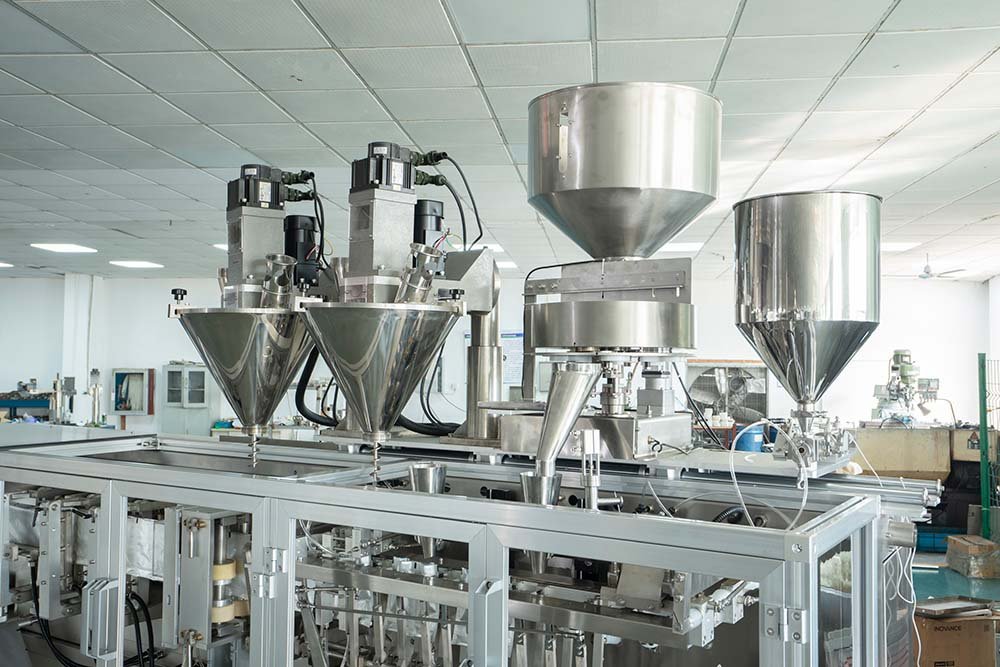
Reference: HS-series multi-lane auger heads, a different machine family. The HIJ8-200 coffee project uses its separately selected auger assembly.
Powder-specific dosing
Select the auger and hopper around the coffee powder and dose.
Configuration and trial detail
Select the screw and hopper for your powder and dose. Weight feedback and stored recipes support adjustment, but variations in density, aeration and settling still require trials. Check the first packs after refilling and restarting.
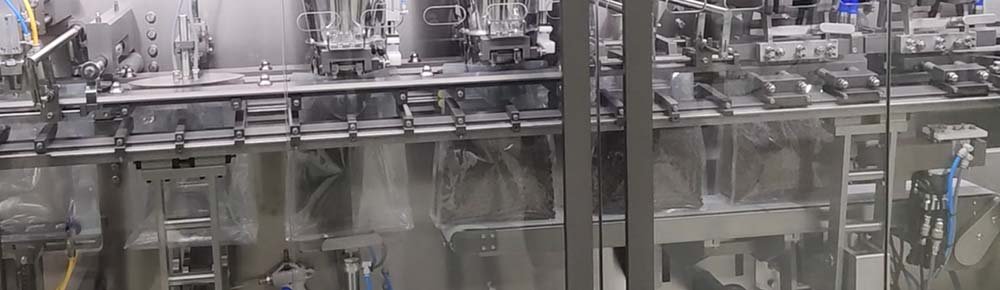
Rotary pouch filling and sealing reference. The issued layout confirms station equipment and access.
Controlled pouch handling
Review feeding, opening, gripping and sealing with the production pouch.
Configuration and trial detail
The documented platform uses PLC control and a precision indexing arrangement. Evaluate pouch feed, opening, gripping and sealing with the production bags. Smooth indexing alone does not establish good-pack output.
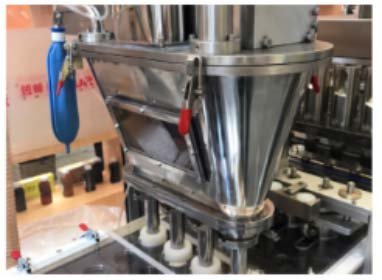
Coffee powder transition-hopper detail; verify fitted connections and cleaning access.
Settling before sealing
Coordinate bottom vibration, mouth handling and seal-area powder control.
Configuration and trial detail
The station sequence includes bottom vibration and a powder duster. Trial the fill drop, settling and mouth handling together, then inspect contamination and perform agreed seal tests. These functions do not guarantee a residue-free or leak-free seal.
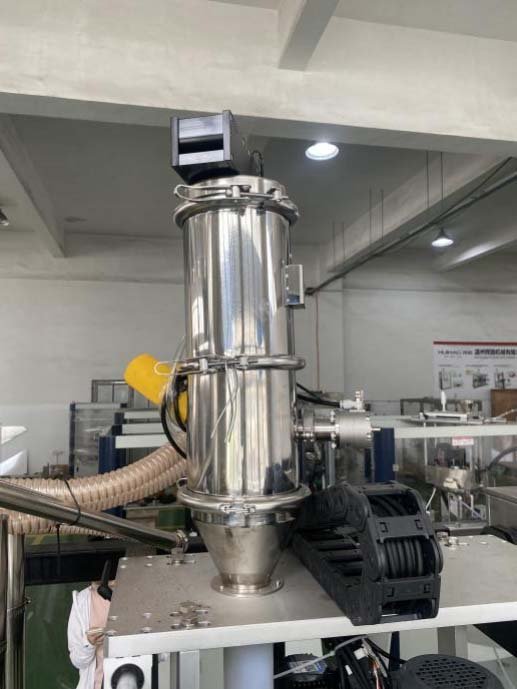
Alternative powder-handling hopper reference; the selected conveyor and its capacity follow the project equipment list.
Coordinated powder refill
Connect the refill equipment and filler level signals as one powder path.
Configuration and trial detail
The proposal’s auger conveyor reference is 3 m³/h with a 230 L hopper, 1.5 kW motor and 2,211 mm discharge height. Volume capacity is not a guaranteed coffee mass throughput. Confirm level control, connections and refill behaviour.
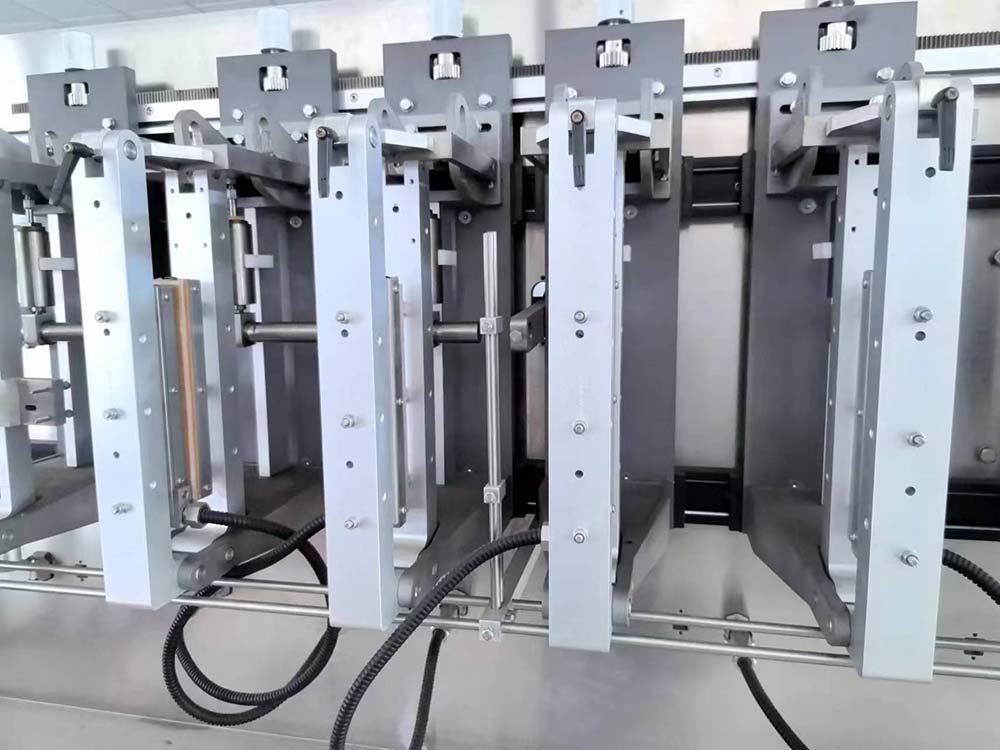
Pouch-holder detail reference. A photo does not establish material grade or hygienic certification.
Practical cleaning access
Review hopper removal, screw changes and reassembly with your team.
Configuration and trial detail
Request the material specification for contact parts, seals and hoses. Demonstrate hopper removal, screw changes, cleaning access and reassembly. The proposal’s SS304 reference does not prove that every contact part is SS304 or that the complete line supports wet cleaning.
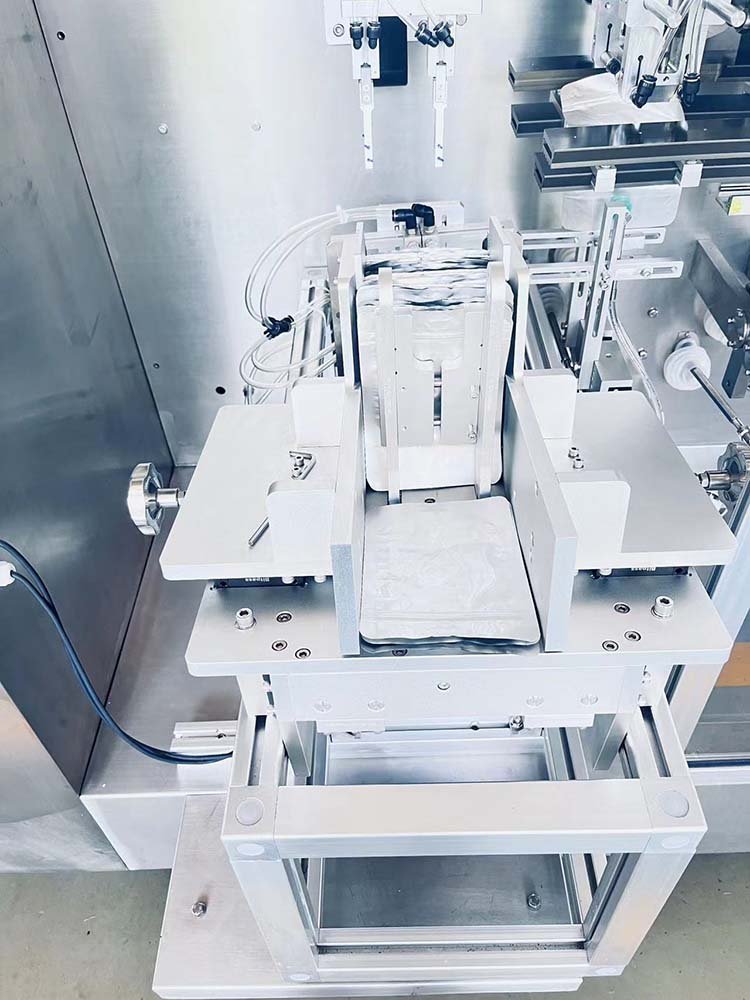
Reference: SG-series pouch feeding equipment, a different machine family. Confirm the HIJ8-200 feed mechanism with its approved configuration.
Defined fault response
Agree dosing inhibition, incomplete-pouch handling and restart procedures.
Configuration and trial detail
The proposal shows material and pouch-open detection. Demonstrate which faults inhibit dosing, how incomplete pouches are handled and how the line restarts. Confirm the selected PLC, HMI and controls in the issued bill of equipment.
How the HIJ8-200 Fills Coffee Powder — 8 Stations
Follow the pouch through the documented eight-station packing sequence. Confirm the selected station equipment and coding arrangement in the project scope.
Pouch Feeding
Vertical feeding presents premade pouches to the rotary sequence. Check the magazine setup and feed reliability with the actual pouch size and stiffness.
Date Coding
The proposal station sequence names a Dikai D03S coder. Confirm the current model, print area, required information and consumables in the equipment list.
Pouch-Top Opening
Open the pouch mouth for filling. Include zipper and bottom-opening requirements where needed, and demonstrate pouch-open detection and fault recovery.
Auger Filling + Vibrating
The selected auger doses the coffee powder while documented bottom vibration supports settling. Agree the recipe and vibration settings for every weight and product.
Powder Dusting
The documented powder duster addresses residue near the pouch mouth. Verify seal-area cleanliness and package integrity with production coffee and film.
Bag-Top Straightening
Present and straighten the pouch mouth for sealing. Verify gripper alignment, zipper clearance and the usable sealing area with finished samples.
Air Exhaust + Heat Sealing
The documented sequence combines heating and air exhaust. Agree temperature, dwell and pressure for the pouch material. Air exhaust is not proof of nitrogen flushing or validated shelf life.
Forming & Discharge
Form and discharge the finished pouch. Confirm discharge orientation and interfaces to inspection or conveying equipment; the supplied station list does not specify a cooling-bar assembly.
Build a Complete Coffee Powder Packaging Line
Define the powder-only equipment list and its interfaces. The source proposal also includes a bean route; its equipment and performance are separate from the coffee powder configuration.
Powder auger conveyor
Define the refill conveyor, its hopper, level signals and connection to the filler. Test refill cycles with the actual powder and record the operating hopper level.
Reference: 3 m³/h · 230 L · 1.5 kW · 2,211 mmSeparate bean weighing route
The coffee proposal includes a 14-head weigher option for 100–1,000 g beans. Its weighing rate and accuracy references do not apply to auger-filled powder or establish a quick powder-to-bean conversion.
Confirm separate equipment and changeover scopeBean elevator option
A Z-type bucket elevator is part of the bean-feeding route in the proposal. It is not automatically included in a powder-only quote; agree the product-contact materials and cleaning requirements.
Bean refill route; individually quotedAccess platform and layout
Confirm the platform, stairs, guarding, refill access and maintenance clearance in the arrangement drawing. The main-machine footprint excludes overhead dosing and auxiliary equipment.
Confirm ceiling height and service clearanceOptional dust extraction
A vacuum cleaner is marked optional. Define capture points, filtration, maintenance and cleaning. Dust-hazard assessment and protective measures require a project-specific review; ordinary extraction is not proof of explosion protection.
Optional; review collector and interface scopePouch opening and freshness
The project lists air exhaust, zipper opening, bottom opening, vibration and powder dusting. Confirm each item in the equipment list. Nitrogen hardware, residual-oxygen tests and valve insertion require separate agreement.
Review pouch samples and complete gas-system scopeConfiguration, trials and service support
Ask INMAYPACK for a current quotation, equipment list, arrangement drawing and documented acceptance plan. Historical prices, fixed delivery dates and payment terms in a previous proposal are not current commitments. Specify the selected powder system, pouch functions, utilities, coding, inspection and downstream interfaces together. Use the coffee packaging machine price and cost guide to compare included equipment, selected options and buyer-side installation costs on the same basis.
Agree factory trials, site commissioning, operator training, spare parts, warranty conditions and technical support in the project documents. Confirm the responsibilities and costs for on-site assistance. Remote or live-video tests should be arranged explicitly, with settings and test records retained for the approved configuration.
Agree the acceptance evidence before placing the order
| Test input | Record and agree |
|---|---|
| Product and pouches | Every SKU, grind or particle form, fill weight, production pouch dimensions, film, zipper and valve location. Include the most demanding product and bag. |
| Weight and accepted output | Test duration, scales, sampling method, weight distribution, rejected packs and good packs per minute. Include refilling and restarting. Agree tolerance at each weight. |
| Seal and package | Visible powder at the seal, seal settings, agreed leak or seal-integrity tests, coding and package presentation. Shelf life remains a separately validated product/package result. |
| Changeover and faults | Tooling and recipe changes, cleaning steps, pouch-opening failures, low powder level, restart procedure and operator approval of first packs. |
| Utilities and records | Local power, complete connected loads, compressed-air pressure and quality, layout clearances, controls/interfaces and the retained configuration and trial records. |
Use the packaging integration checklist to frame interface questions and installation and support guidance to agree commissioning responsibilities.
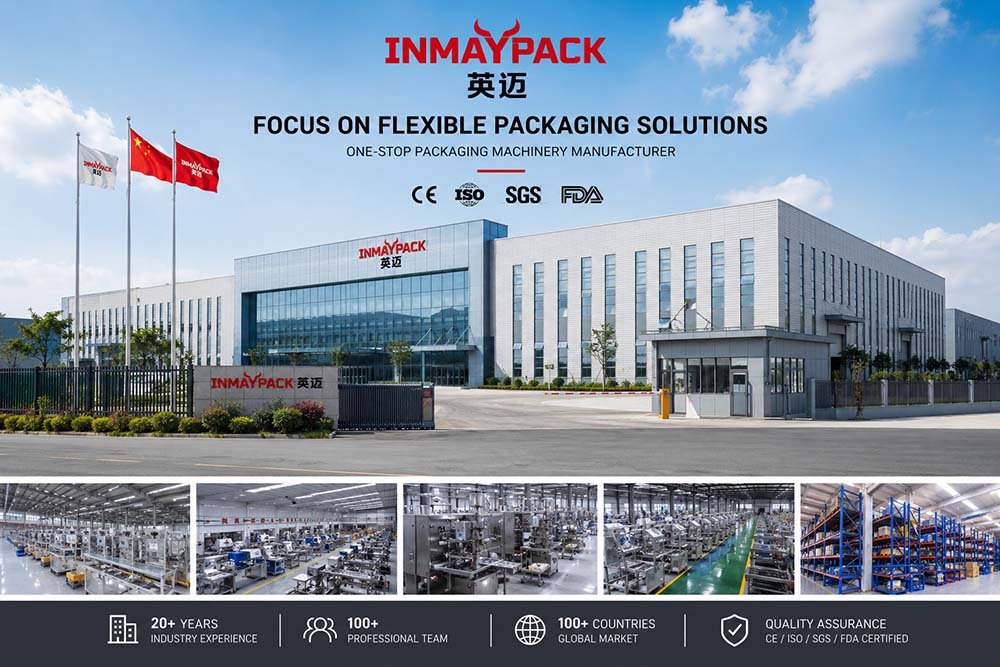
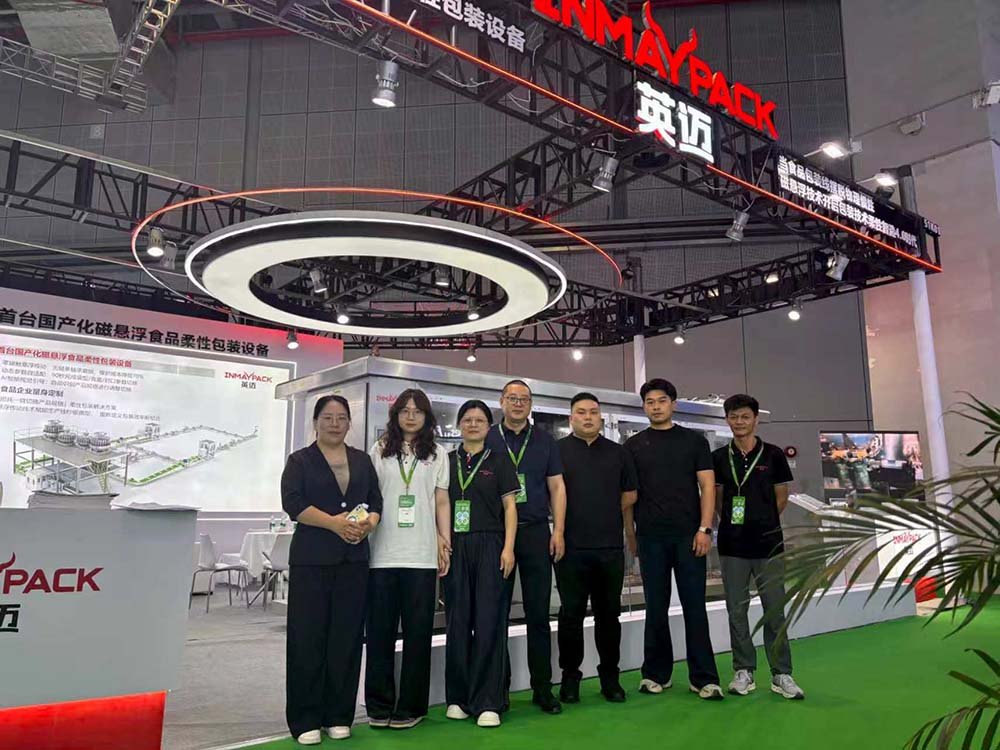
INMAYPACK facility and team references. Discuss the selected equipment, sample trials and project support with our team.
Coffee Powder Filling Machine FAQ
Review the coffee, pouch, filling system and project scope before requesting a quotation.
What products and weights does the coffee powder project cover?
The documented configuration selects a customized auger filler and conveyor for 100–1,000 g coffee powder packs, including 250 g, 500 g and 1,000 g applications. Ground, instant or blended coffee still needs trials for flow, density and pouch handling. The generic 10–2,500 g platform range is not a guarantee for this coffee powder system.
What pouch types and sizes can be evaluated?
The HIJ8-200 platform lists stand-up, zipper, three-side-seal and flat premade pouches, with W 80–200 mm and L 100–400 mm references. Submit samples to check opening, gripping, sealing area, gussets and zipper or valve position. Confirm tooling and changeovers for each SKU.
What filling accuracy can be accepted?
The auger component sheet references ≤±2% at ≤100 g and ≤1% at 100–500 g; agree the 100 g boundary and test every requested weight. It does not provide a numerical 500–1,000 g guarantee. Its 0.1 g scale resolution is not achieved dosing accuracy. Retain the scales, sampling method, product and settings with the test results.
How is actual line output established?
The platform reference is 20–60 pouches/min. The 65 cycles/min cam-design reference and 40–120 fills/min auger reference describe different items. Agree finished, accepted output for the coffee and pouch during trials, including powder refill, start/stop, rejection and seal quality. No specific 250 g production speed is established by the proposal alone.
How are price, delivery and nitrogen options quoted?
Ask for a current equipment and commercial proposal. Price and delivery depend on configuration, samples, tooling, options and interfaces; historical quote terms are not current policy. Air exhaust is listed in the station sequence. The auger description mentions nitrogen filling as a capability, but complete gas hardware and residual-oxygen criteria require explicit agreement.
What support and documents should be included?
Agree installation responsibilities, training, site assistance, warranty conditions, spare parts and support in the current project documents. Request operating and cleaning instructions, a utility schedule, layout, material/component lists and acceptance records. Verify destination-specific compliance evidence for the selected configuration.
Prepare a clearer coffee packaging brief
Compare equipment scope and cost
Review the machine, selected options, delivery, commissioning and accepted-output basis.
Read the coffee machine price guide → 02 / DOSINGChoose the powder filling method
Compare auger and weighing principles with product flow, density, dose and refill behaviour.
Compare auger and weigh fillers → 03 / INTEGRATIONDefine the complete line boundary
Coordinate primary packing, coding, inspection, transfers and downstream equipment.
Review coffee line integration →Let’s build your coffee powder packing configuration.
Start with your coffee type, fill weight, pouch format and required finished-pack output. Share the available details to begin the equipment review; photos, samples and the complete project requirements can follow.
Detailed coffee project checklist
Send your coffee description, every fill weight, pouch dimensions and material, required accepted output, cleaning needs and available utilities. INMAYPACK can use these inputs to define the equipment configuration, sample trial, quotation and installation interfaces.
Or email us directly: sales@ewpackmachinery.com