
Coffee Stick Packing Machine YS-61XBF
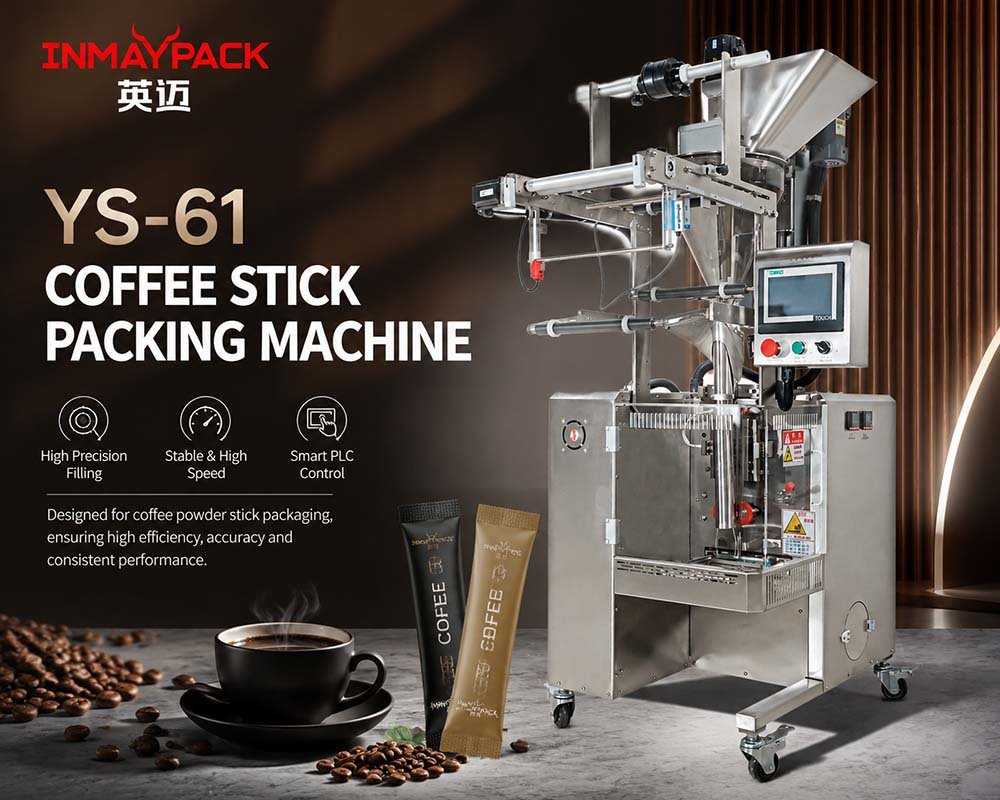
Configure a compact vertical form-fill-seal route around your coffee powder, target dose, film, seal format and accepted finished pack. The reference machine forms, doses, seals, cuts and counts in one cycle.
- 1–100 g reference measuring scope
- 30–70 bags/min reference range
- 30–130 mm reference bag width
Understand what each machine station must control
The source document describes an automatic sequence covering bag making, measurement, filling, sealing, cutting and counting. The final build should connect those functions around the approved coffee and pack rather than treating the machine as a single speed number.
Rollstock handling
The film unwind must present the approved web to the forming path without damaging print or creating uncontrolled tension. Confirm roll width, maximum roll condition, core, winding direction and the location of any eye mark before the holder and film path are finalized.
Powder hopper and screw
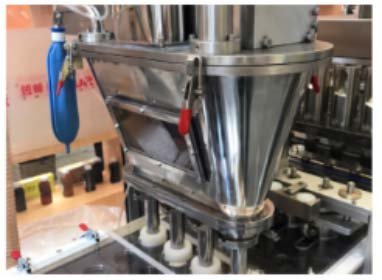
The hopper keeps product available to the straight-screw dosing assembly. Screw geometry, speed and product-level behavior influence the delivered volume. The actual coffee batch is needed to observe bridging, aeration, segregation and residue.
Forming set
The forming set converts the flat web into the selected bag geometry. Finished width, seal arrangement, product drop path and film stiffness must agree with the pack drawing. A different width or seal type may require dedicated format parts.
Film feed and registration
The source sheet identifies stepper-motor bag-length control. For printed film, the project must also define repeat length, eye-mark position and the accepted print-to-cut relationship so bag length and artwork remain coordinated.
Sealing and cutting
The sealing assembly needs a workable combination of temperature, pressure, dwell time and jaw condition for the supplied laminate. The cutter then separates the finished pack at the agreed location without compromising the seal or printed design.
Control and operator interface
The reference source lists touchscreen operation, PLC control and PID temperature control. The project should also define recipe access, alarms, counters, coder settings and the information operators need during startup, refill, stoppage and changeover.
Start with the coffee and finished pack
The YS-61XBF is a powder-dosing machine, not a universal coffee packer. Suitability depends on flow behavior, bulk density, dust, blend segregation, target weight, film and the seal style that defines the accepted retail pack.
Dry coffee powders
Instant coffee and dry coffee mixes can be evaluated with the reference screw-dosing configuration. Supply a representative product batch because flow can change with recipe, humidity and storage.
Ground coffee and blended recipes
Ground coffee, creamer-rich blends and sugar-heavy recipes may behave differently in the hopper and screw. Confirm feeding, dose repeatability, dust control and seal-area cleanliness with the real product.
Beans, capsules or liquid coffee
Whole beans need a weighing route, capsules need dedicated filling and sealing equipment, and liquid concentrates need a liquid filler. Do not force these applications into a powder auger configuration.
YS-61XBF reference configuration and range
The values below come from the supplied YS-61XBF source sheet. They describe a reference machine, not an unconditional result for every coffee, film or pack.
| Reference model | YS-61XBF back-seal straight-screw powder packing machine |
|---|---|
| Reference measuring scope | 1–100 g |
| Reference bag length | 30–170 mm |
| Reference bag width | 30–130 mm |
| Reference packing speed | 30–70 bags/min; accepted output depends on product, dose, bag length, film, coding and quality criteria |
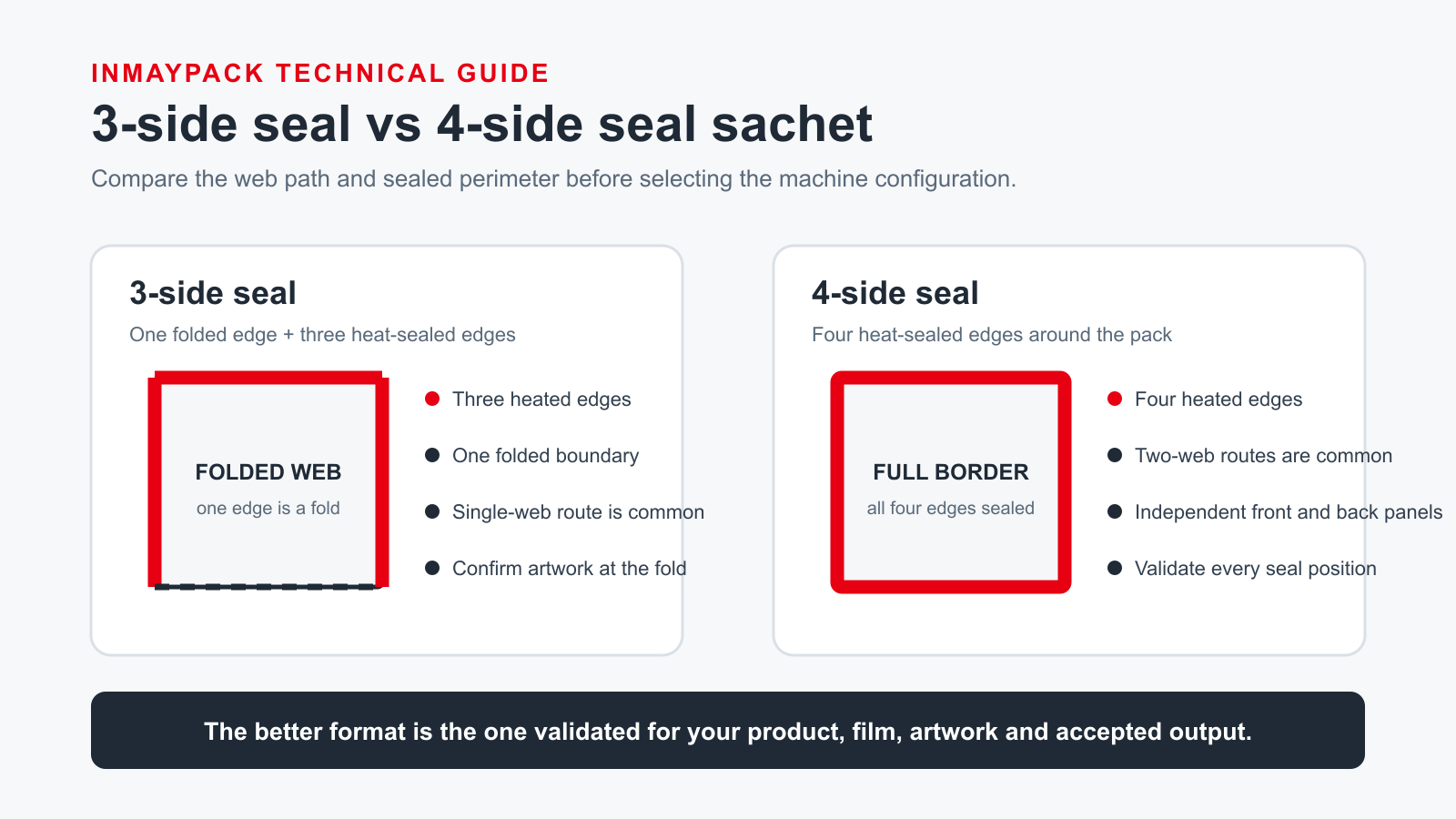
| Seal formats listed in source | Back seal, three-side seal and four-side seal; final former and sealing arrangement must be confirmed |
| Control described in source | Touchscreen operation, PLC control, stepper-motor bag-length control and PID temperature control |
| Film structures listed in source | BOPP/PE, aluminum/PE, paper/PE, polyester/metallized/PE and nylon/CPP |
| Power listed in source | 220 V, 50–60 Hz, 2.2 kW total power |
| Reference machine size | 730 × 1000 × 1600 mm |
| Reference machine weight | 230 kg |
| Optional function named in source | Batch-number printing may be configured to project requirements |
Quotation boundary: final configuration, output, dose tolerance, seal result, utilities, options and acceptance criteria are confirmed after INMAYPACK reviews the supplied coffee, pack drawing and film.
Convert a speed range into a production requirement
The reference speed range is not the same as saleable packs per shift. Production planning must account for accepted output, planned runtime and the losses the buyer chooses to include. Use one agreed calculation basis when comparing suppliers.
| Input | What to define | Why it changes the result |
|---|---|---|
| Accepted packs required | Saleable packs needed per hour, shift or production day | This is the useful output target, not the number of machine cycles. |
| Scheduled runtime | Minutes available after planned breaks, sanitation and changeovers | A shift length does not equal continuous packing time. |
| Product and dose matrix | Every coffee recipe, target weight and pack size included in the project | The slowest or most difficult combination may define the required architecture. |
| Refill and roll changes | How product and film are supplied during the test and normal operation | Unplanned starvation can reduce accepted output even when the packer cycles correctly. |
| Reject definition | Weight, seal, code, cut and appearance defects excluded from good output | Gross cycles can overstate the number of conforming packs. |
| Changeover allowance | Format parts, cleaning, recipe setup and restart approval included in the schedule | Multiple products may need a different solution from one long single-SKU run. |
Comparison method: calculate required accepted packs per running minute from your own production plan, then test each product-and-pack combination against that requirement. Do not divide a daily target by 24 hours unless the line is actually scheduled and supported for that runtime.
Match the dosing method to the real coffee
The name on the recipe is not enough to select a filler. Two coffee powders at the same target weight can require different screw, hopper, agitation and dust-control decisions.
| Product | Primary question | Selection action |
|---|---|---|
| Instant coffee powder | Bulk density, aeration, dust and moisture sensitivity | Run a dosing and seal-area cleanliness test with the intended batch. |
| 2-in-1 or 3-in-1 coffee mix | Blend segregation, sugar and creamer behavior, recipe change | Test feeding stability and confirm the cleaning method between recipes. |
| Ground coffee | Particle distribution, oil, static and flow through the screw | Do not assume powder behavior; compare an auger test with another dosing route if required. |
| Soluble coffee granules | Granule damage and free-flowing behavior | Compare screw dosing with a volumetric or weighing route using the real product. |
| Cocoa or malt in the blend | Dust, bridging and seal contamination | Define hopper assistance, extraction and cleaning access during the test. |
Compare single-lane, multi-lane and premade-pack options
The right coffee packaging route depends on more than the target dose. Output, pack geometry, rollstock or premade material, changeover frequency and downstream handling can justify a different machine architecture.
| Route | Use it as a starting point when | Confirm before selection |
|---|---|---|
| YS-61XBF single-lane VFFS | The pack fits the reference range and the project needs a compact powder-forming route with one packaging lane. | Coffee flow, screw behavior, finished geometry, film, seal format, coding and accepted output. |
| Multi-lane stick or sachet machine | The production target requires several packs to be formed in parallel or the pack geometry belongs on a dedicated multi-lane platform. | Lane count, web width, filler distribution, lane-to-lane weight control, seal consistency and downstream collection. |
| Premade pouch machine | The brand uses purchased finished pouches with zipper, gusset or another feature that should not be formed from rollstock on this machine. | Pouch opening, presentation, fill contamination, sealing, refill method and the accepted pouch specification. |
| Bean weighing and bagging route | The product is whole roasted coffee beans rather than powder and needs a weighing system matched to bean flow and target bag size. | Weigher, bag style, degassing valve, gas handling, seal method and downstream inspection. |
| Capsule filling and sealing route | The primary package is a coffee capsule or compatible cup rather than a flexible stick or sachet. | Capsule geometry, dosing, lid material, sealing, inspection and downstream cartoning. |
One machine, six controlled steps
A stable finished pack depends on every step, not only the nominal cycle rate. The FAT should observe the complete sequence with the approved coffee and rollstock.
- Feed the productMaintain a controlled product level and prevent bridging, segregation or uncontrolled aeration.
- Meter the doseThe screw and drive deliver the configured volume; the verification plan defines how finished weights are sampled.
- Form the webThe forming set converts approved rollstock into the required back-seal or flat sachet geometry.
- Control bag lengthThe stepper-driven film feed sets the reference length and works with registration when printed film is specified.
- Seal and cutTemperature, pressure, dwell time and film structure must create the agreed seal without trapping product.
- Count and dischargeFinished packs leave the machine for collection or a defined conveyor, inspection or cartoning interface.
Confirm installation, documentation and handover inputs
The source sheet lists the reference machine dimensions, weight and electrical supply. A usable project still needs the buyer and supplier to agree how the machine reaches the production area, connects to utilities and is accepted by the operating team.
Site readiness
- Access doors, corridors, lifting route and final machine position
- Working clearance for film loading, hopper access and cleaning
- Confirmed voltage, frequency, isolation and grounding arrangement
- Product supply height and operator loading method
- Finished-pack discharge direction and collection height
- Room conditions relevant to powder flow, dust and film behavior
Documentation and handover
- Approved machine layout and agreed project configuration
- Electrical and pneumatic information applicable to the final build
- Operating, cleaning and routine-maintenance instructions in the agreed language
- Format-part and changeover identification for the supplied pack matrix
- FAT record, open-item list and responsibility for closure
- Training, installation and remote or on-site support scope stated in the quotation
These items are project inputs, not automatic inclusions. Put the required documents, training method, installation responsibility and acceptance records into the quotation so every supplier is compared on the same scope.
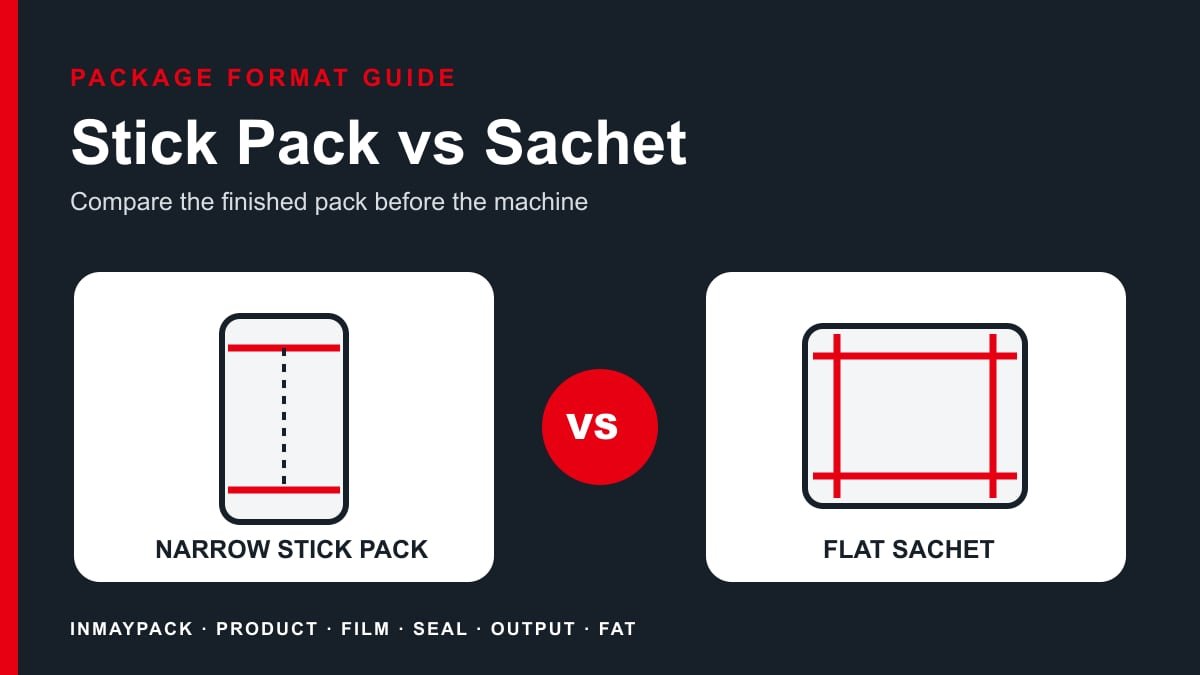
Confirm whether the pack is truly a stick
The source sheet lists a 30 mm minimum reference bag width and three possible seal styles. A slim retail stick, a wider back-seal sachet and a four-side-seal sample are different forming and sealing tasks even when all contain coffee powder.
Use the YS-61XBF page when
Your proposed pack sits inside the reference size range and a single-lane powder route can meet the required accepted output. Send the finished-pack drawing, eye-mark layout and roll direction for review.
Compare another stick-pack route when
The pack is narrower than the reference range, requires several lanes, has a very high output target or uses another dosing technology. Compare the general stick pack machine route and the multi-lane sachet platform.
Prove the seal window with supplied rollstock
The material families listed in the source document are starting references. The converter’s actual structure, thickness, sealant layer, coating, print and roll condition determine whether the machine can form and seal the pack consistently.
- Send the complete film structure and total thickness.
- Confirm finished width, length, seal width and tear feature.
- Provide eye-mark size, color contrast, repeat length and roll direction.
- Define the test used to accept seals, not only their appearance.
- State whether product dust reaches the top-seal area.
- Identify coding position before the machine layout is fixed.
- Specify any barrier or residual-oxygen requirement separately.
- Approve samples made from production-intent coffee and film.
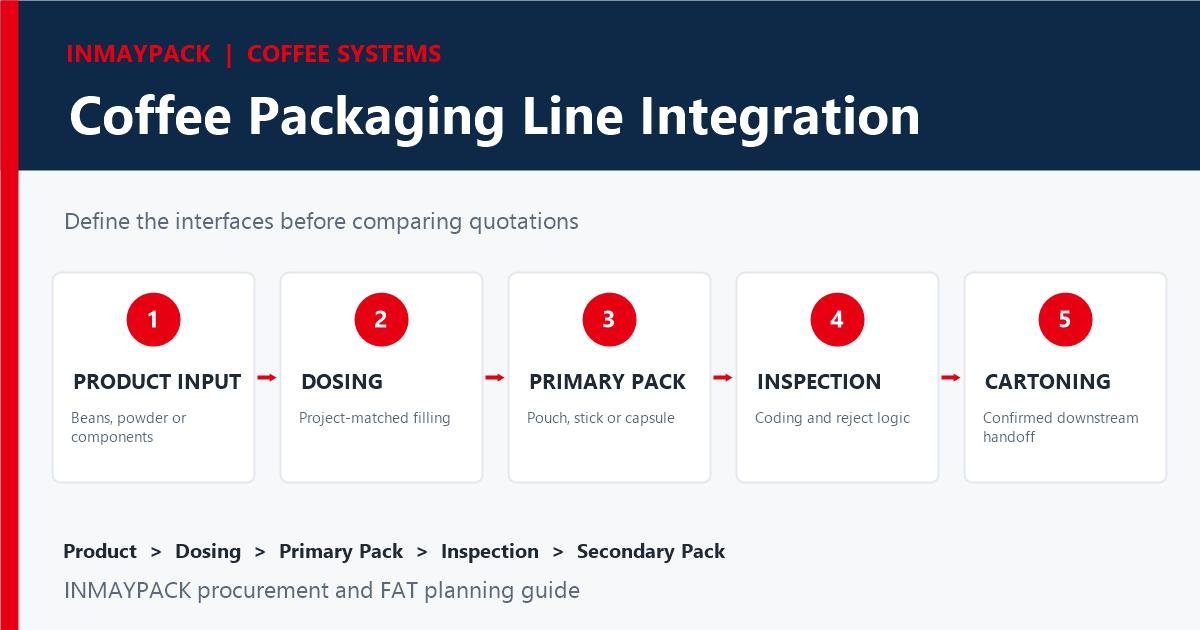
Define the whole packaging cell before quotation
The base packaging machine cannot resolve every upstream and downstream requirement. Put optional devices and interface ownership into the quotation instead of adding them after the mechanical layout is fixed.
Product supply
Confirm manual loading, vacuum conveying or another supply method, plus hopper level control and safe cleaning access.
Coding
Define batch, production or expiry information, print area, data source and inspection method. The source sheet lists batch printing as configurable.
Dust management
State whether extraction, enclosed transfer or additional cleaning access is needed for the actual coffee recipe.
Inspection
Define weight checks, metal detection, code checks or seal tests and who owns reject confirmation.
Discharge
Confirm collection height, conveyor direction, accumulation and the downstream handoff to counting or cartoning.
Utilities and controls
Confirm site voltage, frequency, plug or isolator, compressed-air needs if options require it, and all interlock signals.
Write the acceptance test around conforming packs
A headline speed does not define a successful machine. The test must state the product, dose, film, pack format, run duration, sampling plan and defect rules used to count accepted output.
- Approved coffee batch and production-intent film roll
- Target dose and permitted finished-weight limits
- Approved pack drawing and seal appearance
- Accepted output measured after rejects
- Seal test method and sample frequency
- Code content, position and legibility criteria
- Planned run duration and refill conditions
- Changeover and cleaning scope for required recipes
For a multi-machine project, use the packaging system integration checklist to assign product-flow, controls, quality, utilities, data and FAT evidence at each interface.
Plan recipe changes before the machine layout is fixed
A coffee factory may run black instant coffee, sweetened mixes and recipes containing creamer or cocoa on the same line. The quotation should therefore define what must be removed, opened, inspected and verified between products. “Easy to clean” is not a measurable requirement.
Define the product-contact boundary
List the hopper, screw, tube, forming area and any product-transfer parts included in the cleaning scope. Identify which parts must be removable, where residue can collect and what access the operator needs. If water cannot be used near a powder blend, state the approved dry-cleaning method and the required disassembly.
Separate recipe and allergen risks
Creamer, flavor, cocoa and other recipe components can create cross-contact requirements that plain instant coffee does not. Provide the actual recipe families and the site’s cleaning acceptance rule. The machine configuration cannot substitute for the buyer’s allergen, hygiene or product-release procedure.
Verify restart after changeover
Define how the first packs after cleaning are checked for weight, code, film registration and seal quality. A useful changeover trial includes the shutdown state, removal and cleaning work, replacement parts, recipe settings, restart checks and the point at which conforming output resumes.
Send enough information for a comparable offer
A model name and target speed do not define the project. Use the same input set when comparing suppliers so differences in product handling, coding, inspection, FAT and documentation are visible instead of hidden behind a headline machine price.
- Coffee type, full recipe name and representative sample quantity
- Bulk density or an agreed method for measuring it
- Target weight and acceptable finished-pack weight limits
- Finished bag drawing with width, length, seals and tear feature
- Film structure, thickness, roll width, repeat and winding direction
- Required accepted output for each product and pack combination
- Coding content, print location and data-change method
- Product supply, discharge height and downstream equipment
- Site voltage, frequency and available utilities
- FAT duration, samples, defect rules and required documents
Use the packaging machine RFQ builder if you need a structured brief. The resulting requirement list helps INMAYPACK review whether the YS-61XBF reference configuration, a different filler or a multi-lane system is the better route.
Continue with the machine path that matches the pack
Coffee stick packing machine FAQ
Can the YS-61XBF pack 2-in-1 or 3-in-1 instant coffee?
It is a relevant starting configuration for dry powder blends, but the recipe must be tested. Creamer, sugar, coffee and flavor components can segregate or change flow, so screw selection, hopper behavior, dose verification and cleaning must be confirmed with your actual product.
Can it pack ground coffee?
Possibly, but this is not automatic. Ground coffee particle size, oil, static, aeration and bulk density can differ from instant powder. Provide a representative batch so the dosing route can be tested before the final configuration is fixed.
Is 70 bags per minute guaranteed?
No. The source sheet lists a 30–70 bags/min reference range. Accepted output depends on the coffee, dose, bag length, film, seal style, coding, refill interruptions, rejects and the agreed quality test.
What bag sizes does the source document list?
The reference range is 30–170 mm bag length and 30–130 mm bag width. Final feasibility depends on the finished-pack drawing, former, sealing arrangement, film repeat and product volume.
Which seal styles are available?
The source document lists back seal, three-side seal and four-side seal. The required format must be selected in the project configuration; these are not three simultaneous standard outputs from one unchanged setup.
Can the machine print batch and expiry information?
The source sheet states that batch-number printing can be configured. Confirm the exact content, print area, data input, coder type and inspection requirement in the quotation.
Does the reference machine include nitrogen flushing?
Nitrogen flushing is not stated in the supplied YS-61XBF source sheet. If residual oxygen or shelf-life performance matters, include the target, gas supply, verification method and required hardware as a separate project requirement.
How much does a coffee stick packing machine cost?
Pricing is configuration-specific. Coffee behavior, dose, pack size, film, seal format, coding, product supply, inspection, discharge, documentation and FAT scope all change the quotation. Send those inputs for a current reviewed offer instead of relying on an old fixed web price.
Send the coffee, dose and pack drawing
Include the coffee type and recipe, target weight, finished width and length, film structure, seal style, output target, coding, utilities and acceptance criteria. INMAYPACK can then review the YS-61XBF reference route and the alternatives that fit the project.