
INMAYPACK · YS-61XBK · Roll-film back-seal packaging
Vacuum Packing Machine for Granules
Configure small-dose granule packs around your product, roll film and required vacuum result. The YS-61XBK route combines bag making, measuring, filling and sealing in a compact back-seal format.
Small-dose granules · Bags made from roll film · Product-matched configuration
Start with your product, dose, bag drawing or pack photo, and required output. Film details and test requirements can follow.
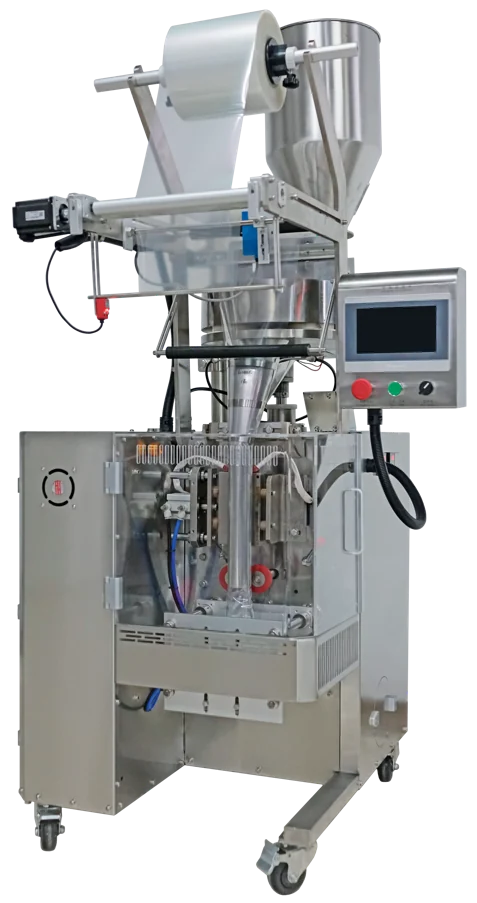
A roll-film route for small granule packs
The YS-61XBK is presented for small-dose granule vacuum packaging using back-seal bags made from roll film. It forms the package on the machine; supplied zipper pouches require a different handling route.
INMAYPACK manufactures packaging machinery configured around the customer's product, packaging samples and production requirements. For this application, the useful starting point is the finished pack: what it contains, how it should look, how air removal will be assessed, and how many acceptable packs the line must deliver.
Review particle behavior, dose, usable bag volume, evacuation and sealing together. A product that fits the weight range may still need a different bag, feeding arrangement or packaging route.
Back-seal format
Package geometry concept, not a finished sample or fixed tooling drawing.
YS-61XBK reference specifications
Use these published model values for initial selection. The approved configuration and sample trial establish the usable combination for your product and film.
| Item | Published YS-61XBK reference |
|---|---|
| Packaging route | Roll-film, back-seal vacuum granule packing |
| Measuring range | 1–100 g |
| Finished-bag width | 30–130 mm |
| Finished-bag length | 30–170 mm |
| Packing speed | 15–25 bags/min |
| Electrical reference | 220 V, 50 Hz |
| Listed power | 1.4 kW |
| Listed machine dimensions (L × W × H) | 730 × 1000 × 1780 mm |
| Listed machine weight | 260 kg |
| Controls | Touchscreen, PLC, stepper-motor bag-length control and PID temperature control |
| Automatic operations | Bag making, measuring, filling, sealing, cutting and counting |
| Batch coding | Configured to the project requirement |
The dose, bag dimensions and speed are separate selection ranges. Their maximum values are not a guaranteed operating combination. Product density, feeding time, film, evacuation and sealing conditions determine accepted output.
Confirm the supplied vacuum equipment, selected dosing device and complete connected load in the quotation. The machine dimensions do not include all loading, film handling, cleaning, maintenance or downstream space. Specify your site's voltage, frequency and phase before the electrical configuration is approved.
For smaller doses, short batches, larger bags or a non-standard format, send a product sample, target weight, bag drawing or pack photo and required acceptable output. INMAYPACK can review a different dosing, forming or packaging route; the YS-61XBK values above remain the reference for this model.
Compare the packaging routes
Swipe or scroll within the table to compare all columns.
| Your starting point | Route to review | Main selection question |
|---|---|---|
| Roll film and small granule doses | YS-61XBK back-seal route | Can the product, usable bag volume and specified evacuation process meet the required pack result? |
| Finished premade pouches | Pouch feeding, opening, filling and closing | What separate equipment and process provide the required air removal? |
| Filled bags loaded into a chamber | Chamber vacuum packaging | What are the loading duties, chamber cycle and sealing requirements? |
| A defined three-dimensional brick pack | A suitable forming, shaping and vacuum system | Which tooling and process create and retain the approved shape? |
These are process comparisons. Equipment availability and integration are confirmed for the selected project.
A back seal describes a seam, not a brick shape. Specify the finished-pack drawing and required appearance before selecting shaping equipment.
Pouch-opening suction handles an empty pouch. It does not demonstrate vacuum removal from the filled package. Air exhaust, nitrogen flushing and vacuum packaging also have different equipment and acceptance requirements.
Compare the premade pouch machine range or use the vacuum packaging route guide when the package supply method is still undecided.
Match the product to the dosing and packing cycle
Product behavior comes before the filler
Send representative granules, the target dose and permitted variation. Include particle size, bulk-density variation, dust, static, surface oil, moisture and any fragile pieces. These details affect feeding, repeatability, filling clearance and the condition of the sealing area.
Volumetric metering can be considered when flow and density are sufficiently stable. A weighing arrangement may be worth evaluating when density varies or dose control requires a different approach. The selected device must also suit the particle size, dose and available cycle time; neither method is a universal standard configuration for this machine.
For delicate products, review the complete path through the hopper, measuring device, drop and evacuation stage. For dusty products, assess containment and seal-area protection. Contact materials, removable parts and the permitted cleaning method belong in the equipment specification.
Coordinate the whole cycle
- Prepare and supply the product. Keep the feed condition representative of normal production, including replenishment.
- Form the back-seal bag. Match the roll, former and seam arrangement to the approved drawing.
- Measure and fill. Coordinate dose release and settling while keeping product out of the sealing zone.
- Evacuate through the specified arrangement. Agree the required result, measurement point and timing.
- Seal, cut and check. Apply the approved sealing conditions and selected coding or inspection functions.
- Discharge acceptable packs. Define collection, rejection and the handoff to downstream equipment.
This sequence describes the functions to coordinate. The selected machine build determines the detailed station arrangement and timing.
Explore granule packaging routes and the pouch filling system guide if the dosing method is still open. Products that behave as powders need a separate powder filling assessment.
Typical engineering applications
The following examples illustrate application reviews. They are not customer delivery cases or measured performance results. Each requires product and packaging trials before a configuration is selected.
01Small portions of free-flowing grain
A producer wants compact individual packs of a dry, flowable grain. The first decision is whether the target mass fits the usable back-seal bag volume while leaving clean sealing space.
Review grain size, density across batches, metering repeatability and particle carryover into the end seal. Compare the proposed dosing arrangement with the target tolerance, then test bag formation, filling, evacuation and sealing as one cycle. The trial should record dose results, punctures, seal contamination and acceptable packs over the agreed run.
Selection outcome: establish the product-and-bag combination before fixing output or ordering format parts.
02Agglomerated coffee granules
A coffee producer is considering a compact portion pack. Agglomerated granules, whole beans and ground coffee present different feeding and packaging conditions; a shared product name does not establish machine compatibility.
Assess fines, bulk density, breakage and the desired appearance after air removal. Define whether the project needs vacuum packaging, gas flushing, a valve or another package approach. Any residual-oxygen or shelf-life objective needs its own agreed evaluation.
Selection outcome: choose the air-control route and filler from the actual coffee. Use the coffee vacuum versus nitrogen-flushing guide and compare coffee bean pouch equipment or coffee powder filling where appropriate.
03Fragile or irregular dry-food granules
A manufacturer needs small packs while limiting broken pieces and film damage. The product may flow through a hopper yet break during measuring, dropping or compression of the finished package.
Review feed geometry, drop distance, sharp edges, allowable breakage and the selected film. Evaluate the evacuation profile and final pack condition using representative product. Check damage after the complete process, and inspect the back-seal intersection and end seals for punctures or trapped particles.
Selection outcome: select a package and handling arrangement that meets the agreed product-protection criteria. If vacuum compression conflicts with that requirement, review another packaging route.
Match the film, seal and vacuum result
Specify the production film and finished bag
Send the laminate specification and production-representative roll. The material name alone does not establish suitability: thickness, sealant, barrier properties, flexibility and handling behavior affect the finished package.
| Input | What to define |
|---|---|
| Film | Layer structure, total thickness, sealant and converter guidance |
| Roll | Web width, core, outer diameter, winding direction and splice requirements |
| Repeat length, registration mark, cut position and coding area | |
| Bag | Finished width and length, back-seal arrangement, end seals and usable filling space |
| Product contact | Relevant contact-material requirements, product temperature and cleaning conditions |
| Appearance | Allowable wrinkles, compactness, deformation and product damage |
Inspect the finished pack after evacuation. Pay attention to the back-seal intersection, folded material, granules in the seal and punctures. A material that seals while flat still needs evaluation in the actual filled package.
Keep the acceptance measurements distinct
| Question | Suitable acceptance focus |
|---|---|
| Was the required evacuation condition reached? | Agreed measurement point, timing, instrument and pressure basis, where relevant to the selected process |
| Is the finished pack acceptable? | Approved shape, compactness, wrinkles, product condition and recheck interval |
| Does the package leak? | A leak-test method qualified for the actual product and package |
| Is the seal strong enough? | Agreed seal-strength method, sampling locations and acceptance limits |
| Is residual oxygen within the required limit? | A separately defined sampling and measurement method |
A pump setting does not replace finished-pack inspection, and a pressure reading is not a residual-oxygen result. Shelf life is a product-and-package validation question rather than a fixed machine specification.
The pouch vacuum-decay testing guide explains one inspection route. Its suitability must be confirmed for the package; it is not automatically included with the packing machine.
Material review can include BOPP/PE, aluminium/PE, paper/PE and polyester/aluminized-film/PE structures listed for the model. The actual laminate, thickness, sealant and converter guidance are checked with the filled pack.
Define accepted output, changeover and line scope
Use the published 15–25 bags/min range for initial screening, then agree output with the actual product, dose, film, bag format and evacuation requirement.
Define conforming packs before the test. Record dose failures, incomplete evacuation, product damage, seal defects and coding rejects separately. State whether the run includes normal replenishment, film changes and short stops. Peak cycle speed alone cannot establish production output.
Make changeover a defined task
List the planned products and bag formats. For each change, identify the former or format parts, dosing adjustments, film settings, sealing conditions and evacuation recipe. Agree the cleaning method and inspect the first packs after restart.
Review access to the hopper, product-contact parts, film path and sealing components. Specify any tools, lifting or maintenance access needed. Stored recipes, alarm information and external signals should match the approved controls scope.
Confirm the equipment boundary
| Area | Include in the quotation when required |
|---|---|
| Product supply | Loading method, hopper, feeder, buffer and selected dosing device |
| Vacuum process | Evacuation equipment, pump or generation arrangement, connections and relevant instruments |
| Packaging | Former, film handling, sealing, cutting and format parts |
| Inspection | Coding, weight checks, detection and defined reject handling |
| Outfeed | Pack collection, conveyor, orientation, accumulation and downstream interface |
| Installation | Full layout, connected loads, utilities, guarding interfaces and service access |
For connected lines, define ready, run, fault, starved, blocked and restart behavior. Assign responsibility for mechanical transfers and controls changes on existing equipment. Review turnkey packaging line scope when the project extends beyond the primary packer.
Agree the sample trial and machine handover
INMAYPACK's project review starts with your product and packaging requirements. Representative samples help define the machine configuration, dosing route, film setup and checks needed for an application-specific trial.
| Trial stage | What the agreed record should show |
|---|---|
| Prepare | Product identity, sample batches, film, bag drawing, dose and planned operating conditions |
| Run | Settings, test duration, total and acceptable packs, rejects and normal interventions |
| Inspect | Dose, package dimensions, required evacuation result, product damage and seal checks |
| Change and restart | Planned format changes, cleaning access and first-pack checks |
| Release | Supplied equipment, documents, open actions and responsibility for closure |
Agree sample quantities for setup, the production run and repeat checks. Include the normal product and any expected variations that affect flow, damage or sealing. Record substitutes and the requirements they cannot verify.
Factory acceptance testing (FAT) checks the agreed equipment and trial conditions before shipment. Site acceptance testing (SAT) addresses the installed utilities, interfaces and operating conditions. The approved plan should distinguish these responsibilities.
INMAYPACK can define export handover documents, installation and commissioning, operator and maintenance training, remote diagnostics and spare-parts planning within the project scope. On-site work, warranty, service charges and parts arrangements are confirmed in the quotation and contract. See service and support.
Vacuum packing machine price and quotation
The price depends on the selected machine build, dosing equipment, vacuum arrangement, bag tooling, inspection, connected equipment and project services. An itemized quotation makes these differences visible.
You can start before every technical field is complete. INMAYPACK can identify the additional information needed for configuration and trial planning. Use the Packaging Machine RFQ Builder to organize a more detailed brief.
For a first review, send:
- Product: name, photos, physical form and representative sample availability.
- Dose and package: target weight, acceptable variation, bag drawing or pack photo, and film details if available.
- Production: required acceptable packs per minute, planned products and changeovers.
- Site and objective: destination, available power, line connections and the intended vacuum-pack result.
Vacuum packing machine FAQ
Does the YS-61XBK use roll film or premade bags?
The published YS-61XBK route forms back-seal bags from roll film. It does not receive finished zipper pouches. For supplied bags, compare a premade-pouch handling system and specify any required evacuation process separately.
What dose and bag sizes should I use for initial selection?
The published references are 1–100 g, bag width 30–130 mm and bag length 30–170 mm. Product volume, particle behavior, filling clearance and sealing space determine the usable combination. Include minimum, normal and maximum dose in the application review.
What vacuum level can the machine achieve?
The published model information does not establish a universal target vacuum level. The quotation and trial plan should identify the supplied evacuation arrangement, relevant measurement point, pressure basis, timing and required finished-pack result.
Does back-seal packaging mean a vacuum brick pack?
No. Back seal describes the seam arrangement. A brick pack requires a defined three-dimensional shape and suitable forming or shaping equipment. Send the target drawing and sample; do not assume that a back-seal specification proves brick-pack capability.
Can it pack coffee powder, beans and granules on the same configuration?
These products need different feeding and packaging reviews. The current model route focuses on granules. Coffee powder needs a suitable dosing and evacuation assessment, while beans introduce different particle and bag-volume requirements. The selected configuration must be confirmed with the actual product.
Is 15–25 bags/min the guaranteed production rate?
It is the published model reference range. Agree accepted output using the actual product, dose, bag, film and evacuation requirement. Count conforming packs over a defined run and record rejects and interruptions.
Does vacuum packaging guarantee shelf life or a residual-oxygen level?
No universal result follows from the machine name. Specify the product, packaging material, air-control process and separate test method for the objective. Pressure, residual oxygen, leakage and shelf life require different evidence.
Which film should I send for testing?
Send production-representative roll film with its structure, thickness, sealant, roll details and converter guidance. Include the printed version and registration requirements when relevant. Agree the finished bag and seal checks before the trial.
What should be included in a complete quotation?
Name the machine, dosing and feeding equipment, vacuum arrangement, format parts, coding, inspection, outfeed and connected equipment. Include utilities, layout, sample tests, documents, delivery and support responsibilities. Mark options and buyer-supplied items clearly.
How much product and film are needed for a trial?
The quantities depend on setup, the agreed run, format changes and repeat checks. Provide the proposed product and packaging specification first so the trial plan can define practical quantities and representative batches.
Discuss your granule vacuum pack
Tell us what you are packing, the dose, your film or bag target, required output and destination. INMAYPACK will review the application and define the information needed for a product-matched configuration.