Technical Explainer | Published August 14, 2026
Choose duplex or quadruplex architecture from accepted output, process time and cross-lane control, not from lane count alone. A four-lane machine can create more pouches per cycle, but every lane still has to form, register, open, fill, seal and discharge an acceptable pack.
Quick answer: duplex is usually the simpler route when two parallel lanes can meet the required saleable output and format range. Quadruplex becomes relevant when four controlled lanes are needed to meet the production basis and the film, filler, sealing system, inspection plan and downstream equipment can support them. The final decision belongs in the URS and FAT, with results reported by lane.
Lane count describes parallel processing
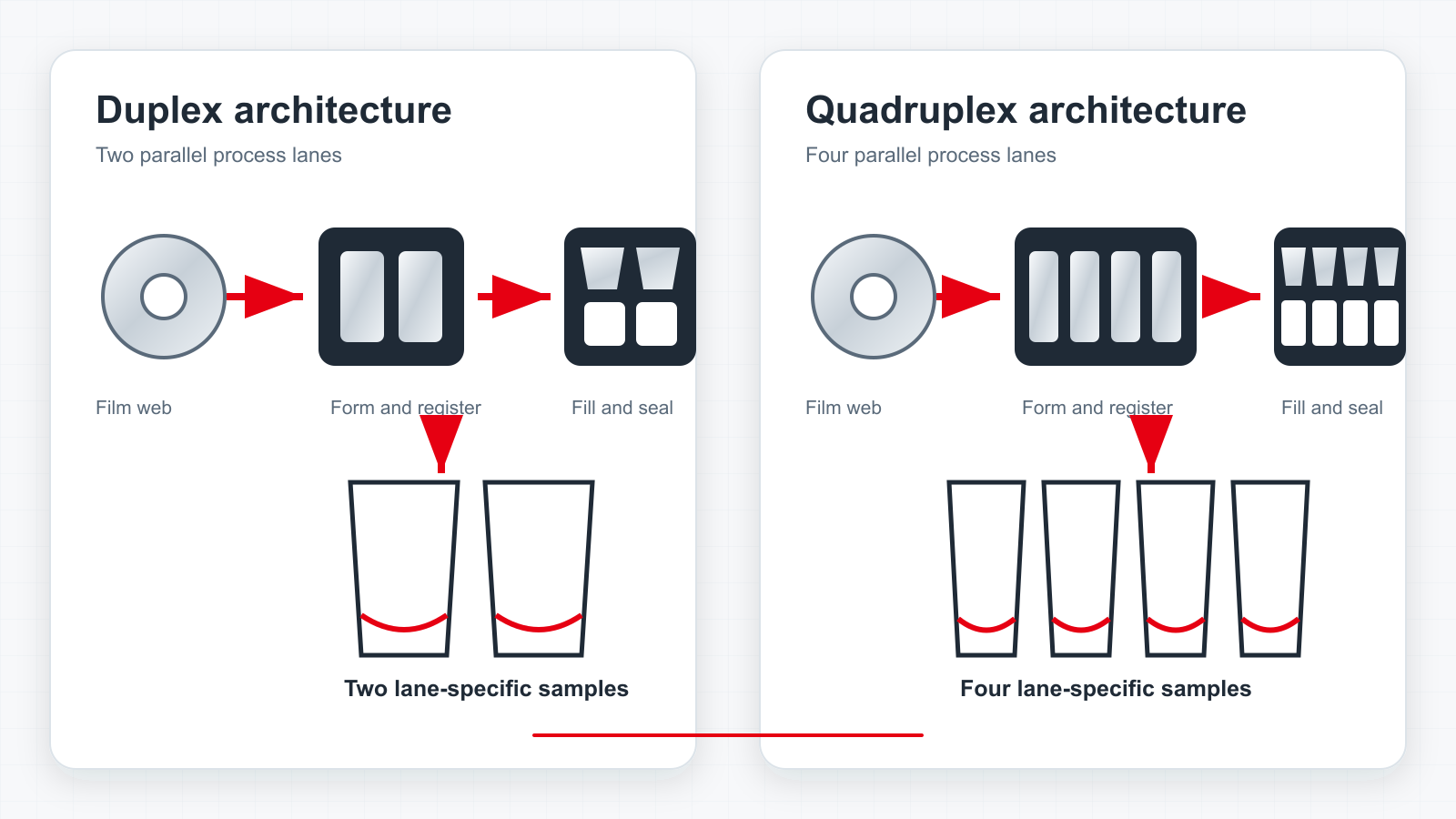
In this guide, duplex means two pouches are processed in parallel and quadruplex means four pouches are processed in parallel. The exact web arrangement, number of filling heads, station sequence and drive architecture still depend on the named machine and project. A lane label does not confirm a universal pouch range, filler type or output.
If the first decision is whether to use one or two parallel pouch paths, compare the single-lane and duplex Doypack routes before evaluating a four-lane architecture. That comparison separates required accepted output from changeover, lane-balance, maintenance and production-resilience tradeoffs.
Duplex
Two parallel pouch paths share the production cycle. The design must control both lanes through web handling, filling, sealing and discharge.
Quadruplex
Four parallel pouch paths increase the number of packs handled per cycle and also increase the number of positions that must remain synchronized and verifiable.
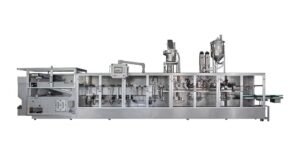
For the broader process sequence, read how a horizontal form-fill-seal machine works. For the high-output product family, review the HMK420Q high-speed Doypack packing machine.
Four lanes do not automatically mean four times the accepted output
Theoretical pouch output can be estimated from cycle rate and the number of pouches handled per cycle. Procurement, however, needs accepted output: saleable pouches that meet the agreed fill, seal, registration, appearance and package-integrity criteria during a defined test period.
A high-speed pouch packing machine can lose the expected advantage when the filler cannot dose every lane within the available time, one lane creates more seal contamination, registration varies across the web, or the downstream system cannot collect and inspect the discharge. These are system constraints, not isolated machine-speed settings.
Record one complete production basis: product, dose, pouch drawing, film, lane architecture, filler, target accepted output, test duration, allowed rejects and downstream condition. A speed number without this basis is not a comparable acceptance criterion.
My Insight
The weakest lane sets the practical production window
I would not approve a quadruplex architecture from the total counter alone. If one lane fills late, opens inconsistently or produces a narrower sealing window, the line is not four identical processes. Separate lane data exposes this variation before it becomes routine waste and downtime.
Use the pouch packing line bottleneck analysis guide to separate machine cycles, filler capacity, accepted packs and downstream constraints.
Compare duplex and quadruplex against six engineering fields
| Decision field | Duplex review | Quadruplex review | Evidence to request |
|---|---|---|---|
| Accepted output | Confirm two lanes meet the saleable-output target with margin. | Confirm four lanes are required and remain productive under the agreed test. | Run duration, total packs, rejects by reason, stops and accepted-output calculation. |
| Film and web layout | Control two print repeats, pouch paths and cut positions across the usable web. | Control four positions across a wider or more densely divided web, subject to the project design. | Controlled film drawing, web map, print repeat, eye marks, splice limits and registration results by lane. |
| Filling time | Two dosing paths must finish within the cycle without disturbing pouch opening or the seal area. | Four dosing paths require balanced feed, cutoff and timing, with sufficient product supply to every head. | Filled-weight data by lane, product condition, filler settings, cutoff behavior and contamination records. |
| Seal and cut control | Both lanes need stable temperature, pressure, dwell, alignment and cutting. | Four lane positions increase the number of seal and cut locations that must be checked. | Seal samples by lane, process settings, test method, failure mode, cut and registration inspection. |
| Changeover and cleaning | Fewer parallel positions can reduce the number of adjustments and product-contact paths. | More parallel tooling and dosing paths can add cleaning, setup and verification work. | Change-part list, adjustment map, cleaning boundary, recipe control and first-off release method. |
| Downstream handling | Collection, inspection and secondary packaging must accept two-lane discharge. | Four-lane discharge may require lane management, accumulation or a higher-capacity downstream system. | Interface drawing, discharge pattern, inspection capacity, reject logic and line-speed trial. |
Product behavior
Powder dust, granule bridging, liquid splash, paste stringing and settling time can limit the cycle differently from the pouch-forming section.
Format range
The priority pouch and the future size range must fit the confirmed web layout, tooling and access needed for every lane.
Cross-lane balance
Each lane needs comparable dose, registration, opening, seal and cut results. An overall average can hide a weak lane.
Operational complexity
More lanes can raise output per cycle while increasing setup points, sample positions and troubleshooting paths.
Before ordering film, use the Doypack film specification guide. If product delivery and pouch access are uncertain, use the stand-up pouch opening and filling guide.
Make FAT lane-specific
The factory acceptance test should prove the complete film-product-machine system under the agreed production basis. The sampling plan must preserve lane identity rather than mixing all finished packs into one average.
Freeze the test basis
Record the product, dose, pouch drawing, film lot and structure, lane configuration, filler, recipe, downstream condition and test duration.
Identify every lane
Keep samples traceable to lane, time and operating condition. Confirm counters and inspection records use the same lane identity.
Measure dosing by lane
Report the agreed fill metric, variation, cutoff behavior and any product contamination of the pouch mouth for each lane.
Inspect formation and seals
Check opening, gusset, registration, seal appearance, seal test results, cut position and finished-pouch stability by lane.
Challenge change and restart
Where included in the URS, verify restart, reel splice, planned stop and format-change recovery without losing lane synchronization.
Release accepted output
Calculate saleable pouches over the agreed run, with stops and rejects classified. Do not substitute instantaneous peak speed for the result.
- Use the same approved quality criteria for every lane.
- Retain lane-specific samples and data with the FAT record.
- Confirm the downstream system during the same production basis.
- Define the post-changeover first-off checks before shipment.
INMAYPACK application reference: confirmed HMK420Q project material records a four-station high-speed Doypack configuration with a reference output of 160 to 200 pouches per minute for the named application. This is not a universal machine guarantee. Final output must be confirmed for the actual product, dose, pouch, film, filler, quality criteria and FAT conditions.
Use the stand-up pouch machine FAT checklist to define evidence and sign-off. Use the stand-up pouch seal integrity guide when the acceptance plan needs a clearer seal-process and test-method boundary.
Duplex and quadruplex Doypack machine questions
What is the difference between duplex and quadruplex pouch machines?
A duplex machine processes two pouch paths in parallel, while a quadruplex machine processes four. The label describes lane architecture, not a universal speed, pouch range or filler configuration.
Is a quadruplex Doypack machine always faster?
It can produce more pouches per cycle when the complete system supports four stable lanes. Actual accepted output also depends on cycle time, film transport, filling, sealing, inspection, rejects, stops and downstream capacity.
When should a buyer choose duplex?
Choose duplex when two controlled lanes meet the required accepted output, priority format range and project economics with a suitable margin. It can also simplify adjustment, cleaning, sampling and troubleshooting compared with a higher lane count.
When should a buyer evaluate quadruplex?
Evaluate quadruplex when the production target cannot be met efficiently with fewer lanes and the product supply, filler, web layout, sealing system, inspection method and downstream equipment can support four synchronized paths.
How should a quadruplex machine be tested during FAT?
Use the agreed product, dose, pouch, film and downstream condition. Keep samples and data traceable by lane, report filling and package-quality results for every lane, classify stops and rejects, and calculate accepted output over a defined run.
Technical references
- FL Tecnics FL 3.2 / 3.8 quadruplex HFFS product reference. This manufacturer example documents the use of quadruplex architecture for high-production roll-stock pouch and sachet applications.
- Bartelt quadruplex HFFS rollstock product reference. This source describes the same architecture in a commercial high-output system context.
Related INMAYPACK resources
Ask for a lane-capacity review before fixing the model
Send the product, dose, pouch drawing, film specification, target accepted output and downstream condition. INMAYPACK will review whether duplex or quadruplex architecture fits the controlled application and define the evidence needed during FAT.
Email: sales@ewpackmachinery.com · WhatsApp: +86 186 5879 9162