
INMAYPACK · First-line equipment selection
Small Packaging Machines for Small Businesses
Choose the package route. Fit the complete packing cell.
Compare compact premade-pouch equipment with roll-film sachet systems for your product, pack and operating space. Start with known requirements; the model, filling system and accepted output follow the application review.
- Premade bags or roll film
- Product-matched filling
- Complete installed scope
For manufacturers and co-packers choosing flexible-pack automation—not a catalogue of household sealers, bottle fillers or pharmacy tablet counters.
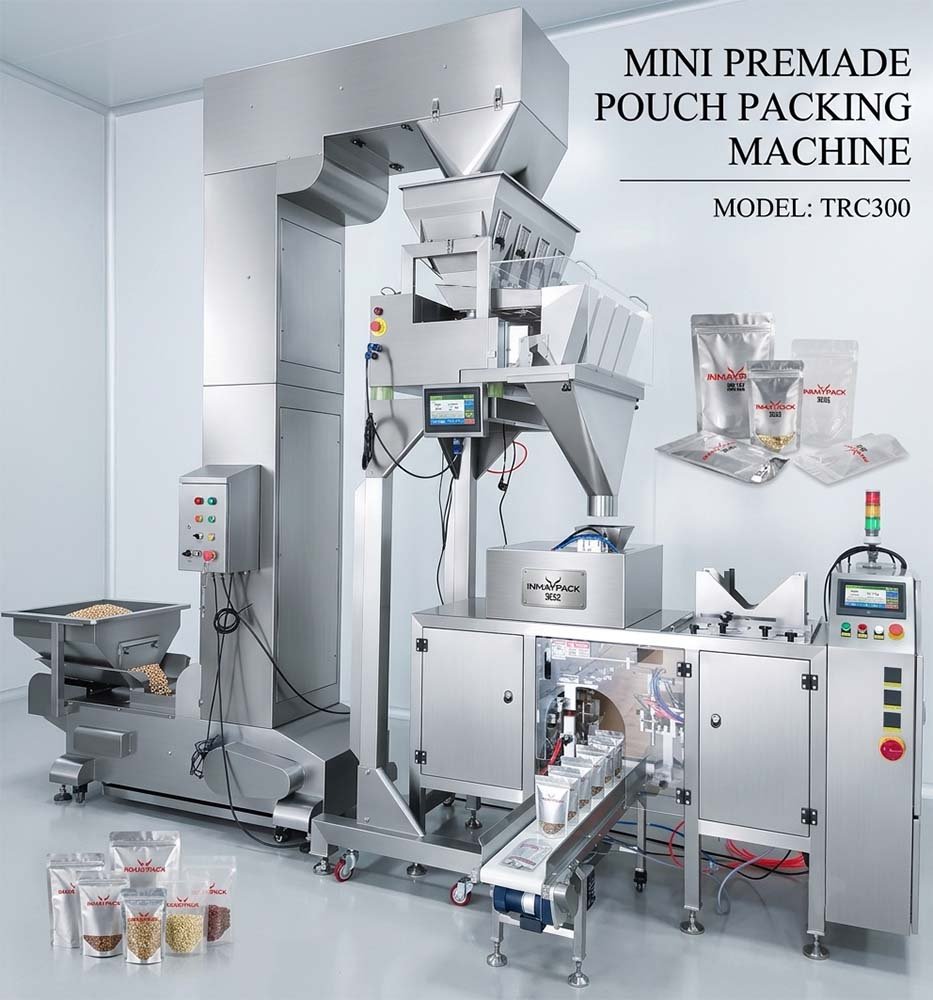
- FeedProduct elevator
- DoseSelected weigher
- PackPouch handling
Equipment reference shown with accessories. The complete illustrated system is larger than the bare pouch-machine frame.
View TRC equipment detailsStart with the purchase you actually need
What makes a packaging machine suitable for a small business?
A suitable small packaging machine automates the right work within your package, staffing, space and budget constraints. A small frame does not automatically include product dosing, feeding, sealing accessories or the utilities needed to run. Compare complete configurations that can produce your required finished packs.
For a first pouch line, decide whether you will buy finished empty bags or make sachets from roll film. Then define the product and dose. Those decisions determine the handling platform, filling device, change parts and material setup—not the word “small” on a catalogue page.
If you already own a filler or sealer, identify exactly which tasks the new equipment must perform. Adding one dosing station and buying an automatic fill-and-seal cell are different projects. INMAYPACK can review the equipment boundary before a configuration is quoted.
Two practical starting points
Finished pouches or roll-film sachets?
Choose around the pack you intend to sell. The two routes use different packaging supplies and setup methods; they are not interchangeable versions of the same machine.
Compact premade-pouch filling and sealing
Review the TRC-300 or TRC-430 when the supplier will deliver finished pouches. The handler picks, opens, presents, closes and discharges the bag while the selected filling device supplies the product.
- Bring production pouches, including the intended zipper, gusset and laminate.
- Match a weigher, auger or liquid-filling arrangement to the product.
- Include pouch loading, product refills and the collection of finished packs in the staffing review.
Form, fill and seal flat sachets
Review an HS-130 configuration when the finished pack is a three- or four-side-seal flat sachet made from film. Pouch forming, filling, sealing and cutting belong in the same machine-and-material review.
- Confirm the sachet drawing, laminate, print repeat and sealing requirements.
- Choose the product-specific filler rather than assuming one device handles every material.
- Account for film threading, first-pack approval, recipe changes and roll replacement.
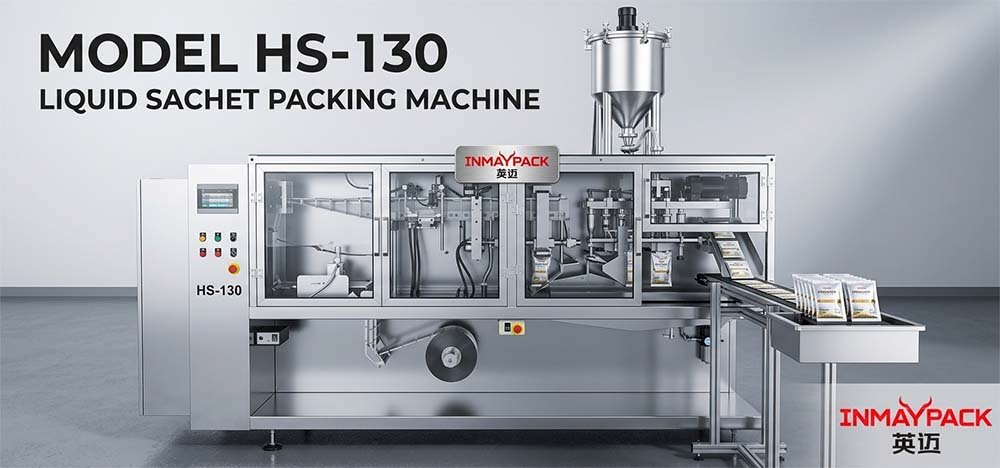
- FormApproved roll film
- FillLiquid-filling setup
- SealFlat sachet
HS-130 liquid-filling reference. The selected product path, options and approved layout define the supplied configuration.
View HS-130 configurationA compact project can still require a complete process
The HS-130 liquid reference configuration pairs a piston-filling arrangement with a product tank. Those items have their own product, cleaning and layout requirements. A powder configuration uses a different product path.
Compare the full configuration rather than treating a photograph or one frame dimension as the complete installation. For a wider view, use the pouch packing machine selection hub.
Documented equipment references
Compare the machine envelope before planning the room
These source dimensions help shortlist a route. They do not include every feeder, filling device, platform, conveyor or service clearance.
On a phone, scroll the table horizontally to compare all columns.
| Reference model | Machine-only L × W × H | Package starting point | Before selecting |
|---|---|---|---|
| TRC-300 | 1,750 × 510 × 1,300 mm | Premade pouch; width 90–300 mm, length 100–300 mm | Add the selected filler, product feed, working access and discharge arrangement. |
| TRC-430 | 1,750 × 510 × 1,650 mm | Premade pouch; width 100–300 mm, length 100–430 mm | Check the actual longer pouch, opening behavior and available filling space. |
| HS-130 liquid-sachet reference | 2,850 × 970 × 1,300 mm | Roll film converted into three- or four-side-seal flat sachets | Approve the sachet drawing, film setup, filling arrangement and complete layout. |
TRC dimensions follow the retained TRC-300/TRC-430 technical sheet. HS-130 dimensions refer to the retained liquid-sachet proposal. Current configuration drawings control the final delivered layout; this is not a full factory floor plan.
The machine frame is only one part of the space requirement. Check doorways and delivery access as well as the operating position. Reserve room for loading bags or film, adding product, removing contact parts, clearing finished packs and reaching service points.
Concept only—not a dimensioned layout or an assertion that every illustrated function is supplied.
The filler follows the product
Powder, granules or liquid: select the product path separately
The same package size does not make different products equivalent. Use representative material and the real package to check the combination.
| Product | Filling route to review | Inputs that affect the configuration |
|---|---|---|
| Powders and ground products | A selected auger or another suitable metering system, with controlled product supply | Bulk density, aeration, flow, target dose, refill behavior, dust and the pouch seal area |
| Granules and pieces | A selected linear or multihead weighing arrangement and feed system | Piece size, fragility, stickiness, bridging, dose variation and the usable package opening |
| Liquids and smooth pastes | A selected pump or liquid-filling arrangement coordinated with pouch or sachet handling | Temperature, viscosity, foam, particulates, drips, cutoff, product supply and cleaning |
The TRC source lists different weighing, auger and liquid-filling options. They are selection options—not a promise that one installed filler can change between every product. Contact materials, removable parts and cleaning must follow the actual formulation and project requirements.
For the detailed application, continue to powder filling systems, granule packaging equipment or liquid and paste pouch packaging.
Staffing and the complete job
Choose automation around the work your team must complete
Do not select only by a catalogue cycle rate. A first line must fit product preparation, material loading, checks, changeovers and the time available to finish the order.
Prepare the actual job
List products, packages, order quantities and changeovers. Identify who prepares material, loads bags or film, replenishes product and approves the first packs.
Run under realistic conditions
Use the proposed staffing, refill method and downstream collection. Record conforming finished packs, interruptions and rejects rather than counting empty machine cycles.
Hand over and change product
Include clearing, cleaning, contact-part changes, recipes, format parts and restart checks. Confirm how the next scheduled product will begin.
A higher reference speed does not solve a refill or collection bottleneck. Equally, a small initial order does not justify a machine that cannot handle the approved package. Separate requirements that are already confirmed from possible future products before adding equipment and options.
For powder-specific short runs and multi-recipe scheduling, use the existing small-batch powder filling selection guide. This commercial page provides the equipment shortlist; the guide explains the detailed batch-planning method.
Before ordering equipment
Check utilities and installation as part of the quotation
Electrical supply and connected load
Provide the site's voltage, phases and frequency. Request the final connected-load and connection requirements for the machine plus the selected filler, feeder and any other included devices.
Do not use a motor rating, plug photograph or a similar model's brochure as the electrical design. Your qualified site team must confirm the installation against the issued requirements.
Air, product supply and safe access
Confirm compressed-air pressure, flow and quality for the configured equipment. Product feed, cleaning arrangements and any extraction or other project utilities must also have a named supply boundary.
Plan hose and cable routes, guarding, operating access, cleaning space and the movement of materials around the line. A narrow machine frame does not remove these requirements.
Use the packaging machine electrical requirements guide and compressed-air requirements guide to prepare the site review.
Compare a complete scope
What should a small packaging machine quote include?
INMAYPACK does not publish a universal “small-business machine price” here. Request a configuration-specific offer and compare the same product, pack and acceptance boundary.
- Machine and packaging formatNamed model, approved pouch or sachet range, supplied format parts and changeover boundary.
- Dosing and product feedingSelected filler, hopper or tank, feed device, control signals and the responsibility for stable product supply.
- Pack finishing and inspectionCoding, opening accessories, product settling, seal checks, weighing, rejection and downstream collection, where required.
- Installation and operating itemsUtilities, access, guarding, spares, consumables, documentation, training and commissioning scope.
- Acceptance and commercial termsSamples, trial method, accepted-output definition, open technical points, delivery basis and current service terms.
Ask each offer to distinguish included equipment, options, buyer-supplied items and exclusions. Compare packaging-material purchasing requirements too: printed film and finished pouches have different ordering, storage and setup implications. A lower machine price is not a complete comparison if essential filling or handling equipment is outside the offer.
The premade-pouch quotation comparison guide provides a fuller cost-and-scope framework for the supplied-bag route.
Make the selection testable
Agree the sample review and machine acceptance method
A relevant trial uses your representative product and production packaging—not a different material chosen only because it runs easily.
Before the review
- Identify the product, dose range, batch condition and any handling or cleaning limits.
- Supply the pouch or film drawing, closure details and representative materials.
- State the intended order pattern, available operators, space and finished-pack target.
- List defects and checks that determine whether a pack is acceptable.
For the agreed acceptance run
- Record the configured machine, selected filler, material identities and settings.
- Use an agreed run duration and a stated refill, staffing and collection method.
- Count conforming packs, stops and rejects against the same time boundary.
- Keep accepted samples, settings, remaining deviations and handover responsibilities together.
The acceptance plan must also address the changes you actually intend to make: a second pouch size, another recipe or a different dose. Passing one short demonstration does not establish every future product. Review support and documentation through INMAYPACK service and project support.
Buyer questions
Small packaging machine questions
Which packaging machine should a small business start with?
Start with the finished package and product. A compact TRC route handles supplied premade pouches; an HS-130 route forms flat sachets from roll film. Then confirm dosing, installed space, staffing, utilities and the accepted finished-pack target. There is no universal best machine for every small business.
Is the TRC-300 frame size the space needed for the whole line?
No. Its retained machine-frame reference is 1,750 × 510 × 1,300 mm. The chosen filler, elevator or product supply, outfeed and required working access add to the installed arrangement. The equipment image shows accessories and must not be read as a dimensioned floor plan.
Can the same compact machine pack powders, granules and liquids?
The TRC reference lists different filling options for these materials. That does not mean one installed filler handles them all. The product path, contact parts, feed and cleaning method must be selected for the actual products and any planned changeovers.
Will one operator be enough?
That cannot be established from the machine label. List bag or film loading, product preparation, refilling, checks, pack collection and cleaning. Review which tasks overlap during the actual order and test the proposed staffing arrangement before accepting an operator-count assumption.
Is a small packaging machine always the lowest-cost route?
No. Compare the configured equipment, packaging materials, staffing, changeovers, utilities and inspection boundary. A bare handler or filler may exclude tasks needed to produce the finished pack. Request an itemized current quote rather than applying one old price to a different product and package.
Do I need to know the exact model before contacting INMAYPACK?
No. Send the product, target dose, intended package and required finished-pack output first. Add the available space, utilities, batch pattern and known budget or timing constraints. Unknown details can be resolved during the project review; you do not need to guess a model.
Can a reference speed be used as a guaranteed production result?
No. Product behavior, the selected filler, pouch or film, refill method, stops and rejected packs affect finished output. Agree the test conditions and the definition of an accepted pack in the proposal and acceptance plan.
Start with your product and package
Get a scoped recommendation for your first packing line
INMAYPACK is a packaging machinery brand based in Shanghai, China, founded in 2009. Share the practical requirements below so the team can review the pouch route, filling arrangement and complete equipment boundary.
Machine suitability, performance and service terms follow the confirmed configuration, product, package and agreed project scope.
- Product and target fill weight or volume
- Premade pouch or roll-film pack, with dimensions if known
- Required accepted packs and typical order pattern
- Available working space and staffing
Add drawings, material samples and utility information when available. The initial enquiry can start with the requirements you already know.