Appropriate when the pouch is supplied premade
The TRC route is for compatible finished pouches presented to the machine. If the project must form bags from roll film, compare an HFFS, VFFS or sachet platform instead.
Packaging systems configured around your application Defined project scope

INMAYPACK · Compact premade pouch packaging
Open, fill and seal ready-made pouches with a compact TRC-300 or TRC-430 platform. Match a weigher, auger or liquid filler to your product, then confirm the pouch format and production target.
Reference speed: 6–15 bags/min. Accepted output is confirmed with your product, dose, pouch and selected filler during the agreed test.
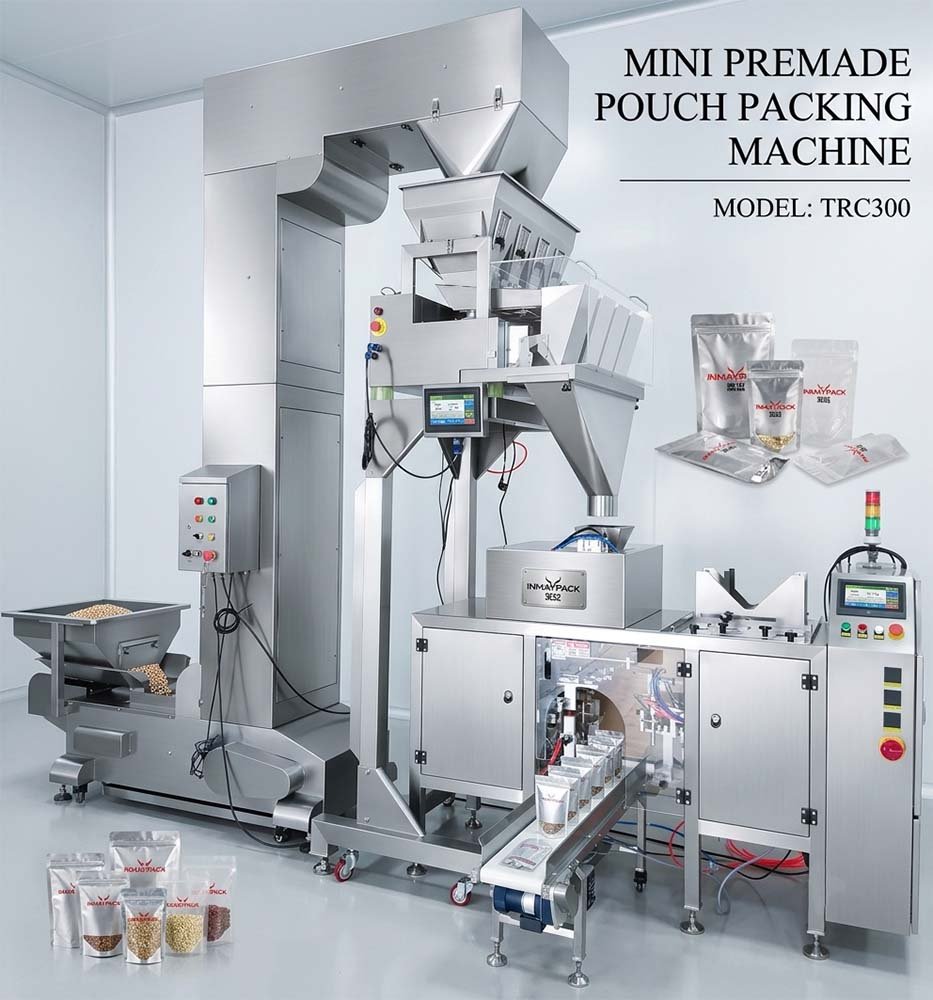
The TRC platform
A mini premade pouch packing machine opens bags that have already been made, coordinates the selected dosing device, and seals each filled pouch. The TRC series offers two compact models: TRC-300 for pouch lengths up to 300 mm and TRC-430 for lengths up to 430 mm.
The pouch-handling frame is one part of the system. Your product determines the filler, feeding equipment, contact parts and cleaning arrangement; your finished pouch determines opening, positioning and sealing requirements.
The TRC route is for compatible finished pouches presented to the machine. If the project must form bags from roll film, compare an HFFS, VFFS or sachet platform instead.
Use the range as a starting point, then define the accepted output with the actual product, dose, pouch, filler, sealing and test duration.
Granules, powders and liquids can require different weighers, augers or pumps. Product-contact parts, refill, cutoff, dust or drip control and cleaning must be included in the quotation.
Zippers, gussets, surface finish, stiffness, static, pouch curl and storage condition can change pickup and opening reliability even when nominal dimensions fit the table.
Choose a different platform when required: a higher accepted-output target, unsuitable pouch presentation, very heavy fill, difficult opening behavior, special vacuum requirement or complex downstream line may require another premade-pouch machine family. Send samples before fixing the model.
Two models · One compact platform
Both models share the 6–15 bags/min reference range. Compare your pouch width and length first; TRC-430 accommodates longer pouches and has a taller recorded machine envelope.
Review this model when your production pouch fits the width and length ranges below.
Review the longer-pouch model when the required bag length exceeds the TRC-300 range.
| Parameter | TRC-300 | TRC-430 |
|---|---|---|
| Reference speed | 6–15 bags/min | 6–15 bags/min |
| Bag width | 90–300 mm | 100–300 mm |
| Bag length | 100–300 mm | 100–430 mm |
| Air requirement | 0.5 m³/min at 0.65 MPa | 0.5 m³/min at 0.65 MPa |
| Machine dimensions (L×W×H) | 1750 × 510 × 1300 mm | 1750 × 510 × 1650 mm |
| Recorded bag formats | 3-side-seal bag, stand-up pouch/doypack, zipper bag, box bag and gusset bag | |
| Filling boundary | Filling device is selected for the confirmed product and dose; it is not established by the TRC frame alone | |
Dimensions and utilities: TRC-300: 1750 × 510 × 1300 mm; TRC-430: 1750 × 510 × 1650 mm (L × W × H). Both list 0.5 m³/min air consumption at 0.65 MPa. Allow additional space for the filler, elevator, platform, guarding and operator access. Final scope and output are confirmed in the quotation and factory acceptance test (FAT).
Finished pouches · Application review
The TRC information sheet lists five bag formats. Dimensions alone do not establish compatibility: zipper position, gussets, material stiffness and seal conditions also matter.
Flat premade bag
Doypack format
Zipper opener reviewed as an option
Structured premade bag
Side-gusset format
Format illustrations are schematic. Send your production pouch drawing and samples to check pickup, opening, filling headspace and sealing. The machine receives premade bags; roll-film bag making requires a form-fill-seal route.
Granules · Powders · Liquids
The TRC platform handles the pouch. Select the dosing and feeding equipment for your material, fill weight or volume, tolerance and cleaning requirements.
Coffee beans, candy and pet food are listed application examples. Choose a one-, two- or four-head linear weigher or a multihead weigher after reviewing particle size, density, fragility, stickiness, target dose and permitted giveaway.
Review an auger dosing and feeding route for the actual powder. Confirm flow, aeration, dust, screw selection, refill, contact parts, cleaning and protection of the pouch seal area.
Compare auger and weigh filling →A liquid-pump filler is an available dosing option. Review viscosity, temperature, particulates, foam, strings, supply pressure, nozzle cutoff, drip control and cleaning before confirming suitability.
Available references include a Z-type bucket elevator, auger conveyor and selected weigher platforms. Define which equipment is included, optional, buyer-supplied or excluded; confirm feeding capacity and every connection to the machine.
Fill range: a universal dose range is not specified for the TRC frame. Fill weight or volume and tolerance follow the selected filler and product trial.
Available options are not all standard equipment. The issued quotation identifies the installed functions and acceptance criteria.
Packing process
Six stages connect pouch handling with the chosen dosing system. The production trial confirms this sequence with your material and package.
Present the confirmed pouch in a repeatable orientation and monitor the available-bag condition.
Transfer one compatible pouch without damage, double pickup or uncontrolled position.
Verify sufficient mouth opening. The supplied feature list records no fill or seal after an opening failure.
Coordinate the selected weigher, auger or pump with pouch position, dose and clean seal headspace.
Apply any confirmed settling or gas function, then seal within the approved pouch-material window.
Separate accepted output from opening, filling, coding or seal rejects using the agreed checks.
Control · Handling · Maintenance
Opening checks, fault prompts and service access help define the machine configuration and operator workflow.
The listed sequence diagnoses a failed opening, withholds filling and sealing, and re-takes the bag. Reuse depends on the pouch condition and your quality rules.
The feature list includes a safety-key interlock stop, no-bag prompt, cartridge-heater warning and cylinder-fault warning. Confirm the installed responses and recovery procedure.
Modular part replacement and hopper positioning are listed features. Confirm format parts, wear items, cleaning access and the complete operating space for your configuration.
Configuration & quotation
A useful quotation includes the pouch machine, selected filler and the equipment needed for your finished pack. Send the application details to receive a configuration-specific offer.
| Scope | What to define | Evidence to request |
|---|---|---|
| TRC machine | TRC-300 or TRC-430, pouch range, installed functions, materials by location and access clearances | Approved configuration and layout |
| Pouches | Bag drawing, material, zipper or gusset, thickness, finish, opening, storage and acceptable variation | Controlled samples and trial record |
| Filler | Selected weigher, auger or pump, refill, product-contact scope, cutoff and cleaning | Dose data and cleaning/changeover review |
| Options | Printer, settling, gas, vacuum, zipper opener, conveyors and platforms marked included, optional or excluded | Installed-equipment list and function test |
| Quality | Dose, seal, code, appearance, reject classification and accepted-output calculation | FAT records and retained samples |
| Commercial handover | Production timing, Incoterm, destination, FAT attendance, documents, spares, training, commissioning and service | Issued quotation, contract and handover register |
Pricing varies with the confirmed configuration and commercial scope. Compare quotations against the same product, pouch, filler, options and acceptance basis.
Prepare your inquiry
Provide the inputs below so INMAYPACK can review the model, dosing system, options and quotation scope together.
Record the product lot, dose, pouch lot and drawing, installed filler and options, recipe, utilities, run duration and permitted adjustments before starting.
Separate successful openings, re-takes, damaged pouches and unrecovered rejects. Verify that an opening failure does not trigger filling or sealing.
Sample the agreed number of pouches across startup and steady operation. Record giveaway, product in the seal area, wrinkles and the chosen seal test.
Count accepted bags separately from empty cycles, opening failures, filling rejects, seal rejects, stops and rework. State the product and pouch beside the rate.
Witness the no-bag, heater and cylinder fault responses plus the approved reset, restart and first-off inspection sequence.
Collect approved samples, settings, alarm records, manuals, drawings, backups, spare-parts list, training records and any deviation or retest item.
Use the premade pouch handling guide to review feeding, opening, gripping and clean seal headspace. For maintenance planning, connect the final as-built list to the machine-specific spare-parts guide.
Keep a controlled pouch drawing and approved sample with the purchase documents. Record supplier, material, dimensions, opening behavior, zipper or gusset details, print orientation and acceptable variation. A demonstration using an easier substitute bag does not prove the production pouch.
The recorded 1750 × 510 mm envelope describes the base machine, not the finished cell. Add space for guarding, doors, bag loading, filler or platform, product feeding, discharge, operator access, maintenance withdrawal and safe utility isolation.
List every approved product and pouch combination, the parts and recipe used, the product-contact path, cleaning tools, inspection points and first-off release method. Measure changeover from the last accepted bag of one run to the first accepted bag of the next.
Specify manuals, drawings, software or parameter backups, recommended spares, training, FAT records, packing list, remote-support route and any site-service responsibility. Warranty, delivery, payment and commissioning terms belong in the issued quotation and contract.
Direct answers to the questions buyers ask before selecting a compact pouch packing system.
INMAYPACK · Your next packing project
Send your product, fill weight or volume, pouch dimensions and photos, required output and destination. Start with the pack you need to produce.