An instant coffee stick pack trial should answer three separate questions: does each pack contain the intended weight, does the blend remain consistent, and does the finished package pass its agreed checks? A stable average weight cannot answer all three.
For 2-in-1 and 3-in-1 coffee mixes, ask the supplier to preserve samples by lane, run stage and refill event. This guide explains how to build that evidence before approving a filling configuration. It is a proposed trial framework, not an INMAYPACK production result, a universal sampling standard or a recipe-development service.
Check the dose and the blend separately
A checkweigher measures total pack mass; it does not identify how much coffee, sugar or creamer is inside. Packs with similar net weights can therefore still require a separate composition check. Conversely, a consistent blend can be delivered at inconsistent weights. Treat these as different acceptance questions.
Powder specialist Jenike & Johanson explains that particle differences can cause a mixture to separate during handling, including hopper filling and discharge. A successful mixing step does not by itself establish that the blend remains uniform through packing. See its segregation and blending guidance for the underlying mechanisms.
For a coffee project, use that principle to decide what to measure—not to assume every recipe will segregate. Your quality team should define a suitable composition test and product-specific acceptance limits. Weight, appearance and taste observations can flag questions, but they should not be presented as a validated measurement of ingredient proportions.
Trial decision rule: record weight, blend and package results in separate fields. If composition has not been tested, mark it as unverified in the trial record rather than treating a passing weight result as proof.
Define what is actually being tested
“3-in-1 coffee” is a product category, not a complete material specification. Give the supplier the intended recipe version and production-representative material. Identify changes in ingredient grade, particle distribution, bulk density, storage or handling that could make one batch different from another.
- Product: recipe and batch identity, available material data, storage history, mixing and transfer sequence, and whether the product is powder, granules or a combination.
- Package: target fill weight, finished drawing, film specification, seal arrangement, code position and intended opening feature.
- Supply path: how the blend reaches the hopper, refill method, permitted working levels, residence time and any agitation or conveying used.
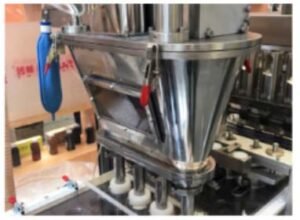
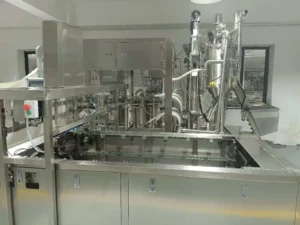
- Machine: the actual filler, forming set and number of active lanes, plus the settings and software recipe used in the trial.
- Acceptance: separate weight, composition, seal, code and accepted-output requirements, with a named owner for each test.
Make the boundary explicit: this procedure assumes a preblended product entering the packer. If ingredients are to be metered separately into each pack, evaluate that as a different process. A hopper agitator should not be assumed to replace a validated upstream mixing operation.
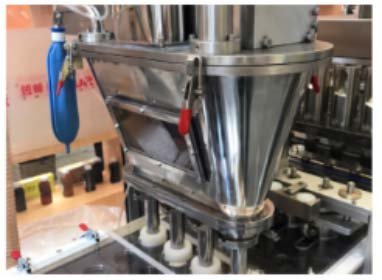
Use the coffee stick packing machine reference for the single-lane configuration and its documented boundaries. This guide does not extend those specifications to another filler, narrower pack or multi-lane platform.
Keep lane, run stage and refill event on every sample
A mixed pile of finished sticks loses information. Agree the sampling method before running, number lanes from one stated viewing direction, and keep the sequence attached to both physical samples and electronic records. On a single-lane machine, use the same method with one lane identity.
Swipe the table sideways on mobile. Keyboard users can focus the table region to scroll.
| Run condition | Keep identifiable | Compare separately | Decision it supports |
|---|---|---|---|
| Startup and settled running | Lane, sequence, settings and the point accepted output begins | Initial and settled weight, blend samples and seals | Whether startup packs need a defined hold or reject rule |
| Falling hopper level | Working level or agreed level band, elapsed time and product batch | Results over the permitted operating range | Whether the proposed level-control range is supported |
| Normal refill | Refill time, material added, loading method and before/after samples | Weight and composition changes around the event | Whether the refill method needs modification or further investigation |
| Stop and restart | Reason, stop duration, product residence and restart settings | First packs versus the preceding stable condition | Whether the restart release procedure is adequate |
| Recipe or format change | Outgoing and incoming recipe, cleaning record and changed parts | New-run results against that recipe's own criteria | Whether one recipe's approval can support the proposed change |
Choose the sample count, intervals, run duration and analytical method with the quality team and supplier. The plan must capture the events it claims to cover; a short run without refilling cannot demonstrate refill behavior. Do not copy a universal sample count from an unrelated machine.
Retain individual results instead of reporting only a pooled average. Use an agreed tare method for net weight and identify the measuring instrument. Keep composition samples separate until the approved method says otherwise; combining them can conceal a lane or time-related difference. Where tests destroy a pack, plan separate, traceable samples for the other checks.
The multi-lane stick pack process guide explains the shared film path and individual filling paths. That distinction matters when comparing a change affecting every lane with one confined to a single lane.
Read patterns as leads, not automatic diagnoses
Weight changes, but blend results remain within the agreed limits
Review the metering and supply record first: hopper state, refill timing, settings and interruptions. A change in delivered mass does not by itself prove segregation. Repeat the relevant condition with the same approved measurement method before selecting a correction.
Weights pass, but composition differs across the run
Do not respond only by adjusting the fill-weight setting. Compare traceable upstream and finished-pack samples, review the analytical and sampling methods, and investigate where the difference appears. Keep product handling and filler decisions open until evidence distinguishes the possible causes.
One lane differs from the others
Check its material supply, dosing setup and pack measurements against the other lanes under the same run condition. A lane-specific pattern helps narrow the investigation; it does not establish which part is at fault. Record any adjustment and repeat the comparison without discarding the original results.
Every lane changes around a refill or restart
Investigate the shared event and product path as well as common settings. Preserve the time sequence. If several variables are changed together, a better result may be real but its cause remains uncertain. Use controlled follow-up trials rather than declaring the first plausible explanation proven.
Approve the product-and-pack combination, not just the machine
Keep seal and finished-pack checks alongside the product results. Record product in the seal area, the specified seal-test outcome, cut position and code readability. A visually neat seal does not replace the agreed test, and a clean empty-film run does not establish sealing performance with the actual blend.
For recipe changes, the site's quality team must define cleaning and product-release requirements, including relevant cross-contact risks. Do not treat a successful mechanical changeover or visually clean hopper as approval to release the next food product. This guide does not prescribe an allergen-validation method.
Create one trial record linking the recipe revision, material batch, machine configuration, film lot, lane, operating event, sample identity, test method, result and decision. Attach settings, observations and any remaining actions. This traceability is more useful for purchasing than a video without identified run conditions.
- Supported for the tested configuration: the defined checks have evidence under the recorded conditions. List which recipes and formats were actually included.
- Further work required: identify the missing test or unresolved result, its owner and the next trial. Do not silently convert an open item into an accepted requirement.
- Different configuration needed: revisit the product transfer, filler, packaging format or production plan where the evidence does not support the proposed route.
Ask the quotation to carry forward the tested product path, agreed working range, inspection scope and acceptance conditions. A demonstration with a simplified manual refill arrangement is not equivalent to a supplied line with a different conveying system. State any untested interface explicitly.
If repeated physical blockage prevents a representative run, address that immediate failure using the powder filler clogging diagnostic guide. Restoring flow and proving blend consistency are separate tasks; completing one does not complete the other.
Questions before a coffee stick trial
Does consistent pack weight prove a uniform 3-in-1 mix?
No. Total mass does not identify the proportions of the ingredients. Define a separate, suitable composition check with your quality team if blend uniformity is an acceptance requirement.
Can an agitator be assumed to prevent segregation?
No. Its effect depends on the material and equipment arrangement. Include the proposed agitation and settings in the trial rather than treating the presence of an agitator as proof of uniformity.
Can one successful recipe qualify all instant coffee products?
Not automatically. Use the recipe and material differences to decide which additional trials are needed. Soluble granules, black coffee powder and creamer-containing mixes should not be treated as identical solely because their packages have the same size.
How many sticks should we test?
Agree the sampling plan against the quality question, expected variation, run events and chosen test methods. This article provides a way to organize evidence; it does not establish a universal sample count or acceptance tolerance.
Discuss a trial for your coffee blend
Share the recipe family, target dose, pack drawing, production-intent film and required accepted output. Include the supply method and the weight, blend and seal evidence your team needs, so INMAYPACK can review the packaging configuration and proposed test scope.