Choose a liquid packaging machine manufacturer by asking for evidence that connects your liquid, package and acceptance criteria to the proposed equipment. A supplier should explain what it will supply, what must be tested and who will resolve the interfaces—not simply quote a maximum speed.
This guide is for buyers comparing equipment for liquid sachets, roll-film pouches and premade liquid or spout pouches. It provides a supplier-screening worksheet, not a ranked list of manufacturers. Bottle lines, sterile production and product-processing systems require separate assessments; do not assume a flexible-pouch proposal includes them.
Give each supplier the same liquid and package brief
Different assumptions produce different quotations. Before asking which manufacturer is more reliable, check that candidates are solving the same task. Send one controlled brief and ask each supplier to identify exclusions and unanswered questions against it.
- Liquid at the filler: product identity, intended filling temperature, available flow or viscosity information, particles, foaming observations and storage conditions. Include formulation variants that matter to the equipment review.
- Finished package: every fill amount and pack drawing, plus film or premade-pouch samples. For spout packs, include the spout and cap as a matched set rather than only a photograph of the finished pouch.
- Required output: accepted packs over a defined running period, with the intended inspection and reject rules. Identify changeovers and planned production stops.
- Plant boundary: product supply, utilities, available space, downstream handling and the party responsible for each connection.
- Cleaning and verification: products to be changed over, the site's cleaning requirements and which records the quality team needs before release.
If the package route is still undecided, first use the liquid packaging machine route overview. Supplier evaluation should follow a defined application; it should not conceal a different machine architecture inside a lower price.
Use evidence gates instead of a supplier popularity score
A useful shortlist separates a demonstrated fit from an open question. Do not award a high overall score that allows an unresolved package interface or acceptance condition to disappear beneath attractive price and delivery promises.
For each gate, record one status: supported by identified evidence, open with a named owner and next action, or not suitable for a requirement that cannot be met. These are working decisions for your project, not an industry certification or a prediction of supplier performance.
Swipe the comparison table sideways on mobile. Keyboard users can focus the table region to scroll.
| Supplier statement | Evidence to request | Keep the gate open when… |
|---|---|---|
| “We can fill your liquid.” | A proposed product path, dosing arrangement and trial plan tied to the actual product condition. | The proposal names only a pump type or shows a different product without explaining the difference. |
| “Your pouch is compatible.” | A controlled format list covering dimensions, opening, film or pouch construction, spout and cap where applicable. | Compatibility is based only on nominal bag width or fill volume. |
| “The line will meet your output.” | The package, dose, product, inspection method and running conditions attached to that output claim. | The evidence is empty cycling, a short edited clip or a different configuration. |
| “Cleaning is straightforward.” | Drawings or a demonstration of access, removable parts, circuits and the proposed cleaning boundary. | “Easy clean” or “CIP” appears without describing what is included and how the result will be verified. |
| “We supply the complete system.” | An inclusion/exclusion list, interface drawing and responsibility allocation for bought-in modules. | Product supply, cap feeding, inspection, conveying or controls integration has no owner. |
| “We can support the equipment.” | Named support channels, documentation scope, parts identification, training and the proposed service terms. | Support is only described as “lifetime service” without a defined process or commercial boundary. |
A supplier's willingness to identify a limitation can be useful evidence of a well-defined proposal. It is not proof of reliability on its own. Ask what would close the gap: a revised drawing, a product sample, an engineering review or a witnessed trial.
Check what a demonstration actually proves
Ask for the identity of the equipment and configuration shown, the product used, the pack format and the conditions recorded. Separate three kinds of evidence: an equipment photograph shows an arrangement; a running demonstration shows operation under the demonstrated conditions; an acceptance record documents checks against agreed criteria.
A water demonstration may help illustrate sequence and package handling, but should not be treated as proof that a foaming, particulate or viscous product will meet the same requirements. Ask the supplier to explain which parts of the demonstration transfer to your application and which remain untested.
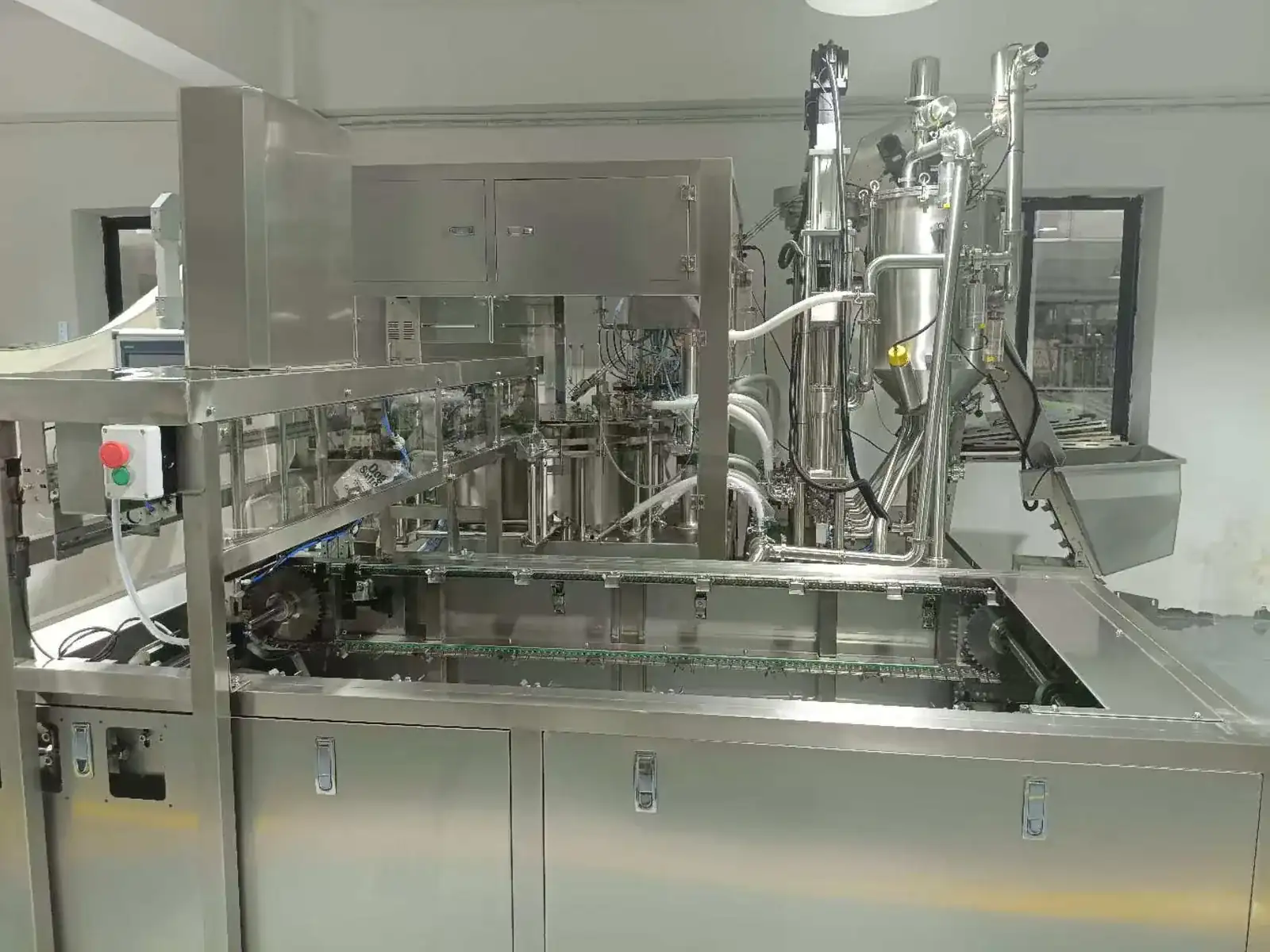
The documented spout pouch equipment build is an example of configuration evidence to discuss. Ask for the relevant dosing, pouch handling and closure interfaces in your own proposal, rather than assuming every pictured component is standard.
For references, request an authorized contact or an appropriately anonymized record relevant to the same application. Do not require a supplier to disclose another customer's confidential formulation, drawings or identity. If a reference cannot be shared, record that limitation and agree an alternative form of evidence.
Agree the test plan before the acceptance meeting
Factory acceptance should not be the first time the buyer and supplier discuss a passing result. PMMI's OpX factory acceptance guidance emphasizes clear criteria, expectations and responsibilities between equipment suppliers and end users. Use that principle to make the proposed liquid-packaging trial explicit.
- Inputs: identify who supplies the product, film, pouches, spouts and caps; agree quantities and the treatment of substitute materials.
- Measured results: define fill assessment, seal or closure checks, reject handling and accepted-output measurement. The methods and limits belong to the agreed project specification.
- Operating events: include relevant product replenishment, normal stops, restart and selected format changes, not only favorable steady running.
- Records: identify the report, raw observations, footage, deviations and sign-off responsibilities required for the decision.
- Open items: agree how an unresolved finding is assigned, corrected and rechecked. Keep shipment and final acceptance decisions distinct where the project requires it.
Factory testing cannot automatically verify every site interface. Identify what will be checked after installation using the actual utilities, product supply and downstream equipment. This is a technical planning framework, not a substitute for a reviewed purchase agreement.
Ask the supplier to explain the proposed cleaning process without making unsupported sanitation, shelf-life or sterile-filling claims. Cleaning, product treatment and package integrity are separate questions. Your responsible quality team should define the evidence needed for the intended product and market.
Keep a decision record that survives quotation revisions
Use the same evidence gates for every candidate. For each requirement, record the supplier response, document or video identifier, configuration revision, remaining question, responsible person and next decision date. A checked box without an evidence reference is difficult to audit when the proposed machine changes.
Before comparing totals, put the quotations on the same boundary: supplied equipment, change parts, inspection, documentation, trials, packing, delivery responsibilities, installation, training and agreed support. Do not turn an excluded item into an assumed inclusion because another supplier lists it.
A practical decision sequence is:
- Remove application mismatches. If the supplier cannot support the required product or package route, a lower quotation does not resolve the mismatch.
- Close critical unknowns. Request the missing interface definition or trial evidence before treating the offer as technically comparable.
- Compare the remaining offers. Review commercial scope and operating responsibilities against the same requirements, not an isolated headline price.
- Record the chosen basis. State which evidence supports the decision and what remains subject to verification. Carry these items into the next project stage.
To prepare a consistent starting brief, use the packaging machine RFQ builder. Keep supplier replies against that brief rather than maintaining several incompatible specification lists.
Liquid packaging supplier selection questions
Is a manufacturer always preferable to an integrator?
No. Assess the actual work scope and who owns the interfaces, testing, documentation and support. Ask which modules are built in-house, bought in or integrated, and who is accountable when a problem crosses those boundaries.
Can I shortlist suppliers from videos alone?
Videos can support an initial review, but identify the configuration and demonstrated conditions. Use drawings, written scope and an agreed test plan to resolve requirements that a clip cannot establish.
Should the cheapest quotation win if the stated speed is the same?
Only compare price after the application and equipment boundaries are aligned. Equal headline speeds do not establish equal accepted output, inspection, cleaning scope or support responsibilities.
What should I send before asking for a supplier recommendation?
Start with the liquid, intended filling condition, fill amount, package and required accepted output. Identify any important cleaning or interface constraint. Drawings, samples and a more detailed acceptance brief can follow during technical review.
Discuss a defined liquid packaging application
For an INMAYPACK proposal, share your product, pouch or sachet type, fill amount and required accepted output. Include existing drawings or observed filling difficulties if available. The next useful step is to define the equipment boundary and the evidence needed for a trial—not to select a machine from a generic reliability claim.
Configuration, delivery, service terms and acceptance commitments remain project-specific until confirmed in the issued proposal.