
A K-seal pouch is identified by its bottom seal layout, not by a universal capacity or one machine setting. The angled seal areas, gusset fold, side seals and filled-product load work together to create the base.
This guide shows how to distinguish common bottom-gusset descriptions, what to request from the pouch converter and which evidence to preserve before a premade-pouch or roll-stock HFFS route is approved.
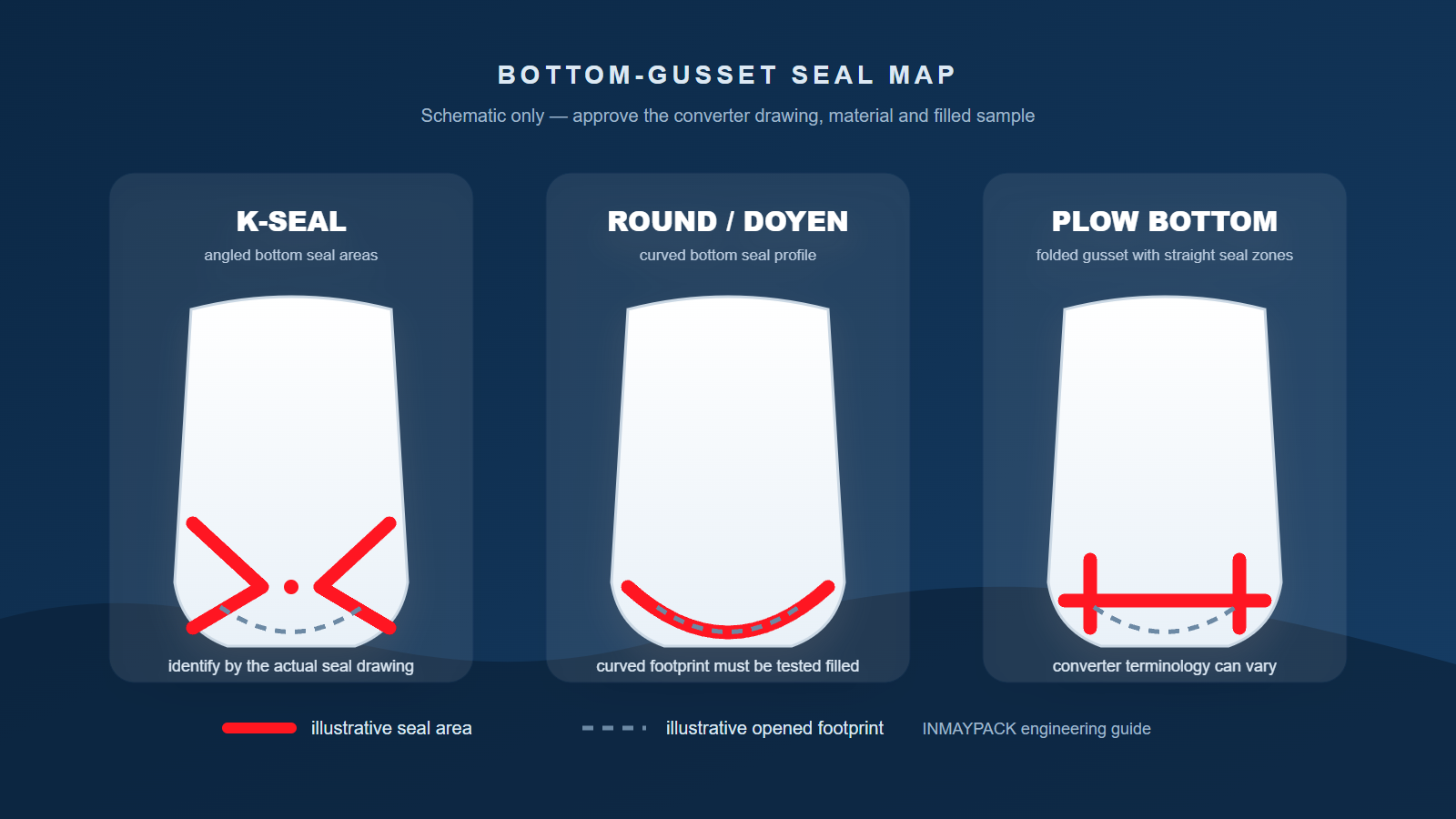
A K-seal pouch is a stand-up pouch whose bottom-gusset area uses angled seal zones that form a K-like pattern when viewed on the front and back panels. The term describes the seal layout. It does not, by itself, define the film structure, gusset depth, usable volume, product suitability, filling method or accepted standing performance.
If a sample or quotation says only “K-seal,” ask for the flat pouch drawing, bottom-seal map, gusset definition and filled reference. The bottom-gusset forming guide explains why fold position, multi-layer transitions and filled footprint must be reviewed together.
K-seal, round/Doyen and plow-bottom are not interchangeable labels
Names used by converters and machinery suppliers are helpful starting points, but they are not a controlled package specification. Two pouches sold under the same family name can differ in the angle, radius, sealed area, fold depth and relationship between the bottom and side seals.
Angled seal zones
Look for diagonal seal areas around the bottom gusset. Confirm how those angles meet the side seals and how much of the gusset remains available to open.
Curved bottom profile
A curved seal profile can create a different footprint and corner behavior. The curve, gusset depth and product load still need a filled-package check.
Folded construction
The fold and straight seal zones may be described differently by suppliers. Review the actual section, seal map and converter tolerance instead of assuming one standard geometry.
| Decision | K-seal | Round / Doyen | Plow-bottom description |
|---|---|---|---|
| Identify from | Angled bottom seal map plus physical sample | Curved bottom seal profile plus sample | Fold and straight seal-zone drawing |
| Do not infer | Capacity, maximum fill or machine speed | Automatic stability or drop resistance | Universal film path or sealing window |
| Critical review | Angle-to-side-seal transition and open area | Radius, corner lift and usable footprint | Fold location, layer presentation and corner closure |
| Approval basis | Controlled drawing, actual laminate, representative product, intended fill, machine trial and agreed package tests | ||
Put the bottom construction on the drawing before quoting the machine
Nominal pouch width and height do not show where the gusset starts, how the angled or curved seals are formed, or how the bottom interfaces with the side seals. A machine supplier needs the converter-controlled definition and samples from the intended production construction.
For roll dimensions, repeat length, registration marks, winding direction and machine-facing film data, use the Doypack film specification guide.
The product determines whether the gusset becomes a useful base
Bottom geometry creates the potential footprint; the product decides how that footprint is loaded. Free-flowing granules may distribute across the base differently from aerated powder, rigid pieces, paste or liquid. The same flat pouch can stand differently when fill mass, bulk density, settling, headspace or handling changes.
Flow and aeration
Check bridging, trapped air, product in the seal zone, settling time and whether the base opens evenly at the target dose.
Distribution and point load
Check whether pieces concentrate at corners, prevent full opening or create an unstable center of mass after conveying.
Dynamic load and closure
Check slosh, nozzle withdrawal, contamination control, top closure and the effect of handling on the bottom and side transitions.
Define the evaluation condition before comparing samples
A pouch examined immediately after filling may not represent the package seen after vibration, settling, cooling or distribution. State when the standing check occurs, the support surface, the permitted lean or rocking condition, and whether the package must recover after a controlled tip or handling event. If the pouch enters a checkweigher, coder, cartoner or case, preserve that downstream state in the trial.
Do not compare two bottom constructions using different fill masses, headspace, product lots or evaluation times. The useful comparison keeps the product and test basis controlled, then records how each candidate opens, carries the load, seals and transfers. Package appearance is one result; seal integrity, accepted output and downstream handling remain separate acceptance results.
Decide whether the machine receives a finished pouch or forms it from roll stock
A bottom-style name cannot select the equipment by itself. First establish whether the K-seal pouch arrives as a premade empty package or whether the project expects an HFFS system to create the bottom geometry in line.
Premade-pouch filling route
The converter supplies the finished empty pouch. The machine must separate, pick, grip, open, support, fill and top-seal it without damaging or masking the approved bottom geometry. Use the stand-up pouch opening and filling guide to define vacuum, gripper and fill-clearance checks.
Roll-stock HFFS route
The machine and tooling participate in forming the gusset and closing multi-layer transitions. Film path, fold control, seal pattern, opening, filling and cooling become one process boundary. Review the Doypack packing machine route only after the required pouch geometry and film are known.
Converter-machine handoff
For either route, freeze one controlled drawing and sample set. The pouch converter, film supplier, machine supplier and package owner should use the same revision, test product and acceptance language.
If the project has not yet decided between roll stock and finished empty pouches, compare the handling responsibilities in the pouch versus bag packaging guide and the premade-pouch machine selection page.
Inspect the multi-layer corners before changing temperature
The bottom/side intersection can present more film layers and abrupt thickness changes than the pouch body. A leak or wrinkle in that area is not proof that the entire seal temperature is too low. Preserve the failure location and first inspect layer presentation, sealant contact, contamination, jaw contact, pressure distribution, dwell and cooling.
| Observed result | Possible process family | First evidence to preserve |
|---|---|---|
| One corner remains folded | Pouch opening, gusset stiffness, gripper support or product bridging | Empty opening sequence, filled sample and left/right footprint |
| Leak near angled seal | Seal-map transition, contamination, layer alignment or jaw contact | Failure location, seal impression, material lot and test method |
| Pouch leans consistently | Asymmetric fold, product distribution or unequal base opening | Flat drawing, fold center and filled-pouch orientation |
| Good first samples, later drift | Web tracking, thermal stabilization, refill condition or tooling movement | Time-stamped samples, settings, alarms and material splice |
| Top seal contamination | Filler cutoff, dose timing, nozzle path, dust or splash | Filling video, rejected sample and machine-cycle state |
Use the stand-up pouch seal integrity guide to separate seal strength, continuity and leak evidence rather than treating one test as proof of every package property.
Release the filled package, not the bottom-style name
Agree in advance who owns the pouch drawing, film release, machine settings, package tests and final disposition. A supplier trial can demonstrate one controlled combination; it does not automatically approve every size, laminate, product or converter lot. Record deviations instead of silently changing the reference during the run.
Lock the inputs
Identify the drawing revision, converter, pouch lot, laminate, product lot, target fill, machine recipe, utilities and installed tooling.
Observe empty handling
Record separation, pickup, opening, gripping, fold symmetry, damage and any corner that resists opening before product is introduced.
Measure filling and closure
Keep accepted dose, seal cleanliness, top-seal position and rejects tied to the same sample identity and machine condition.
Evaluate the filled footprint
Use the defined settling condition. Record contact area, lean direction, recovery after handling, conveyor behavior and secondary-pack fit.
Apply package tests
Use methods and limits owned by the package specification. Record failure mode and sample location, especially around bottom and side transitions.
Challenge normal events
Include refill, restart, material splice, changeover and downstream block conditions that are part of the agreed FAT boundary.
K-seal pouch FAQ
Is a K-seal pouch the same as a Doyen pouch?
No universal naming rule should be assumed. K-seal commonly refers to angled seal areas around a bottom gusset, while Doyen or round-bottom descriptions commonly refer to a curved bottom profile. Ask the converter for the controlled seal drawing and sample because terminology and construction details can vary.
Does a K-seal pouch always hold more product?
No. Usable volume depends on the complete pouch dimensions, gusset geometry, sealed area, film behavior, product density, fill level and headspace. A name alone does not establish capacity.
Can the same filling machine run K-seal and round-bottom pouches?
Possibly, but compatibility must be demonstrated for the exact pouch sizes and materials. Review magazine or roll handling, pickup, opening, gripper position, fill clearance, support, sealing and change parts. Do not infer compatibility from similar flat dimensions.
Is K-seal better for heavy products?
Some suppliers position different bottom constructions for different loads, but the accepted choice must come from the converter’s recommendation and testing with the intended product, fill, distribution and handling. Avoid treating a generic marketing rule as a project acceptance result.
What should be included in a K-seal pouch RFQ?
Include the controlled flat drawing, physical samples, laminate and sealant details, target product and fill, all priority sizes, features, supply format, accepted output, machine route, package tests, FAT duration, inspection and destination requirements. The packaging machine RFQ builder can organize the wider project boundary.
Sources used for the bottom-gusset review framework
Supplier reference that distinguishes Doy-pack and K-seal gusset options while making clear that final configuration matters.
Converter reference listing bottom-gusseted K-seal and Doyen pouches as distinct constructions.
Technical reference for folded-gusset formation, multiple film layers and sealing through the gusseted bottom.
Test-method reference; the package owner must define the sample plan, conditions and acceptance limits.
Continue from geometry to the complete pouch system
Send the pouch drawing, samples and product condition
INMAYPACK will review whether the project fits a premade-pouch route, roll-stock Doypack system or another configuration, and identify the pouch, film, opening, filling and FAT inputs that still need confirmation.
Request a K-seal pouch application review






