
A quad seal pouch is a gusseted flexible package reinforced by four vertical corner seals. Those corner seals help define a box-like shape and four display panels, but the name alone does not tell a machine supplier how the pouch will be supplied, formed, filled or accepted.
This guide separates quad seal from four-side-seal sachets, compares roll-stock and premade-pouch routes, and turns the chosen format into a usable film, machine and FAT brief.
Quick answer: choose a quad seal pouch when the four-corner structure, panel presentation and filled-pack geometry suit the product and distribution route. Before selecting equipment, confirm whether the package arrives as roll stock or as a converted premade pouch. Then define the approved drawing, film or pouch construction, filler interface, corner-seal geometry, top closure, test methods and accepted output. Do not treat “quad seal” and “four-side seal sachet” as interchangeable terms.

What is a quad seal pouch?
A quad seal pouch, also called a quad seal bag or four-corner-seal bag, uses four longitudinal seals at the package corners. The panels and gussets can open into a more rectangular cross-section after filling. Depending on the approved construction, the package may have a box-like bottom, a separate top closure, a rear seam or no center back seal.
The format is used when the buyer wants a structured filled appearance, clearer panel definition or more uninterrupted printable surfaces than a conventional center-seal gusseted bag. Coffee, tea, pet food, snacks and nutrition products are common market examples, but suitability still depends on the actual product, pack mass, laminate, barrier requirement, distribution load and filling process.
Four corner seals
The defining feature is a vertical seal at each corner. Seal width, alignment and transitions belong on the approved pouch drawing.
Side gussets
Gussets create package depth. Their fold position and opening behavior affect forming, filling access and finished presentation.
Panel presentation
Front, rear and side panels can provide distinct print areas, but artwork must follow the converter's dieline and registration capability.
Top and bottom remain project-specific
Do not infer the closing method, easy-open feature, zipper, valve or bottom construction from “quad seal” alone.
Quad seal is not the same as a four-side-seal sachet
This naming error can send a project toward the wrong machine family. A four-side-seal sachet is normally a flat packet closed around four outer edges. A quad seal pouch is normally a gusseted bag whose four vertical corners are sealed to create a three-dimensional structure.
| Question | Quad seal pouch | Four-side-seal sachet |
|---|---|---|
| Primary geometry | Gusseted, three-dimensional package with four vertical corner seals | Flat packet with seals around four outer edges |
| Typical presentation | Defined front, rear and side panels; may form a box-like footprint | Two broad flat faces with a perimeter seal band |
| Key drawing details | Panel widths, gusset depth, corner-seal widths, rear seam if present, top and bottom construction | Finished width and length, perimeter seal widths, notch, registration and cut position |
| Machine discussion | Often a VFFS quad-seal configuration or a machine designed to handle premade quad-seal pouches | Often a flat-sachet forming, filling and sealing process |
| Common purchasing mistake | Assuming any gusseted-bag machine can add four controlled corner seals | Calling every four-seam package “quad seal” without showing the cross-section |
If the real decision is between flat sachet formats, use the 3-side vs 4-side seal sachet guide. Keep that task separate from selecting a gusseted quad-seal package.
Choose the package supply route before choosing the machine
A buyer can receive the same general shelf format through different production routes. The correct route changes the machine boundary, material specification, change parts, quality checks and cost structure.
| Decision area | Roll-stock forming and filling | Premade quad-seal pouch filling |
|---|---|---|
| Incoming packaging material | Printed or unprinted web supplied on a roll | Converted pouches supplied in defined orientation and stacks or bundles |
| Machine task | Unwind, guide, form gussets and panels, make the required longitudinal/corner seals, fill, close and cut | Feed one pouch, open and present it, fill without distorting the structure, close the top and discharge |
| Critical material data | Film structure, thickness, web width, winding, registration repeat, coefficient-of-friction behavior and sealant side | Finished drawing, tolerances, mouth opening, stack condition, sealant orientation, zipper/valve details and pouch lot |
| Main format risk | Corner alignment, gusset tracking, film tension, heat balance, registration and consistent forming | Single-pouch pickup, opening, gripping, gusset presentation, filling access and clean top seal |
| Commercial boundary | More package-making work sits inside the packaging machine project | Pouch conversion sits with the pouch supplier; the packaging machine handles the supplied geometry |
Capability must be confirmed from the drawing and samples. A machine that runs ordinary pillow or gusseted bags is not automatically a quad-seal machine. Likewise, a standard premade-pouch gripper may not control a tall or heavily gusseted quad-seal pouch. Send the real construction before accepting a model recommendation.
Use the vertical form fill seal machine guide when the project begins with roll stock. Use the premade pouch handling guide when the pouch is converted before it reaches the filling line.
Define the pouch before asking for speed
“We need a quad seal bag” is not enough for a technical quotation. The supplier needs a dimensioned, material-specific packaging task. Begin with a packaging drawing and a range table for every planned SKU.
- Record the product condition. State particle size distribution or bulk density for dry products, temperature and flow behavior where relevant, dust or oil behavior, target dose and allowable product giveaway.
- Define filled geometry. Provide front-panel width, side-gusset depth, finished length, top and bottom geometry, headspace and the acceptable filled-pack shape.
- Locate every seal and feature. Show corner-seal width, rear seam if any, top seal, bottom construction, zipper, valve, notch, handle, label and code area.
- Identify material supply. For film, state web width, roll direction, print repeat, eye mark and splice rule. For premade pouches, state orientation, stack condition and dimensional tolerances.
- Define downstream loads. Explain checkweighing, metal detection, conveying, case packing and any compression, drop or distribution test that the closed pack must tolerate.
- Send production-representative samples. Samples should come from the intended converter and represent the planned material, printing, zipper or valve—not a visually similar substitute.
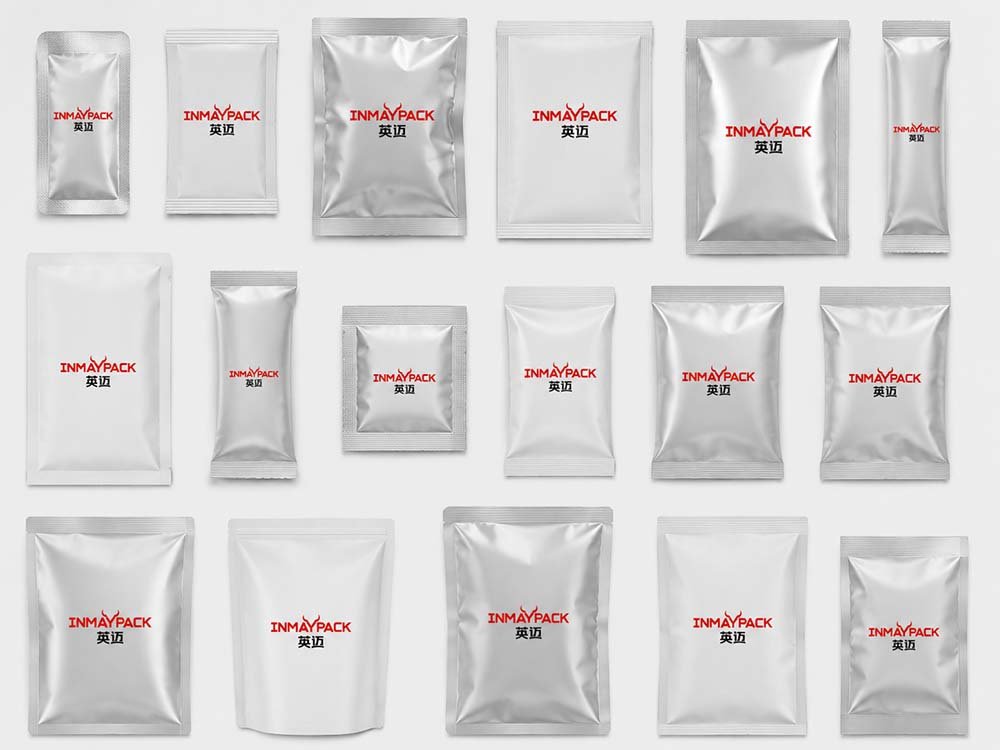
Match the filler and product path to the geometry
Package structure cannot compensate for an unstable filling process. The filler must deliver the product through the available mouth while protecting the corner folds and the final top-seal area.
- Free-flowing granules and pieces: review the weigher or volumetric filler, drop height, timing, product bounce and whether pieces lodge in folds or the top seal.
- Powders: document bulk density, aeration, dust, settling and extraction needs. A clean-looking outer panel does not prove that the seal area stayed free of powder.
- Oily or coated products: observe product transfer, wall contact and buildup. The filling interface and cleaning plan may be more important than nominal speed.
- Large fills: verify bottom support, package expansion, grip load and downstream transfer at the maximum planned dose.
Ask for accepted finished packs per minute under the agreed product and package condition—not only empty-machine cycles. The quote should state which filler, infeed, dust control, inspection and downstream devices are included.
Control the corner seals, gussets and top closure
Four visible corner seals create more transitions to inspect. The control plan should locate each seal, define what a conforming sample looks like and state which test answers each quality question.
| Control point | What to verify | Evidence to retain |
|---|---|---|
| Corner-seal alignment | Seal location, width, continuity and symmetry against the approved drawing | Marked samples, measurements, lane or station, film/pouch lot and recipe |
| Gusset formation or presentation | Folds open and close without wrinkles, trapped product, skew or panel distortion | Empty and filled samples plus images at the relevant machine point |
| Top-seal cleanliness | No product, dust, oil or fold crosses the required sealing band | Reject samples, filler timing, product condition and stop/refill event |
| Seal strength and failure mode | The agreed specimen meets the buyer's package specification under the defined method | Method, conditioning, specimen location, result units and failure description |
| Leak or package-integrity check | The selected test can detect the defect being controlled | Method, apparatus, pressure or procedure, sample count and disposition rule |
| Filled-pack geometry | The package stands, conveys and fits the downstream and case-packing boundary | Dimensioned filled samples, weight, settling condition and downstream result |
The food packaging seal integrity testing guide explains how visual review, seal-strength testing and leak methods answer different questions. Acceptance limits must come from the approved package specification; they should not be copied from another film or pouch.
Run a FAT that exposes weak transitions
A short demonstration with hand-selected material does not establish a production result. The FAT should use approved product and packaging material, include planned SKUs and record the disturbances most likely to affect forming, filling and seals.
- identify every film roll or premade-pouch lot used in the run;
- record nominal operating condition, duration, staffing and all planned adjustments;
- separate gross discharged packs from accepted packs and retain the reject reason;
- challenge startup, normal sustained production, refill, stop/restart and material replenishment;
- test the smallest, largest and most difficult approved SKU rather than only the easiest format;
- retain samples from all relevant lanes or stations and from the beginning, middle and end of the run;
- verify corner seals, top closure, code, dose, filled dimensions and downstream handoff with the agreed methods;
- list every item still to be confirmed instead of converting assumptions into acceptance claims.
Use the stand-up pouch machine FAT checklist to connect package evidence with dosing, coding, inspection, reject logic and accepted output.
What to put in a quad seal pouch RFQ
A useful RFQ lets suppliers quote the same boundary. Attach the following instead of asking for an undefined “best quad seal machine.”
- product description, state, density or flow behavior, target dose range and tolerance method;
- package drawing with all finished dimensions, tolerances, seals, folds, features and code areas;
- roll-film specification or premade-pouch specification and representative production samples;
- planned SKUs, changeover frequency and which parts or settings may change;
- required accepted output and the exact definition of a conforming finished pack;
- utilities, hygiene boundary, cleaning method and environmental conditions;
- inspection, reject, accumulation and downstream equipment interfaces;
- FAT duration, sample plan, test methods, documentation and witness requirements;
- installation, training, spare parts and service scope by responsible party.
If the machine route is still undecided, use the packaging machine RFQ builder to preserve unknowns as items to confirm rather than guessed specifications.
Quad seal pouch questions buyers ask
Does quad seal mean the same thing as four-side seal?
No. In machine selection, quad seal normally describes a gusseted package with four vertical corner seals. A four-side-seal sachet is generally a flat packet sealed around four edges. Always send a drawing or cross-section because terminology varies between suppliers.
Can every VFFS machine make a quad seal bag?
No. The machine needs the forming, gusset and sealing arrangement required by the approved geometry. Confirm capability with the film structure, finished drawing, size range, product and samples before selecting a model.
Can a premade-pouch machine fill quad seal pouches?
Only if its magazine, pickup, opening, grippers, fill access and closing stations are designed and validated for that pouch. A conventional stand-up pouch result should not be assumed to transfer to a quad-seal construction.
Is a quad seal pouch always flat bottom?
No. The two terms can overlap in market usage, but they do not automatically define the same construction. The approved drawing should show the bottom panels, folds and seals rather than relying on a name.
What controls the achievable speed?
Product flow, dose, package size, film or pouch behavior, forming and seal time, filling access, inspection, reject logic, downstream handling and the accepted-quality definition all matter. Ask for evidence under your approved condition.
Related packaging engineering guides
Technical references
- Sealed Air, quad seal pouch structure and applications.
- Triangle Package Machinery, machine-produced package styles including quad seal.
- ASTM International, F88/F88M-23 seal strength of flexible barrier materials.
- ASTM International, F2096-11(2019) gross-leak detection by internal pressurization.
Review your quad seal pouch project
Send the product condition, dimensioned pouch drawing, film or premade-pouch specification, target accepted output and FAT method. The INMAYPACK Engineering Team will review the packaging route and identify which machine capabilities still need confirmation before a quotation is fixed.







