Technical Explainer · Print-to-Cut Control
Published July 30, 2026
When a printed pouch begins cutting through the artwork, the fastest response is not to move the photo-eye or keep changing the electronic offset. First decide whether the defect is lateral web drift, longitudinal registration error, or an incorrect relationship between the artwork, mark, seal and cut line.
Those three faults can look similar on a finished pouch, but they belong to different control loops. Treating them as one problem creates avoidable scrap and can hide the real source until the line returns to production speed.
For the measurement side, the guide to startup scrap and registration film loss shows how to separate this loss from roll-change, changeover and planned-test material.
Quick answer
Web guiding controls cross-machine position. Film tension and traction keep the web stable as it advances. The print-mark sensor provides a repeat reference, and the controller applies a bounded correction to the film-feed axis so the cut and seal remain in the intended position. The artwork-to-mark geometry must already be correct; a machine cannot correct a converter file whose mark, repeat or cut line is wrong.
Classify the error before changing settings
Place several consecutive pouches on a flat surface in production order. Do not judge only the first and last pouch. Mark the printed image, registration mark, pouch edge, seal band and cut line, then look for the direction and pattern of movement.
1. Lateral web drift
The artwork, pouch edge and seal position move sideways together. The likely search area is the roll mounting, web edge, roller alignment, unwind behavior, web guide, former entry or a guide that is forcing the film. Moving the longitudinal print offset will not center the web.
2. Longitudinal registration error
The pouch remains laterally centered, but the artwork moves forward or backward relative to the cut or seal. The search area includes mark detection, recipe selection, target mark position, film-feed traction, dynamic tension, encoder or servo behavior, and correction limits.
3. Artwork, repeat or cut-line geometry error
The machine detects each mark consistently and produces a repeatable pouch, but the print remains in the wrong place by the same amount. Compare the approved artwork and roll specification with the physical web. A stable constant error may belong to the converter file or approved layout rather than the sensor.
My Insight
Do not move the registration sensor simply because the cut is wrong. First label the error as lateral, longitudinal or geometric. Only after that classification should the team choose between web guiding, tension and traction checks, print-mark control, or an artwork and roll-specification review. This single discipline prevents several departments from correcting different symptoms at the same time.
— Forester Xiang, Founder & Chief Engineer, INMAYPACK
Freeze the printed-film inputs before adjusting the machine
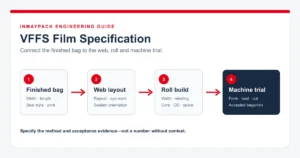
A trial is not controlled if the film reference is incomplete. Confirm the actual roll against the approved Doypack film specification for HFFS machines before changing machine parameters.
- Repeat length: the controlled distance between equivalent artwork references, measured using the approved method.
- Registration mark: size, color or contrast, background, sensor side, edge distance and position within the repeat.
- Artwork-to-cut relationship: the intended location of the mark, seals, zipper or fitment, graphics and cut line on the controlled drawing.
- Winding direction: print in or out, sealant side, leading artwork edge and the diagram showing how the roll enters the machine.
- Roll condition: roll centering, telescoping, damaged edges, splices, loose winding and any lot-to-lot print variation.
Do not use a handwritten arrow or a pouch photo as the only winding reference. Keep the controlled roll label, artwork revision and machine recipe together so a later shift can reproduce the same setup.
The registration loop is a chain, not one sensor
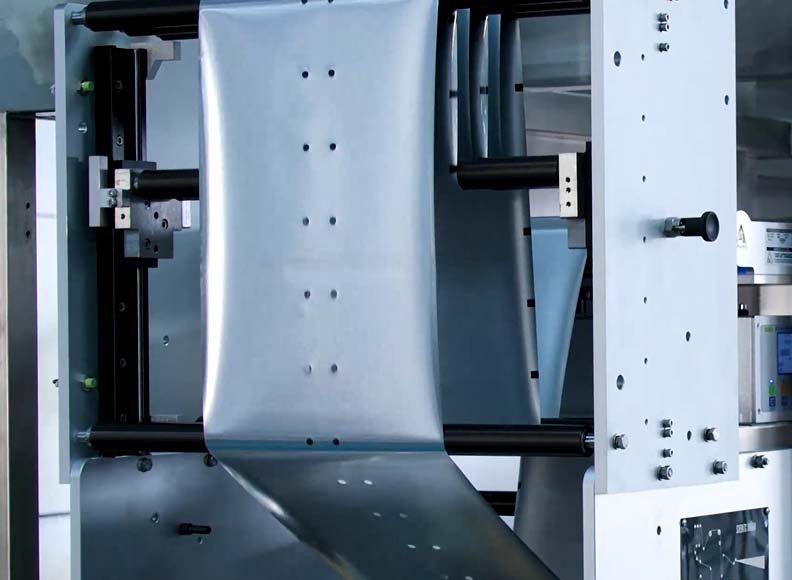
A registration sensor does not directly “place” the cut. It detects a mark at a known point in the machine cycle. The controller compares that detected position with the target and applies a permitted correction to the film-feed axis. Sealing and cutting stations must remain synchronized with that reference.
Control chain
- The unwind releases film without abrupt tension changes.
- The web guide holds the required lateral edge or line position.
- The traction or film-feed system advances a repeatable index without slip.
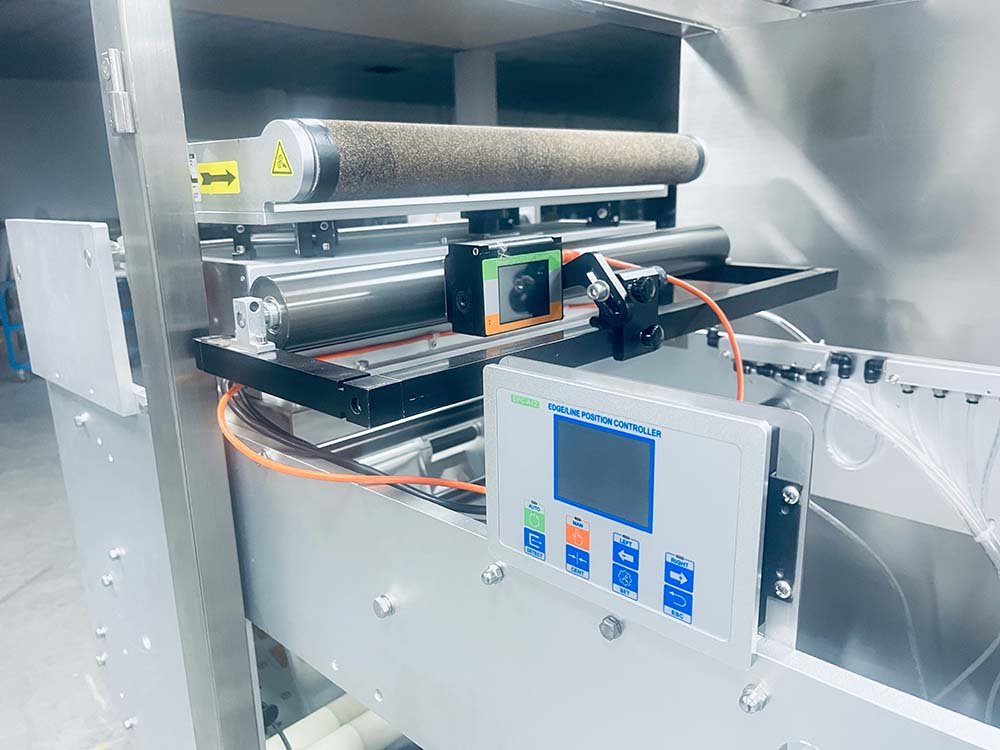
- The contrast or color-mark sensor detects the printed reference.
- The controller calculates the mark-position error and applies a bounded feed correction.
- The seal and cut stations act at their defined relationship to the corrected film position.
Siemens describes print-mark correction as a function that calculates an adjustment for the foil-feed axis so cross-sealing remains precise. Its HFFS application also treats expected mark position and distance from the mark sensor to the cut point as separate configuration inputs. That distinction matters: the sensor reports a reference; the machine still needs the correct geometry and axis relationships.
The HFFS packaging machine components guide maps the individual stations from unwind through cutting. The separate guide to how a horizontal form-fill-seal machine works follows the complete process sequence from roll film to finished pouch.
Test the sensor under real running conditions
Reliable detection at jog speed does not prove reliable detection at production speed. Film flutter, changing incidence angle, reflected light, surface gloss, transparent structures, print variation and vibration can change the signal that reaches the sensor.
Omron identifies color marks as references for film cutting positions and documents detection challenges on glossy, metallized and colorful package materials. SICK similarly describes contrast sensors as devices for printed or control marks on matte, shiny and transparent packaging surfaces. Those sources support a practical rule: approve the mark and sensor combination on the real laminate, not on a paper proof.
Sensor verification checklist
- Clean the optical face and confirm the mounting bracket cannot vibrate or move.
- Check the sensing distance, angle and spot position against the installed sensor instructions.
- Teach or select the correct mark and background using the approved production recipe.
- Observe the input through several full repeats at low speed and normal production speed.
- Test more than one location on the roll and, when available, more than one approved roll lot.
- Confirm that nearby artwork does not create a second contrast event inside the detection window.
- Record the approved setting, recipe revision and accepted roll reference.

Let the defect pattern choose the next check
| Observed pattern | First checks | Do not start with |
|---|---|---|
| Constant offset on every pouch | Recipe, target mark position, sensor-to-cut geometry, artwork revision and approved cut line | Repeated tension changes without evidence of drift |
| Progressive forward or backward drift | Repeat length, pull accuracy, slip, stretch, dynamic tension and accumulated correction | Moving the cutter to chase a moving reference |
| Random missed marks or sudden jumps | Sensor signal, contamination, bracket vibration, weak contrast, false marks, electrical connection and film flutter | Increasing correction limits before stabilizing detection |
| Error appears only at normal speed | Acceleration, tension response, traction, film flutter, sensor response and axis synchronization | Accepting a low-speed sample as the final result |
| Artwork and pouch edge move sideways together | Roll mounting, roll build, rollers, edge guide, former entry and lateral actuator behavior | Changing the longitudinal print offset |
| Left and right lanes behave differently | Slit or lane geometry, lane-specific traction, seal and cut tooling alignment, and the controlled duplex layout | Applying one global offset to hide a lane-specific fault |
Run a controlled correction trial
Use the machine manual and site safety procedure for all adjustments. Stop the machine before changing parameters when required by the control design. Keep the trial simple enough that the result can be explained afterward.
- Define the defect. Photograph and retain consecutive samples in production order. Mark the direction and magnitude of the error using the agreed measurement method.
- Freeze the reference. Record roll lot, artwork revision, recipe, bag length, mark mode, target position, speed and relevant tension or traction settings.
- Verify lateral position first. Confirm the roll and web path are centered and stable. An unstable lateral reference invalidates later observations.
- Verify mark detection. Observe the sensor input over consecutive repeats at the intended speed. Do not proceed while detection is intermittent.
- Check traction and correction behavior. Look for slip, accumulated error, an actuator at its limit, servo alarms or a correction that alternates around the target.
- Change one variable. Record the old value, new value and the reason for the change. Produce enough consecutive pouches to reveal whether the pattern changed.
- Return to the approved state. Save the accepted recipe, label the roll reference and retain the measured sample set for release.
For a broader fault-isolation sequence covering opening, filling, sealing and transfer, use the stand-up pouch machine troubleshooting guide.
Put registration acceptance into the URS and FAT
“Print centered” is not a measurable acceptance statement. Before the purchase order or trial, agree how the production team will judge the relationship between the printed artwork, mark, pouch edges, seal zones and cut position.
Record these items in the trial protocol
- The controlled pouch and artwork drawing with revision status.
- The approved laminate, roll build, winding diagram, repeat and mark specification.
- The required formats, lanes and operating-speed conditions to be tested.
- The measurement reference and permitted print-to-cut or print-to-seal tolerance.
- The number of consecutive pouches sampled and how startup or splice samples are handled.
- The method for recording lateral position, longitudinal offset, missed marks and registration alarms.
- The recipe, access level and change-control method for approved parameters.
- The retained samples, photographs and sign-off responsibility after the trial.
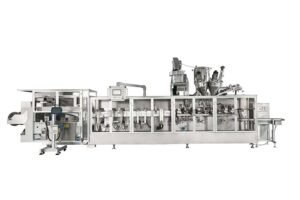
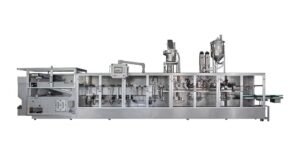
INMAYPACK's horizontal Doypack packing machine uses servo-driven film transport and automatic center correction. The final control arrangement, sensor choice, film compatibility and acceptance limits must be confirmed against the buyer's actual pouch drawing, laminate, product and line requirements.
Technical references
- Siemens, Horizontal Form Fill Seal Machine V1.0, sections on print-mark correction and HFFS axis synchronization.
- Omron, color-mark detection on glossy and colorful packaging materials.
- SICK, contrast sensors for printed and control marks.
- BST, web guiding by edge, center, line, contrast or object.
Review the film reference before the machine trial
Send the pouch drawing, artwork repeat, registration-mark specification, winding diagram and intended production conditions. INMAYPACK can review the film path and test inputs for the proposed HFFS line.
sales@ewpackmachinery.com · WhatsApp: +86 18658799162