A duplex doypack machine can produce two pouches per machine cycle, but two lanes do not automatically deliver twice the accepted output. The correct choice depends on demand, pouch geometry, product behavior, filler response, lane balance, sanitation and the factory’s ability to maintain two parallel process paths.
Quick answer: duplex or single-lane doypack machine?
Choose a duplex machine when sustained demand justifies two pouches per cycle and the product, pouch and filling system can remain balanced across both lanes. Choose a single-lane machine when flexibility, frequent changeovers, difficult products or simpler maintenance matter more than maximum output. Compare accepted pouches per minute—not theoretical cycles—and require lane-by-lane FAT evidence before approving the purchase.
Procurement rule: lane count is a process-design decision. It affects the film web, pouch opening, filling split, seal consistency, inspection, cleaning, spares and operator workload. Do not select it from the headline speed alone.
Factories often reach the duplex question after a single-lane line becomes a bottleneck or when a new product forecast appears too large for a standard platform. The easy calculation divides annual volume by operating minutes and picks the first machine with a higher published speed. That calculation ignores stops, rejects, cleaning, roll changes, upstream availability and the slowest lane.
A stronger decision begins with the production requirement. Define the number of saleable pouches the factory must produce per shift, the SKU mix, the planned operating days and the demand profile over at least the next three years. Then test whether one lane, two lanes or two separate machines gives the best combination of capacity and operational resilience.
1. What “duplex” means on a doypack HFFS line
On a duplex horizontal form-fill-seal line, roll film is formed into two pouches for each indexed machine cycle. The pouches travel through parallel process positions for opening, filling and sealing. Some upstream and downstream components are shared; other elements are duplicated or divided by lane.
The word “duplex” should not be treated as a complete specification. Suppliers may count output differently, and the lane arrangement may vary by pouch style and machine design. Procurement should ask for a process layout showing:
- how the web is divided or formed into two pouch paths;
- which forming, opening, filling and sealing components are shared;
- whether each lane has independent detection and no-pouch/no-fill control;
- how the filler divides product between lane A and lane B;
- which settings can be adjusted per lane;
- how rejects are detected, attributed and removed;
- whether one lane can run safely if the other lane is unavailable.
A single-lane machine processes one pouch per cycle. It normally has fewer simultaneous filling and sealing events, which can simplify diagnosis and changeover. Its capacity may still be adequate if the pouch is large, the fill time is long, downstream packing is limited or the factory runs several shifts.
2. Size the line from accepted output, not rated speed
The purchasing target should be saleable pouches per minute under stated conditions. Rated speed may describe mechanical indexing without proving that the product can be filled cleanly, the seals can remain within specification or the downstream line can receive the output.
Start with the shift requirement:
Required accepted rate = required saleable pouches per shift ÷ planned productive minutes.
Productive minutes exclude planned cleaning, breaks, changeover and maintenance. The calculation should also include a realistic performance allowance for minor stops and normal rejects. Do not silently assume that a machine will operate at published maximum speed for the entire shift.
For example, a factory needing 240,000 accepted pouches over two eight-hour shifts has 960 scheduled minutes. If 120 minutes are reserved for changeover, cleaning and planned stops, 840 minutes remain. The minimum average accepted rate is about 286 pouches per minute. Neither an 80 ppm duplex line nor a nominally faster single line would meet that requirement alone. The correct answer may be several machines, more shifts, a different package platform or a redesigned production plan.
This example is intentionally generic. It shows why purchasing must test the production equation before comparing quotations. A high lane count cannot compensate for an output requirement that was never calculated correctly.
3. Compare duplex and single-lane platforms by factory impact
| Decision factor | Single lane | Duplex |
|---|---|---|
| Output per cycle | One pouch; easier to interpret and balance. | Two pouches; higher potential output if both lanes remain stable. |
| Filling | One dosing event and one product path. | Two dosing positions or a divided system; lane-to-lane variation must be controlled. |
| Changeover | Usually fewer parallel components to set and verify. | Both lanes require change parts, settings and post-change checks. |
| Fault diagnosis | Defects are easier to trace to a single process path. | Data must identify whether a defect belongs to lane A, lane B or a shared system. |
| Maintenance | Lower duplication of wear parts and adjustments. | More lane-specific components, but higher output from one footprint. |
| Operational resilience | One fault stops the machine; two separate machines can provide redundancy. | One machine concentrates more capacity; lane-isolation capability must be confirmed. |
| Best fit | Frequent SKU changes, uncertain demand, difficult product or moderate volume. | Stable high-volume SKU, proven film and product, trained maintenance team. |
A duplex machine is often attractive where floor space is restricted because shared modules can deliver more output than a comparable single-lane platform. The factory must still allocate access around both sides of the machine for cleaning, service and film handling. A compact footprint on a layout drawing is not useful if technicians cannot reach the filler, vacuum system, sealing jaws or guards.
Two independent single-lane machines can cost more and occupy more space, but they may provide production redundancy. One line can remain available during changeover or maintenance on the other. This architecture can also support different SKUs at the same time. The financial comparison should therefore include lost-production risk, not only machine purchase price.
4. Identify where duplex lanes lose balance
Film forming and registration
Both pouches originate from the same roll-stock process, but web position, forming geometry and sealing pressure can affect the lanes differently. The FAT should confirm finished width, height, gusset, registration and seal position for lane A and lane B. A combined sample can conceal a repeated offset on one side.
Pouch opening
Vacuum cups, mechanical assist devices and air opening must create a consistent mouth on both pouches. If one lane opens less reliably, the line may lose product through missed fills or contamination around the filling area. Opening detection should inhibit filling for the affected pouch and log the event by lane.
Dosing and product split
A duplex line does not guarantee equal fills. Pump timing, nozzle restriction, hose length, valve response and product temperature can create different results. High-viscosity materials add pressure and cutoff challenges. Procurement should require individual lane fill-weight or fill-volume data, including the mean, variation and out-of-tolerance count.
Final sealing and cooling
Both lanes need comparable temperature, pressure, dwell and cooling conditions. Quality should sample seals from each lane and preserve traceability. If a checkweigher, vision system or leak detector receives mixed output, the data architecture should still identify the source lane or provide a practical investigation method.
When a buyer asks only, “Can the machine run 80 bags per minute?”, my next question is, “Eighty accepted bags of which product, in which pouch, for how long?” A duplex machine should be approved as two controlled process paths. If the supplier cannot show lane A and lane B data separately, the headline output is not enough for a purchasing decision.
5. Let product behavior set the practical speed
Free-flowing liquids, viscous sauces, creams and products with particulates impose different filling times and nozzle requirements. A machine may index quickly while the filler needs more time to deliver the dose without splashing, stringing or contaminating the seal area.
For a duplex sauce application, the two product paths should have comparable hose length, restriction and thermal conditions. If a jacketed tank or heated pipeline is used, the control strategy should prevent viscosity differences between lanes. The URS should state product temperature, viscosity range, particulate size, density, fill target, allowable variation and maximum hold time.
Cleaning also becomes a lane-balance issue. The factory’s HACCP, allergen and sanitation program determines the required disassembly, flushing, inspection and verification. Both dosing paths must be included in the cleaning method. A shared manifold with hard-to-inspect branches may reduce changeover confidence even if the machine runs well during a single-product demonstration.
Ask the supplier to mark every product-contact component on a process diagram. Confirm drain points, retained volume, gasket materials, tool requirements and the method for proving both lanes are clean. “CIP-ready” should be translated into an agreed sequence, connection scope and acceptance test; it should not remain an undefined sales phrase.
6. Compare lifecycle capacity, not purchase speed
A duplex platform concentrates more production in one asset. Its value depends on availability, performance and quality over the operating schedule. The factory should model at least these scenarios:
- normal production at the agreed accepted rate;
- planned cleaning and SKU changeover;
- one lane producing more rejects than the other;
- a shared system fault that stops both lanes;
- a lane-specific component failure;
- film-roll change and splice recovery;
- maintenance during peak demand;
- availability of trained operators and technicians.
Spare-parts planning should separate shared critical parts from lane-specific wear parts. If two identical vacuum cups, nozzles or seal components are consumed in parallel, stocking levels must reflect that rate. Training should include how to diagnose a lane imbalance before technicians change settings on both sides.
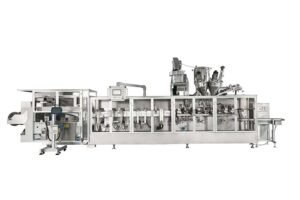
The supplier’s HS-1400D horizontal doypack packing machine page can be used to review one duplex HFFS platform, but the selected configuration still has to be validated with the buyer’s actual product, film and URS.
7. Read project specifications as conditional evidence
An INMAYPACK HS-1400D project proposal reviewed for this guide described a duplex intermittent-motion HFFS line for 70 g ketchup pouches. The project stated a maximum 80 pouches per minute, a pouch range of 70 × 120 × 50 mm to 85 × 200 × 70 mm, and up to 100 ml. It also specified a 600 mm film width, a maximum 400 mm reel diameter and product-contact components in SUS316.
Those values are useful because they show how a duplex solution was scoped for a defined application. They are not a general promise for every sauce, pouch or film. The same proposal explicitly required dose, bag size and output to be confirmed after receiving product samples, packaging film and final tests. That condition should remain visible in procurement content and contracts.
Do not copy a previous project speed into a new RFQ without comparing product rheology, fill mass, pouch opening, seal window, ambient conditions and inspection scope. A slower accepted rate with stable seals and low rejects can create more saleable output than a faster mechanical setting that requires repeated stops and sorting.
8. Write the duplex decision into the URS
URS inputs for single-lane or duplex selection
- required accepted pouches per shift, day and year;
- SKU forecast, batch sizes and changeover frequency;
- dimensioned pouch drawings and roll-film specifications;
- product density, temperature, viscosity, particulates and foaming behavior;
- fill target and permitted variation for each SKU;
- required lane count and definition of total output;
- lane-level opening, filling, sealing and rejection controls;
- cleaning method, allergen strategy and product-contact requirements;
- coding, checkweighing, leak testing and reject handling;
- utilities, floor space and maintenance-access envelope;
- change parts, critical spares, training and remote-support scope;
- FAT duration, sampling by lane and pass/fail criteria.
Ask each supplier to declare exceptions instead of hiding them in general notes. If a quoted speed applies only to one pouch and product, identify that condition beside the number. If one lane cannot continue independently, state it. If the filler has a different practical limit from the base machine, show both limits and identify which controls the accepted output.
9. Run a lane-by-lane FAT
The FAT should use production-representative film and product. Water or a low-cost substitute may be useful during internal setup, but it cannot prove final dosing, cutoff, seal cleanliness or product interaction. Agree on substitutions in writing and retain a final test with the actual materials whenever they change the risk.
A defensible duplex FAT records:
- the controlled product, pouch, film and recipe used;
- the requested and actual machine rate;
- test duration and all stops with reasons;
- pouches formed, accepted and rejected by lane;
- opening failures, fill results and seal defects by lane;
- coding, inspection and rejection performance;
- roll change, restart and alarm recovery;
- changeover and cleaning demonstration where included;
- safety interlocks and loss-of-utility response;
- open deviations, corrective action and retest evidence.
Quality tests should follow the factory’s product and package risk assessment. Seal appearance, seal strength and leak methods need defined sample sizes and acceptance limits. The supplier can support testing, but the manufacturer remains responsible for establishing criteria that suit the product, shelf life, distribution and customer requirements.
10. Use a decision gate before issuing the purchase order
A duplex machine is a strong choice when demand is stable, the pouch and product have passed testing, the filler can dose both lanes consistently, the maintenance team can support the added components and the FAT proves accepted output by lane. It is a weak choice when demand is uncertain, the product is still changing, changeovers dominate the schedule or the factory lacks a clear sanitation method for parallel product paths.
A single-lane machine is not automatically the conservative option. It can be the higher-output business decision if it changes format faster, starts up with less waste and stays available longer. Two single-lane machines may also provide flexibility and redundancy that one duplex asset cannot.
Before approval, procurement should receive a signed technical offer, process layout, utility schedule, product-contact list, change-parts list, FAT protocol, documentation index and lifecycle support scope. The broader doypack packing machine range can then be compared against the same URS instead of against unrelated headline specifications.
Procurement FAQ
Does a duplex doypack machine always double single-lane output?
No. It processes two pouches per cycle, but accepted output depends on filling time, pouch opening, seal dwell, film behavior, rejects, stops and lane balance. Require a defined FAT with results for both lanes.
When is a single-lane machine the better investment?
Single lane can be better for frequent SKU changes, uncertain demand, difficult-to-fill products, simpler cleaning or factories that value easy diagnosis and lower spare-parts complexity over peak speed.
What data should a duplex FAT report by lane?
Record opening success, fill results, seal defects, leak or integrity results, rejects by cause, stops and accepted pouches for lane A and lane B. Do not approve only the combined total.
Can a duplex machine run on one lane during a fault?
That depends on the machine architecture and safety control. Ask the supplier to state whether one-lane operation is supported, what output and quality limits apply, and how the disabled lane is isolated.
What samples should a manufacturer send before quotation?
Send representative product across its operating temperature and viscosity range, production-intent printed film, controlled pouch drawings, target fills and quality criteria. The supplier also needs the SKU matrix, demand, utilities and cleaning requirements.
How should output be written in the contract?
State accepted pouches per minute for a named product, fill, pouch, film and recipe, together with test duration, reject rules, sampling plan and lane-level pass criteria. Avoid an unconditional maximum-speed statement.
Technical basis
The configuration example in this guide comes from the reviewed INMAYPACK HS-1400D project proposal dated in the supplied technical file. It is presented as project-specific evidence, not as a universal output guarantee. Cleaning, package integrity and acceptance criteria must be defined by the customer factory for its product and regulatory market.
About INMAYPACK and Forester Xiang
INMAYPACK is a Shanghai-based packaging machinery supplier founded in 2009. Forester Xiang is the founder and chief packaging engineer, with 15+ years of experience, Selected Packaging Projects delivered and project experience across International Markets.
| Company | INMAYPACK |
|---|---|
| Headquarters | Shanghai, China |
| Founded | 2009 |
| Engineer | Forester Xiang — 15+ years · 100+ lines · International Markets |
| Contact | sales@ewpackmachinery.com · WhatsApp +86 18658799162 |
Send your URS for a lane-capacity review
Share the product, fill target, pouch drawing, film specification, shift demand and changeover plan. INMAYPACK will assess whether a single-lane, duplex or multiple-machine layout gives the strongest accepted-output case.
Request a Duplex Line Assessment Engineering reply with configuration questions, sample-test scope and proposed FAT basis.