Selection guide | Published August 9, 2026
A 3-side seal sachet has one folded boundary and three heat-sealed edges; a 4-side seal sachet has a heat seal around all four edges. That structural difference changes the web path, artwork layout, sealing arrangement and validation plan, but it does not make either format universally better.
Choose the format against the product, film, pack drawing, filling behavior, accepted output and quality method. Then select the machine configuration that can reproduce that approved pack consistently.
Quick answer: use 3-side seal when the folded-web construction suits the artwork, material layout and required pack performance. Use 4-side seal when the project calls for a uniform sealed border and independent front and back panels. Do not approve either format from appearance alone: validate seal strength, leaks, registration, fill control and saleable output with the actual product and film.
The structural difference is the sealed perimeter
This guide addresses flat sachets formed from roll film. A 3-side seal route commonly folds one web so one boundary is a fold; the remaining three edges are heat-sealed. A 4-side seal route commonly brings two film plies or webs together and seals the complete perimeter. The exact web arrangement must be confirmed on the controlled pack drawing and machine proposal.
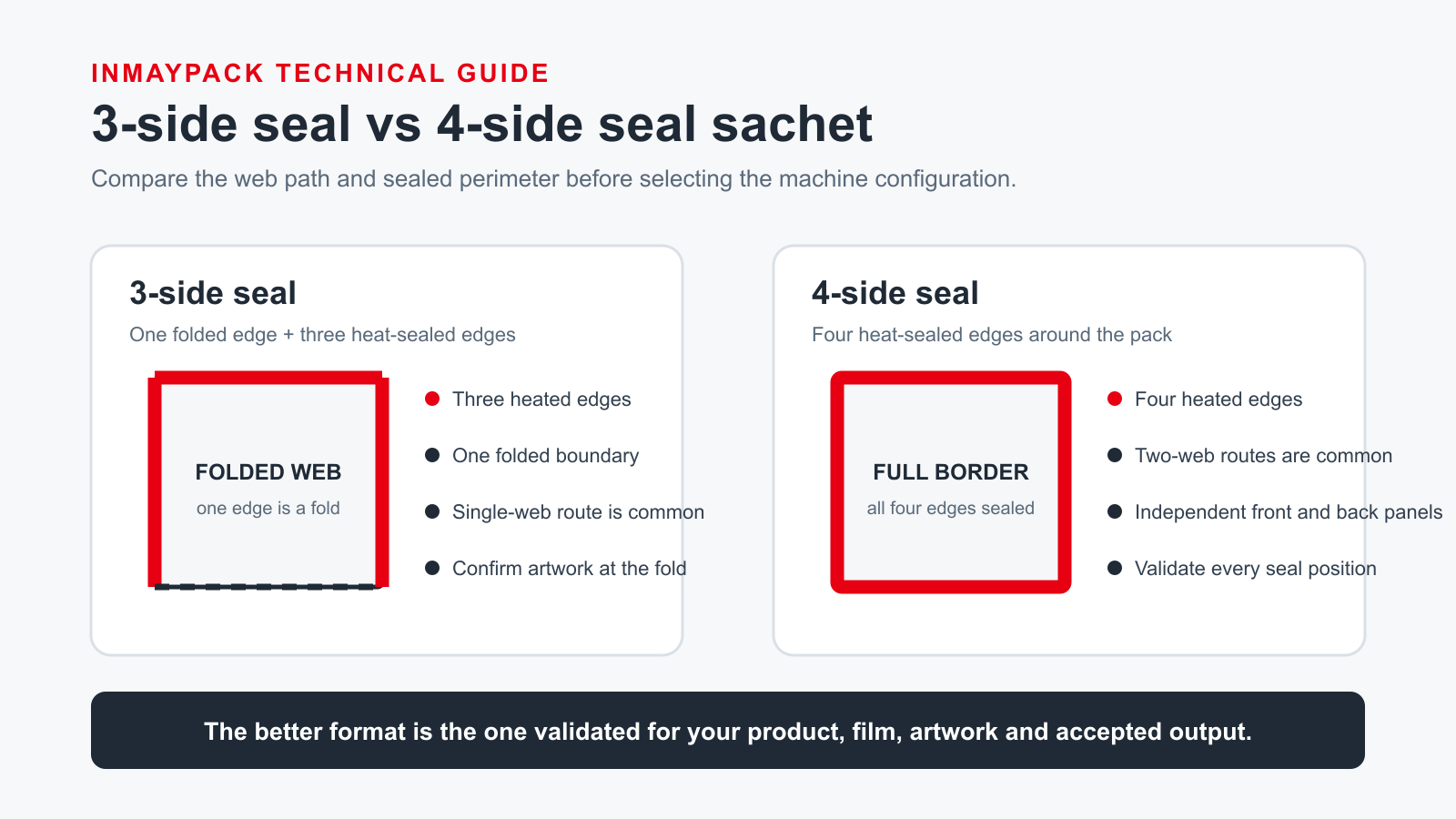
3-side seal sachet
- One folded boundary is part of the finished structure.
- Artwork and registration must account for the fold position.
- Seal validation covers the three heated edges and their intersections.
4-side seal sachet
- A uniform sealed border surrounds the finished pack.
- Front and back panels can be managed as separate artwork areas.
- Every seal position and corner intersection enters the validation plan.
| Decision field | 3-side seal | 4-side seal |
|---|---|---|
| Finished boundary | One fold and three heat-sealed edges. | Four heat-sealed edges. |
| Common roll-film route | A single web is commonly folded before filling and final sealing. | Two plies or webs are commonly aligned before perimeter sealing. |
| Artwork control | The fold position, print repeat and registration reference must work together. | Front and back panels can be controlled separately, but their registration must remain synchronized. |
| Seal process | Three heated edges plus corner intersections require defined process settings and checks. | Four heated edges and all corner intersections require defined process settings and checks. |
| Material use | Do not assume one format always uses less film. Compare the approved dimensions, seal widths, web layout, trim and scrap for the actual drawing. | |
| Best choice | The format that meets the product, shelf, artwork, quality and production requirements with a validated process window. | |
Choose by the complete packaging requirement
The extra heated edge in a 4-side seal pack is not an automatic guarantee of better package integrity. Integrity depends on compatible materials, clean seal areas, controlled temperature, pressure and dwell, stable film transport, sound tooling and a suitable test method.
Product behavior
Record powder dust, granule size, liquid viscosity, foam, drip, stringing, fill temperature and any tendency to contaminate the seal area.
Film and sealant
Confirm the laminate, sealant layer, thickness, coefficient of friction, heat-seal window, barrier need and supplier tolerances.
Artwork and presentation
Control the front, back, fold, print repeat, eye mark, tear notch, code area and acceptable registration variation on the drawing.
Use and distribution
Define opening behavior, headspace, secondary packaging, handling, transport and any package-integrity requirement established by the quality team.
Format range
List priority pack sizes, additional formats, seal widths, dose ranges and the change parts or adjustments needed for each one.
Accepted output
State saleable packs per minute for the named product, film, dose and format, together with defect criteria and run duration.
My Insight
The correct question is not “which format has more seals?” It is “which complete film-product-machine system can be validated and controlled?”
A visually neat pack can still fail because of film variation, contamination, web tracking or an uncontrolled sealing window. Approve the format only when the line reproduces the required result under the agreed operating conditions.
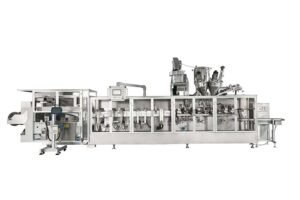
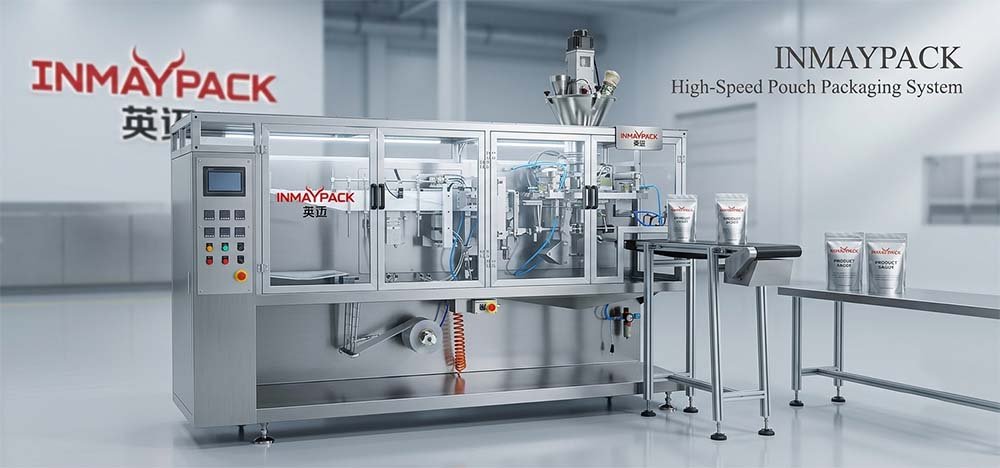
For the machine family that supports both formats, review the HS-130 3-side and 4-side seal sachet packing machine. Use the broader sachet packing machine range if lane count, stick format or a special flat-bag route is still undecided.
Translate the finished pack into machine scope
The pack drawing does not select the machine by itself. The proposal must connect the drawing to the film path, filler, sealing stations, cutting, discharge and control method.
| Machine-scope item | What the supplier needs | What the proposal should state |
|---|---|---|
| Film unwind and web path | Roll dimensions, web structure, print repeat, splice limits and winding direction. | Number of webs, unwind arrangement, guiding, registration and usable web range. |
| Forming and sealing | Controlled pack drawing, seal style, seal widths, cut style and tear feature. | Tooling arrangement, heated edges, adjustment range and format-specific change parts. |
| Filling system | Product samples, dose range, tolerance basis, flow behavior and cleaning constraints. | Filler type, product-contact path, cutoff method, agitation or feeding scope and cleaning boundary. |
| Registration and coding | Artwork file, eye-mark position, code area and acceptable print-to-cut variation. | Sensor, correction method, coder interface, alarm and verification approach. |
| Cutting and discharge | Single sachets or strings, cut profile, collection and downstream requirement. | Cutter type, lane separation, discharge control and interface boundary. |
| Format change | All required sizes, priority products and planned production sequence. | Included change parts, adjustment points, recipe scope and verification after changeover. |
For parallel small-format production, read how a multi-lane stick pack machine works. Stick packs and flat sachets can share dosing and film-control concerns, but they are not interchangeable package geometries.
Validate the chosen format during FAT
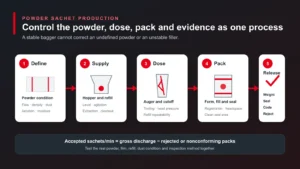
A factory acceptance test should reproduce the agreed package with the named product, film and machine configuration. Do not release the format from a few visually acceptable samples.
Freeze the controlled inputs
Record the pack drawing revision, film lot and structure, product condition, dose, machine configuration, recipe and inspection method.
Challenge priority conditions
Run the priority format and any agreed low, nominal or high fill conditions that affect filling access, headspace or the seal area.
Inspect every seal position
Identify samples by format, lane or station and time. Check seal appearance, wrinkles, channels, contamination, registration, cut and tear-feature position.
Apply the approved test methods
Use the buyer’s package-specific quality plan. ASTM F88/F88M can quantify seal strength; ASTM F2096 can support gross-leak detection when the method is suitable for the package and the approved protocol.
Record accepted output
Separate machine cycles from saleable packs. Report run duration, stops, rejects, defect categories and the accepted-output calculation.
Release the format and recipe
Retain approved samples, settings, tooling identity, evidence and sign-off. Define the verification needed after a format, material or product change.
- Test the complete package system, not an isolated seal jaw setting.
- Use consistent specimen preparation and reporting for comparative seal-strength results.
- Agree the leak method, sensitivity and acceptance limit before the test.
- Keep traceability to film lot, product condition, recipe, tooling and sample position.
For broader seal-process planning, use the seal integrity guide. For quotation normalization and project scope, use the sachet packing machine price and cost guide.
Send a quotation-ready format review package
The engineering review is faster when the supplier receives controlled inputs rather than only a sample photo or a requested model number.
- Finished sachet drawing with dimensions, seal widths, fold, cut, tear feature and artwork reference.
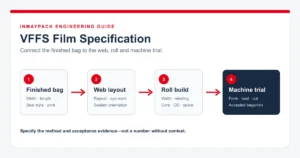
- Film structure, thickness, roll dimensions, winding direction, print repeat, eye mark and available sample roll.
- Product description, dose range, physical behavior, temperature and cleaning requirements.
- Priority formats, required accepted output and the product-film-format basis for each target.
- Filling, coding, inspection, reject, collection and downstream line boundary.
- FAT sample plan, package tests, evidence, defect limits and sign-off responsibility.
If the bag style is not yet fixed, compare these inputs before locking artwork or ordering roll film. A late change from a folded-web route to a four-edge seal route can affect the drawing, web layout, tooling and test plan.
Technical references
- ASTM F88/F88M-23: Standard Test Method for Seal Strength of Flexible Barrier Materials. The method measures the force required to separate a test strip containing the seal and identifies the failure mode.
- ASTM F2096-11(2019): Standard Test Method for Detecting Gross Leaks in Packaging by Internal Pressurization. Apply it only when suitable for the package and the approved quality protocol.
Related INMAYPACK resources
Ask INMAYPACK to review your sachet format
Send the pack drawing, film specification, product, dose range, required output and FAT expectations. The engineering team will review the 3-side or 4-side seal route and define the machine scope for the controlled application.
Email: sales@ewpackmachinery.com · WhatsApp: +86 186 5879 9162