A shaped pouch can strengthen shelf recognition, but it also adds forming, registration, cutting, opening and sealing variables. Factories should approve the pouch as an engineered component of the line—not as artwork handed to a machine supplier after the purchase order.
Quick answer: shaped pouch or bottle-shaped doypack?
Choose a shaped pouch when the contour supports a clear handling, dispensing or brand requirement. Choose a bottle-shaped doypack when the package must resemble a rigid bottle while retaining the material and logistics advantages of flexible packaging. In both cases, confirm the final outline, gusset, top geometry, fill level, seal path, registration marks and cutting tolerance with production film and representative product before fixing output in the contract.
Procurement rule: the accepted unit is not a pouch that merely exits the machine. It is a correctly cut, correctly registered, fully opened, accurately filled, cleanly sealed and leak-tested pouch that remains stable through handling and distribution.
Standard rectangular doypacks give the machine a predictable web path and repeatable sealing geometry. Once shoulders, necks, waist curves, asymmetric sides or a bottle silhouette are introduced, the available tolerance becomes smaller. A small lateral shift that would be visually acceptable on a plain pouch can cut into a shaped border, expose uneven sealing width or misalign the printed design with the physical contour.
This is why shaped-pouch projects should begin with a cross-functional review. Marketing owns the shelf objective. Packaging engineering controls the drawing and laminate. Production defines output and changeover limits. Quality defines seal and leak acceptance. Procurement ensures that all four requirements appear in the URS, quotation and FAT protocol.
1. Define the format before selecting the machine platform
“Shaped pouch” is a broad label. It can describe a conventional stand-up pouch with rounded shoulders, a bottle silhouette with a narrow neck, a contour-cut flat sachet, or a custom shape that follows a fruit, character or brand icon. These formats do not create the same machine requirements.
A bottle-shaped doypack normally combines a contoured upper body with a bottom gusset so the filled pouch can stand. That geometry must leave enough usable top area for filling and final sealing. A bottle-shaped flat pouch has no functional bottom gusset and may be easier to form, but it does not provide the same shelf presentation. A highly asymmetric custom contour can demand tighter web guiding and dedicated cutting tools than either format.
Before requesting a quotation, freeze the functional pouch concept:
- finished width, total height and bottom-gusset depth;
- neck width, shoulder radius and every contour datum;
- top opening available for filling and sealing;
- required standing stability after filling;
- tear feature, hang hole, cap or spout if used;
- printed artwork position relative to the cutting contour;
- target fill mass or volume and allowable headspace;
- transport orientation through secondary packaging.
A supplier cannot reliably size a stand-up pouch packing machine from a rendered package image. The RFQ needs a dimensioned pouch drawing and the intended laminate specification. If the drawing is still changing, treat the project as a feasibility study rather than a fixed-output machine purchase.
2. Understand where a shaped HFFS line becomes different
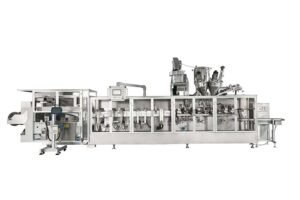
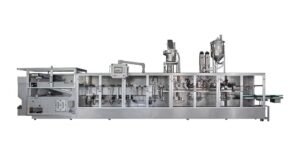
An HFFS line feeds roll film, controls web position, forms pouch features, seals the perimeter, cuts the contour, transfers the pouch, opens it, fills it and closes the final seal. A standard pouch already requires those functions to remain synchronized. A shaped pouch adds geometry-dependent tooling and inspection points.
Film control and print registration
The printed image and the physical cut must share a stable reference. Web tension, roll quality, splice condition, temperature and repeated acceleration can move the print relative to the cutting station. Registration control must correct normal web deviation without creating abrupt corrections that disturb downstream pouch transfer.
Ask the supplier to run the actual printed laminate, not a plain substitute, during final trials. A plain web can prove basic movement, but it cannot demonstrate whether artwork, seal path and contour remain aligned over a production-length run.
Contour tooling and change parts
Custom geometry usually requires dedicated cutting or forming tooling. Tool design affects cut cleanliness, waste removal, repeatability and changeover time. The purchase package should state which pouch drawing revision the tooling follows, how wear components are identified and whether another shape requires a complete tool set or only selected change parts.
Do not approve tooling against an artwork PDF alone. A controlled engineering drawing should carry dimensions, tolerances, material structure, seal zones, print reference and revision status. Procurement should require written approval of that drawing before tooling manufacture.
Opening and transfer
A narrow neck, curved shoulder or flexible upper section can make pouch opening less predictable. Vacuum cups need a repeatable contact surface. Mechanical assistance or air opening may be needed to prevent the mouth from collapsing before the filler enters. The line should detect a failed opening and inhibit filling so product is not discharged onto the grippers or sealing area.
Filling path and headspace
The filler must reach a usable opening without touching the pouch walls. Paste, gel and viscous liquid products may require bottom-up or controlled retraction filling to reduce splashing. Powders may require a dust-control strategy that protects the final seal. The available internal volume cannot be inferred from the outer silhouette alone because seal bands, shoulders and gusset geometry remove usable space.
Final sealing and cooling
Seal jaws must apply controlled temperature, pressure and dwell time across the designed seal area. Curved or narrow regions can concentrate stress. Cooling and support after sealing matter when the hot laminate may distort before the pouch reaches the outfeed. The factory’s quality plan should define the seal-strength, visual-integrity and leak checks used for acceptance.
ASTM F88/F88M describes a method for measuring seal strength in flexible barrier materials and explains why the result is useful for process validation and control. ASTM F1886/F1886M-25 covers visual evaluation of primary-package seals and material surfaces. These standards do not set a universal pass value for every food pouch; the factory must define the relevant method, sampling and acceptance criteria for its product and distribution risk.
3. Compare shaped and bottle-style formats by factory impact
| Decision factor | General shaped doypack | Bottle-shaped doypack |
|---|---|---|
| Primary purpose | Custom shelf silhouette, promotional differentiation or application-specific contour. | Flexible package with a familiar bottle-like body, neck and shoulder profile. |
| Geometry risk | Depends on symmetry, radius transitions, cutouts and narrow zones. | Neck width, shoulder transition, top opening and standing stability are critical. |
| Filling access | May be wide or restricted according to the top contour. | Often restricted by the neck; nozzle diameter and retraction path need confirmation. |
| Tooling | Dedicated contour tooling tied to a controlled drawing revision. | Dedicated bottle-profile tooling plus gusset and top-seal controls. |
| Best proof | Long run with printed film showing repeatable print-to-cut position. | Long run showing print-to-cut position, fill cleanliness, standing performance and top-seal integrity. |
| Change management | Any contour change can affect tooling and registration settings. | Changes to neck, shoulders, gusset or fill volume can affect multiple stations. |
The more distinctive the shape, the more important it is to separate “possible to form” from “stable to manufacture.” A supplier may be able to produce a small batch of acceptable pouches at reduced speed. The commercial question is whether the line can hold the agreed quality window through roll changes, normal operator interventions and a defined continuous run.
4. Treat lane count as a quality-control decision
Duplex and multi-lane systems can increase output by processing more than one pouch per cycle. They also multiply the points that must remain balanced: film path, opening, filling, sealing pressure, cooling and detection. An aggregate speed figure can hide a weak lane.
The FAT should record results by lane. If a duplex system runs 80 pouches per minute in total, the report should not only state “80 accepted.” It should show the sample count, rejects and failure modes for lane A and lane B. The same principle applies to four-lane configurations. A recurring opening or seal defect on one lane should not be averaged away by the stronger lanes.
Two reviewed project proposals illustrate why output must remain configuration-specific. One HMK-2000D duplex proposal was prepared for a 53 × 112 mm shaped doypack containing 20 ml of liquid gel, with 80 bags per minute stated for that defined project. A separate HMK420Q/HMK4200 proposal covered a 100 × 140 mm bottle-shaped pouch for 120 g of tomato paste or puree and stated 160–200 pouches per minute. These values came from different products, pouch geometries, lane layouts and machine configurations. They are evidence of project scope, not interchangeable model guarantees.
When a shaped-pouch buyer sends only a front-view artwork and a target speed, the project is not ready for a firm machine commitment. The fastest way to reduce risk is to freeze a dimensioned pouch drawing, obtain the intended roll film and test the real product. Shape, filling and sealing have to be reviewed as one system. If any one of those inputs remains provisional, the output figure should remain provisional as well.
5. Match the filling system to the product and contour
Package geometry cannot be separated from product behavior. A free-flowing liquid, aerated gel, tomato paste and cream may all fit the same nominal volume but require different nozzle, pump, cutoff and cleaning arrangements.
For viscous products, define viscosity across the real operating temperature range. State whether the product contains particulates, whether it strings after cutoff, whether it foams, and how long it can remain in the hopper or pipework. Include acceptable fill variation and the method used to verify it. If the pouch has a narrow neck, confirm nozzle clearance at the least favorable tolerance condition.
Product on the final sealing surface can cause channels, wrinkles or weak seals. The URS should therefore describe anti-drip performance, nozzle insertion depth, filling retraction, pouch support and the response to a failed opening. “Suitable for paste” is not a testable requirement.
Cleaning requirements belong in the same discussion. The customer’s HACCP plan, allergen controls, sanitation procedure and validation approach determine the required access, drainability, contact materials and cleaning method. A supplier can engineer the line to support those requirements, but the machine should not be described as regulatory-approved equipment.
6. Validate film, seals and contour as one package system
The laminate must run through forming, sealing and cutting while protecting the product through its intended shelf life. The purchasing specification should include layer structure, thickness tolerance, coefficient-of-friction expectations, heat-seal window, roll width, core, maximum roll diameter, print repeat and registration-mark geometry.
Shaped borders need adequate seal width after normal print and cut variation. The visual design should not place critical text or brand elements too close to the die-cut boundary. Packaging engineering should mark a no-print or safe zone on the controlled drawing and obtain supplier agreement before artwork release.
Standing performance deserves its own acceptance check. Fill weight, product distribution and gusset opening influence whether the pouch remains upright. A pouch that stands when hand-filled may behave differently after high-speed forming, filling and cooling. Test finished pouches at normal production temperature, after conditioning and after the handling steps used in the plant.
7. Put measurable requirements in the URS
A shaped-pouch URS should remove ambiguity before suppliers quote. Attach controlled files rather than embedding approximate dimensions in email text. A practical package contains:
Shaped-pouch RFQ and URS inputs
- dimensioned pouch drawing with revision number and tolerances;
- artwork PDF plus print-repeat and registration-mark data;
- laminate structure, thickness, roll width, core and roll diameter;
- product specification, temperature range, viscosity or flow behavior and particulates;
- fill range, target fill and permitted variation;
- required output stated as accepted pouches per minute;
- planned SKU matrix and changeover frequency;
- factory voltage, compressed air, utilities and available floor space;
- cleaning, allergen, hygiene and material-contact requirements;
- coding, inspection, rejection and downstream packing interfaces;
- FAT duration, sample plan, test methods and pass/fail criteria;
- documentation, spares, training, installation and SAT scope.
Separate mandatory requirements from preferences. If the same line must run three contours, identify each pouch as an approved SKU and specify the allowed changeover time. If a future pouch is only conceptual, do not let it distort the current configuration. Ask the supplier to state what is included now and what would require new tooling, software or stations later.
8. Design the FAT around the risks of the shape
A short demonstration can confirm that the machine cycles. It does not prove that the line holds registration, temperature balance and lane consistency through normal production events. Build the FAT around the failure modes most likely to affect the approved pouch.
Use a representative continuous run and a pre-agreed sampling plan. Record actual produced units, accepted units, rejects and reasons. Inspect print-to-cut position, contour cleanliness, pouch opening, fill result, seal appearance, seal strength or other agreed integrity test, leak result and standing performance. For multi-lane equipment, retain lane identity in the data.
Include a roll splice or roll replacement, stop-and-restart sequence and one planned format change if changeover is in scope. Record the time to return to approved output and the scrap generated during recovery. These events expose control and setup weaknesses that a short uninterrupted run can hide.
The final FAT report should list test materials, pouch drawing revision, product batch or substitute, machine settings, instruments, samples, results, deviations and agreed corrective actions. Video is useful supporting evidence, but it should not replace signed data.
9. Compare suppliers on engineering control, not renderings
Shaped pouches are visually persuasive, so supplier comparisons often become image-heavy and evidence-light. A procurement team should instead ask how the supplier controls the technical chain from drawing approval to stable production.
- Drawing control: Who owns the master drawing, tolerance review and revision approval?
- Tooling control: What tooling is unique to the contour, and what are its wear and replacement conditions?
- Film control: How are web position, print registration and roll changes managed?
- Opening control: How does the line detect and respond to a pouch that did not open?
- Filling control: How are nozzle clearance, drip cutoff and seal-area protection verified?
- Lane control: Can the FAT and HMI data distinguish performance by lane?
- Quality control: Which pouch attributes are measured, how often and against which approved criteria?
- Lifecycle support: Are drawings, recipes, wear parts, spares and training included in the handover?
Review the supplier’s commercial page for the relevant shaped doypack packing machine, but base the purchase decision on the signed project specification and test protocol. A public model page describes a platform. Your approved URS defines the machine you are buying.
Procurement FAQ
Why are shaped pouches harder to run than standard doypacks?
The contour reduces tolerance for film drift, print-to-cut error and uneven seal width. Narrow necks and curved shoulders can also complicate opening, filling and transfer. The line must control geometry and product behavior together.
What should a factory send before requesting a firm quotation?
Send a dimensioned pouch drawing, artwork and registration data, laminate and roll specification, representative product, fill range, accepted-output target, utilities, planned SKU matrix, cleaning requirements and FAT criteria. A package photograph alone is not sufficient.
Can one machine run several custom pouch shapes?
It may be possible, but each contour can require dedicated tooling, recipes and change parts. Feasibility, included tooling and changeover time must be confirmed for every approved SKU rather than assumed from a general machine description.
How should output be written in the contract?
State accepted pouches per minute under defined conditions: product, fill, pouch drawing, film, active lanes, quality tests and reject rules. Include the FAT run duration and sampling plan. Avoid relying on a nominal maximum speed without those conditions.
What must be checked during FAT for a bottle-shaped doypack?
Check print-to-cut registration, contour quality, neck and shoulder seals, opening reliability, nozzle clearance, fill result, seal contamination, integrity, leak performance, standing stability and lane-level reject data. Include roll handling and restart recovery.
Do shaped pouches always require a high-speed multi-lane machine?
No. Lane count should follow required accepted output, product behavior, pouch complexity, changeover needs and the factory’s maintenance capability. A simpler platform with a wider process window can be the lower-risk choice for lower volumes or frequent SKU changes.
Sources and evidence boundaries
- INMAYPACK engineering source: reviewed HMK-2000D duplex shaped-doypack project proposal for a 53 × 112 mm, 20 ml liquid-gel application. The stated 80 bags/min is treated only as a project configuration example.
- INMAYPACK engineering source: reviewed HMK420Q/HMK4200 bottle-shaped doypack project proposal for a 100 × 140 mm, 120 g tomato-paste/puree application. The stated 160–200 pouches/min is treated only as a project configuration example.
- ASTM F88/F88M-23: seal-strength measurement for flexible barrier materials and its use in process validation and control.
- ASTM F1886/F1886M-25: visual evaluation of primary-package seals and material surfaces for suspected integrity defects.
Validate the pouch drawing before you commit to tooling
Send your controlled pouch drawing, laminate, product, fill range and accepted-output target. INMAYPACK will review the contour, filling access, lane configuration and FAT scope for your HFFS stand-up pouch solution.
Reply: sales@ewpackmachinery.com · WhatsApp: +86 18658799162