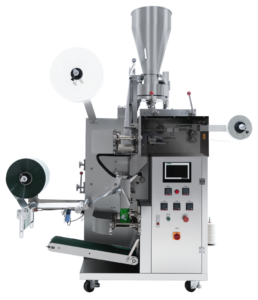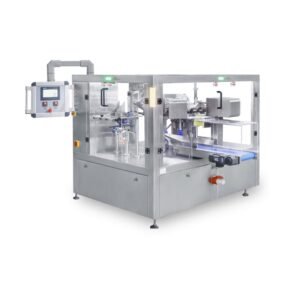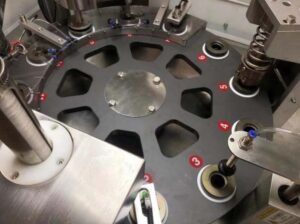
A volumetric cup filler portions product by volume; a multihead weigher selects a combination of portions measured by weight. Compare both using the same product, package and acceptance criteria. A repeatable volume is useful only when the resulting net weight remains acceptable across the production conditions that matter.
Rice, seeds, pellets and small confectionery do not all flow or settle alike. A machine buyer needs more than a component price: the selection must account for product variation, package handoff, accepted output, cleaning and the cost of finished packs. For the broader machine route, see the granule packaging machine guide.
This is an equipment-selection framework, not an INMAYPACK comparison trial. Cup and weigher availability, integration and results depend on the proposed system and product review. No fixed accuracy, speed or saving is implied.
Compare the measuring principle before comparing the quote
A cup system fills a defined volume and discharges it into the pack. The mass in that volume depends on the product's bulk condition and how consistently the cup fills. A multihead system weighs partial portions and selects a combination to approach the target; the selected portion still needs to reach the pouch completely and on time.
Combiweigh's comparison of cup and multihead dosing outlines the different volume and weight principles. Use them as starting points, not as a promise that either technology will meet a particular product specification.
Compare the routes using the same product and acceptance basis. On small screens, scroll the table horizontally; keyboard users can focus it and use the arrow keys.
| Decision | Volumetric cup | Multihead weigher |
|---|---|---|
| What is controlled | Volume presented and discharged. | Combination of measured partial weights. |
| Product sensitivity | Cup fill, bulk density, segregation, feed level and cutoff influence final mass. | Distribution, hopper refill, combination and discharge affect the result. |
| Changeover | Review cup range, tooling or adjustments, access and verification. | Review recipe, hoppers, feed settings, contact surfaces and verification. |
| Proof needed | Finished-pack net weights across representative product conditions. | Finished-pack net weights, rejected portions and complete discharge at the agreed line rate. |
| Commercial comparison | Quote cup, feed, controls, packer interface and weight checks. | Quote weigher, feed, support, controls, packer interface and weight checks. |
A cup arrangement may be a candidate for uniform, free-flowing product; weighing may deserve closer review when pieces or bulk conditions vary and net-weight control is important. A trial under the agreed product and package conditions provides the deciding evidence.
Describe the product across the production range
Send representative product, not just a product name. Particle size, shape, fines, coating, moisture, temperature and handling history can change how product enters a cup or distributes across weigher hoppers. Include the smallest and largest pack sizes and any blends or seasonal variation that the purchase must cover.
- Flow and refill
- Observe bridging, surging, hopper-level changes and restart after a stop. Specify the infeed and operator adjustments.
- Bulk condition
- Identify changes caused by settling, vibration or particle mix. Check whether the same cup volume continues to produce an acceptable mass.
- Product integrity
- Agree how breakage, fines, sticking or coating loss will be recorded through feeding, dosing and discharge.
- Cleaning and changeover
- List products and allergens, contact parts, cleaning access and verification before the next product is released.
For rice, the rice pouch packaging guide connects net weight with usable pouch volume, product handling and the complete packing route.
Compare the decision for different product conditions
The material name alone does not select a filler. The same product family can contain narrow or broad particle sizes, different levels of fines or a blend that separates during conveying. Use the following scenarios to prepare a trial, then check the proposed configuration against the actual product.
- Uniform, free-flowing granules
- Consider a cup when the material repeatedly fills the cavity and the resulting pack weights meet the agreed specification. Include hopper refill and both high and low product levels in the assessment. Compare a weighing route if lot-to-lot bulk condition or product value makes overfill important.
- Rice or similar small grains
- Compare a representative lot at the intended weight and bag size. Check the effect of fines, broken pieces and changes in bulk condition on cup fill. With a multihead route, review feeder distribution, hopper size, discharge into the bag and whether the line meets the finished-pack requirement.
- Irregular pieces or fragile snacks
- Piece size and shape can leave variable voids in a cup or bridge at an opening. A multihead configuration may be worth evaluating when individual piece weights vary. For either route, record breakage, fines and pieces caught at discharge; net weight alone is not a product-quality result.
- Blends, coated or sticky products
- Ask whether particles separate during feeding or adhere to contact surfaces. A scale can meet a total-weight target while the component ratio varies; a cup can show a similar limitation. Define blend composition, cleaning and acceptable residue separately from net weight.
These are screening questions, not a list of proven INMAYPACK applications. Product samples, pouch geometry, filler availability and the final acceptance method must be reviewed for the individual project.
Separate target weight, variation and product giveaway
Define the declared or target net weight, permitted variation and the sampling and measurement procedure before comparing suppliers. Applicable legal and commercial requirements depend on the product and destination; agree the relevant basis with the responsible quality and compliance team.
Record individual net weights, the measurement method and the condition of the product lot. An average near the target alone cannot show whether individual packs meet the agreed requirements. Keep underweight packs, overweight packs, rejected portions and measurement uncertainty visible in the report.
Giveaway is product dispensed above the target under the agreed accounting basis. Estimate its business effect using actual product cost and observed production data, with consistent treatment of rejects and rework. A headline accuracy or isolated sample does not establish your long-run giveaway.
Use a simple, clearly labelled comparison
For illustration only, suppose an accepted pack has a 100 g target and an observed average net fill of 101 g over a defined sample. The observed average excess is 1 g per accepted pack for that sample. At an assumed product cost of $4 per kg, this corresponds to about $0.004 of product per accepted pack. It is an arithmetic example, not an expected result, a legal tolerance or a supplier performance claim.
To compare proposals, use the same accepted-pack count, product cost, tare method and production conditions. Record underweight packs and rejects separately; an average excess does not show the full distribution, and a short trial may not represent all shifts or incoming lots. Do not use an average above the label weight as proof of compliance.
Evaluate the finished pouch, not the filler alone
A filler must transfer the dose into the available pouch opening and clear the seal area. Map the product path from infeed through cup or scale, chute, bag opening, filling, settling, sealing and downstream checks. Capture missed fills, product in the seal, spills, damage and rejected bags alongside net weight.
Compare the same bag style and filled condition. Roll-film HFFS and premade-pouch routes have different forming or bag-presentation steps; define the filler interface, discharge timing and available space. The multihead weigher pouch-line page explains how weighing and the pouch machine work as one system.
If the proposal includes a checkweigher or reject device, define who supplies and integrates it, how rejects are identified and how results are reconciled. A downstream check does not by itself fix unstable dosing or authorize release of a failed pack.
Build one comparable trial and quotation brief
Request comparable offers with the same product sample, pack drawing, target weights, production schedule and acceptance criteria. Identify the setup and responsibility for feeding, packaging materials, weight checks, rejects and records. A trial helps define the purchase; it does not guarantee future results outside the agreed conditions.
- Define the product range: representative lots, particle variation, target packs and operating conditions.
- Agree setup and warm-up: document the filler, tooling, hopper condition, settings, start-up and permitted adjustments.
- Observe the run: retain individual pack measurements, elapsed time, interruptions, rejects, spills and product damage using the agreed sampling plan.
- Test relevant changes: review start-up, refill, stops and priority pack-size or product changeovers.
- Reconcile the result: separate machine cycles from accepted sealed packs and document assumptions, open issues and scope exclusions.
Ask each supplier to itemize filler, infeed, support, controls, packer interface, tooling, utilities, inspection, commissioning and documentation. Compare product loss, labor and changeover using your own evidence. Do not equate an unpriced interface with an included system.
Agree the trial report before running samples
Specify who supplies representative product and packaging, who operates each system, how much setup time is permitted and when the recorded period starts. Agree the number and timing of samples with the quality team rather than accepting a convenient handful of good packs. If a full comparison cannot be run at one site, use a common written protocol and document differences in product lot, bagger, operator and environment.
Keep the gross and tare method clear. Use the same calibrated measurement procedure for both routes, identify whether net weights come from individual pouch tare or an agreed tare convention, and retain the individual results. The test report should show adjustments, interruptions, rejected packs and reasons; otherwise a good average can conceal repeated stopping or product loss.
At the end, jointly record which requirements passed, which remain open and what evidence will close each item. A cup trial should cover the agreed variation in bulk condition; a multihead trial should cover distribution, complete discharge and the actual packer interface. Neither route should be accepted on a no-product cycle demonstration alone.
Compare the complete purchase and operating scope
Request an itemized offer rather than a single filler price. A cup may require specific sizes or change parts; a multihead weigher may require a support platform, product elevator, chutes or controls. Whether any item is included depends on the quotation. Confirm the packer interface, access for operators and maintenance, and the space available above the machine.
Use the same assumptions when comparing installation, utilities, initial tooling, spare parts, commissioning and training. For operating cost, use measured accepted packs, product giveaway, rejects, cleaning time and changeover time where available. Identify costs that the buyer will supply separately. Revisit the calculation when the product range, schedule or package changes.
A lower initial quote can be suitable if the complete system satisfies the agreed requirements; a higher quote may be justified only when its included scope or demonstrated result serves the project. Avoid assuming one method is always faster, more accurate or cheaper without a comparable offer and test.
If the decision is between two weighing methods, use the multihead versus linear weigher guide to compare combination and sequential weighing.
Buyer questions about cup fillers and multihead weighers
Is a volumetric cup filler always less accurate?
There is no universal result. Cup fill and product bulk conditions influence mass; measure the result with the actual product and agreed pack-weight procedure. Compare like-for-like trials.
Does a multihead weigher guarantee every finished pouch is on target?
No. Weighing is one step. Incomplete transfer, product retention, timing, pouch handling and downstream inspection can affect the finished package.
Can one filler handle every granule or pack size?
Do not assume so. Confirm the product family, target range, tooling or hopper configuration, pack opening and changeover requirements in the proposal.
Which is cheaper to operate?
Compare complete installed scope and observed product loss, labor, cleaning, changeover and maintenance. A component price alone cannot establish total cost.
Does a checkweigher make cup dosing equivalent to weighing every portion?
No. A downstream checkweigher measures or sorts finished packs according to its configured role; it does not automatically correct the cup dose or recover product from rejected packs. Confirm the feedback arrangement, reject handling and responsibilities in the agreed system.
Can the same result be expected after changing the material lot?
Not without review. Changes in particle mix, settling, moisture or handling can alter how material fills a cup or flows through a weigher. Define which lot variations must be covered and how the result will be checked during production.
Prepare your granule-packaging brief
Share the product, target net weight, pouch style, desired accepted output and the variations or changeovers your line must handle. INMAYPACK can review the packaging route and dosing arrangements proposed for the project.