
A pillow pouch describes a finished flexible pack with transverse end seals and a longitudinal seal. It does not identify one universal machine. Powders, granules and small pieces commonly enter a vertically formed bag, while bars, biscuits, bakery items and other discrete products commonly travel through a horizontal flow wrapper.
This guide separates those two product paths and shows which product, film, seal, accepted-output, changeover and FAT evidence should be fixed before a pillow pouch packaging machine is selected.
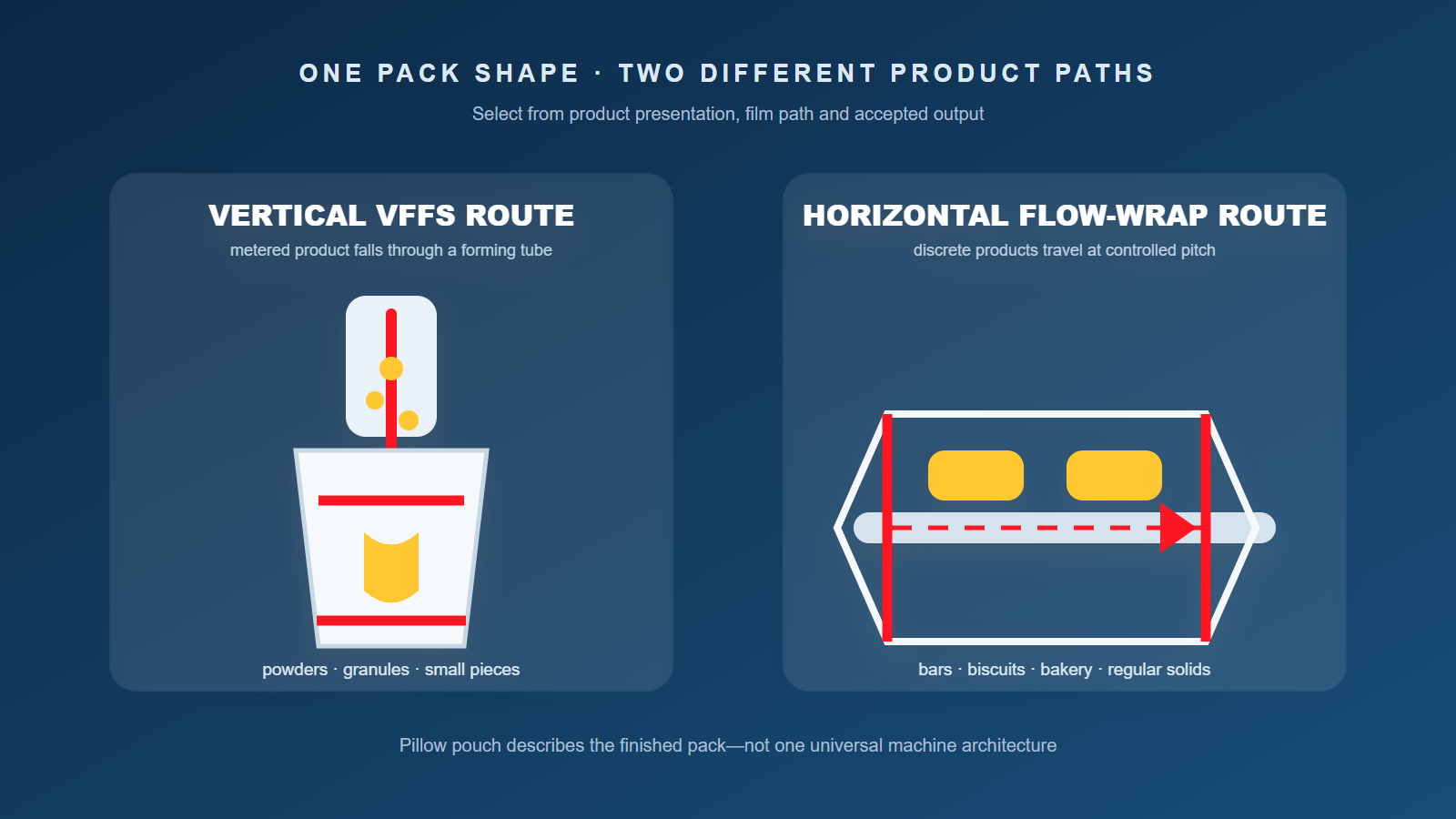
A common pillow pack has a top seal, a bottom seal and one longitudinal seal, often centered on the back. “Pillow pouch” or “pillow bag” describes the package shape and seal layout. The correct equipment still depends on whether product falls into a vertical forming tube or moves horizontally in a controlled pitch while film wraps around it.
Do not approve a quotation that says only “pillow packaging machine.” Ask the supplier to state the product path, film path, longitudinal-seal position, end-seal method, filler or infeed boundary, discharge condition and definition of an accepted finished pack. If package naming is still unclear, first review the pouch versus bag packaging guide.
Choose the product path before the machine model
The fastest way to separate the two routes is to watch the product immediately before it meets the film. If the product is dosed downward through a forming tube, the project is a vertical form-fill-seal problem. If individual products are spaced on an infeed and film is formed around them, the project is a horizontal flow-wrap problem.
Vertical VFFS pillow bag
Best considered when gravity, an auger, a weigher, a cup, a pump or another filler can deliver the product downward into an open tube of film.
- Powders and granules
- Snacks, frozen pieces and small components
- Loose products measured by dose or weight
- Projects where filler cutoff and product fall are central
Horizontal flow-wrap pillow pack
Best considered when each product can be presented at a controlled orientation and pitch while the web travels around it.
- Bars, biscuits and bakery products
- Trays, grouped pieces or rigid articles
- Products that should not fall through a tube
- Projects where infeed control is central
| Selection question | Vertical VFFS route | Horizontal flow-wrap route |
|---|---|---|
| Product movement | Dosed downward through a forming tube | Travels horizontally at a controlled pitch |
| Upstream interface | Weigher, auger, cup, pump or other filler | Manual, belt, lug, chain, feeder or distribution system |
| Longitudinal seal | Usually made along the formed tube | Fin or lap seal formed around the moving product |
| Main disturbance | Product fall, dust, bounce, trapped air and dose cutoff | Pitch variation, rotation, contact, accumulation and product height |
| Useful speed basis | Accepted bags/min with conforming dose and seals | Accepted packs/min with conforming presentation and seals |
A VFFS pillow bag starts with dosing and product fall
On a vertical route, roll stock is guided around a forming collar and tube. A longitudinal seal closes the tube; transverse jaws create the end seals and separate one package from the next. The filler and bagger must exchange a reliable discharge signal so the dose arrives inside the available bag window and clears the sealing area.
Define the dose system
State whether the product uses a multihead weigher, linear scale, auger, volumetric cup, pump or another device. Include target dose, tolerance and refill behavior.
Observe the real trajectory
Long stringy pieces, dusty powder, fragile product and bouncing particles can require different timing, tube geometry, settling time or dust control.
Keep product away from jaws
The accepted result depends on cutoff, bag length, product settling and jaw closure—not on an empty-machine cycle rate.
If your project uses loose powder, granules or small pieces, begin with the vertical form-fill-seal machine guide and then define the filler, bag and FAT boundary for the actual product.
A flow-wrap pillow pack starts with stable product presentation
A horizontal wrapper cannot reliably correct doubled, rotated, touching or irregularly spaced products by itself. The infeed, distribution, accumulation and reject response are part of the packaging line. Film is formed around the moving product, the longitudinal seam is closed, and end-seal jaws close and cut between successive products.
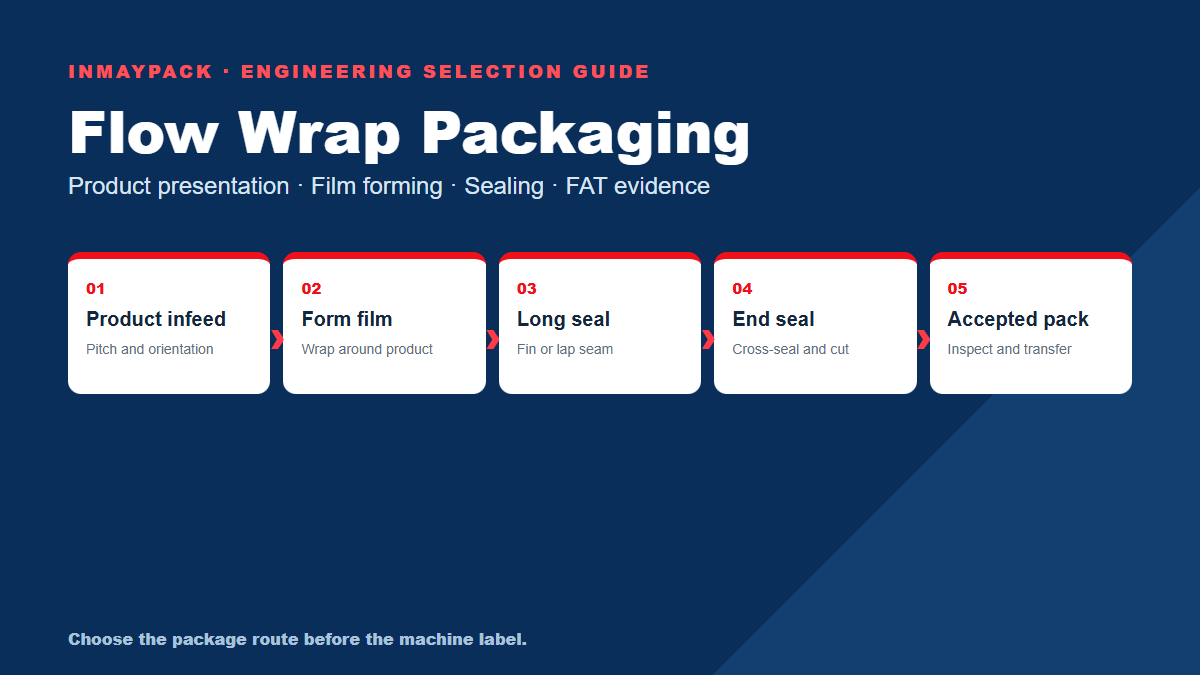
For discrete products such as bars, biscuits and bakery items, use the flow-wrap packaging machine guide to define the complete infeed-to-discharge boundary.
Freeze the film, seal layout and finished dimensions together
A package drawing should identify finished width and length, longitudinal-seal type and position, end-seal width, print repeat, eye-mark position, code area, opening feature and permitted tolerances. The film specification should identify the complete structure, total thickness, sealant side, roll width, maximum reel diameter, core, winding direction, splice rules and any coefficient-of-friction or static behavior needed for the application.
Do not substitute one film because its nominal thickness looks similar. Machine behavior depends on the entire construction and sealing window. A laboratory seal result can help characterize material, but it does not reproduce the production machine’s tension, contamination, jaw geometry, dwell, pressure, cooling or product load.
Fin seal or lap seal
Confirm which surfaces meet, how the seam is oriented, the clear width available, whether the pack must sit or display in a particular way, and how the seam behaves through downstream handling.
End-seal and cut definition
Specify seal width, cut position, crimp or jaw impression, easy-open features, permitted wrinkles, product clearance and the test used to release the seal.
The package geometry is simple; the product interaction is not
A pillow pouch bag may be economical and familiar, but reliable production depends on how the product reaches the seal area. Dust can coat a transverse seal. Fragile pieces can break during a long fall or aggressive infeed correction. Warm bakery products can affect film and sealing. Sharp products can puncture the web. Trapped air can inflate a bag and disturb the next cut or downstream case count.
| Product condition | Vertical-route question | Horizontal-route question |
|---|---|---|
| Dust or fines | Can cutoff, extraction and timing keep the seal zone clear? | Does the infeed or product surface carry dust into the fin or end seal? |
| Fragile product | What fall height, tube contact and jaw timing preserve acceptable breakage? | What belt transfer, guide pressure and spacing action preserve the product? |
| Variable size | Will the largest product pass the tube and settle before sealing? | Can the infeed control the largest and smallest envelope without doubles? |
| Warm or sticky | How do temperature and residue affect dosing, film drag and seals? | How do product temperature and contact affect film tracking and seam formation? |
| Trapped air | Is air removal, settling time or perforation required? | Does the film form closely enough without compressing or shifting the product? |
Compare accepted packs per minute—not an isolated cycle rate
A machine may cycle while producing an underweight dose, a contaminated seal, a misplaced print, an incomplete cut or a pack that cannot enter the next machine. Those outputs should not be counted as useful production. Define a conforming pack, test duration and the events included in the calculation before comparing quotations.
Record the product lot, target dose or product envelope, film lot, active lane or infeed, recipe, utilities, staffing, refill or splice events, planned stops, unplanned stops and rejects by reason. State whether ramp-up, first-off inspection and restart packs are included. A short run at an ideal setting is not evidence of sustained production behavior.
Start with released materials
Use the intended product and production-representative film, not an easier substitute that changes flow, friction or seal behavior.
Stabilize the complete line
Include the filler or infeed, printer, inspection, reject, discharge and downstream interfaces inside the agreed test boundary.
Challenge normal events
Observe refill, film splice, stop/restart, low-product, blocked discharge and normal adjustment conditions required by the project.
Count by result
Separate gross cycles, accepted packs, rejects, rework, downtime and the cause assigned to each nonconforming result.
Ask what must change, clean and be re-released
A second SKU can change much more than bag length. On VFFS, the forming set, tube clearance, filler parts, film roll, date code, recipe and discharge may change. On flow wrap, the former, infeed pitch, guides, fin-seal setting, end-seal timing, product sensor and downstream transfer may change. List every planned size and product before the quotation is fixed.
Name the physical scope
Identify forming sets, funnels, augers, cups, belts, lugs, guides, seal jaws, printers and tools required for each SKU.
Define the product risk
State allergen, oil, dust, moisture and sanitation requirements, plus access, removal and inspection expectations.
Measure return to production
Define who approves first-off dose, registration, code, seal, cut and downstream transfer after changeover.
Quote “changeover time” only against a defined start and finish. For example: last accepted pack of SKU A to first accepted pack of SKU B, with cleaning and inspection included. Otherwise two suppliers may report different boundaries while appearing comparable.
Send enough evidence to select the pillow packaging route
A useful RFQ lets the supplier reconstruct the real packaging task. Photos are helpful, but dimensioned drawings, physical samples, product data and acceptance rules are stronger. Separate confirmed requirements from targets and optional future SKUs.
Use the Packaging Machine RFQ Builder to organize these inputs before asking for a configuration and quotation.
Preserve the failed pack before changing several settings
When a fault appears, keep the pack, its orientation, time, recipe, product and film lot tied together. Multiple simultaneous adjustments can hide the real cause. Start from the location and failure mode, then change one controlled factor where practical.
| Observed result | Possible process family | First evidence to keep |
|---|---|---|
| Product in end seal | Dose cutoff, fall time, product pitch, bag length or jaw timing | Cycle video, product position and rejected pack |
| Longitudinal seam opens | Film orientation, contamination, overlap, temperature, pressure or dwell | Seam cross-section, film lot and machine settings |
| Cut or print drifts | Web tension, tracking, eye-mark sensing, repeat variation or slip | Consecutive pack sequence and roll identification |
| Random wrinkles | Former alignment, product contact, web tension or jaw presentation | Wrinkle direction, machine side and empty-film run |
| Good speed, poor downstream flow | Air, orientation, discharge spacing, hot seal or unstable product | Discharge video and downstream stop history |
Pillow pouch packaging machine FAQ
Is a pillow pouch the same as a three-side-seal sachet?
No. A common pillow pouch uses one longitudinal seam plus two transverse end seals. A three-side-seal sachet is commonly sealed around three edges from two film faces or a folded web. Confirm the actual section and seal drawing because market terminology can vary.
Should I use VFFS or horizontal flow wrap?
Choose from the product path. Products that can be dosed downward commonly fit VFFS. Discrete products that must retain orientation and pitch commonly fit horizontal flow wrap. Product, film, accepted pack and line integration must still be trialed.
Can one pillow pouch machine run powder, granules and biscuits?
The package name does not establish that capability. Powder and granules may use different fillers on a vertical platform, while biscuits commonly need a horizontal infeed and wrapper. A change in product path can mean a different machine architecture rather than a simple change part.
What determines pillow packaging machine speed?
Useful speed depends on product supply, dose or pitch, package dimensions, film, sealing, inspection, rejects, changeovers and downstream capacity. Compare accepted packs per minute under a documented test condition, not a headline cycle rate.
What samples should I send before quotation?
Send representative product, intended film or its complete specification, a finished-package drawing, physical pack samples, all priority SKUs and the required tests. State if any material is provisional so it is not mistaken for the final acceptance basis.
Sources used for the machine-route framework
Manufacturer reference describing the common three-seal pillow-bag layout and vertical form-fill-seal application route.
Manufacturer reference showing horizontal product infeed, film formation, longitudinal sealing, end sealing and discharge as one flow-wrap process.
Seal-strength test reference. The package owner must still define the sample plan, conditioning, technique and acceptance limits.
Laboratory heat-seal practice used to characterize material behavior; it is not a substitute for validation on the production package and machine.
Continue from the package name to the complete line
Send the product, package drawing and film specification
INMAYPACK will review whether the application belongs on a vertical VFFS or horizontal flow-wrap route and identify the filler or infeed, sealing, inspection and FAT inputs that still need confirmation.
Request a pillow pouch application review






