
INMAYPACK · Fine-powder dosing and flexible packaging
Fine Powder Filling Machine
Control the powder path. Verify the portion. Protect the finished pack.
Choose fine-powder filling equipment around flow, bulk-density changes, dust and the required dose. Review the auger, product supply, weight checks and extraction together, then integrate the selected filler with your sachet or pouch machine.
- Powder-specific auger review
- Feed & refill planning
- Weight verification
- Dust & seal-area control
Send representative powder, all doses, permitted variation, pack samples and the required accepted output.
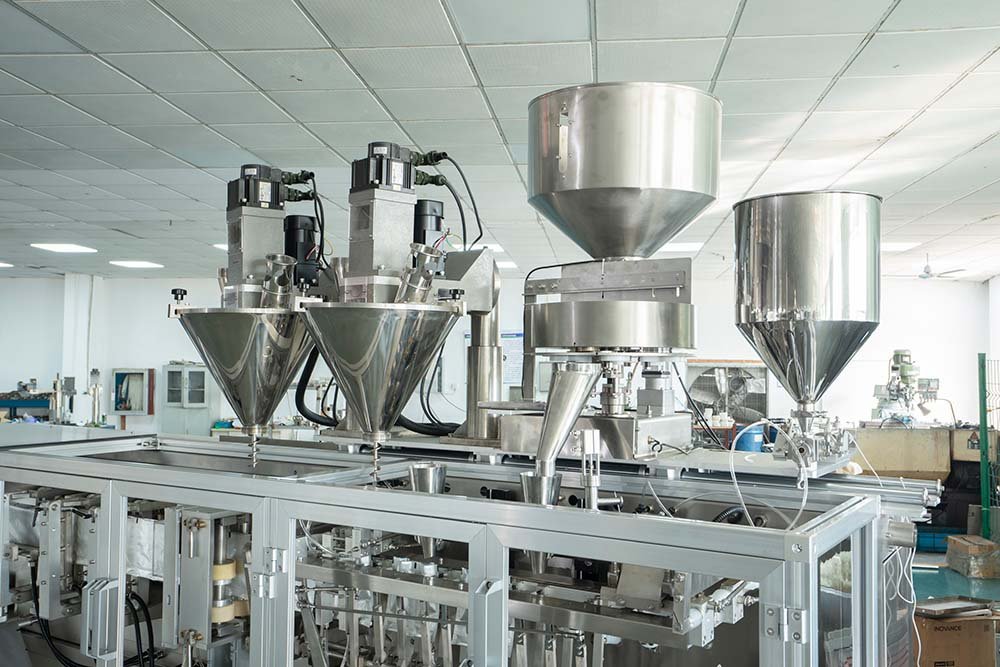
What is a fine powder filling machine?
Meter the actual powder. Build the complete filling path.
A fine powder filling machine meters a powder portion into the selected package. An auger route controls delivery through a screw and hopper; product supply, cutoff and weight verification are selected around the material and dose.
“Fine” or “superfine” describes the proposed material, not one universal particle size or machine setting. Provide representative samples and any available particle-size, density, moisture and flow information. Review filling behavior under the conditions your plant expects.
The supplied powder-pouch document specifically includes powder and superfine powder in its auger-filler description. The actual recipe and package still need a trial. See powder filling systems for the wider equipment range.
Fine-powder production challenges
Flow, dose and dust. Three linked selection questions.
Identify the conditions that need to be controlled in your application. The same recipe name does not establish the same filling behavior across batches.
01 · Product release
Assess bridging and interrupted flow
Describe how the material leaves storage and enters the selected hopper. Observe release, refill and restart so the proposed supply and metering path can be assessed together.
02 · Portion consistency
Record changes in bulk density
State the dose and permitted variation. Check portions under the intended storage, supply and settling conditions rather than approving one setting from one startup sample.
03 · Package closure
Include dust around filling
Review the fill outlet, available opening, usable cavity and powder residue at the seal. Coordinate extraction and package checks with the actual powder and packaging material.
Powder changes after storage or refill?
Send samples in the condition you expect to run, together with the handling and production schedule.
The fine-powder filling path
Supply the auger. Leave room for a clean closure.
Approve the chosen supply, hopper, screw, outlet and package as one working arrangement.
01 · Metering path concept
Match the screw and delivery path
Review the selected auger parts, product level, replenishment and fill outlet with the required powder portions. Confirm adjustments and parts for each recipe.
02 · Finished-pack concept
Reserve the closing area
Agree the usable cavity, intended filled appearance and seal band. Check the actual product level and residue after filling and any selected settling step.
Concept drawings explain the selection points. They are not machine drawings, approved pack dimensions or evidence of a particular dust-removal result.
Documented auger equipment references
Keep volume, weight and module cycles distinct.
AGS30 values come from the HMK project’s auger section. The second reference comes from the powder-pouch project’s separate auger-filler table.
| Selection item | AGS30 reference | Powder auger reference |
|---|---|---|
| Document reference | AGS30 auger screw feeder | Powder auger module in supplied pouch document |
| Dose basis | 0–1,000 ml listed dispensing volume | 1–1,000 g reference after power and hopper-size update; confirm selected build |
| Source cycle reference | 10–50 PPM module cycle rate | 40–120 filling actions/min module reference |
| Hopper reference | Confirm selected feed and hopper arrangement | 25 L; enlarged 35 L reference |
| Power / supply reference | 2.0 kW; AC220 V ±10%, 50/60 Hz | 0.95 kW; updated 1.2 kW; 3-phase AC208–415 V, 50–60 Hz |
| Dimensions L × W × H | 450 × 800 × 950 mm | 800 × 790 × 1900 mm |
| Main confirmation | Product-specific gram dose, screw and control mode | Exact model, upgraded scope, portions and approved recipe range |
Millilitres do not establish grams without actual product density. Module cycles do not establish accepted finished packs/min. The powder-pouch proposal separately specifies a 100–1,000 g powder system; that quoted scope is distinct from the upgraded filler-table range. A 0.1 g scale reference is not a 0.1 g filling-accuracy guarantee. Approve the selected build and test limits.
Fine powder dosing accuracy
Specify the control method. Verify the released portion.
Ask for results under agreed product and run conditions, including startup, steady filling, refill and restart.
Metering setting
Review screw-revolution dosing
The AGS30 description includes a selected auger size with a preset number of revolutions. Review the relationship between settings and measured portions for the actual powder and operating conditions.
Control arrangement
Specify feedback or scale-controlled cutoff
The supplied documents describe weight feedback and, separately, a scale-controlled auger stop. Name the required control arrangement and how it is implemented in the current proposal; these are distinct functions.
Released package
Define independent weight verification
Agree sample timing, tare handling, limits and the response to out-of-range portions. A selected checkweigher, manual sampling plan or other inspection arrangement must have its own scope and acceptance method.
The supplied filler has an accuracy table, but it is not a universal guarantee for every powder, weight or configuration. State your required limits and have the selected setup demonstrated. Compare auger filling equipment for the metering principle and module scope.
Feed, refill and cleaning
Control the supply conditions around the filler.
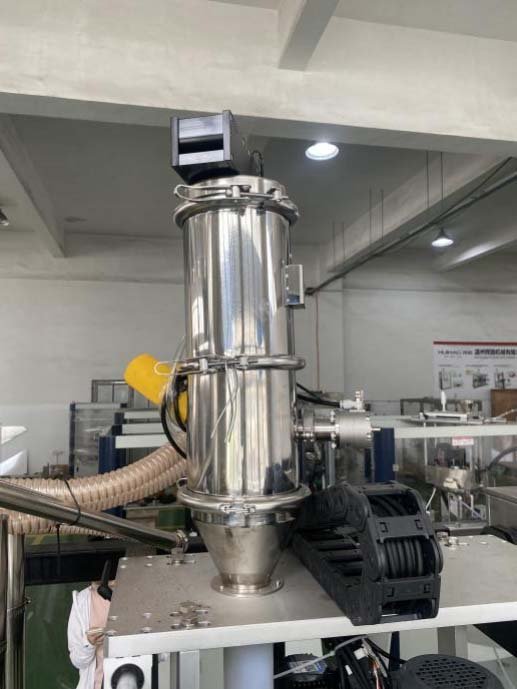
Product supply
Assess transfer into the receiving hopper
Define the selected conveying method, receiving hopper, replenishment control and cleaning access. Review powder condition before and after the actual transfer path.
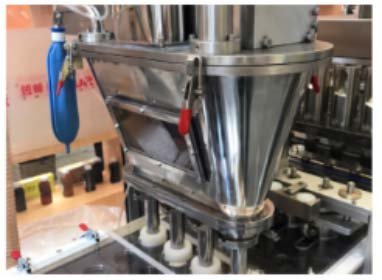
Contact-part access
Plan emptying and recipe changes
Identify the screw, hopper, outlet and transition parts that your team must empty, remove, inspect and reassemble. Include recipe separation and the selected cleaning method.
Dust control at the filling and closing area
Specify the extraction scope. Verify the package result.
The HMK source includes two separate dust-removal references. Select the extraction arrangement around the actual fill point and powder requirements.
| Selection item | HS-2 | DC3 |
|---|---|---|
| Source designation | HS-2 recoverable dust collector | DC3 non-recoverable dust remover |
| Listed maximum flow | 200 m³/h | 300 m³/h |
| Listed suction / inlet size | 51 mm | 102 mm |
| Power reference | 2.2 kW | 1.5 kW |
| Dimensions L × W × H | 1100 × 500 × 1650 mm | 500 × 500 × 1300 mm |
| Project selection | Define collected-material handling and intended use | Define extraction, disposal and cleaning arrangements |
Maximum flow is a device reference, not proof of extraction performance at your filling point, a clean room classification or a dust-free pack. Collected material is not automatically approved for reuse. Supply material-handling requirements and agree the equipment selection, connections, checks and disposal scope.
Fine powder filling and sealing
Select the filler first. Coordinate the package platform.
Use the finished package, product and production target to choose between roll-film forming and supplied premade-pouch handling.
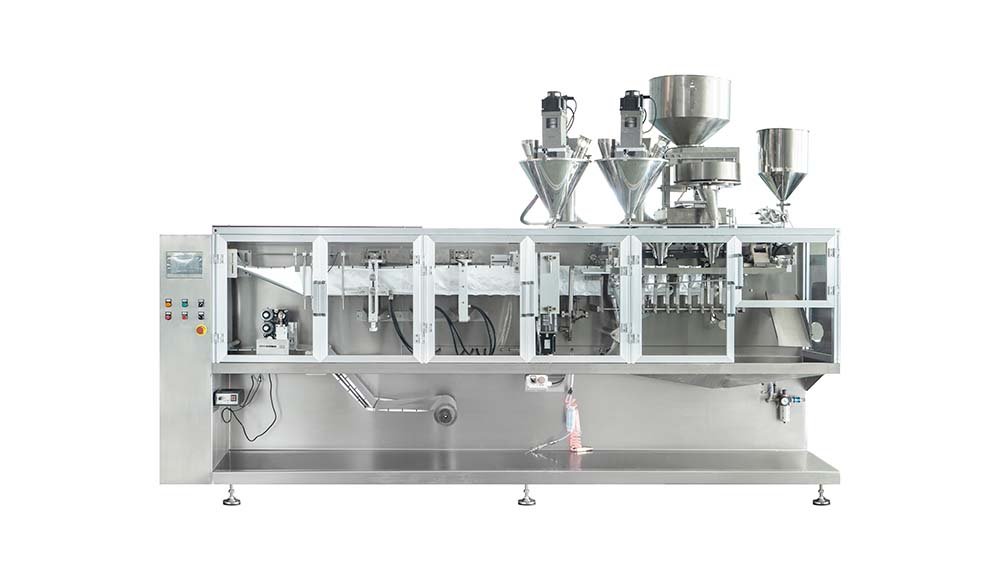
HS-180 · Roll-film pouch / sachet route
Integrate the filler with bag forming.
The supplied HS-180 proposal includes an auger and screw elevator for baking soda. Use that documented project as a configuration reference, then review your fine powder, film and package.
- One filling station in the source
- 40–70 bags/min machine reference
- Approved dose and output require your trial
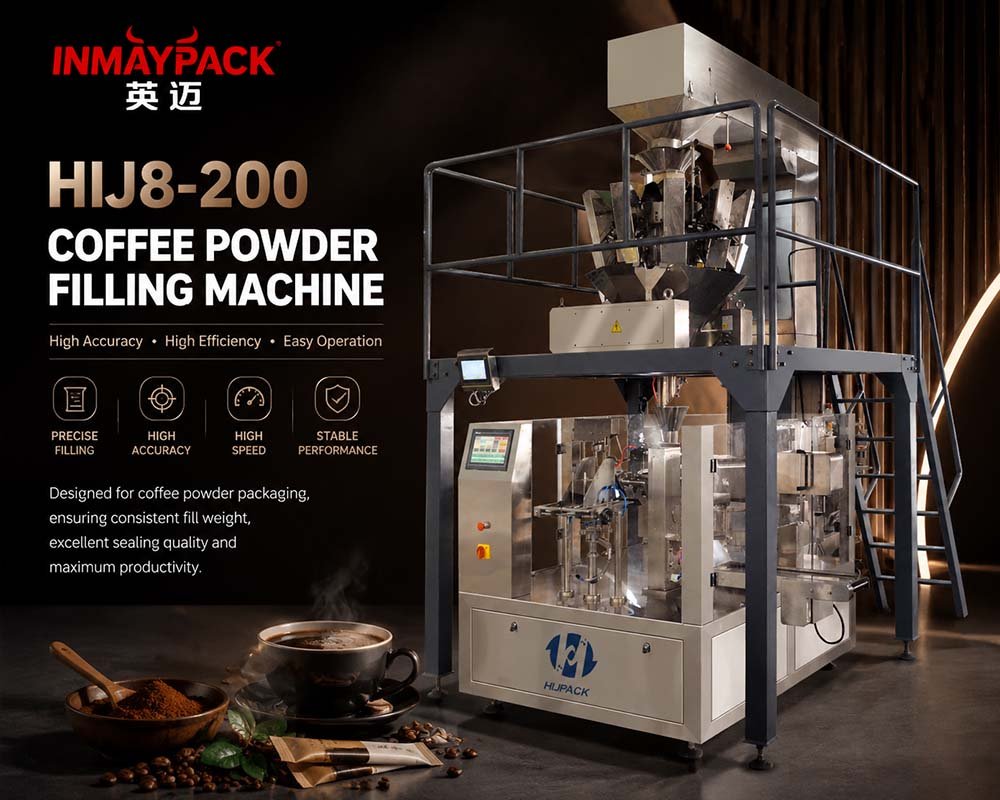
HIJ8-200 · Premade-pouch route
Integrate the filler with supplied bags.
The powder-pouch proposal includes a separate auger filler and conveyor for a 100–1,000 g requirement. Define opening, powder delivery, top preparation and sealing using your production pouches.
- Rotary premade-pouch machine reference
- 20–60 pouches/min machine reference
- Current proposal defines powder and accessory scope
Photos show packaging-platform references with accessories. They do not identify every selected powder module or establish a fine-powder production rating. Bottle, jar, bulk-bag and pharmaceutical process-filling requirements need a separate equipment review.
Application review
Send the actual recipe. Approve its working window.
Food ingredients
Flour, starch and seasoning
Provide density, flow, dust and recipe-change requirements with the dose and pack. Use the actual formulation, including mixed or oily ingredients, in the trial.
Retail nutrition
Milk, drink and protein powders
Include all blends, target portions, storage condition, usable pack volume and cleaning expectations. Review recipe changes alongside production output.
Other proposed powders
Define the material requirements
Describe cosmetic or other proposed powders with the required product-contact and handling conditions. A powder name alone does not establish compatibility or a supplied protective function.
Fine-powder acceptance trial
Check the dose and seal through the complete production run.
Agree permitted variation, sampling, package-check methods and run conditions before approving output.
Prepare the materials
Use representative powder, all portions, production film or pouches and the intended supply conditions.
Run the operating events
Include normal filling, refill, stops, restart and the planned recipe or format changes.
Measure portions and packs
Record tare, weight results, seal-area residue, closure checks and rejects by reason.
Approve the working scope
Record the accepted output, run duration, settings, contact parts and selected dust-handling arrangement.
Fine powder filling machine price
Compare one clear scope. Request an itemized proposal.
Price follows the material, dose, control method, powder handling, package platform and agreed test.
01 · Selected dosing
Auger, hopper and controls
Specify the exact filler, approved recipes, portions, selected screw parts, hopper, supply controls and weight-control arrangement.
02 · Powder handling
Supply, access and dust scope
Itemize transfer equipment, receiving hopper, cleaning access, extraction module, connections and collected-material handling.
03 · Finished packaging
Packer, inspection and handover
Define roll-film or premade-pouch equipment, selected coding, weight checks, rejects, collection, factory trial, installation and operator training.
Quote the powder path and package together.
Send your recipe list, dose limits, pack samples, dust requirements and required output.
Historical document prices are not current offers. Use powder packaging line planning when the inquiry includes the connected production system.
Work with INMAYPACK
Connect product behavior with the equipment proposal.
Share the powder your team expects to run and the package your customer will receive. Review the metering module, supply equipment, package platform and selected inspection as one project.
Include the launch products and expected changeovers. Ask for the approved recipe range, required parts and finished-pack test in the current proposal.
Buyer questions
Fine powder filling machine FAQ.
What is a fine powder filling machine?
It meters fine powder into a package using selected dosing equipment. An auger route coordinates the screw, hopper, powder supply and cutoff with the actual material. A complete flexible-pack system also includes package forming or premade-pouch handling and sealing.
Is there one particle-size limit for every fine powder filler?
No universal particle-size limit is established by the supplied documents. Provide your material data and representative powder. Evaluate its flow, density variation, dust, storage condition and dose on the selected setup.
Can the supplied auger reference handle superfine powder?
The powder-pouch document explicitly describes an auger filler for powder and superfine powder. That is a route for review, not proof of every recipe’s performance. Approve screw parts, supply, portions and trial conditions for your material.
Does the AGS30 1,000 ml reference mean 1,000 g?
No. The AGS30 dose reference is volumetric. Gram weight depends on the actual product density and operating condition. The separate powder auger table and quoted powder project use weight-based ranges with their own configuration boundaries.
Does a 0.1 g scale establish 0.1 g filling accuracy?
No. A scale reference does not establish portion accuracy for every powder or dose. Agree the measurement method and permitted variation, then inspect results across startup, normal filling, refill and restart.
How do fixed revolutions and weight control differ?
Fixed-revolution dosing uses selected screw parts and a set rotation amount. The source also describes scale-controlled cutoff, while another document describes weight feedback. Specify the required arrangement and how the supplied system measures and responds; do not treat these functions as identical.
Is a dust collector’s maximum flow a dust-free packing guarantee?
No. Device flow figures do not prove capture at the actual filling point or acceptable seals. Define extraction connections, powder requirements, collected-material handling and package checks, then assess the complete selected arrangement.
What is needed for a fine powder filling machine quote?
Send representative powder and available material data, all doses and permitted variation, production packs, required accepted output, refill and recipe-change plans, dust and inspection requirements, utilities, destination and connected equipment.
Continue your equipment review
Related powder machines and applications.
Start with your actual powder and pack
Send the material and dose.
Build a clearer filling proposal.
Include powder conditions, target weights, permitted variation, pack samples, accepted output, dust needs, changeovers, destination and utilities.