An intermittent-motion cartoner advances cartons in indexed steps, with a dwell at working positions. A continuous-motion cartoner transports cartons through the working path while coordinated mechanisms perform the required operations. Choose between them by how reliably your product groups can meet the loading sequence, not by treating one motion type as a universal speed or quality upgrade.
This guide is for buyers placing already packed products, such as sachets, stick packs or coffee capsules, into retail cartons. It compares operating principles and the evidence to request from a supplier. It is not a claim that INMAYPACK supplies every architecture described, nor a performance specification for a particular machine.
Motion type and loading direction are different decisions
In an intermittent cartoning machine, the carton transport indexes between positions. The planned dwell gives a defined interval for operations at those positions. This does not mean every component stops together: a carton feeder, collator or conveyor may follow its own coordinated sequence. Ask which transport the supplier means when describing the machine as intermittent.
In a continuous cartoning machine, the carton transport runs continuously during normal production. Loading and other mechanisms must remain synchronized with the moving carton over their working interval. Continuous motion does not mean the machine never stops, and a continuously running infeed belt does not establish that the carton transport itself uses continuous motion.
Horizontal or end-load describes product entering through an open carton end; vertical loading describes entry from above. Neither term establishes the motion type. Set the required loading direction using the end-load versus vertical cartoning guide, then assess the proposed motion and feeding arrangement separately.
Manufacturer terminology examples: Uhlmann identifies its C 2155 as intermittent motion and its C 2156/C 2206 as continuous motion. These are external architecture references, not INMAYPACK models or evidence of equivalent performance. The purchasing checks below are a selection framework, not results from a comparative machine test.
Compare the loading sequence, not a speed label
| Decision point | Intermittent motion | Continuous motion |
|---|---|---|
| Carton transport | Indexed movement with a planned dwell at working positions. | Continuous travel during normal running, with coordinated working mechanisms. |
| Loading interval | The product group must be ready for the defined loading dwell. | The group and loading mechanism must meet the moving carton within the synchronized interval. |
| Irregular product supply | Check how missing groups affect indexing, empty positions and controlled waiting. | Check group availability, empty-position handling and any permitted speed adjustment or controlled stop. |
| Product protection | Trial acceleration, settling, restraint and insertion during the actual index sequence. | Trial transfer alignment, relative movement and support throughout the loading interval. |
| Selection evidence | Accepted cartons, stop causes and changeovers with representative materials. | The same evidence, including synchronization and recovery at the proposed operating conditions. |
Evaluate intermittent motion where an indexed working sequence fits the product-handling task. Evaluate continuous motion where sustained demand, predictable grouping and coordinated transfer can use that architecture effectively. These are reasons to investigate a route, not rules that small batches must be intermittent or large batches must be continuous.
Product behavior can outweigh the label. A loose group of flexible sachets may change shape as it enters a carton; a capsule group may need controlled orientation and support. A successful empty-carton run proves neither task. Inspect what holds the group, what guides the carton opening and what happens if a seal edge catches during insertion.
Do not set a universal switch-over speed. The sensible boundary depends on product count, carton geometry, loading mechanism, closure, inspection and line supply. Ask each supplier to demonstrate the same accepted result rather than choosing an architecture from an unrelated catalog maximum.
Translate primary-pack output into complete carton groups
A cartoner receives usable product groups, not the upstream machine's headline packs per minute. Record how many accepted primary packs reach the grouping station, how they arrive and how many belong in each carton. A multi-lane machine may release several packs together, while a conveyor or manual replenishment step may create a different arrival pattern.
For one SKU at a steady average supply, the theoretical supply ceiling in cartons per minute is accepted primary packs arriving per minute divided by packs per carton. This is only a material-balance ceiling. Grouping losses, unavailable cartons, loading restrictions, inspection and stops can reduce finished-carton output. A mixed assortment also depends on the availability of each required component.
Record short interruptions, not only the average
Observe the actual infeed over a representative production period. Note gaps after primary-pack rejects, bursts after a restart, orientation changes, uneven lane discharge and replenishment interruptions. Ask the cartoner supplier to show how incomplete groups are retained, completed, rejected or stopped without being released as complete cartons.
Define a buffer in complete usable groups as well as physical conveyor space. For a full buffer of B usable groups and a draw of R cartons per minute, B/R is the theoretical coverage in minutes when upstream supply stops. It assumes one group per carton and that every buffered group can be released. Usable capacity can be smaller than the conveyor's geometric capacity.
For interfaces spanning primary packing, grouping, cartoning and downstream inspection, use the packaging system integration checklist to assign ownership of signals, transfers and recovery. A buffer cannot compensate indefinitely for an upstream process whose average accepted supply is below demand.
Specify what happens when the normal sequence is interrupted
Both architectures need a controlled response to starvation, a missing carton, a rejected group or a blocked discharge. Specify the required sequence before comparing quotations. “Automatic restart” is not enough: it must be clear which products and cartons remain valid, which are removed and who confirms the restart condition.
- Product supply stops: identify the group already committed to loading, the remaining usable buffer and the conditions for waiting or stopping.
- A carton is missing or fails to open: demonstrate how the associated group is prevented from being lost, damaged or counted as accepted output.
- The downstream conveyor blocks: show the stop request, stopping sequence and treatment of cartons inside loading and closing stations.
- Production resumes: account for retained products, partly completed cartons, inspection results and the first accepted carton after restart.
Continuous motion requires coordinated working mechanisms during operation, but that alone does not establish whether its recovery is better or worse. Intermittent motion includes scheduled dwells, but those dwells do not prove that arbitrary supply gaps can be absorbed. Compare the actual control sequence and the observed results.
Have the supplier demonstrate fault challenges through approved test procedures. Do not bypass guards or reach into a running machine to create a missing-product event. Request the relevant operating and recovery instructions as part of the delivered documentation.
Use one acceptance sheet for both proposals
Agree the product, carton and acceptance conditions before the demonstration. Use production-intent materials, the required count and orientation, and the proposed inspection and closure arrangement. A short video is useful for seeing the sequence; it is not a substitute for a recorded test that includes normal production events.
| Test item | Hold consistent or document | Record for the decision |
|---|---|---|
| Product group | Actual packs, count, orientation, group dimensions and allowable damage. | Incomplete groups, lost orientation, damaged seals or lids, and loading rejects. |
| Carton and closure | Drawing revision, board lot, opening behavior, tuck or adhesive arrangement. | Opening failures, flap damage, incomplete closure and rejected cartons. |
| Supply pattern | Representative arrival gaps, bursts, replenishment and grouping equipment. | Starvation duration, buffer behavior and missing-group response. |
| Stops and recovery | Agreed normal stops, blockage and approved fault challenges. | Recovery time, cleared products, held cartons and restart inspection results. |
| Accepted output | Same quality criteria, test duration and timing boundary. | Conforming finished cartons, rejects, downtime and reasons for losses. |
Report accepted cartons divided by the agreed elapsed test time. If a supplier also reports the running rate excluding stops, keep it as a separate measure. A high running rate and a lower elapsed-time result answer different questions; neither should be silently substituted for the other.
Test the formats that create different handling risks, not only the easiest carton. A larger count may change group stability; a tighter carton may change insertion clearance; a different board lot may change opening. Record which combinations passed and which still need trials. An approved result for one combination does not validate the entire proposed range.
Compare changeovers and quoted scope before choosing
Motion type does not establish purchase price, operating cost or maintenance effort. Compare the supplied system: carton handling, grouping, loading, closure, coding, inspection, reject confirmation, guarding and upstream/downstream controls. An offer for a cartoner alone is not equivalent to an integrated grouping-and-cartoning cell.
For changeovers, ask what must be adjusted when the carton size, product count or group pattern changes. List format parts, change locations, recipe settings and verification steps. Time the transition from the last accepted carton of one format to the first accepted carton of the next, including clearance and checks under agreed conditions.
For the detailed format conversion, use the cartoner changeover trial and release checks to separate parts, physical positions and recipe settings. Record the direction of each tested transition, the resources used and the evidence for first acceptance and stable production.
Review access for cleaning, fault recovery and maintenance with the proposed layout. Identify wear parts and format parts separately, request their supply terms and determine whether critical recovery needs supplier support. Avoid assuming that either motion architecture always uses fewer parts, less energy or fewer operators.
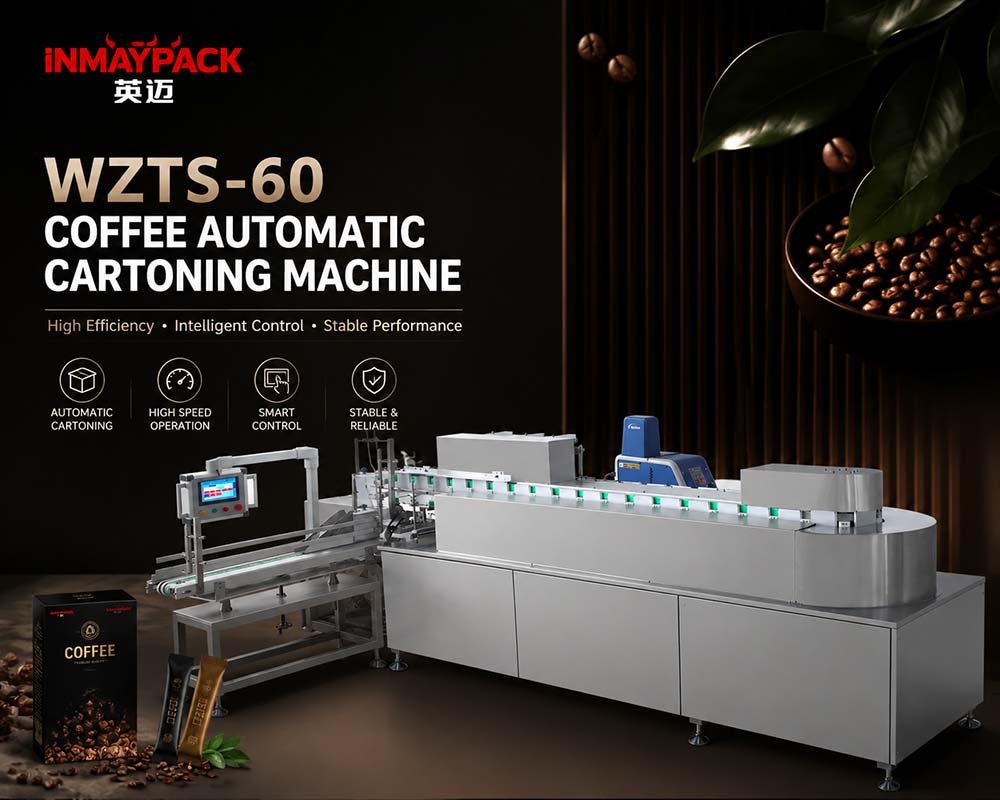
Use the INMAYPACK cartoning machine selection page for the current commercial scope. The WZTS-60 cartoning machine page owns the documented model specifications. Any required motion type, feeding arrangement and accepted output must be confirmed for the proposed configuration before purchase.
Questions buyers ask about cartoner motion
Is a continuous-motion cartoner always faster?
No universal ranking follows from the label. The product group, carton, loading mechanism and integrated line determine the usable result. Compare accepted cartons under the same conditions, not maximum speeds from different applications.
Can intermittent motion handle an irregular product supply?
It may suit an indexed sequence, but missing groups still require defined controls. Confirm whether the machine waits, skips a position, rejects material or stops, and prove that response using the expected supply pattern.
Does a continuously running infeed mean the cartoner is continuous motion?
No. Infeed, grouping and carton transport can follow different sequences. Ask the supplier to identify the carton transport motion and show how the loading mechanism is synchronized with it.
Which motion type should I use for sachets or stick packs?
Start with the finished group: count, orientation, stiffness, trapped air, seal geometry and carton clearance. Compare how each proposed machine forms, supports and transfers that group. The primary pack name alone does not choose the cartoner.
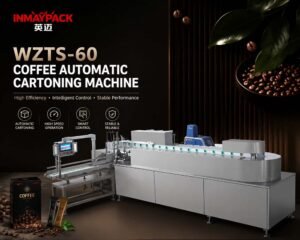
Does the WZTS-60 photograph prove a continuous or intermittent configuration?
No. A still photograph cannot prove the operating sequence. Request confirmation for the exact proposed machine and a representative demonstration. This comparison guide does not assign an unverified motion classification to that model.
Send the product group and carton together
Start with your product or primary pack, units per carton, carton drawing and required accepted output. Add the upstream arrival pattern, priority formats and planned downstream equipment. INMAYPACK can review these inputs against its documented cartoning scope; architecture availability and performance require configuration-specific confirmation.
Samples, line layout and acceptance requirements can follow during the technical review.