
Cartoning Machine Systems
A cartoning machine erects folding cartons, loads products or counted primary packs, closes the cartons and discharges them. INMAYPACK configures automatic cartoning around your product group, carton drawing, loading direction and upstream packaging equipment.
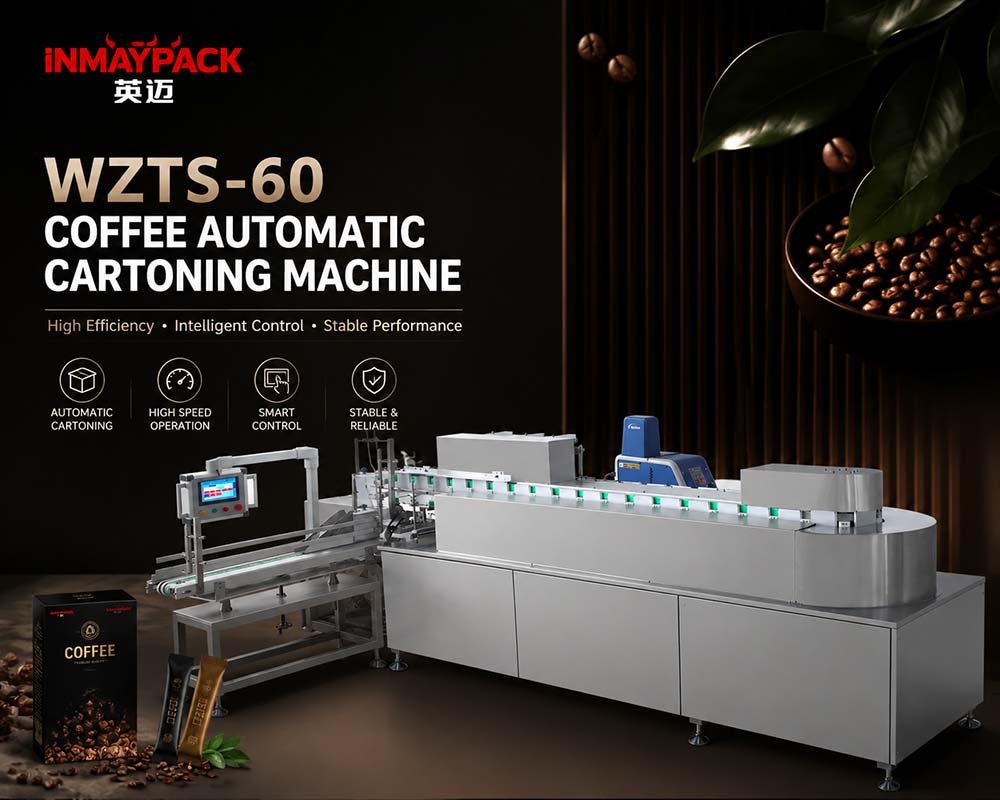
Choose the loading route
Start with how the product enters the carton. Loading direction and machine motion are separate choices: a vertical-loading cartoner can use intermittent movement, while an end-loading arrangement needs its own product-transfer and insertion design.
| Selection point | Vertical loading | End loading |
|---|---|---|
| Entry path | The group enters an open carton from above. | The group enters through an open end of the carton. |
| Product presentation | Review the drop or guided placement, group stability and available opening. | Review the insertion profile, pushing force, guides and resistance to snagging. |
| Carton drawing | Check the loading opening, flap clearance and support during filling. | Check the end opening, flap position and product-to-carton clearance. |
| Project decision | Assess the WZTS-60 route with actual primary packs and cartons. | Use the loading comparison to define the insertion task before selecting equipment. |
For the transfer details, compare an end-load vs vertical cartoning machine. Then assess intermittent versus continuous motion cartoning against the required loading time, feed pattern and carton handling.
This page concerns folding retail cartons. Shipping-case erection, case packing and palletizing are separate packaging tasks.
WZTS-60 vertical cartoning
The WZTS-60 combines carton handling with a connecting and feeding arrangement for an upstream coffee capsule machine. Product grouping, the carton format and closure equipment define the delivered configuration.
Use the compact specification here to identify the route, then review the WZTS-60 product page and full specification for the machine-level requirements.
- Cartoning rate
- 10–30 cartons/min, according to the coffee capsule filling machine feed
- Carton envelope
- 40 × 30 × 50 to 180 × 180 × 300 mm, L × W × H
- Control system
- Siemens PLC and touch screen
- Carton closing
- Tuck-in tongues at both ends, with a hot-melt option
Match the group to the rate
A cartoner consumes individual packs, but its output is measured in cartons. Define the number of packs in each carton before comparing the upstream pack rate with the required cartoning rate.
Packs/min = cartons/min × packs/carton
Grouping concept only; enter your own pack count in the calculation.
Planning arithmetic, not a machine capacity rating. Allow separately for rejects, buffer recovery, stops and the measured feed pattern.
Average rate alone does not describe the transfer. Record whether packs arrive individually or in batches, their spacing and orientation, how a partial group is held, and what happens when either machine stops. A carton should not be released for loading until its required group is available.
Define the primary-pack handoff
Different packs require different grouping and transfer arrangements. Specify dimensions, stiffness, surface friction and the surfaces that may be contacted. These inputs connect the primary packaging machine to the cartoner.
Coffee capsules and packs
Define the count, orientation and discharge pitch within the integrated coffee packaging line. Include the discharge condition after an upstream reject, not only the normal production pattern.
Stick packs and sachets
For narrow flexible packs, use the stick pack grouping and count verification plan. Address overlapping sticks, incomplete groups, transfer confirmation and reconciliation after interruptions.
Individually wrapped food
Define spacing and accumulation with the flow-wrapper packaging process. Continue with wrapped-bar infeed and cartoning requirements or wrapped-cookie and biscuit cartoning requirements for the relevant pack.
If the primary packaging method is still being selected, start with the food packaging machine selection page before fixing the cartoner interface.
Specify the carton closure
The WZTS-60 uses tuck-in paper tongues at both ends. A hot-melt arrangement changes the closure equipment, adhesive supply, carton flap details and operating checks. State the selected closure on the carton drawing and the equipment schedule.
Tuck-in closure
Check tab engagement, flap alignment and the effect of carton-board variation. Inspect the loaded carton as well as the empty erected carton: the contents can obstruct the closing path or distort the carton.
Hot-melt closure
The Meler B4 unit shown is a hot-melt equipment option. Itemize the adhesive unit, hoses, applicators and control connections. Define the adhesive pattern and the closed-carton check with the board and adhesive selected for the project.

Follow the carton through the line
Use the station sequence to assign mechanical and controls responsibilities. The product count, loading confirmation and carton release need to remain coordinated when the line stops or restarts.
Present the carton
Load the approved blank into the magazine. Check orientation, separation and consistent presentation to the erecting mechanism.
Erect and support
Open the carton and hold its shape. Confirm that the opening and support allow the intended product group to enter.
Form the group
Collect the specified number of primary packs. Define the response to a missing pack, duplicate feed or interrupted arrival.
Transfer and load
Move the complete group into position. Confirm that loading has finished before the carton advances to closing.
Close and check
Complete the selected closure. Apply the agreed coding, inspection and reject functions at their assigned stations.
Discharge and release
Transfer closed cartons to the downstream path. Record accepted cartons separately from rejected or reworked packs.
Compare the complete quotation
Cartoning machine price depends on the carton formats, product groups, feeding arrangement, closure and line-integration scope. Send one requirement sheet to each supplier so that a base cartoner is not compared with a connected packaging system.
Machine and format tooling
List the first carton and every additional format, the product group in each format, magazines, loading guides and change parts. Separate the included items from optional tooling.
Use the cartoning format-change acceptance guide to define representative transitions, setup references and the first accepted carton after a change.
Feeding and integration
Identify who supplies counting, grouping, transfer, accumulation and discharge equipment. Assign the controls handoff, guarding interfaces and responsibility for connecting the upstream and downstream machines.
Closure and acceptance
Specify tuck-in or hot-melt closure, coding, inspection and reject functions. List the product samples, carton batches, run duration, accepted-output measure and records included in the factory acceptance test.
Delivery and operating costs
Separate equipment from packing, freight, site work, installation, commissioning and training. Compare quotation currency, delivery basis, validity, service terms, spare parts and the recurring cost of cartons, adhesive and wear parts.
Issue the carton drawing with its revision, primary-pack samples, minimum and maximum pack sizes, count pattern, target output, site layout, utilities and destination requirements. Mark each quoted item as included, optional, customer-supplied or excluded.
Accept the finished carton
Agree the trial before the run. Use production cartons and representative primary packs, then retain the conditions, results and samples that explain the accepted output. An empty mechanical cycle count does not describe loaded-carton production.
| Check | Record for the agreed run |
|---|---|
| Test conditions | Product and carton batch, drawing revision, format tools, count pattern, settings, staffing and timed interval. |
| Count and loading | Required contents per carton, missing or extra products, loading completion, damaged packs and the agreed fault response. |
| Carton condition | Shape, flap engagement or adhesive closure, visible damage, coding and the selected inspection result. |
| Output and losses | Accepted cartons, rejects, rework, jams, stops and lost production time, counted separately. |
| Recovery and changeover | Partial-group handling, restart checks, format transition and the first accepted carton after recovery. |
Connect these records to the packaging system integration checklist. For multi-machine delivery, review the turnkey packaging line integration scope and assign one owner to each interface.
Cartoning purchase questions
Can one cartoning machine cover several carton sizes?
A size envelope identifies the machine range; the approved carton drawings determine the format tools. List every required carton and product group in the quotation, including change parts and the transition used for acceptance.
How does the number of capsules or sticks per carton affect line speed?
Multiply cartons per minute by packs per carton to find the required primary-pack feed rate. Then evaluate arrival patterns, rejects, accumulation and recovery. Increasing the pack count can make the upstream supply or grouping operation the limiting step.
Is the WZTS-60 carton-board specification enough to approve a carton?
The equipment specification lists 350 g/m² board according to carton size. Board weight alone does not establish stiffness, crease behavior or flap engagement. Submit the drawing and production blanks so the carton and tooling can be assessed together.
Does a hot-melt option include the entire adhesive system?
The quotation should identify the adhesive unit, hoses, applicators, controls connections and installation scope. Also specify adhesive, carton board, application pattern and the finished-closure check. A statement of hot-melt compatibility does not itemize those components.
How should partial groups be handled when a cartoner stops?
Define whether the group is held, rejected or manually reconciled, and how its count is confirmed before restart. Assign responsibility for packs remaining between the upstream machine, grouping device and loading station.
What information is needed for a cartoning machine quotation?
Send primary-pack samples and dimensions, packs per carton, the carton drawing and blanks, target accepted output, upstream discharge details, closure and coding requirements, layout, utilities and destination documentation needs. Include every planned format.
Can a cartoner connect directly to an existing packaging machine?
Check the existing discharge height, spacing, orientation, rate variation and stop signals. The connection may require grouping, transfer or accumulation equipment. Define the interface scope and verify the combined sequence with the planned packs and cartons.
Define your carton project
Send the primary pack, count pattern and carton together. INMAYPACK will develop the loading, closure and line-interface scope for your quotation.
Prefer a separate enquiry page? Send project requirements.