
INMAYPACK · Granule packaging project review
Vacuum Packing Machine
Your product. Your package. A defined vacuum process.
Select the package-making, dosing, evacuation and sealing arrangement around your granules and required finished pack. Request a configuration review for the YS-61XBK route and the complete equipment scope.
- Roll-film pack review
- Product-matched dosing
- Defined evacuation & seal criteria
Confirm the named machine, usable dose and bag range, evacuation arrangement and accepted output in the current application proposal.
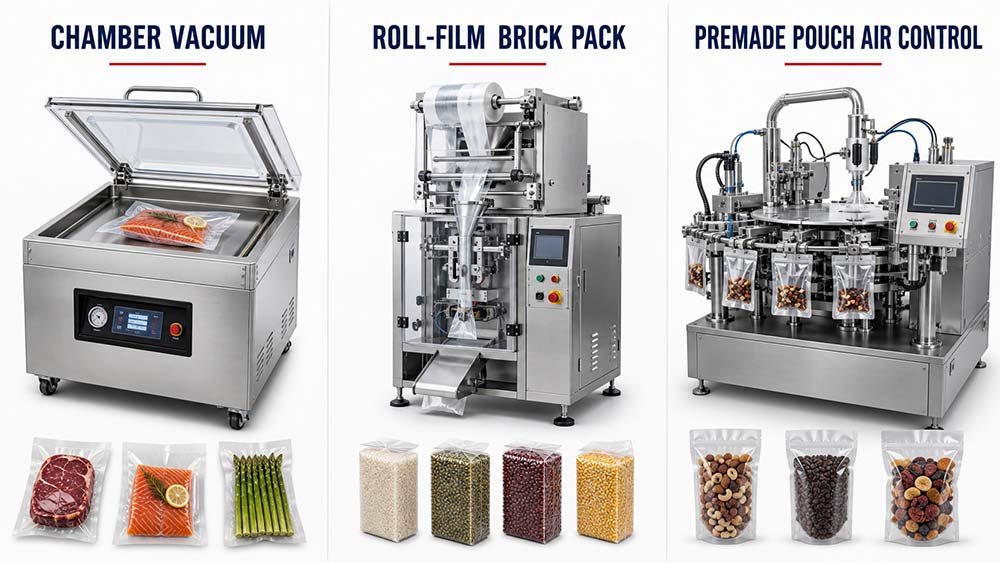
Define the packing objective
What does a vacuum packing machine do?
A vacuum packing machine removes air from the packaging space as part of the specified process and seals the package. The required equipment depends on the product, packaging material, bag supply and evacuation method.
For this granule-packing inquiry, review how the roll-film bag is formed, dosed, evacuated and sealed. Confirm the exact YS-61XBK variant and evacuation arrangement before fixing the final layout and production requirement.
Start with the vacuum packaging route guide when the package supply or process is still open.
Choose the material supply and process
Match the route to the pack you need
The machine name alone does not define how air is removed or how the package is supplied. Compare these selection paths before requesting a configuration.
Bag formation, dosing & evacuation
Roll-film packing route
Review former and back-seal geometry, product metering, the specified evacuation stage and final sealing. Include the required compactness or shape in the finished-pack drawing.
Pouch handling with specified air removal
Supplied-pouch process
Review the selected pouch pickup, opening, filling and air-removal functions. Air exhaust or nitrogen flushing alone does not establish a vacuum-packaging process.
Batch loading and package evacuation
Chamber process comparison
Compare a chamber route when the product and package objective call for that architecture. Confirm loading duties, cycle time, seal arrangement and supplier scope separately.
Process comparisons do not confirm that every architecture is included in the current INMAYPACK offer. The selected machine and functions must be named in the quotation.
Keep vacuum packaging, air exhaust and pouch opening separate
A suction device used to open an empty pouch handles the bag; it does not prove that the filled package is evacuated. Product settling, pouch air exhaust, gas flushing and vacuum packaging also have separate equipment and acceptance requirements.
Use the premade pouch machine range for supplied bags and define any required evacuation stage explicitly.
Vacuum packing machine configuration
Define the machine, process and production result
Use this checklist to obtain an application-specific specification and a comparable quotation. The current proposal should state the dose range, usable bag sizes, speed, power and dimensions for the named vacuum configuration.
Selection basis
Product & package
Review granular-product behavior and the controlled finished-pack drawing together.
Process basis
Evacuation & seal
Specify the air-removal arrangement, finished appearance and test method.
Production basis
Accepted output
Agree conforming packs under defined product, film and run conditions.
Open the complete configuration and specification checklist
| Selection field | What to send | What the current quotation confirms |
|---|---|---|
| Machine & material supply | Required product and package; roll film or supplied bag | Exact model suffix, forming or handling equipment, evacuation stage and equipment list |
| Product & dose | Minimum / nominal / maximum dose; tolerance; density; particle size and flow | Dosing device, feeding arrangement and sample-test conditions |
| Finished pack | Drawing, package dimensions, seal geometry and compactness or shape target | Usable format range, former or tooling and change parts |
| Vacuum result | Required result and where / how it will be measured | Evacuation arrangement, relevant instruments and acceptance method |
| Film & sealing | Laminate, thickness, sealant, printed roll and converter guidance | Material compatibility and approved sealing conditions |
| Accepted output | Required good packs/min, shift pattern and batch sizes | Product-, dose- and format-specific agreed production test |
| Power & process utilities | Destination voltage, frequency and available services | Connected load, electrical arrangement and all air / vacuum / cooling duties |
| Complete footprint | Available layout and access restrictions | Machine, feeding, service clearances and downstream envelope |
| Cleaning & contact parts | Product condition, cleaning method and changeover requirements | Specified contact materials, removable parts and approved procedures |
| Inspection & handover | Coding, weighing, detection, records, documents and support requirements | Included devices, reject handling, responsibilities and delivery scope |
Use the approved model-specific specification for purchasing and layout planning. Confirm that the datasheet describes the required vacuum configuration, selected filler and connected equipment.
Specify the complete packing sequence
Coordinate dosing, evacuation and sealing
This selection sequence defines the functions to review. The approved machine configuration determines the installed arrangement and cycle timing.
Prepare the product
Define the normal production condition, dose and selected feeding arrangement.
Form or present the package
Match roll film, former or supplied bag to the approved finished-pack drawing.
Measure & fill
Coordinate dose release, settling and clean access to the sealing area.
Evacuate as specified
Use the agreed evacuation arrangement and verify the defined package result.
Seal & inspect
Apply the approved sealing process, coding and selected inspection checks.
Discharge & collect
Coordinate cutting or discharge, reject handling and the downstream handoff.
Product behavior & dosing
Review the product before choosing the filler
Application examples are inquiry inputs. They do not establish that each product runs on one standard vacuum-machine configuration.
Product and dosing review
Free-flowing granules
Send particle size, bulk density and flow across representative batches. Review metering repeatability, target tolerance, hopper supply and bridging. Compare granule packing routes →
Application-specific review
Coffee & dry-product requirements
Review beans and powder separately. Specify roast condition, dose, barrier material, package presentation and the desired air-control process. Compare coffee bean pouch packing →
Handling and package review
Fragile, sharp or mixed products
Define allowable breakage, film puncture risk, segregation and compaction. Trial product transfer and finished-pack compression with representative samples.
Separate configuration review
Powders & other product behaviors
A powder, liquid or paste needs its own dosing and evacuation assessment. Compare powder filling routes when the material does not behave as a stable granule.
State the intended package result
Describe the required shape, compactness, allowable wrinkles, product damage and seal appearance. For coffee, include any degassing, valve or gas-flushing requirement in the process review. Shelf-life and residual-oxygen results require their own product and package evaluation.
Compare dosing methods and product-feed conditions
- Minimum / nominal / maximum dose and acceptable variation
- Density variation, particle distribution, flow, dust or static
- Surface oil, moisture, temperature and sticky or fragile pieces
- Feed replenishment, hopper access and product-drop arrangement
- Metering principle, cutoff, settling and seal-area protection
Use the pouch filling system guide to connect product behavior and the selected dosing equipment.
Film, pack appearance & sealing
Match the material to the evacuation and seal process
Supply production-representative packaging material and a controlled bag drawing. Confirm compatibility with the selected vacuum arrangement and desired finished-package appearance.
Finished-pack drawing
Define the bag and seal geometry
Record width, length, seam arrangement, cut position, coding area, fill volume and the intended pack shape. The product, film and evacuation behavior must fit that package.
Include the production material
- Laminate structure, total thickness and sealant layer
- Converter sealing guidance and material sample
- Roll width, core, diameter and unwind direction where applicable
- Print repeat, registration mark and batch-code position
- Package appearance and agreed seal-integrity inspection
Agree vacuum measurement and package acceptance
Define what result is required, where it is measured, when the result is checked and the instrument or inspection method. A vacuum-generator setting and a residual-oxygen result answer different questions; specify the measure needed for your project.
- Vacuum criterion or finished-pack appearance relevant to the chosen process
- Timing and location of the agreed measurement
- Product damage, package wrinkles and material puncture checks
- Seal contamination, leakage and agreed test method
- Sample handling and acceptance records for the trial
Options, interfaces & line scope
List the equipment you want included
Keep the machine and selected accessories in one quotation so layout, utilities, acceptance and support responsibilities can be reviewed together.
Upstream
Product supply & dosing
Specify loading, metering, buffers, contact materials and cleaning access. Name the selected product-feed and dosing equipment.
At the pack
Coding, inspection & rejects
Define batch coding, weight checks, metal detection or other required inspections, with clear reject handling and interface duties.
Downstream
Outfeed & downstream handling
Define collection, conveying, grouping or cartoning where needed. Agree accumulation, transfer, stop and restart behavior.
Review changeover, utilities, guarding and documentation
- SKU and bag-size matrix, tooling and change parts
- Recipe settings, access permissions and required alarm information
- Total installed loads and all process utility connections
- Film replacement, product loading, cleaning and service clearances
- Guarding, stop / restart procedures and project documentation
- Manuals, drawings, parts list, operator training and agreed support
Vacuum packing machine price
Get a quote for your product and package
The price depends on the selected machine, filling method, evacuation system, tooling, accessories and project services. Send the application inputs for a current itemized quotation.
Machine, filler & package
- Named model and included vacuum arrangement
- Product-specific dosing and feeding equipment
- Bag forming, tooling and usable package range
- Film handling, sealing and selected coding
- Contact materials, cleaning and change parts
Test, delivery & project services
- Required accepted output and test samples
- Inspection, rejection and connected equipment
- Full layout, utilities and integration duties
- Trial records, manuals, training and commissioning
- Delivery terms, warranty and support scope
Prepare a useful inquiry
Send the product and pack. Review the configuration.
These inputs let INMAYPACK compare the material supply, filler, evacuation arrangement and required production result together.
Product & finished package
- Product name, photos and representative sample
- Dose range, tolerance, density and particle behavior
- Film sample, material specification and finished-pack drawing
- Required compactness, appearance and allowable damage
- Vacuum or air-control requirement and acceptance method
Production & project
- Required conforming packs/min, batches and shift pattern
- Launch SKU list and expected product / format changes
- Coding, inspection, reject and downstream requirements
- Site layout, destination utilities and cleaning method
- Destination, test, documentation and support requirements
Use the Packaging Machine RFQ Builder to organize your requirements.
Agree the factory test and handover criteria
Factory acceptance testing (FAT) should connect the tested product, film, dose and bag format to measurable finished-pack results. Agree the run conditions and acceptance basis before the trial.
- Use representative product and production packaging material
- Check dose results, bag geometry, required evacuation result and seals
- Count conforming packs, rejects and reasons for stops during the agreed run
- Verify planned changeover, cleaning access and controlled restart
- Confirm supplied accessories, open interfaces, documents and training
Accepted output means conforming packs divided by the agreed run time. The test must define what makes a pack conforming.
Talk to INMAYPACK
Connect your packaging requirement to a defined proposal
Review the machine and project scope together
Share the product, package and production requirements. Request a named configuration with clear equipment, trial, documentation, delivery and support responsibilities.
- Product and film review for the proposed configuration
- Itemized equipment and interface scope
- Agreed production-test and handover criteria
Review service and support and complete packaging-line scope for your project.
Buyer questions
Vacuum packing machine FAQ
Direct answers about the package route, model specification, vacuum result, output, material and quotation.
What does a vacuum packing machine do?
Is this inquiry for roll film or supplied pouches?
Which YS-61XBK specifications should I request?
What output can I expect?
What vacuum level or residual-oxygen result is available?
Which granular products can be reviewed?
Can the machine be reviewed for coffee?
Is pouch air exhaust the same as vacuum packaging?
Can it run any film or make any bag shape?
What determines the machine price?
What samples should I send for a trial?
What installation, warranty and support are included?
INMAYPACK · Your vacuum packing project
Request a configuration for your finished pack
Send your product, dose, film, pack drawing, required vacuum result, output target and destination. Define the machine and complete-line scope together.
sales@ewpackmachinery.com · +86 186 5879 9162