
INMAYPACK · Custom single-dose packaging
Shaped Stick Pack Machine
A distinctive pack. An engineered filling and sealing process.
INMAYPACK supplies shaped stick-pack equipment for projects that need a custom single-dose outline. Bring your product, pack concept and target output. Our team will review the forming route, dosing system, sealing area and contour tooling with you before defining the machine configuration.
A concept or reference photo is enough to start the discussion. Final pack geometry, equipment scope and performance are confirmed during technical review.
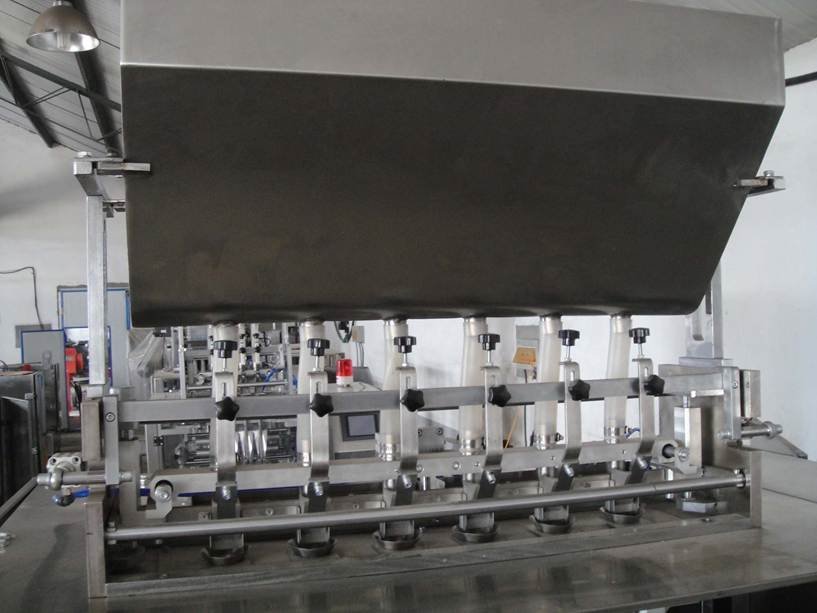
What is a shaped stick pack machine?
A shaped stick pack machine combines single-dose filling and sealing with tooling that produces a specified pack outline. The shape may involve the sealed ends or a more extensive contour. Choosing it requires the pack drawing, product behavior, film and cutting arrangement to work together.
Use this page for custom-contour sticks. Use the standard stick pack machine range when a conventional straight-cut stick meets the brief.
Define which part of the stick needs to change
“Shaped” can describe very different packages. Separate a change to the cut edge from a change to the filled cavity, sealing tools or forming path before comparing equipment.
Shaped ends
Rounded or profiled ends can affect the transverse seal, cutting tool and opening position even when the stick body remains straight. Specify the actual end profile and which side the consumer opens.
Waist or side contour
A narrower section changes the available product space and the relationship between the cut line and seal band. Review filling access, film forming and safe separation of the finished pack.
Dispensing-led outline
A pack intended for squeezing or controlled emptying needs an opening and product path that suit the formula. Assess the complete filled pack, including grip, tearing and product release.
A contoured flat sachet, a shaped stick and a gusseted stand-up pouch are not interchangeable specifications. If your design must stand upright, compare the shaped doypack packaging route. If it is a wider flat liquid portion, review the liquid sachet equipment route.
Specify the pack before selecting lanes and tooling
Use one drawing revision for the film converter, equipment proposal and sample review. A marketing outline alone does not define the space needed to form, fill, seal and open the package.
| Drawing input | What to identify | Decision it supports |
|---|---|---|
| Finished outline | Overall length and width, curved sections, neck or waist, and dimensional tolerances. | Whether the contour can be formed, filled, sealed and cut with the proposed arrangement. |
| Cut and seal relationship | Cut contour, usable seal band and clearance around the filled cavity. | Tool design and how registration or cut variation will be checked without weakening the seal. |
| Longitudinal seam | Proposed seam type and position relative to the contour, artwork and consumer grip. | Forming-set selection, print layout and an accessible opening or dispensing path. |
| Product cavity | Target fill, available volume, headspace and filling access at the narrowest section. | Dosing and nozzle or tube arrangement, with a realistic filling window. |
| Opening feature | Tear direction, notch or other requested opening feature and intended user action. | Opening trials on actual filled packs, not just an unfilled outline. |
| Artwork and coding | Print repeat, registration mark, code position, orientation and readable areas. | Web layout, print-to-cut alignment and inspection requirements. |
| SKU family | Which outlines, lengths, fills and products must run on the proposed equipment. | Included format sets, change parts, additional tools and separate approval work. |
On a narrow screen, scroll this table horizontally. The table also supports keyboard scrolling.
Review both on the same drawing, with the proposed product cavity between them. A visually attractive contour can still leave an unsuitable sealing area or filling opening. Final tolerances and acceptance limits belong in the project specification, not in a generic catalogue promise.
Match the dosing route to the product inside the shape
The product name and a nominal portion size are not enough to choose a filler. The following are assessment routes; the selected metering system and compatible products are confirmed in the proposal.
Powders and blends
Review flow, bulk-density changes, dust, cohesion and settling. Check the available filling passage and whether powder reaches the seal area during dosing or stopping.
An auger or another metering approach must be assessed with the real blend. Use the powder filling systems overview when the dosing principle is still open.
Free-flowing granules
Describe particle size, flow variation, moisture sensitivity and any risk of particles entering a narrow seal zone. Review the selected volumetric or weighing arrangement rather than assuming every granular product behaves alike.
Confirm refill behavior, bridging checks and the method used to verify the actual net content.
Liquids, pastes and gels
Review flow at filling temperature, particles, foaming, dripping and stringing. The chosen pump, nozzle and cutoff must fit the opening and keep residue away from the closing seal.
For formula-specific questions, the energy gel filling and trial guide provides a separate review framework.
Tell us about allergens, product-contact requirements, cleaning restrictions and any required heating or cooling. A product-contact material, hygienic option or cleaning method should be identified in the quotation for the actual configuration.
Coordinate forming, sealing and contour cutting
A typical roll-film review follows the sequence below. The exact station order and tooling arrangement depend on the chosen machine and package architecture.
Control the web
Review film feed, tracking, tension and the repeat used to align printed packs.
Form the pack
Confirm the forming path and seam position for the required stick body.
Meter the product
Coordinate dosing, headspace and cutoff with the available filling window.
Seal and shape
Agree seal tooling, contour cutting and print-to-cut control for the chosen outline.
Release and transfer
Separate finished packs, manage any trim and deliver accepted sticks to the next operation.
Where trim is generated, specify its collection and removal path. Confirm how the equipment responds to a blocked discharge, an incomplete cut, a film splice or a restart. These interfaces should be reviewed alongside the visible bag shape.
Review the laminate, print repeat and opening together
Film supplied for the actual project
Provide the structure, thickness, sealant layer, sealing information, friction characteristics and roll specification. Share the production artwork rather than only a rendered pack image. The contour, seam and code area must fit the same web layout.
For a recyclable or mono-material proposal, evaluate forming, sealing, cutting and pack performance with the chosen film. A material description alone does not establish that the finished pack is compatible or recyclable in the destination market.
A usable finished portion
Identify how the customer should hold, tear and empty the pack. Check that the intended opening does not release loose pieces or interfere with the product path. Review readability and code placement on filled packs after separation.
A shaped end is not, by itself, an easy-opening feature. Agree the opening construction with the film converter and machine supplier, then test the actual filled package.
Include changeover and downstream handling in the brief
Every approved format needs a defined setup
List the forming parts, seal tools, contour cutters, guides, recipes and dosing-contact parts required for each SKU. Identify which items are shared, which are changed and which additional outlines need a separate tool.
Include first-off checks after tool replacement, film changes and product changes. Do not assume that changing the cutting tool alone is sufficient for every new outline.
The custom shape must leave the machine reliably
Review discharge orientation, collection, counting and group formation with the intended downstream equipment. A shape that is acceptable in isolation may still need a different transfer or collection arrangement.
If sticks enter retail cartons, define the handoff using the stick-pack counting and cartoning review. Cartoning, checkweighing or other inspection is included only when specified in the project scope.
What should a shaped stick pack machine quotation include?
Compare proposals against the same product, drawing revision, film and accepted-output requirement. The total scope matters more than a machine name or an unqualified cycle figure.
Define equipment and format scope
- Selected machine architecture, model and lane arrangement
- Dosing system, product feed and any holding equipment
- Approved pack drawings, forming sets, seal tools and contour tooling
- Film handling, coding and selected inspection or reject functions
- Trim handling, discharge and downstream interfaces
- Change parts, spares and additional-format responsibilities
Define delivery and acceptance responsibilities
- Product and film samples, drawings and artwork provided by the buyer
- Agreed trials, FAT records and open-item resolution
- Required site utilities, access, layout and installation boundaries
- Operating and maintenance documents and training scope
- Commissioning, service arrangements and commercial terms
- Explicit exclusions and customer-provided equipment or services
Output, dose tolerance, dimensions, lane count, price and lead time are project-specific. Our technical team confirms these in the proposal after reviewing the application; this page does not assign standard-stick catalogue ratings to a custom contour.
Agree what the sample trial must demonstrate
Approve a trial plan before comparing output claims. The following is a proposed purchasing checklist, not a report of a completed INMAYPACK shaped-stick installation.
| Review item | Evidence to agree | Acceptance decision |
|---|---|---|
| Outline and cut | Retained samples, drawing revision, dimensional checks and print-to-cut observations across the active lanes. | Whether the approved contour and opening position are repeatable within the agreed limits. |
| Net content and seal area | Dose samples, refill and stop/restart observations, and inspection for product in the seal zone. | Whether the proposed filler and settings meet the defined portion and cleanliness requirements. |
| Seal and opening | Agreed package-integrity checks, opening trials and filled-pack handling or dispensing observations. | Whether the actual product, film and geometry produce an acceptable finished pack. |
| Accepted output | Timed run, active lanes, accepted and rejected packs, stops and agreed operator interventions. | Whether the complete configuration meets the required usable output under the recorded conditions. |
| Changeover and discharge | First-off packs after changes, trim removal, collection and downstream restart records where included. | Whether formats and interfaces have been demonstrated, or remain documented open items. |
Scroll horizontally if needed. Agree methods, sample quantities and pass/fail limits for your package rather than borrowing generic limits.
Keep representative product and film identifiers with the trial records. Retain approved packs, relevant settings, photos or video and the unresolved-item list. A trial with one formula or one contour does not approve every other product or format.
Shaped stick pack machine FAQ
Can INMAYPACK provide shaped stick pack equipment?
Yes. INMAYPACK can review and supply shaped stick-pack equipment for an agreed application. Share your product, pack concept and output requirement so our team can define the machine, dosing, film and contour-tooling scope. Compatibility with a particular outline and product is confirmed during technical review.
Can an ordinary stick pack machine be converted by changing the cutter?
That must be assessed on the actual machine. Forming space, seam position, seal tooling, product cavity, cutter support and discharge can all affect the conversion. Ask the supplier to identify required changes and demonstrate the proposed finished pack before treating a cutter replacement as a complete solution.
What shapes can I request?
You can submit a concept for shaped ends, curved profiles or a more extensive contour. The drawing is then reviewed for forming, filling access, usable seal area, cutting and handling. The illustrations on this page are concepts, not a promise that every outline will work on every configuration.
Can the same system pack both powder and liquid?
A shared machine platform does not automatically provide both dosing routes. Powders and liquids can require different metering, contact parts, sealing-area controls and cleaning arrangements. List the required products and formats so the quotation identifies the actual equipment and any changeover scope.
How many lanes and what speed should I choose?
Start with accepted packs per shift or hour, product behavior, fill, geometry and film. Then review the usable lane arrangement and the complete cycle, including cutting and discharge. The selected model and output are confirmed in the proposal and acceptance plan; standard straight-stick ratings are not automatically shaped-pack ratings.
Can shaped sticks use recyclable film?
Submit the intended film specification and the destination-market requirements. Forming behavior, sealing, contour cutting and pack performance must be reviewed with that film. Compatibility and any environmental claim need their own evidence; a machine category does not establish finished-pack recyclability.
What determines the price?
Price depends on the selected architecture, dosing system, pack formats, forming and sealing parts, contour tools, film handling, inspection, discharge, integration and agreed trial or service scope. Request an itemized current quotation for your application rather than comparing offers with different included equipment.
Do I need a final drawing before contacting you?
No. Start with a product description, target portion, concept image or existing sample and an output requirement. Our team can discuss the technical inputs needed for a proposal. Final drawings, film and representative samples are agreed at the relevant review and trial stage.
Bring the product and pack idea. We will discuss the equipment route.
Start with the details you already have. Our technical team will follow up on geometry, dosing, tooling, film and the configuration needed for your project.
The equipment photograph is a stick-pack platform reference. The outline diagrams are illustrative. Model-specific specifications, supply terms and acceptance criteria are provided for the selected project.